
Black and Grey Forearm Tattoo Ideas: Designs to Try
Which black and grey design will still read as yours after ten years of sun, sweat, and a few hundred thousand wrist movements?
Most galleries never answer that. They show fresh work under studio lights and skip the part where the forearm is the most sun-exposed flat canvas you own, and where pale grey washes soften while fine dotwork spreads.
The forearm still rewards grey shading better than almost any other placement. It's wide, fairly flat, and stable through weight change, so graduated tones and negative space can do their job. The trade-offs are just as real: UV from driving and outdoor work, constant movement at the wrist, and visibility every time you roll up a sleeve.
Body art isn't a niche hobby, either. The FDA consumer page on tattoo safety reports that roughly 30% of Americans have at least one tattoo, rising to about 40% among adults aged 18 to 34. That's a mature craft with tested technique behind it.
Seven approaches follow. Each pairs the design with the execution decisions and aftercare habits that decide whether a black and grey forearm tattoo holds its shape.
Table of Contents
1. Photorealistic Black and Grey Portrait - Where Photorealistic Portraits Fail
3. Chicano-Style Script and Icon Sleeve - The Reversibility Trade-Off
4. Dotwork and Stipple Mandala - Healing Is the Weak Point of Dotwork
5. Black and Gray Wolf or Owl Realism - Texture and Overwork
6. Black and Gray Geometric Shading - Line Spacing Decides the Next Decade
7. Traditional Skull and Anatomy Shading - How Skull Shading Ages
1. Photorealistic Black and Grey Portrait
A lifelike portrait is the format clients ask for most, and the forearm is the canvas that shows it best. The surface is wide enough to hold a face or an animal's head at real detail and flat enough that shading doesn't wrap around a curve. Depth comes from layered shading, smooth gradients, and deliberate contrast, never from one heavy pass.
The finished result looks like this when the value structure is handled properly.
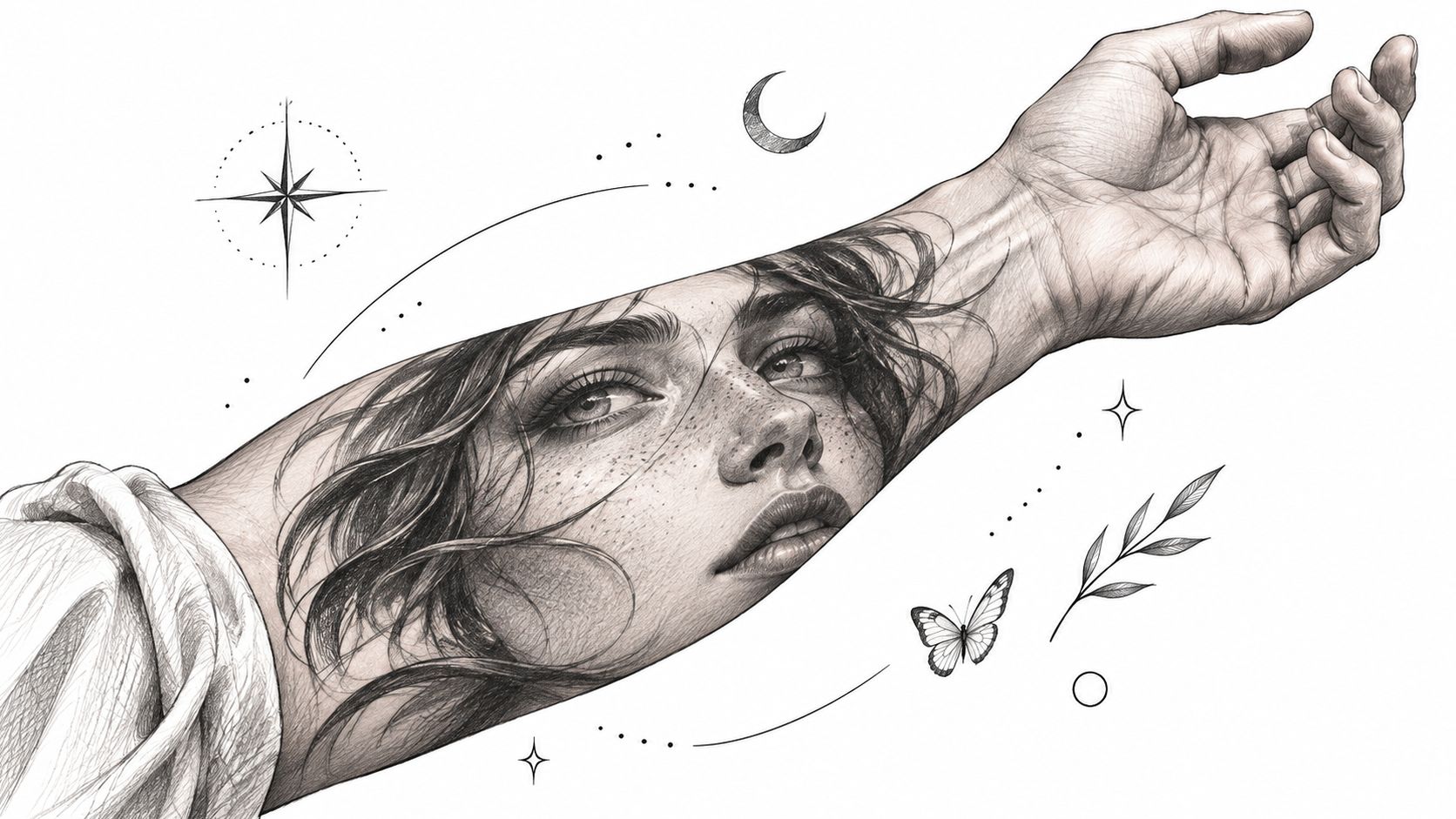
Memorial pieces drive most of the requests: a parent, a partner, a dog. Musicians and public figures come second. The pieces that survive are the ones with tonal separation. True black anchors the eyes, the jawline, and the shadow under the nose. Mid greys carry the skin, and bare skin holds the highlights.
Where Photorealistic Portraits Fail
Failure is usually the same story, and it starts on the drawing table: too many middle values and no true dark. Contrast keeps a likeness legible at arm's length, and it's what stops a portrait flattening as pigment settles.
Ink quality is the second variable, and it's less settled than clients expect. The FDA fact sheet on tattoos and permanent makeup reports more than 50 tattoo pigments and shades in use, none approved specifically for injection into the skin. Independent lab testing has also found that inks on the market often contain additives or pigments missing from the label. That gap makes the studio's sourcing habit worth a direct question: a shop that can name its ink brands and batch practices is easier to trust with your skin.
The real constraint: A portrait needs density to stay readable, so build contrast in the mid-tones rather than flooding the shadows with black you can't take back.
Bring high-resolution references. Several photos in good light, not a screenshot of a screenshot.
Ask to see healed portraits. Fresh studio shots hide everything that matters, because a face at six months tells you how the gradients settled.
Book the touch-up into the plan. A second pass after healing is normal for realism, and the forearm's sun exposure makes it more likely you'll want one.
Learn the layering order. Our breakdown of black and grey realism covers how artists stack value.
2. Gray Wash Botanical
A rose vine that starts at the wrist and climbs toward the elbow is the most forgiving black and grey piece you can book, and the easiest to ruin with a rushed shade pass. Wash gives petals and leaves volume, so the flower reads as a soft, painterly object instead of an outline with filler inside it.
Botanicals suit the forearm because the shape follows the anatomy. A fern run along the outer forearm uses the length. Wildflowers clustered at the wrist work with the narrow end. A full rose fills the widest part of the canvas.
Ask How the Grey Is Made
Two greys can look identical on paper and heal differently. Some artists dilute black pigment down to a 20% or 30% wash. Others pour a premixed grey. Both work, but you should know which one is going into your arm and whether the studio can name the brand.
Safety data here is narrower than the internet suggests. A New York City field study of 300 tattooed adults found 10.3% reported an adverse reaction, split into 4.3% acute and 6.0% chronic reactions lasting more than four months, according to the published contact dermatitis study. In that group 90.3% had black tattoos, yet only 25% of chronic reactions involved black ink.
Soft botanical work rewards a light hand and punishes a heavy one. If an artist promises a full forearm of wash shading in a single sitting, book someone else.
Ask for healed wash examples. Soft shading is where inexperience shows first.
Follow the forearm's curve. Run stems along the length, not across the wrist crease.
Treat sunscreen as part of the tattoo. Pale washes fade faster than black outlines do.
Expect a softer result than a photo. Wash botanical work is painterly by design, not crisp.
3. Chicano-Style Script and Icon Sleeve
Chicano style grew out of Los Angeles street culture and settled into a recognizable visual language: bold black outlines, dense grey fills, script lettering, and iconography such as Our Lady of Guadalupe, roses, ribbon banners, and payasa faces. On a forearm it reads as a graphic statement, closer to a woodcut than to a photograph.
The style's strength is its structure. Black outlines hold the composition together from across a room, and grey fill gives the image weight. That's also where the longevity decisions get made. A Chicano piece with crisp, well-spaced outlines and controlled fills still reads at sixty. One with lines packed too close blurs into a dark band.
The Reversibility Trade-Off
Bold black outlines are the reason this style survives time and the reason it's hard to undo later. Black pigment absorbs across a broad range of wavelengths, which is why it responds better to laser than most colors, but response isn't clearance. The clinical overview of tattoo removal identifies Q-switched Nd:YAG treatment as a preferred option for darker skin types, and research in skin types III through VI found 1064-nm Nd:YAG effective with minimal adverse reactions, partly because the longer wavelength is absorbed less by epidermal melanin. Some black tattoos still need many sessions and never clear completely.
A dense Chicano sleeve is a lifetime commitment dressed up as a style choice. Decide you can live with the fill before you commit to it.
Talk about the history first. Ask your artist where the symbols come from and what they mean.
Space the lettering for legibility. Script that looks elegant on paper closes up as skin ages.
Fit the design to the arm. A banner across the inner forearm needs different proportions than one running wrist to elbow.
Plan the fill deliberately. Dense grey packing is the part that costs you optionality later.
4. Dotwork and Stipple Mandala
Dotwork builds value without a single solid fill. Density does the work: tightly packed dots read dark, sparse dots read pale grey, and the gradient between them is optical rather than painted. On a mandala, that creates a symmetrical pattern that sits beautifully on the flat middle of the forearm.
A short look at how the technique behaves on skin.
Healing Is the Weak Point of Dotwork
Every dot is a tiny puncture, and thousands of them in a session add up. Clinical reviews report acute tattoo reactions such as irritation, infection, delayed healing, itching, and stinging in roughly 15% to 68% of cases, and the review of tattoo complications notes swelling and itching in about 30% of tattooed people and sun-related problems in about 20%. Dotwork concentrates those risks because the technique covers a large area in shallow, closely spaced marks.
Dense dot gradients settle and spread. Design the pattern so it still reads when the mid-tones merge, and don't count on razor-sharp individual dots five years out.
Check healed dotwork, not fresh. The merge is what you're judging.
Plan a touch-up after the first session. Density often needs a second pass.
Keep the pattern proportional. A mandala has to fit the arm's width, not just its length.
Read the symbolism before you wear it. HD Asian Art on mandala significance is a useful start, and our guide to the dotwork tattoo style covers execution details.
5. Black and Gray Wolf or Owl Realism
A wolf portrait that wraps the outer forearm uses the arm's length as the composition, not a flat canvas. Muzzle toward the wrist, ears toward the elbow, the eye sitting at the widest point where you look at it. Fur is layered fine strokes over grey wash. Drawing every hair is how the piece turns into a dark smear once the skin moves and the sun hits it.
Owls sit better on the inner forearm, and that placement is less forgiving. Feather texture needs a lighter hand because the skin is thinner and more sensitive, so fine detail has less room before it blurs. Both animals carry meanings clients usually want: loyalty, wisdom, strength, a family pack. Those meanings only hold if the face still reads after years of bending, washing, and UV.
Texture and Overwork
Animal realism fails when fur is packed until the greys collapse into one dark mass. The animal loses its shape. A hospital review of 493 tattoo-related adverse events in 405 patients, published in a dermatology journal, found 13% were papulonodular reactions that occurred mainly in black tattoos and were attributed to pigment agglomeration, while bacterial infections made up 11% of events. Pigment density and poor hygiene drive those papulonodular reactions and infections, and overworking a patch of forearm skin increases that density.
Soft grey in the fur is what keeps a wolf or owl readable five years later. Once the mid-tones go solid black, no amount of aftercare brings the muzzle back.
Request a stencil preview. Judge the composition on your arm, not on a tablet.
Follow the arm's natural lines. Let the muzzle point toward the wrist, not across it.
Ask how fine texture will heal. Fine strokes blur on thin inner-forearm skin, especially where the arm flexes.
Disclose medical history. Prior reactions, sarcoidosis, or granulomatous disease change the plan.
6. Black and Gray Geometric Shading
Geometry is the one black and grey family that has to read from across a room, and the one most likely to be redesigned later. Clean shapes like triangles, hexagons, and hard lines get their depth from grey shading that softens the hard edges and makes the piece dimensional instead of flat.
That readability has a price. A geometric forearm piece is built from long, unbroken lines and evenly packed fills, and both are unforgiving when the skin changes.
Line Spacing Decides the Next Decade
Lines placed too close merge into a single band within a few years, and a merged band can't be repaired without lasering the area first. Black remains the most common target for removal work: black ink accounted for 75% of the 560,042 tattoos treated for removal in a 2024 global dataset, as Practical Dermatology reported. Plan the spacing so a future redesign has room.
Build a geometric piece with breathing room between the fills. Negative space is what lets you cover or rework it later without a laser.
Ask about line spacing explicitly. Wide enough to survive skin change is wider than most stencils suggest.
Use the consultation to test symmetry. A hexagon pack looks wrong if it drifts off the arm's centerline.
Plot the wrap. Shapes that cross the wrist crease distort with movement.
Keep edges crisp with aftercare. Moisturize and keep the fresh linework out of the sun. Our guide to geometric blackwork tattoos covers proportion and layout.
7. Traditional Skull and Anatomy Shading
Old imagery, modern rendering. A grey-shaded skull with roses, a dagger, or a banner draws on tattoo traditions that go back generations, but the shading is contemporary: black outlines hold the silhouette while graduated grey gives the cranium and eye sockets their depth.
Skulls work on a forearm because the shape is roughly vertical. An anatomical skull with the jaw running toward the wrist sits naturally on the outer forearm, and the widest part of the canvas takes the cranium. Stack it with a rose near the elbow and the piece gets a top and a bottom instead of a floating head.
How Skull Shading Ages
The eye sockets and nasal cavity are the first places to go soft. They hold the deepest shadows, and if the artist fills them with solid black that spreads, the skull loses its hollow look and turns into a smear. Compare a healed piece to a fresh one before you commit.
Depth in a skull comes from the light side of the bone, not the dark of the socket. If the highlights aren't planned, the piece reads flat within five years.
Review healed skull work. Socket shading is where the difference shows first.
Keep detail proportional. A jawbone full of fine cracks will blur; the silhouette won't.
Plan the touch-up. Grey shading softens before black linework does.
Protect the arm. Driving, gardening, and outdoor work put steady UV on a forearm piece.
Black and Grey Forearm Tattoo Ideas Compared
Item | Best For | Shading Technique | Aging Behavior | Skill Level Needed |
|---|---|---|---|---|
Photorealistic Black and Grey Portrait | Personal portraits and lifelike imagery | Layered gray gradients and strong contrast | Gray tones often age gracefully; fine details may soften | High; realism experience required |
Gray Wash Botanical | Soft, flowing floral and plant designs | Diffused gray washes with minimal hard outlines | Soft style is forgiving, but faint washes may fade | High; wash and gradient experience needed |
Chicano-Style Script and Icon Sleeve | Culturally meaningful imagery, script, and bold compositions | Heavy black outlines and dense gray fills | Bold contrast tends to remain readable | Experienced artist; careful spacing and cultural understanding needed |
Dotwork and Stipple Mandala | Symmetrical, geometric, and meditative patterns | Shading built from dense or sparse dots | Dots may spread or blur, reducing crispness | High; dotwork experience recommended |
Black and Gray Wolf or Owl Realism | Symbolic animal portraits with dimensional texture | Layered gray shading and fine fur or feather strokes | Fine texture may soften over time | High; animal realism experience required |
Black and Gray Geometric Shading | Modern, structured designs with clear shapes | Gray gradients paired with precise geometric linework | Lines can blur if spacing is too tight | High; precise geometric planning required |
Traditional Skull and Anatomy Shading | Classic skull or anatomical imagery with bold contrast | Gray modeling with bold black outlines | Bold contrast holds up; fine details may soften | Moderate to high; detail and shading experience recommended |
Choose Your Forearm Piece With Confidence
Which piece will still read clearly after years of sun, sleeves, friction, and healed skin? Start with the practical limits. A photorealistic portrait and a Chicano sleeve are multi-session commitments with the heaviest fill. Dotwork and soft botanicals go faster but ask more of your aftercare. Geometric pieces are forgiving on the table and demanding on spacing.
Run this checklist before you book:
Book the consultation, not the appointment. A complimentary consultation at Think Tank Tattoo covers design direction, placement, and timing before money changes hands.
Bring three to five references. Add a note on what you like in each: the shading, the composition, the expression.
Ask for healed work. A piece photographed at one year tells you more than a fresh one.
Budget a second session. Realism, wash shading, and dotwork often need one.
Prepare clean files. Reference quality drives stencil quality, and fixing floating faces in stencils is a useful read if your portrait photo is low resolution.
Denver clients can see the work in person before committing. Think Tank Tattoo has been in business since 2002, works across a broad range of styles, and serves clients 18 and older. The shop is 3,000 square feet with a large, open layout, and appointments require a $100 non-refundable deposit against a $100 shop minimum. The shop sits at 172 S. Broadway, Denver, CO 80209, and is open Tuesday through Saturday, 12pm to 8pm. Call or text (720) 932-0124 or email thinktanktattoo@gmail.com, and do not send a deposit until an artist or staff member directs you to.
A forearm piece has to earn its place on skin that moves, sees sun, and gets looked at every day.
Think Tank Tattoo has been a Denver studio since 2002 and works across a broad range of styles, so a forearm consultation is a conversation about contrast, placement, and healing rather than a catalog pick. Booking starts with a complimentary consultation by phone or text at (720) 932-0124, or by email at thinktanktattoo@gmail.com.
Comments