
Tattoo Hygiene Standards: What Clients Should Expect
The most repeated piece of tattoo hygiene advice is to look for a clean studio. Spotless floors, fresh paper on the chair, an artist snapping on gloves before you sit down. It's easy to follow, and it tells you almost nothing about the two things that decide whether a tattoo heals cleanly. The first is how the studio controls contamination while it works. The second is where the ink in the bottle came from and whether anyone can prove it.
Cleanliness is what you can see. Safety is what gets recorded: which pigment went into your skin, which batch it came from, whether the needle pack was still sealed when it was opened, and whether the surface disinfectant got the contact time printed on its label. Those are questions you can ask before you book, and the answers separate a professional shop from a tidy one.
A studio can pass the eye test and still fail the paperwork test. Check these things in the order they matter.
Table of Contents
Who Sets Tattoo Hygiene Rules and Why It Varies - Procedure and Product Are Separate Problems
Equipment and Supplies That Must Be Single-Use or Sterile - Disinfection Versus Sterilization - The One Test That Beats Every Claim
How a Session Runs From Prep to Aftercare - Why the Order Matters - What to Watch During a Long Session
Ink Traceability Clients Can Verify - The Traceability Checklist
Why Ink Recalls Matter as Much as Clean Benches - Turn the Record Into a Routine
Common Myths About Clean-Looking Studios - Décor Is Not a Control - Packaging and Price Prove Less Than They Seem To
Confirm These Standards Before You Book - Where to Check Independently
Who Sets Tattoo Hygiene Rules and Why It Varies
The licence on the wall is the least standardized part of the whole setup. In the United States, the FDA fact sheet on tattoos and permanent makeup sets out the split: the agency classifies tattoo inks used intradermally, including permanent makeup pigments, as cosmetics, while state and local jurisdictions regulate the practice of tattooing itself. That is why one county can demand spore-test logs, the next can ask for little more than a business licence, and the pigment rules stay federal either way.
The risk side is clearer than the paperwork. Unsterile equipment and needles are possible transmission routes for HIV, hepatitis, and bacterial skin infections such as those caused by Staphylococcus aureus. Federal product oversight does not inspect the station in front of you, so infection control still lives with the person assembling it.
A restaurant with a spotless kitchen can still serve spoiled food if nobody checked the delivery. A tattoo studio needs a clean workflow and verified materials, and those are two separate jobs.
Procedure and Product Are Separate Problems
A station can look disciplined and still use a bottle nobody can trace. The FDA has recorded infection incidents and recalls tied to contaminated tattoo inks, including a 2019 advisory warning consumers, artists, and retailers about inks contaminated with microorganisms. The same agency notes that infections can follow contaminated ink even when an artist follows hygienic procedures, which means glove changes and surface film do not settle the pigment question.
Every standard worth trusting covers two layers. The procedure layer is needles, tubes, barriers, hand hygiene, skin preparation, and disinfection held for the contact time on the label. The product layer is sealed manufacturer containers, legible labels, color names, batch numbers, and storage that keeps those bottles intact. Strength on one layer does not cancel weakness on the other.
Other personal-service trades write the same split into their routines. For a benchmark of how specific a cleanliness policy should get, browse salon cleanliness guidelines and compare that level of detail with what a tattoo studio can show you before any deposit changes hands.
The checks fall into six groups:
Equipment. Items that must be sterile or single-use, and the visible proof for each.
The session. Hand washing, barriers, sealed needle opening, cleanup, and what a breakdown looks like.
Ink. Label, color name, batch, and whether the studio can connect the bottle to your appointment.
Recalls. Why a clean bench cannot protect you from a contaminated bottle.
Myths. Beliefs that get mistaken for safety.
Before you book. What to ask, and where the answer can be checked outside the shop.
Start with the licence. Your local health authority holds the studio's registration and inspection history for its jurisdiction, and the latest report carries more weight than any review score. Then ask the product question early: which ink line will be used, and can the artist point to the batch before you sit down.
Equipment and Supplies That Must Be Single-Use or Sterile
Every item that touches your skin, or the station around it, has a required status, and you can verify nearly all of them without touching anything. This is the list I'd hold any studio to.
Item | Required Status | How to Verify |
|---|---|---|
Needles and tubes | Sterile, single-use, sealed package | Watch the artist open a sealed pack in front of you |
Needle grips and tube holders | Single-use, or sterilized and logged | Sealed bag or sterilization record |
Tattoo ink | Dispensed from sealed manufacturer containers | Check labels, color names, and batch numbers |
Ink caps and cups | Single-use, new for each client | Fresh caps visible at the station |
Dilution water | Sterile water | Sealed bottle or stated source |
Gloves | Changed before each client and after any contamination | Glove change visible during the session |
Protective barriers | Single-use film on machine, switches, and chair | Film visibly new and replaced between clients |
Work surfaces | Cleaned, then disinfected for the label's contact time | Disinfectant named and timed |
Sharps and waste | Puncture-resistant container, sealed when full | Container present at the station |
Artist vaccination status | Hepatitis B immunity documented where offered or required | Ask the studio directly |
Disinfection Versus Sterilization
Sterilization applies to anything that penetrates skin: needles, tubes, and reusable grips. In practice that means a steam autoclave cycle validated for the load, with each cycle logged and monitored, usually with biological indicators and chemical indicator strips. A bottle of blue liquid labelled "cold sterile" is not the same thing, and it never has been.
Disinfection applies to surfaces and equipment that don't break skin, and it's a two-step job. Clean first to remove visible debris and organic material, then apply a disinfectant approved for the surface and leave it wet for the contact time on the label.
Wiping a surface dry seconds after spraying skips the part that kills anything. If you watch an artist spray and immediately wipe, you've just seen a disinfection step that didn't happen, and the chair is no cleaner than it was before.
The One Test That Beats Every Claim
A studio can claim sterility all day. The test is whether the sealed needle package is opened in front of you, with the lot number and expiry visible on the pack, and whether the caps on your tray are new. Both moments are visible, repeatable, and hard to fake without real effort.
Hand hygiene runs alongside that list, and it's where a station can look prepared and still fall short. A bottle of instant hand sanitizer at the station earns its place between sink visits, when gloves come off mid-session and hands need cleaning before the next task, but it doesn't replace soap and running water at the start and end of the appointment.
One row in that table isn't about your skin at all. Hepatitis B vaccination protects the artist, and asking whether the studio documents immunity tells you how the shop thinks about exposure. A studio that tracks it usually tracks its autoclave logs too.
Practical rule: if a studio can't show you a sealed needle pack or fresh ink caps, the standard isn't being met, no matter how the room looks.
How a Session Runs From Prep to Aftercare
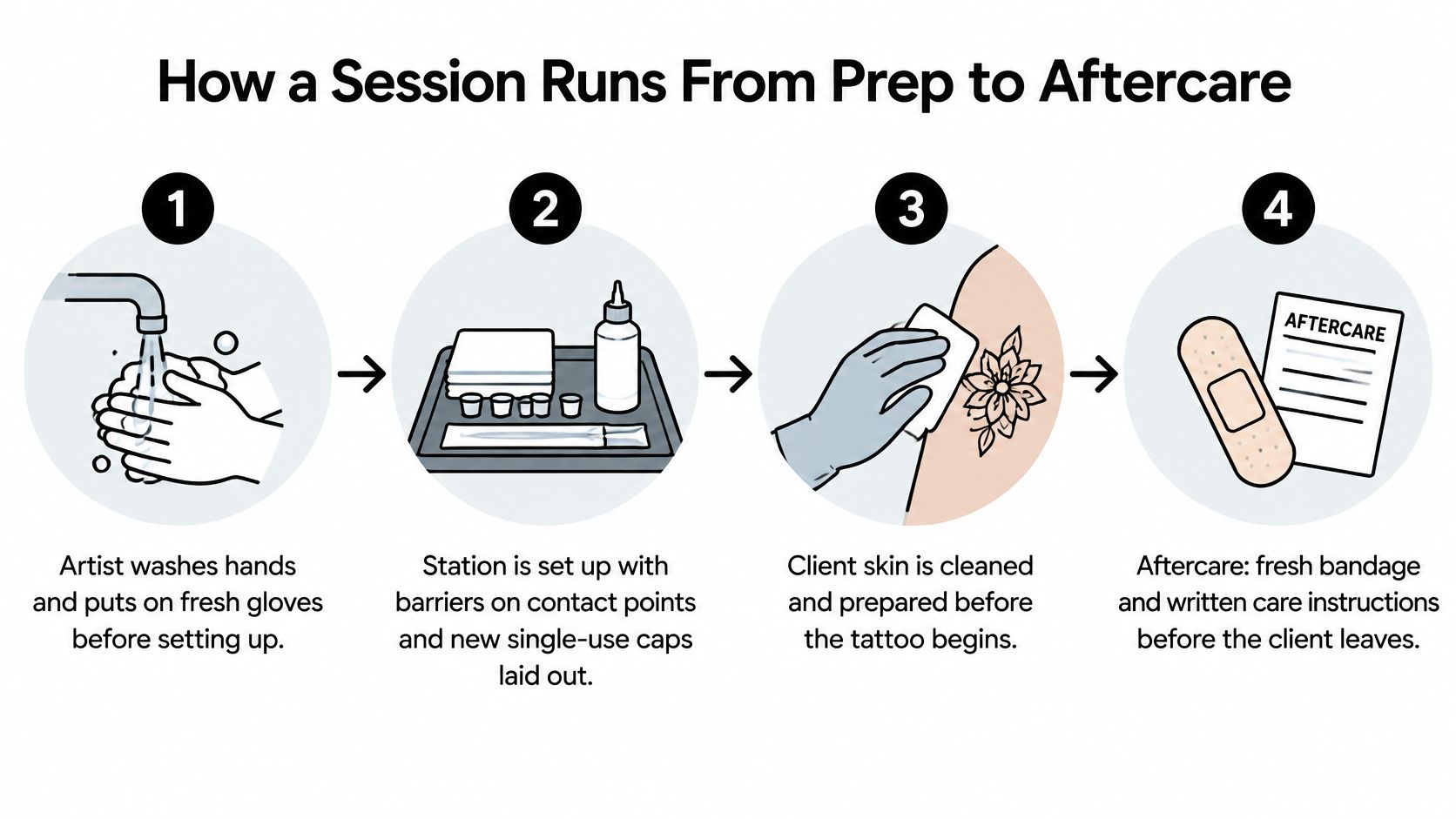
A safe session runs on a fixed order. Each step protects the one after it, and the sequence is what separates a controlled setup from a tidy-looking one.
Hands first, then gloves. The artist washes hands and puts on fresh gloves before the station is set up, not after.
Barriers before supplies. Contact points on the machine, the power switch, the chair, and the tray get single-use film, and new single-use caps are laid out.
Skin preparation. Your skin is cleaned and prepared with an antiseptic before any marking, including stencil work.
Needle opened in view. The sealed pack comes off the shelf, gets opened in front of you, and the needle is loaded from it.
Ink into a fresh cap. Pigment is dispensed into a new cap, never back into the stock bottle, and the cap is discarded when the session ends.
Glove changes at the boundaries. If a glove touches a phone, cash, hair, or any non-sterile surface, it's changed before the artist touches you or the tray again.
Breakdown and disinfection. The needle goes into the sharps container, barriers come off, and surfaces are cleaned and then disinfected.
Clean hands for aftercare. Hands are washed again, fresh gloves go on, and aftercare is applied with clean materials.
Four of those stages carry most of the risk, and they run in this order.
Why the Order Matters
Steps one and four carry more weight than they look like they do. Gloves pulled on before setup haven't touched a drawer handle, a light switch, or the inside of a pocket, which is why hand washing comes before the station is laid out rather than after. A needle opened in view is a needle you can trace to a sealed pack. A needle already loaded on the machine when you walk in is a needle whose history you can't see.
The quiet failure isn't a dirty tool. It's the sequence run out of order: station set up first, gloves pulled from a box, needle loaded before the barriers are down. Everything looks right, and the tray is contaminated before the first line goes in.
What to Watch During a Long Session
Large work, a sleeve spread across four sittings or a back piece, repeats the entire sequence each time. The cumulative risk isn't one long exposure, it's four chances for a shortcut. Watch for the same three signals in every sitting:
A fresh setup each time. New tray, new caps, new barriers, even if the artist remembers yesterday's station perfectly.
Glove changes at the boundaries. Before the session, after any break, and any time a hand leaves the sterile field.
A written aftercare handoff. Instructions you keep, not a talk you have to remember on the drive home.
Aftercare belongs in writing. Read our tattoo aftercare sheet before your appointment so the first 48 hours aren't guesswork, and ask for a copy if the studio doesn't offer one.
Ink Traceability Clients Can Verify
A studio can look immaculate and still use ink nobody can trace. That's the failure clients miss, because every visible signal, the gloves, the barriers, the sealed needle, points at the procedure and says nothing about the bottle.
What you're looking for at the station is a labeled manufacturer container, a batch number, and an artist willing to show you both.
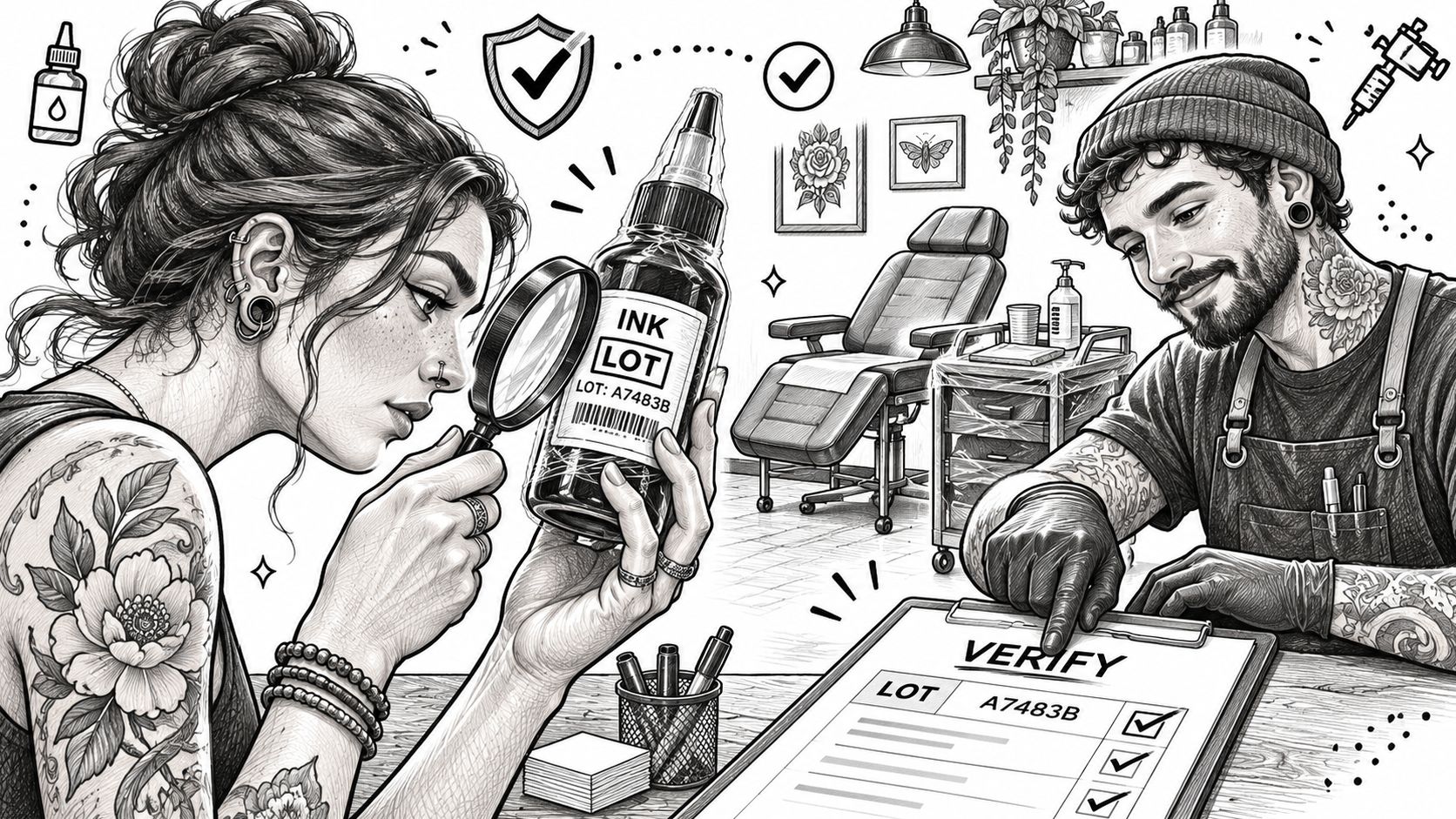
Tattoo-associated infections have increased since 2000, and contaminated ink has been identified alongside inadequate hygiene as a substantial source of outbreaks. A review of tattoo-associated infection outbreaks documented 11 outbreaks followed by ink recalls, including infections caused by non-tuberculous mycobacteria. Those are infections that came out of a bottle, not off a bench.
Regulation doesn't settle it for you either. In the United States, tattoo inks are treated as cosmetics without mandatory premarket approval, while the EU's REACH framework restricts thousands of chemicals. Same word, different meaning, so "regulated" tells you almost nothing about the bottle in front of you.
The Traceability Checklist
Questions to ask, and what a good answer sounds like:
Manufacturer and color name. A brand and a shade, not "black." Studios that buy through distributors know this without checking.
Lot or batch records. The number on the bottle, written down against your appointment. If the shop can't match a record to a bottle, there's no traceability.
Expiry information where it applies. Pigments have shelf lives, and stock opened years ago is a gamble you don't need.
Sealed manufacturer containers. The ink comes out of a container the studio opened, not a refilled squeeze bottle of unknown origin.
Single-use caps. Your ink is poured into a new cap and never returned to the stock bottle. Navy Medicine guidance specifically calls for single-use ink containers and disposal of unused material after each procedure.
Sterile water for dilution. Sealed sterile water for any wash or dilution, not tap water from the sink beside the chair.
Leftover ink discarded. Whatever remains in your cap goes into the waste when you leave.
If you want to understand what's in the bottle beyond the color name, read what goes into tattoo ink before your consultation.
This walkthrough shows the setup side of the same idea.
A studio that can't answer these questions isn't necessarily hiding something. It may never have been asked. Treat the gap as a warning sign rather than a minor detail, and let the answer decide whether you book.
Why Ink Recalls Matter as Much as Clean Benches
A surgical-level bench doesn't protect you from a contaminated bottle. The FDA's 2024 guidance notice on tattoo inks states that between 2003 and 2019, tattoo-ink firms conducted 15 recalls in the United States, including 14 recalls resulting from microbial contamination.
Composition problems show up in testing as well as in recall notices. In 2024, the Netherlands Food and Consumer Product Safety Authority analyzed 52 tattoo dyes from 26 brands and found 27 samples with non-compliant composition, according to the NVWA's supervision of tattoo inks and dyes. None of those bottles would have looked any different on a spotless bench.
A recall is only useful to you if someone can tell you which bottle your piece came from.
The EU shifted the benchmark in a way that matters for traceability. On 4 January 2022, the EU began applying restrictions under its REACH chemicals framework to hazardous substances in tattoo inks and permanent-makeup mixtures, as the ECHA hot topic on tattoo inks explains. The rules cover thousands of hazardous chemicals, including carcinogenic, mutagenic, or reprotoxic substances, certain chemicals prohibited in cosmetics, skin sensitizers, skin and eye irritants, metal impurities, aromatic amines, and specified pigments.
Pigment Blue 15:3 and Pigment Green 7 received a transition period that moved their compliance date to 4 January 2023. The regulation also requires tattooing and permanent-makeup mixtures to state their intended use on the label. That labelling requirement gives a studio and a client a practical way to identify what was used.
A recall history this long is why the numbers below belong in a booking conversation.
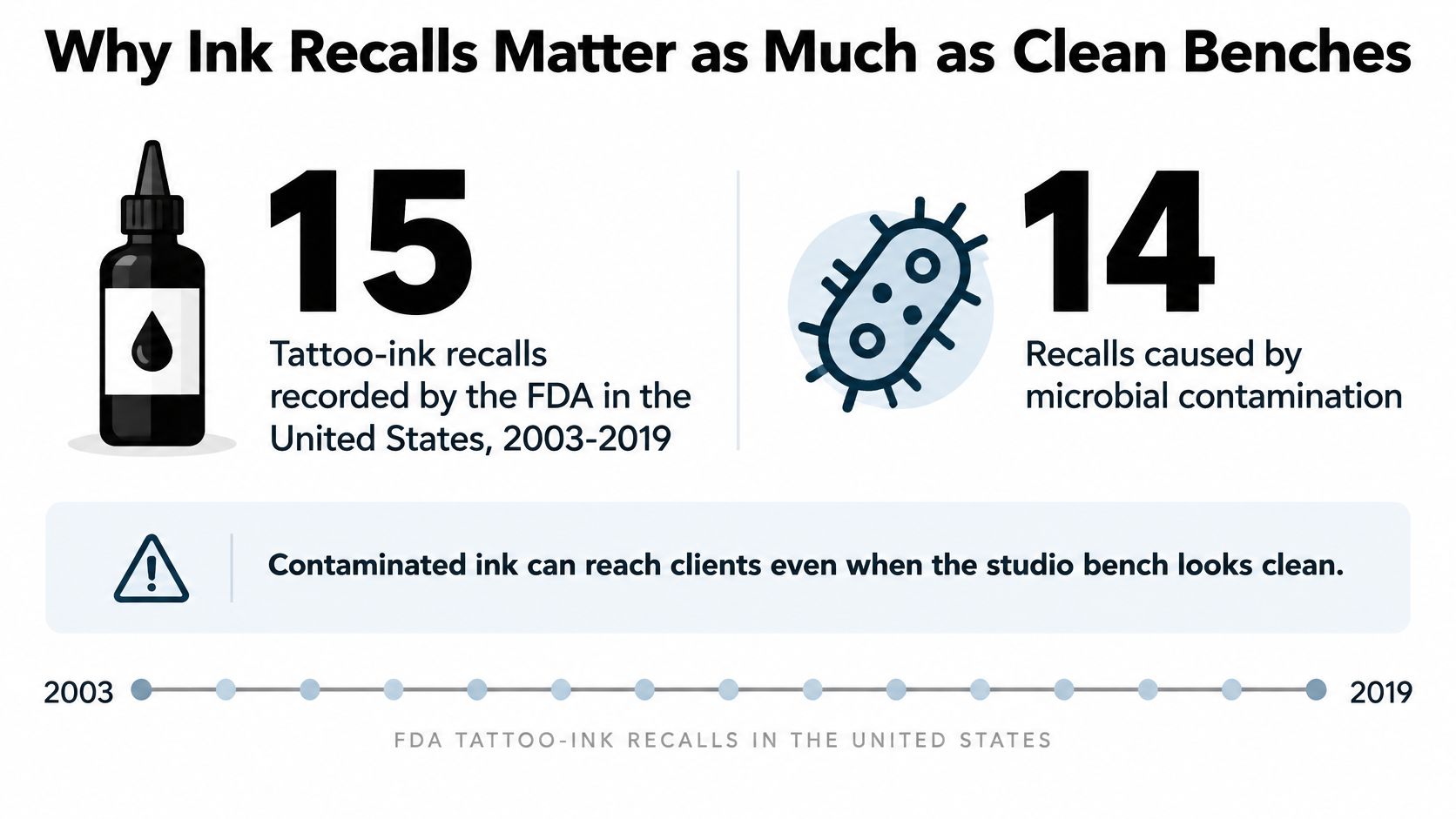
Measure | Figure | Source |
|---|---|---|
US tattoo-ink recalls, 2003 to 2019 | 15 | FDA 2024 guidance notice |
Recalls caused by microbial contamination, 2003 to 2019 | 14 | FDA 2024 guidance notice |
Tattoo dyes tested by the Netherlands NVWA in 2024 | 52 dyes from 26 brands | NVWA |
Samples with non-compliant composition | 27 | NVWA |
Outbreaks followed by ink recalls | 11 | Tattoo-associated infection review |
Turn the Record Into a Routine
Keep a record of which product went into which client. Avoid any ink without batch information, and treat a recall notice as a reason to stop using that product the day you see it, not the week after.
The working habit is simple: match bottle, batch, client, and session. If any one of those links is missing, the paperwork fails at the moment it matters. A clean station still has value, but it cannot identify the ink under your skin or tell you whether that exact bottle was part of a recall.
Recall history isn't a reason to avoid tattoos. It's a reason to demand traceability, and the studios that already keep batch records find that demand easy to satisfy.
Common Myths About Clean-Looking Studios
Four beliefs pass for safety checks, and each one fails on its own terms.
Décor Is Not a Control
A tidy studio is a safe studio. Visible cleanliness doesn't show sterilization logs, ink integrity, or whether the disinfectant stayed wet long enough. A wiped chair looks identical whether or not the surface was ever properly disinfected, and the floor tells you nothing about the autoclave.
Gloves prove safety. Gloves are required, and they're not proof. NSW Health's tattooing fact sheet requires sterile articles that penetrate skin, handwashing at multiple points, clean protective clothing, and single-use gloves. What the requirement can't tell you is what happens after a gloved hand picks up a phone, a bottle, or the aftercare jar. Contaminated gloves transfer organisms to those surfaces, and the next thing they touch may be your skin. The tell is the glove change at the boundary, not the glove itself.
Packaging and Price Prove Less Than They Seem To
One sealed needle is enough. The needle is one link in a chain. Grips, tube holders, caps, water, barriers, and surfaces all need the same control. A sterile needle loaded onto a machine whose power switch was never covered is a sterile needle in a contaminated room.
An expensive studio must be compliant. Price reflects an artist's time and demand, not traceability. A busy shop charging premium rates can still buy ink without batch records, and the questions in the ink section apply to a celebrated studio exactly as they apply to a new one.
Replace the décor test with a paperwork and sequence test. Look for sealed packs opened in view, fresh caps, and a studio that can tell you which ink is in your skin. That habit holds up better than any first impression.
Confirm These Standards Before You Book
Take these six questions into a consultation or send them by email. They're short, and the answers tell you more than another lap around the lobby.
Can you open the sealed needle package in front of me? Yes is the answer. If the machine is already loaded when you arrive, ask why.
Are the ink caps new for each client? Look at the tray when it's laid out, not after the first line.
Which manufacturer, color, and batch is my ink from, and is it recorded? A specific answer here is the clearest sign a shop tracks product.
How do you dispose of leftover ink and sharps? The right answer involves a puncture-resistant container and discarding the ink left in your cap.
What disinfectant and contact time do you use on surfaces? A named product, the stated time on the label, and cleaning before disinfection.
Can I see your current local health licence and the most recent inspection report? Both exist, and both should be producible without a search.
Good answers are specific, consistent across all six, and backed by materials you can see. Vague answers drift into "we're very careful here," change between the email and the appointment, or arrive with a tone of annoyance. Treat that inconsistency as a warning sign rather than an inconvenience.
A vague answer isn't a personality quirk. It's a missing record.
Where to Check Independently
You don't have to take the shop's word for the licence. The local health authority for the studio's jurisdiction holds the licence register and the inspection records, and in Denver that's the city's public health department. Search the register, read the last inspection, and note whether anything was corrected afterward.
You can put all six questions to us. Questions to ask a tattoo artist covers the rest of what's worth raising about design, healing, and pricing. Think Tank Tattoo offers complimentary consultations, appointments are booked by calling or emailing the shop, and the studio sits at 172 S. Broadway in Denver.
Consultations cost nothing, the shop is 18 and older only, and a $100 non-refundable deposit reserves your appointment once an artist or staff member directs you to send it. Ask for those terms in writing before any money changes hands.
A studio that answers these questions without hesitation, and backs the answers with a sealed pack and a labeled bottle, is meeting the standard. That's the one to book.
Think Tank Tattoo has been tattooing in Denver since 2002, with eight artists working in a 3,000 square foot studio on South Broadway, and those are the people who will answer your traceability questions before you ever sit in a chair. Book a complimentary consultation by calling or emailing the shop, bring the six questions above, and you'll leave knowing exactly which ink goes into your piece and how the station is controlled from setup through aftercare. Visit Think Tank Tattoo to see the artists and start the conversation.
Comments