
Red Ink Tattoo on Dark Skin: How It Heals
Saturated, well-outlined red can stay legible on darker skin, while a diluted red wash often softens, and no reliable percentage predicts visibility for every person. The popular advice gets this backwards in both directions. One camp says skip red entirely if your skin is brown or deep brown. The other treats red as an automatic pop color because it looks loud on a phone screen. Neither camp is looking at the healed tattoo.
A red ink tattoo on dark skin is a contrast problem first and a medical problem only when the red itself stays angry after the rest of the piece has calmed. Fresh photos lie. Swollen skin pushes pigment toward the surface, so almost any red looks brighter in the chair than it will after the epidermis settles. What lasts is value, saturation, and structure, not the complexion label on a flash sheet.
Table of Contents
How Healed Red Ink Reads on Darker Skin - Six choices, one rule - Four pieces, same skin
Why Melanin Filters Red More Than Black - The window, then the undertone - Old reds and the reds in the bottle now
Plan Saturation Scale and Placement - Four decisions, in order - What the consent talk should include
Tell Healing Apart From a Red Reaction - When only the red stays angry - Creams, rules, and when to stop
Removal Wavelengths for Darker Skin - Why the red wavelength is the harder one - What to write down now
How Healed Red Ink Reads on Darker Skin
Red is allowed on darker skin. It is not automatically vivid. Healed contrast is the ink's value sitting against melanin-rich skin, and clinical writing does not hand artists a universal rate for how often red stays easy to see. Pigment formula, how packed the color is, where it sits, sun, scar, and undertone all move the result. A 2015 dermatology review also makes the safety version of this point: calling red unsafe on dark skin is too simple. The stronger pattern is that red pigment shows up more often in inflammatory and allergic reactions, not that darker skin is barred from the color. Post-inflammatory darkening, pale patches, keloid tendency, and undertone can change the same drawing on two people more than simple fading does.
Read the fresh photo as a preview, not a promise. The table is the healed-read verdict.
Design choice | Fresh look | Healed read on darker skin | Planning note |
|---|---|---|---|
Saturated opaque red | Vivid and solid | Softens but usually stays the most legible red | Prefer this over thin color for main shapes |
Diluted red wash | Bright pink-red | Often fades toward a faint warm stain | Avoid as the only color in a small piece |
Red with black outline | Strong edge pop | Outline holds the shape after red softens | Best default for motifs and lettering accents |
Red-only fine line | Sharp in the chair | Detail can blur into skin | Scale up and thicken the line |
Red beside open skin | High chroma at first | Contrast depends on undertone and negative space | Check warm versus cool brown before committing |
Black-heavy piece with red accents | Black dominates | Red reads as a highlight rather than the structure | Reliable when red is not the only value |
Six choices, one rule
Saturated opaque red is the workhorse. Pack it so the healed red still has body after the shine of a fresh tattoo drops. Use it for petals, flags, hearts, and any shape that has to read from across a room.
A diluted wash is the trap. In the chair it looks like a bright pink-red veil. After healing it often becomes a faint warm stain, close enough to many brown undertones that the shape disappears unless something darker holds it. Do not let a wash be the only color in a small piece.
A black outline is the default for symbols and lettering accents. The red can soften and the motif still has an edge. That is the same reason many people compare a color tattoo with black and grey before they commit: black carries structure, color carries mood.
Red-only fine line looks sharp while the skin is tight and shiny. Once the line spreads a little and melanin filters the color, letter edges and tiny gaps can blur into skin. If red itself is the line, scale the design up and thicken the stroke.
Red beside open skin depends on whether the brown is warm or cool, and on how much untouched skin frames the shape. A blue-leaning red can separate from a warm undertone and sit closer to a cool one. Negative space is part of the design, not empty paper.
Red accents inside a black-heavy piece age like highlights, not like the architecture. The black does the reading. The red punctuates. That split is reliable when you are not asking red to be the only value in the tattoo.
Practical rule: If you cannot describe the shape with the red turned off, the red is doing too much of the structural work.
Four pieces, same skin
Say the motif is a traditional rose. Heavy black contour, packed red petals, a little black shading in the folds. The fresh tattoo is loud. The healed tattoo is quieter, but the outline still draws the flower and the saturated red still reads as red rather than as a blush on the skin. That is the longevity pattern: structure plus red.
Now shrink the idea to thin red-only script on a forearm. The letters look crisp under the lamp. Months later the strokes have spread, sun has knocked the chroma down, and the counters of letters like a, e, and o start to close. The sentence is still there if you already know it. A stranger may not be able to read it.
A dagger or a banner flips the priority. Black builds the blade, the ribbon, and the lettering. Small saturated red accents sit in the hilt or behind a word. You are not betting the whole image on one color surviving at full strength. That piece ages more predictably than a red-only scene with no dark value to fall back on.
The easiest design to lose is a red-orange watercolor sunset on a shoulder or a calf. Soft edges, thin washes, no outline, and a placement that sees sun. Fresh, it looks like stained glass. Healed, it can flatten into a warm blur that fights the skin instead of sitting on it. If red is the subject, give it larger scale, packed color, and an edge. If red is a highlight, let black hold the drawing.
A scar, a darker patch after inflammation, a pale spot, a keloid tendency, or a strong undertone can move any of these four pieces. Two people can wear the same rose and not get the same healed contrast. Match structure-plus-red when you want the motif to last. Enlarge the scale when the red itself has to be the subject.
Why Melanin Filters Red More Than Black
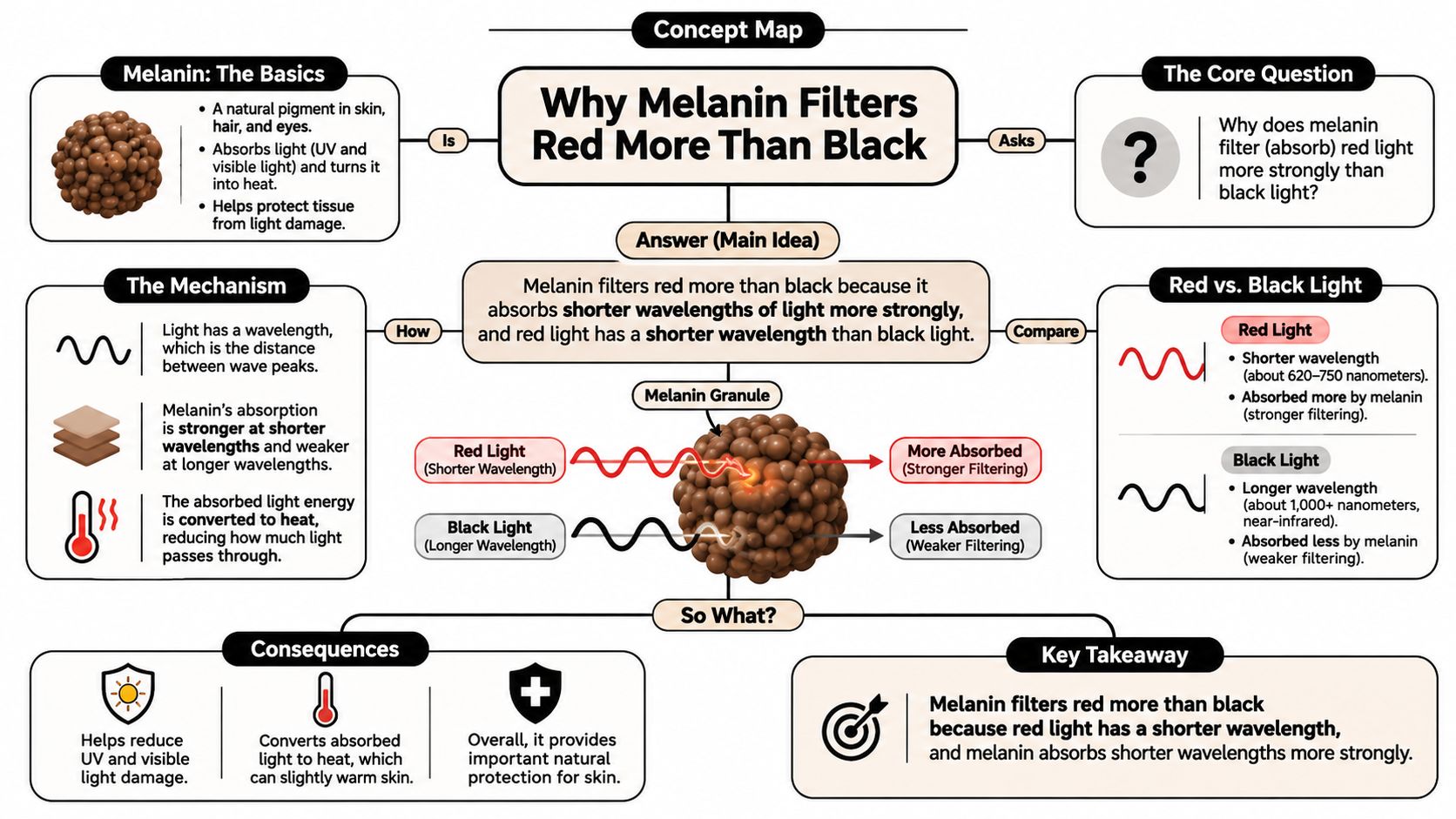
Think of the epidermis as a tinted window. Light has to enter the skin, hit the ink, and bounce back out to your eye. Melanin in that window filters brightness and saturation on the way in and on the way out. Black still reads because its value sits far from the skin. Red sits closer to many warm brown undertones, so a high-chroma color is not automatically high contrast.
The window, then the undertone
Say two clients book the same packed red heart. One has a warm, golden-brown forearm. The other has a cooler, olive-brown forearm. In the chair both hearts look intense, partly because the skin is swollen and the surface is glossy. As the epidermis heals, the warm undertone pulls the orange side of the red toward the skin. The cooler undertone may separate a blue-leaning red more cleanly, or it may swallow a burgundy that looked deep on a light-skin sheet. There is no single fade rate. Placement, sun, how saturated the pass was, and whether the session chewed the skin all change the ending.
Too little pigment leaves a stain. Too much trauma, from overworking one spot or from a long session on thin skin, muddies the color and can leave texture that reads louder than the red. The healed question is not "did it look bright at minute one." It is "does this red still separate from this undertone once the window settles."
Old reds and the reds in the bottle now
Historically, red tattoo color was often cinnabar, or mercury sulfide, a recognized sensitizer. Modern bottles more often use organic reds such as azo compounds and quinacridones. Reactions still happen. A 2025 clinical review is clear that current literature does not provide a reliable universal percentage for how often red remains visible on dark skin, and that results vary with formulation, saturation, placement, sun exposure, scar formation, and undertone. The same review notes that red-ink reaction symptoms commonly appear approximately one year after application, with reported onset ranging from one month to several years.
That history matters when you are judging a bold red design, not because every modern red is mercury, but because a color can look fierce while the skin is injured and then soften, and because a calm heal does not close the book on a later reaction limited to the red. In the consult, ask what this red will look like on this undertone after healing, not how it looks on a light-skin flash sheet. A small color test or staged work can be reasonable. Persistent inflammation that stays inside the red pigment needs a medical evaluation, not another layer of aftercare cream.
Plan Saturation Scale and Placement

A fresh red tattoo is a poor guide to its healed brightness. Epidermal melanin filters some incoming light, which can make red appear less bright and saturated once the skin heals. A 2016 clinical review emphasizes strong value separation when planning for a healed result. Saturated, relatively opaque red tends to remain more legible than a diluted wash. A dark outline can clarify the edge, but high chroma alone does not guarantee contrast. What matters is how the healed red reads against your skin and the open space around it.
Four decisions, in order
Pigment opacity comes first. If red has to carry the image, ask about a saturated, relatively opaque red rather than a watered wash. “A little red” and “packed red” create different results.
Design scale comes next. Fine petals, tiny symbols, and small script can lose separation as the color softens. Enlarge the motif or remove details that depend on narrow gaps. A rose the size of a coin has less room to keep its petals distinct than a palm-sized rose.
Line weight and negative space often help more than extra red shades. A near-black outline and untouched skin around the shape can preserve its edges. Several similar reds may add little separation. If the drawing's edge disappears in a black-and-white view, color alone may not restore it.
Placement affects how consistently the tattoo can heal and hold color. Ribs and the sternum move with each breath, which can make even saturation harder to achieve. Hands, fingers, feet, elbows, and knees face friction and sun exposure, and may need touch-ups. Upper arms and thighs offer a steadier canvas. On healed tattoos, sunscreen helps protect color from fading.
What the consent talk should include
A patch test may be worth discussing if you have reacted to pigment before, but it cannot rule out a later reaction. Red pigments are frequently represented in reports of tattoo reactions, which include different patterns of skin inflammation. Ask what red pigment will be used and make sure the ink details are recorded in the consent conversation. Reds in different bottles are not automatically interchangeable.
Use this checklist in the consult:
Opacity: Choose saturated, relatively opaque red if it carries the image.
Scale: Make the design large enough for softened edges to remain distinct.
Edge: Use a dark outline or clear negative space rather than red-on-red detail.
Placement: Consider a steadier, less sun-exposed area if color longevity matters more than a specific spot.
History: Mention prior pigment reactions, keloids, or dark or pale patches after injury.
Record: Have the red and any other colors written down before you leave.
A short consult video shows how an artist can discuss color and placement before the tattoo begins.
Tell Healing Apart From a Red Reaction
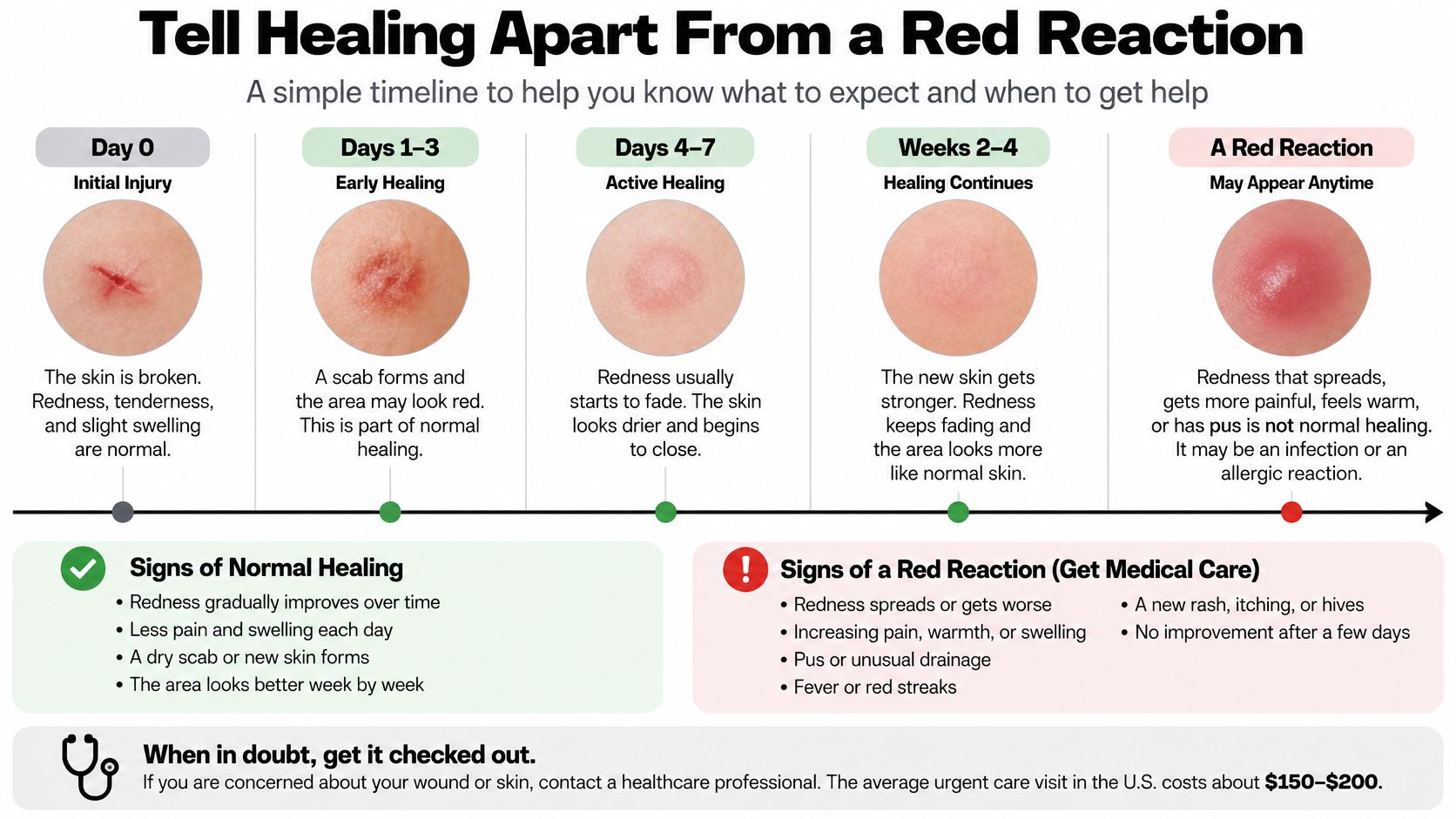
A fresh red tattoo can look alarming and still be healing normally. The useful distinction is how the skin changes over time and whether irritation affects the whole tattoo or stays within the red pigment.
Days 1 to 3 may bring soreness, warmth, plasma, or a little blood across the piece. From days 4 to 14, scabs and itching can appear as the skin closes. Picking can pull out pigment and cause scarring. Wash gently, moisturize, and leave flakes alone. The tattoo healing advice guide explains this whole-tattoo timeline.
When only the red stays angry
A reaction may appear weeks, months, or even years after an apparently normal heal. Persistent itching, swelling, raised plaques, papules, nodules, or scaling limited to red areas deserve attention. A 2019 pigment-identification study found chronic tattoo reactions concentrated in red and red-shade pigments. Its analysis identified Pigment Red 22, Pigment Red 210, and Pigment Red 170 among the pigments associated with these reactions. The study also cited a review of tattoo reactions seen at a Copenhagen dermatology clinic, where chronic allergic reactions made up a substantial share. These findings cover tattoos across skin tones, not dark skin alone.
A 2024 case report in Asia Pacific Allergy described itchy nodules in a red-ink area four weeks after a leg tattoo was applied. That timing is a reminder that a reaction can begin before the “years later” scenario many people expect. Persistent, localized inflammation calls for medical assessment, not just more moisturizer.
A clinic report published in 2025 in Dermatology Reports described tattoo-related complications that included allergic reactions to red ink. A 2024 UAB Medicine report also discussed red pigment in allergic tattoo reactions. These reports concern people across skin tones; they do not establish that red ink will react on any particular person.
Pattern | Typical timing | What you see | Next step |
|---|---|---|---|
Normal early healing | Days 1–14 | Soreness, plasma, then scabs and itch over the whole tattoo | Wash gently, moisturize, do not pick |
Infection | Usually early days | Spreading redness, pus, heat, or fever beyond the piece | Urgent medical care |
Delayed red reaction | Weeks to years | Itch, swelling, or plaques confined to red ink | See a dermatologist |
Granulomatous inflammation | Months to years | Nodules or firm bumps in the red | Seek medical assessment; do not cut or laser it yourself |
Keloid or pigment change | During or after healing | Raised scar, darker patches, or pale spots | Ask a clinician about treatment |
Creams, rules, and when to stop
Steroid creams can thin skin or change its color, so a clinician should guide their use. EU REACH rules restrict some substances in tattoo inks, but permitted reds such as PR 170 and PR 266 have still been associated with allergic reactions, according to a 2024 regulatory review. Compliance does not guarantee that a pigment cannot trigger a reaction.
If the rest of the tattoo has calmed but the red remains inflamed, raised, or itchy, stop home treatment and seek medical advice.
Spreading heat, pus, or fever calls for urgent care. Nodules should not be shaved, cut, or treated with a laser outside a medical setting. An artist can discuss the tattoo's appearance; a dermatologist can assess the skin and recommend treatment.
Removal Wavelengths for Darker Skin
Red ink is not automatically impossible to remove from darker skin, but removal can be more complex than a fresh tattoo photo suggests. Red, orange, and some yellow pigments generally respond to approximately 532-nm Q-switched or picosecond laser treatment. 1,064 nm is commonly used for black and dark-blue pigments because melanin absorbs less of this longer wavelength. A clinical laser review describes 1,064 nm as a workhorse wavelength for darker skin types and identifies 532 nm as a wavelength used for red pigment.
Why the red wavelength is the harder one
The shorter wavelength that targets red can also be absorbed by epidermal melanin, increasing the risk of unwanted light or dark patches, especially on Fitzpatrick V-VI skin. A 694-nm ruby laser is not the wavelength used to target red ink on very dark skin. Frequency-doubled Nd:YAG systems are used for red. To compare wavelengths for deeper skin tones, keep in mind that the right choice depends on the pigment and the skin, not only on a machine's ability to treat tattoos.
Ink chemistry, particle size, depth, density, and mixed colors all affect how a tattoo responds. A red-only piece is not guaranteed to be easy to remove because red can respond to 532 nm. In a tattoo that combines red and black, the pigments may require different wavelengths, and treating red can carry greater pigmentary risk on darker skin. In rare allergic reactions, laser treatment may release ink-associated material and trigger a broader reaction. Severe allergy may call for surgical removal instead.
What to write down now
Ask the artist to record the ink colors, including the brand and shade name, and note which colors sit beside the red. That information can help a medical laser provider assess the tattoo more accurately than a faded photo alone. Any lightening consultation belongs with a qualified provider experienced in treating darker skin. Fading cream is not a substitute for that assessment.
Plan the tattoo as though you intend to keep it. Keep the ink details in case a physician needs them later.
Book a Tone-Specific Consultation
The decision is a consult about this skin, not a screenshot of someone else's healed red. Bring the drawing, the body area, and any history of keloids, pigment change after an injury, pigment allergy, or a tattoo that misbehaved. Ask what this red will look like healed on this undertone, covering saturation, a dark outline, scale, placement, and sun. Ask how a delayed red-only itch, plaque, papule, nodule, or scaly patch differs from normal scabbing, and when the next stop is a dermatologist instead of another ointment.
If you have reacted to pigment before, ask whether a small patch test is reasonable, and hear the limit out loud. A quiet test spot cannot rule out a reaction that starts months or years later. If lightening might matter someday, ask for the exact red and the other colors written down for a medical laser provider who treats darker skin.
We offer complimentary consultations for that conversation, and you can call or text (720) 932-0124. The studio is at 172 S. Broadway, Denver, CO 80209. Choosing the person who will do the work is its own step. Read how to choose a tattoo artist before you pick red off a light-skin sheet. Leave with a healed-result plan, written aftercare, and a stop rule for home treatment if only the red stays inflamed. Clients are 18 and older.
Think Tank Tattoo plans color against your actual undertone in a complimentary consultation, including how saturated red, outline, scale, and placement should look after healing rather than in a fresh photo. If a red ink tattoo on dark skin is the piece you want, bring the design and any history of pigment reactions or keloids. Visit Think Tank Tattoo to set that consult and leave with a healed-result plan.
Comments