
Fine Tattoo Work Explained for Lasting Results
The most common advice about fine tattoo work is too simple: choose the smallest needle, keep the design tiny, and expect it to fade on a predictable schedule. None of those shortcuts tells you whether a tattoo will remain readable. A delicate tattoo succeeds when the artist gives its lines enough room, places pigment carefully, and plans for skin that heals and changes.
Small doesn't mean medically minor, either. A fine-line tattoo still creates a wound, and its aftercare deserves more attention than its size might suggest. A useful consultation starts with what you want to recognize in the finished piece, not how small you can make it.
Table of Contents
What Fine Tattoo Work Actually Means - Start with the kind of image you want - Popularity doesn't replace design judgment
How Fine Lines Stay Readable in Skin - Depth and saturation are different decisions - Particle measurements aren't a shopping guide - Apply the biology to the drawing
How Artist and Client Build the Piece - Move from references to a workable stencil - Match the artist to the drawing
Healing Signs and When to Get Help - Judge the direction of symptoms - Know who should answer the question
Longevity Variables and Removal Reality - Ask what could make this particular piece harder to maintain - Small tattoos aren't automatically simple to remove
Plan Your Fine Tattoo Work in Denver - Prepare an inquiry the artist can use - Leave room for a better version of the idea
What Fine Tattoo Work Actually Means
Fine tattoo work compared with other styles
Approach | Line and shading | Typical subjects | Aging behavior |
|---|---|---|---|
Fine tattoo work | Thin consistent lines, light shading, open negative space | Script, florals, delicate portraits | Edges can soften; packed detail may merge |
American traditional | Bold black outlines, limited solid color | Icons meant to read at a distance | Heavy shapes offer more visual margin as edges soften |
Black-and-gray realism | Smooth value rather than hard outlines | Larger portraits and tonal scenes | Needs scale so neighboring midtones remain distinguishable |
Micro or single needle | Finest marks, very little ink load | Tiny symbols and minimal lettering | Least margin when lines spread |
Fine tattoo work is drawing carried by thin, consistent lines and restrained shading. Its quality isn't measured only by how delicate it looks immediately after the appointment. The more useful test is whether you can still distinguish its letters, petals, or facial features after healing.
The table describes design trade-offs, not a clinical ranking of how many years each style lasts. Clinical literature doesn't establish a fixed lifespan that reliably places fine line above or below every other approach.
Start with the kind of image you want
Fine line suits subjects that can communicate through selective marks. A flower might need an outer silhouette, a central vein, and a few carefully chosen folds rather than every visible texture. Script needs recognizable letter shapes and clear openings inside letters, not a thin stroke.
American traditional takes a different route. Bold outlines and solid shapes make an anchor, rose, or animal recognizable without requiring close inspection. Reducing that kind of image and replacing every heavy outline with a hairline doesn't automatically produce a successful fine-line design.
Black-and-gray realism relies on value, meaning the difference between light and dark. A portrait needs enough physical space to separate a cheek highlight from an eye socket or a shadow beneath the nose. Without that space, adding more shading can make the subject harder to recognize.
Micro work pushes delicacy further, but micro describes scale, while single needle describes a tool arrangement. Neither term guarantees quality. An extremely small symbol may work well when its silhouette is simple, while miniature lettering can become difficult to read if its openings are already cramped.
Choose the approach that preserves the important information in your idea, not the label that sounds most delicate.
Popularity doesn't replace design judgment
Global Google search interest for fine line tattoos increased 21-fold between 2016 and 2026, according to SkinGraphica's global tattoo-trends analysis. That helps explain why so many first-time clients arrive with references for this look, but popularity doesn't make every reference suitable for every placement.
A photograph can hide the actual size of a tattoo. A close crop can make tiny lettering look generous, while bright lighting can exaggerate the separation between pale shading and bare skin. Ask to understand the design at its real scale rather than judging only a magnified image.
Before discussing needle size, match your idea to a row in the table. Decide whether its identity comes from an outline, a silhouette, tonal modeling, or very sparse marks. That choice gives the artist a useful starting point.
How Fine Lines Stay Readable in Skin
A tattoo isn't ink resting on a sheet of paper. The artist places pigment into living tissue, where both the application and the body's response influence the result. Placement within the dermis matters more than putting ink deeper.
Use the consultation to connect a reference image to the actual area of skin that will carry it.
Depth and saturation are different decisions
An in vivo two-photon imaging study detected pigment in epidermal and dermal cells, including keratinocytes, dendritic cells, basal cells, macrophages, mast cells, and fibroblasts, and found pigment in 75% of tattoos examined up to nine years old. That observation concerns pigment detection, not a promise that a tattoo remains visually unchanged.
The surface epidermis sheds. Pigment placed only superficially can be lost with that turnover, while appropriate dermal placement supports retention. Going deeper isn't a solution to every weak line, however, and repeatedly working a narrow stroke can increase trauma rather than improve it.
The same imaging study observed carbon-black particles around an incision for 84 days. That's a reminder that biological activity can continue beyond the point when a surface looks settled, not a universal healing deadline.
Controlled saturation means depositing enough pigment for the intended mark without treating the skin as a container to fill. A client can request a darker appearance, but the artist must decide whether another pass is appropriate for the tissue.
Particle measurements aren't a shopping guide
An analysis of tattoo pigments and human tissue reports particle sizes ranging from below 100 nanometers to above 1 micrometer, with particles reaching several micrometers in examined skin and smaller nanoparticles capable of reaching lymph nodes. Those measurements describe microscopic material behavior, not the visible width an artist should choose for your lettering.
You can't turn a particle-size figure into a reliable claim that an ink will produce the sharpest healed tattoo. Ink formulation, the way pigment is dispersed, and the amount deposited all matter. A small needle grouping doesn't remove those variables.
Pigment retention also involves immune cells called macrophages. As pigment-containing cells die and other cells take up released material, the body can retain the tattoo while its visible edges gradually soften. The practical response is to design with tolerance for change rather than demanding an edge that never changes.
Apply the biology to the drawing
These design choices give fine lines more room to remain distinct:
Control the ink load. A narrow stroke shouldn't be packed darker just because it looks lighter than a bold outline.
Protect negative space. Leave visible gaps between neighboring letters, leaf veins, and hair strokes instead of filling every opening.
Separate light and dark. A deliberate dark accent beside open skin can communicate more clearly than a cluster of nearly identical grays.
Increase scale when necessary. Enlarge script or a portrait until essential features have their own space, or remove details that don't help recognition.
Say you want a botanical tattoo with overlapping leaves. If every leaf contains closely spaced veins, the artist may preserve the leaf outlines and remove some interior strokes. You keep the plant's character without making every small gap essential to its readability.
Placement needs the same scrutiny. Hands, fingers, and feet present movement, friction, and surface conditions that can make delicate work less forgiving. A forearm or calf may offer a more workable area for a particular drawing, but no placement guarantees an unchanged result.
The video below provides a visual companion to the discussion of fine-line work.
Ask the artist to identify the smallest important stroke, the tightest gap, and the place where the skin folds or moves. Then ask what could be removed without losing the subject. Detail that only reads on still, freshly tattooed skin is too demanding for that design or placement.
How Artist and Client Build the Piece
A productive consultation turns a visual preference into a drawing that can be tattooed responsibly. You don't need to arrive knowing machine settings or needle configurations. You do need to explain what matters to you and leave room for an artist to translate it.
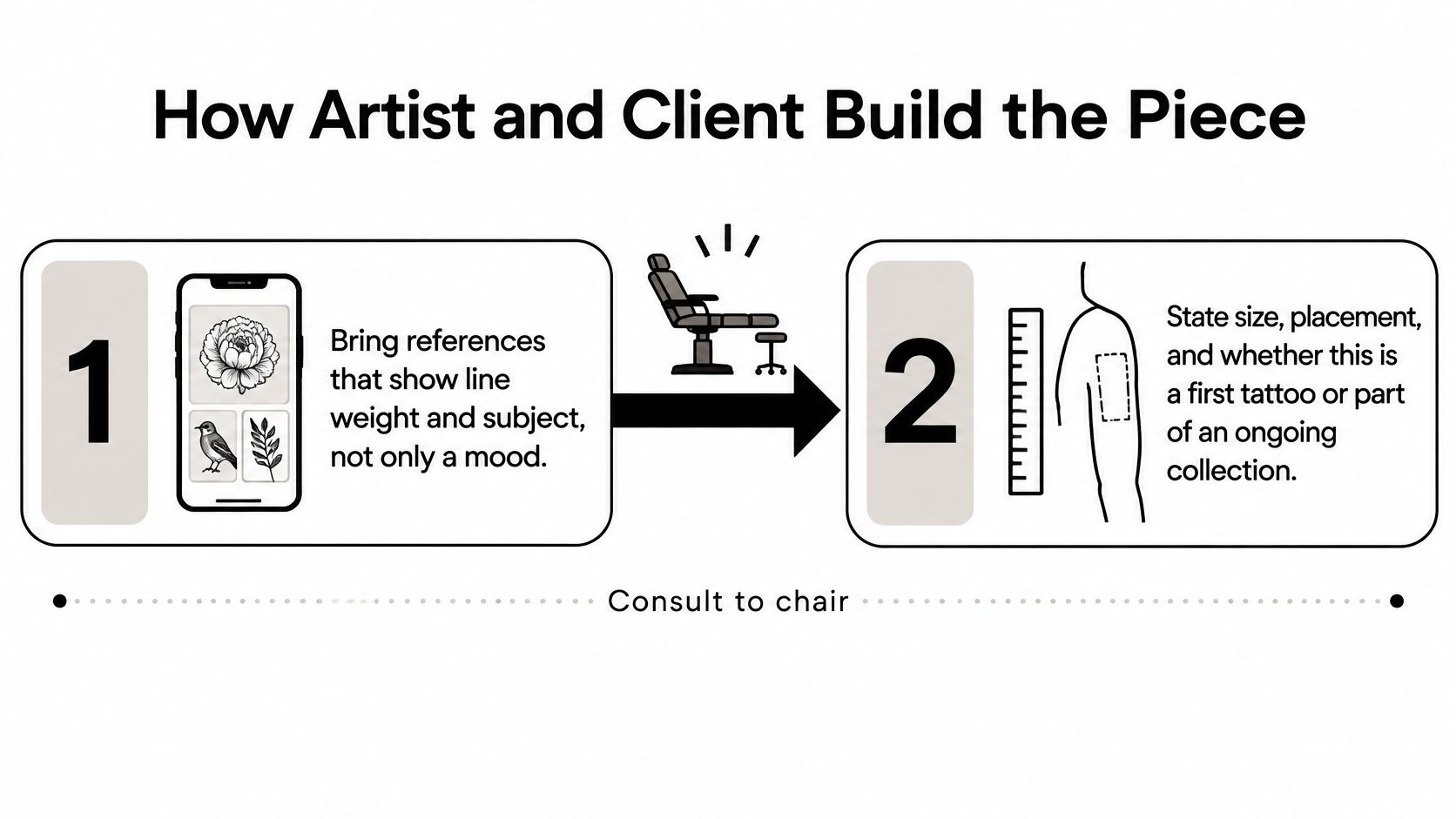
The sequence below makes the decisions visible before they become permanent.

Move from references to a workable stencil
Bring references that explain the look. Include images that show the subject, preferred line weight, and amount of shading, and identify what you like about each. This prevents an artist from mistaking a general mood for a request to reproduce an unsuitable design.
State placement and approximate size. Explain whether this is your first tattoo or part of a collection, and mention nearby pieces you may want later. That context helps the artist consider orientation and composition beyond the edges of the current drawing.
Share relevant skin and health history. Disclose unusual scarring, known pigment reactions, active rashes, immune suppression, and medications, with medical questions directed to a qualified clinician. The reason is suitability and safety, not an attempt to have a tattoo artist diagnose a condition.
Allow a redraw before approving the design. The artist may open letter spacing, remove secondary texture, or adjust proportions. Use our design feedback process to understand how to communicate priorities without treating every reference detail as mandatory.
Check the stencil on your body. Look while standing naturally and moving the nearby joint, not only while the skin is stretched for application. This catches awkward orientation or crowding while changes are still ink-free.
Let the artist control the passes. Speak up about discomfort, ask for a break when needed, and avoid requesting repeated darkening of every pale-looking area. The artist needs to judge the skin's response rather than chase the appearance of a fresh photograph.
Leave with written instructions and a follow-up plan. Confirm how to ask routine aftercare questions and when to send a healed photograph. A fresh image records the application, but it can't settle every question about the finished result.
Match the artist to the drawing
A studio with several stylistic approaches can help distinguish between fine script, illustrative linework, and a softly shaded portrait. At our shop, collaboration allows the conversation to focus on who fits the project rather than assuming every artist handles every subject identically.
Review comparable work, including healed examples when available. Pay attention to letters, curves, and small gaps that resemble the demands of your own idea.
Your job is to bring honest references and a realistic scale. Choosing a needle number is the artist's job.
Healing Signs and When to Get Help
A tiny fine-line tattoo isn't a medically trivial procedure. A fresh tattoo is a wound regardless of line weight, and a small footprint doesn't rule out infection, allergy, or an inflammatory reaction.
A clinical review of tattoo complications identifies infections, scarring, allergic responses, and inflammatory reactions, including granulomatous and lichenoid reactions, with differing timing and presentation. You don't need to identify which condition is present before seeking help for worsening symptoms.
Fine tattoo healing versus warning signs
Window | Often expected | Get clinical help if |
|---|---|---|
Early healing | Some redness, warmth, tenderness, mild swelling, and light plasma, ink, or blood ooze | Pain or redness worsens quickly, or fever, chills, or pus develops |
While the surface repairs | Itching, flaking, and light scabbing that gradually settle | Open sores, blisters, increasing pain, or persistent swelling appear |
After the surface closes | Dryness managed with fragrance-free moisture and protection from sun and friction | Raised, scaly, or persistently inflamed patches develop |
Before booking | Disclose keloids, pigment allergy, active skin disease, immune suppression, and medications | Active disease or immune concerns need assessment before proceeding |
Judge the direction of symptoms
Expected irritation should generally become easier to manage, not progressively more painful. A tattoo that looks small can still need prompt clinical assessment if redness spreads or you develop pus, fever, or chills. Don't use a photograph of someone else's healing tattoo to dismiss your own symptoms.
For routine care, wash your hands before touching the area. Follow the written dressing instructions, clean gently with fragrance-free soap when directed, and pat dry rather than rubbing. If an ointment is recommended, use a thin layer rather than leaving the tattoo heavily coated.
Avoid scratching, peeling flakes, or picking scabs. Keep the healing area out of pools and other soaking water, and reduce friction from tight clothing or equipment. Once the surface has healed, ongoing sun protection and suitable moisturizing become part of caring for the tattooed skin.
For product-selection context, ALODERMA's guide to gentle skincare for sensitive skin can help you think about a simple routine. It isn't a substitute for tattoo-specific instructions, and a product intended for ordinary skin shouldn't automatically go onto an open wound.
Know who should answer the question
Our tattoo healing advice can support routine aftercare decisions. Questions about a dressing, cleaning technique, or sending a progress photo belong with the artist; worsening pain, spreading redness, systemic illness, or an unusual persistent reaction belong with a clinician.
Safety rule: Don't wait for a scheduled studio check if symptoms are getting worse.
Before booking, discuss significant medical concerns with an appropriate healthcare professional. Don't stop prescribed medication to prepare for a tattoo unless your prescriber directs you to. Good aftercare protects both the appearance of the line and the person wearing it.
Longevity Variables and Removal Reality
A fixed expiration date is the wrong way to assess fine tattoo work. Available clinical literature on tattoo pigment retention and movement describes pigment held by dermal macrophages and moving through lymphatic pathways, but doesn't establish a reliable, peer-reviewed year count comparing fine line with every other style.
Treat an exact lifespan offered without individualized assessment as a sales claim, not a forecast. A tattoo can remain meaningful and recognizable while its appearance changes. Whether that change is acceptable also depends on what you expect to see when you look at it.
Ask what could make this particular piece harder to maintain
Ink density, spacing, placement, ultraviolet exposure, skin characteristics, healing behavior, and later touch-ups all affect the planning conversation. Those variables don't combine into a simple countdown. Our explanation of why tattoos fade over time offers context for discussing appearance changes without assigning a universal deadline.
Use specific questions rather than asking only whether fine line lasts:
For script: Will the word remain recognizable if the smallest openings become less distinct?
For a miniature portrait: Which facial features carry the likeness, and can the artist preserve those without excessive texture?
For a high-friction placement: Would you still choose that location if it required later assessment or adjustment?
For future touch-ups: What can realistically be reinforced without closing the remaining gaps?
A touch-up isn't a reset button. Adding ink may help an under-retained section, but it can't create new bare skin between crowded marks. That's why maintenance should be discussed as a possibility, not offered as a cure for an overpacked drawing.
Small tattoos aren't automatically simple to remove
A prospective study of 116 patients treated between 2020 and 2024, published in 2025, found that dotwork tattoos required an average of 4.4 removal sessions, compared with 6.9 for line tattoos and 7.0 for mixed-technique tattoos. Within that study, line tattoos took more sessions on average than dotwork.
That finding doesn't predict your treatment count or establish that every fine-line tattoo behaves like every line tattoo in the sample. It does challenge the assumption that thin-looking work will necessarily disappear easily.
If removal is already part of your decision, the Ideal Face & Body tattoo removal guide provides background for questions to take to a qualified treatment provider. Seek an individual assessment rather than treating a session average as a quote.
Choose a tattoo you're prepared to wear, not one you assume will be effortless to erase. A healed-photo review is a more useful commitment than a promise of permanent crispness.
Plan Your Fine Tattoo Work in Denver
Arrive with a clear idea, but don't make the smallest possible version a condition of getting tattooed. Bring references, a preferred placement, and an approximate size you're willing to reconsider. The useful decision is whether the artist can preserve what matters to you without forcing essential details into inadequate space.
At Think Tank Tattoo, we offer complimentary consultations to discuss design direction, placement, and timing. We've been in business since 2002, and our studio is at 172 S. Broadway, Denver, CO 80209. Use the conversation to test the idea on your body rather than committing from a close-up photograph alone.
Prepare an inquiry the artist can use
Send enough information to make the first conversation specific:
Your references: Identify the linework, subject, or shading you want to retain.
Your intended placement: Include a clear photo if existing tattoos affect the available area.
Your priorities: Say which details are essential and which could be simplified.
Your questions: Ask which artist fits script, black-and-gray, or illustrative fine work.
You can call or text us at (720) 932-0124, or email thinktanktattoo@gmail.com. We book appointments by calling or emailing the shop, and we're open Tuesday through Saturday, 12pm to 8pm. Our studio serves clients 18 and older.
Leave room for a better version of the idea
A recommendation to enlarge or simplify a drawing should come with a clear reason. Ask the artist to show which letters crowd, which portrait features compete, or which small marks could be removed. You should understand the trade-off before approving the stencil.
Choose fine tattoo work when the design can breathe, and treat healing symptoms that worsen as a medical question rather than a cosmetic inconvenience. Bring those expectations into the consultation before treating the drawing as final.
Think Tank Tattoo offers complimentary consultations to work through the size, placement, and design choices behind fine tattoo work. Visit Think Tank Tattoo to arrange a consultation, and bring references so we can discuss what to preserve, simplify, or enlarge before you commit.
Comments