
Why Do Tattoos Fade Over Time? Causes and Fixes
Approximately every 90 days, immune cells can release and recapture tattoo pigment instead of locking it permanently in place. That constant recycling is why tattoos fade gradually, and why fading is normal and only partly controllable.
You may notice it when you compare a fresh tattoo photo with the same piece after it has fully settled. The black looks a little softer, a bright color seems less lively, or a fine line no longer has the crisp edge it had on appointment day. That change doesn't automatically mean your artist used poor technique or that you neglected your aftercare.
The better answer to why do tattoos fade over time has several parts. Your immune system continually handles the pigment, ultraviolet light can break down certain molecules, skin changes with age, and friction can affect how a tattoo looks. Even a well-protected tattoo may slowly lose some sharpness because pigment can redistribute beneath the surface.
A useful way to understand the process is to separate three visual changes:
Color loss: A pigment becomes paler, duller, or less saturated.
Line diffusion: A crisp edge gradually looks softer or slightly spread.
Contrast reduction: The tattoo remains present, but it stands out less against the surrounding skin.
Those changes can happen together, but they don't have the same cause. Sunscreen helps with light-driven pigment breakdown. It can't stop immune-cell turnover, natural skin aging, pigment movement, or every source of rubbing. That distinction matters when you're planning a sleeve, a back piece, or any large tattoo completed across multiple sessions.
Table of Contents
How Tattoo Ink Lives Inside Your Skin - The capture and release cycle
The Immune System's Role in Slow Fading - Why colors don't age alike
Sun Exposure and Pigment Breakdown - Why cumulative exposure matters
Placement, Ink Quality, and Technique - A practical placement comparison
Why Even Protected Tattoos Lose Crispness - Three changes that look similar
Protecting Your Tattoo the Smart Way - During the healing stage - After the skin has healed - A straightforward maintenance routine
When to Consider a Touch-Up - A sensible touch-up conversation
Why Your Tattoo Changes as It Ages
A client often arrives at a consultation with the same question after looking closely at an older piece: “Why doesn't it look like the photo from the day it was finished?” The answer isn't that the tattoo has failed. Fresh ink photographs with swelling, surface brightness, and intense saturation that naturally change as the skin settles.
A healed tattoo is a living part of the skin, not a printed image sealed beneath glass. The body keeps repairing, renewing, and protecting the tissue around the pigment. Some particles remain held in the dermis for years, while others become redistributed or cleared gradually.
Aging well doesn't mean looking frozen in time. It means the design remains readable as the skin and pigment change together.
The first change is often color loss. A red may look less vivid, or a light tone may lose some of its original saturation. Ultraviolet exposure can contribute, but pigment chemistry also matters, so two colors in the same tattoo may age differently.
The second is line diffusion. Lines can look less razor-sharp as particles move through nearby tissue and as the surrounding skin changes. This is especially noticeable in tightly packed detail, where small changes in spacing affect readability.
The third is contrast reduction. A tattoo may still contain plenty of pigment, yet appear quieter because the color is less saturated or the skin around it has changed. A black-and-gray design, for example, can remain identifiable while looking softer than it did when freshly healed.
These processes are normal to some degree. You can reduce avoidable stress with sensible placement, thoughtful design, careful healing, and long-term sun protection, but no aftercare routine can suspend biology. Understanding that limit helps collectors plan work that has enough structure and breathing room to age gracefully.
How Tattoo Ink Lives Inside Your Skin
A tattoo needle places pigment into the dermis, the deeper layer beneath the outer epidermis. The goal is to put the ink where it will not just shed away with the surface skin. The body still recognizes the pigment as foreign material, though, and immune cells respond to it.
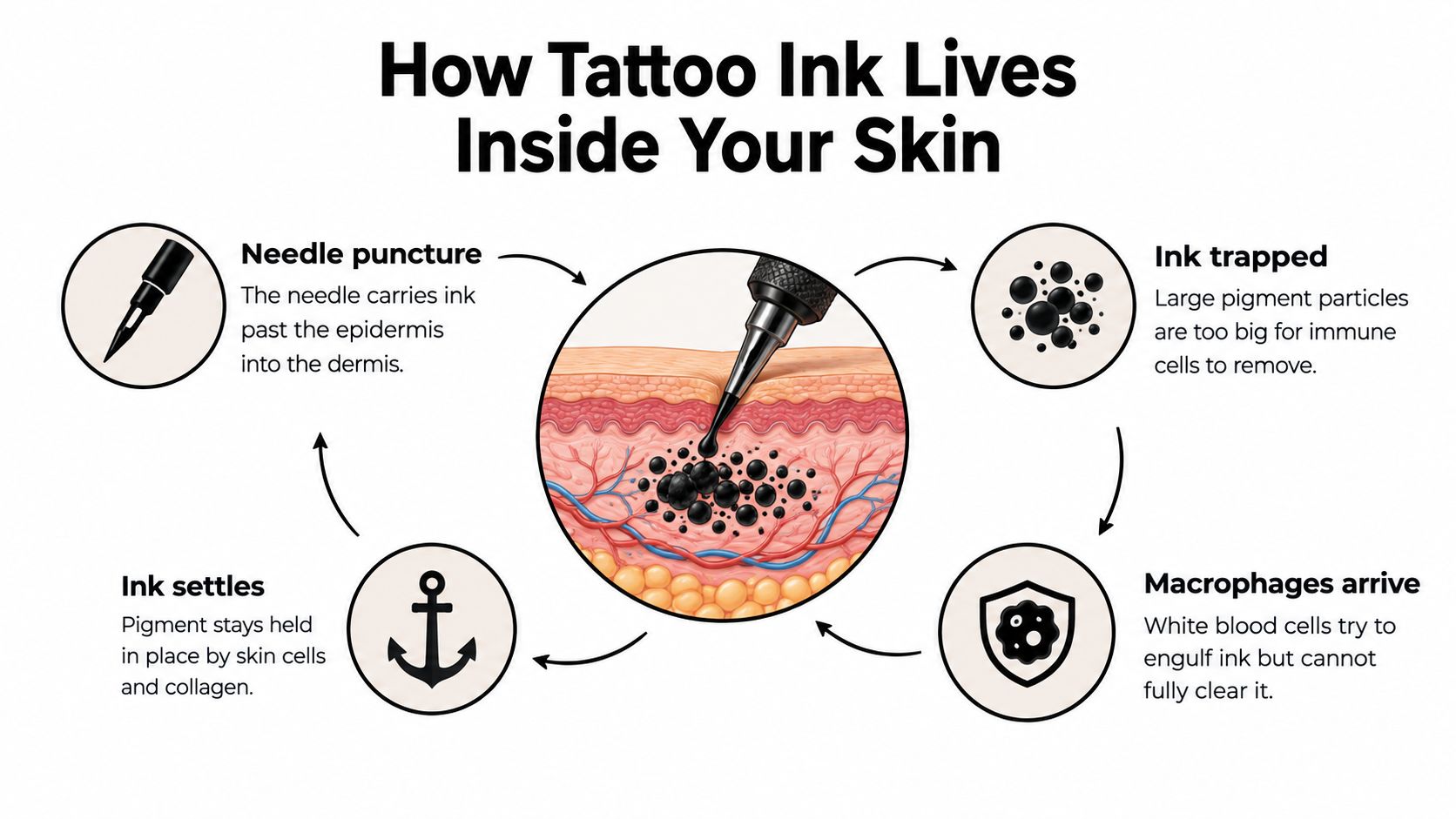
Think of dermal macrophages as small storage containers operated by the immune system. They move toward foreign particles, engulf them, and hold them inside the cell. In tattooed skin, these cells store pigment without chemically digesting it, which helps explain why ink can remain visible for years.
A 2018 study published in the Journal of Experimental Medicine found that dermal macrophages were the identified cells taking up tattoo pigment in tattooed mice. When those macrophages died, they released the particles into nearby tissue. New macrophages then captured the released pigment, creating a repeated capture, release, and recapture cycle over approximately 90 days (Science News explains the macrophage research).
The capture and release cycle
The process is easier to understand in steps:
The needle deposits pigment in the dermis.
Macrophages arrive and engulf some of the particles.
The cells hold the pigment rather than breaking it down completely.
When those cells die, nearby tissue receives the released particles.
New macrophages take up some of the pigment again.
That cycle creates an important paradox. The ink stays in the skin because immune cells keep holding it, but the ink also changes because those cells don't remain in place forever. Some pigment may become more dispersed, move deeper, or enter normal tissue-clearance pathways.
Pigment can also associate with fibroblasts, the cells that help maintain connective tissue. The result isn't a solid pocket of ink sitting untouched in one location. It's a changing arrangement of particles, cells, and surrounding skin.
If you're curious about what goes into the material being placed in the dermis, this guide to tattoo ink ingredients offers useful background. The practical point is simple: tattoo permanence comes from pigment being retained in deeper skin, not from the body treating it as a permanent, immovable object.
The Immune System's Role in Slow Fading
The immune response explains why a tattoo can remain recognizable for a long time without staying visually identical. Macrophages hold pigment in the dermis, and fibroblasts can also become associated with it. As pigment particles are exposed to light, heat, inflammation, and ordinary tissue turnover, some can break into smaller fragments.
Smaller fragments are easier for the body to move. Some macrophages release their contents, other immune cells collect the material, and a portion can travel through lymphatic clearance. That doesn't mean the body removes all tattoo ink quickly. It means the visible design reflects a balance between pigment retained in the skin and pigment gradually redistributed or cleared.
Why colors don't age alike
Pigment chemistry determines how a color absorbs energy. Optical studies used in laser experiments found that red, orange, and rose pigments were lightened at 532 nanometers, while brown pigments were lightened at 1064 nanometers. Yellow and green required different wavelengths and higher measured fluence in the tested setup (the optical study reports color-specific laser responses).
Laser-removal settings aren't a timetable for natural tattoo fading. They do demonstrate a useful principle: color and particle size affect energy absorption and clearance. A pigment that responds differently to a specific wavelength is behaving differently at the molecular level. That's one reason a multicolor tattoo may show uneven changes instead of just becoming uniformly lighter.
The immune system also responds to the condition of the skin around the tattoo. Repeated irritation, inflammation, and mechanical abrasion can affect the appearance of a piece. Friction from clothing or movement may be especially noticeable on areas that bend, rub, or receive frequent contact.
A tattoo doesn't fade through one single exit door. Light can alter pigment, immune cells can redistribute it, and skin movement can change how sharply the design reads.
This is also why a healed tattoo shouldn't be judged by color alone. A piece can retain much of its pigment while losing some edge definition. Conversely, a color may look visibly weaker even when the linework remains clear. The visible result depends on the interaction between pigment chemistry, particle distribution, and the skin's condition.
Sun Exposure and Pigment Breakdown
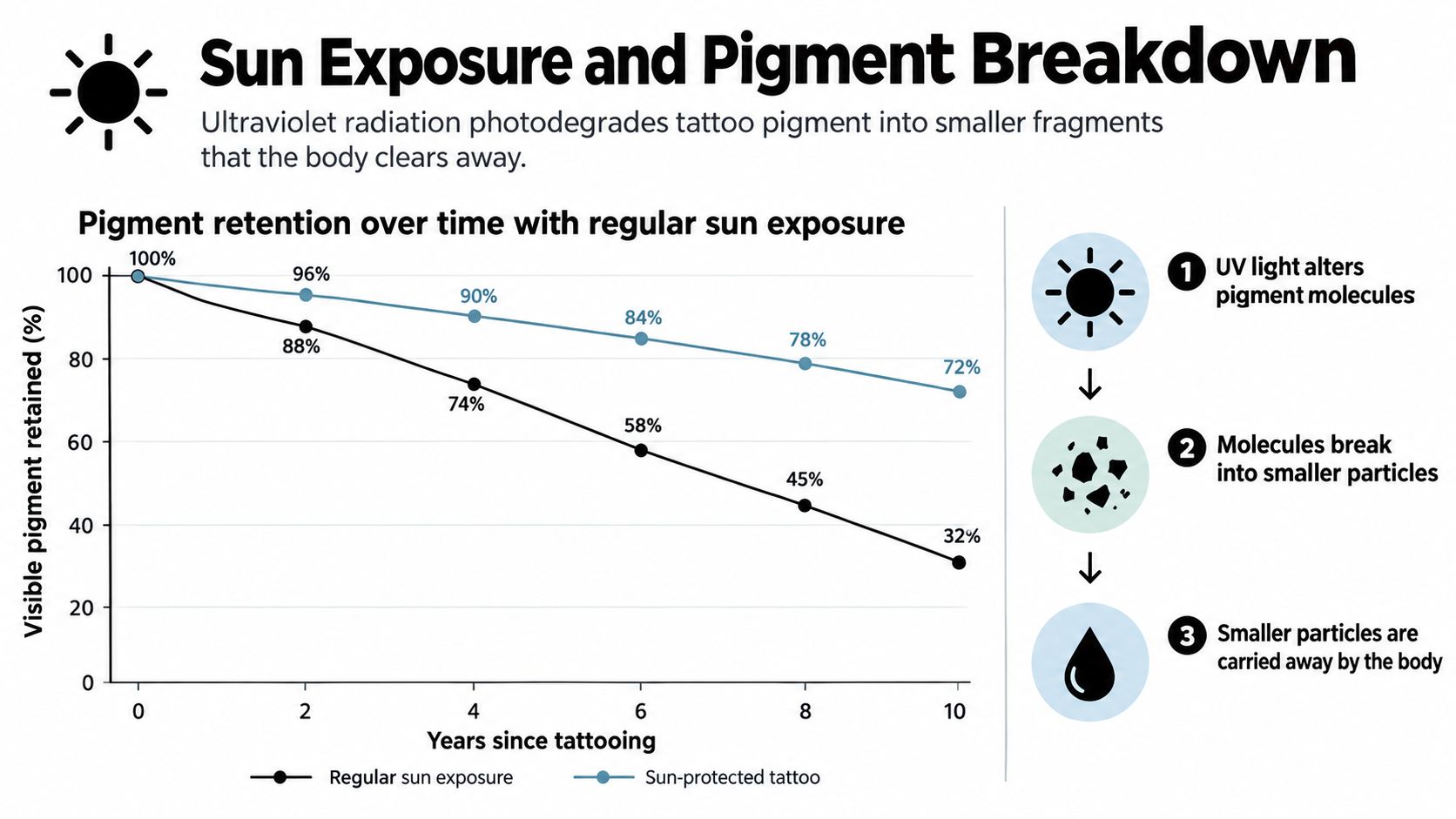
Ultraviolet radiation affects tattoos through photodegradation, a chemical process in which light alters pigment molecules. The resulting fragments may be smaller, less colored, or colorless. Once pigment has changed in this way, the body may handle and clear some of it more readily.
Laboratory research has demonstrated tattoo-pigment degradation under simulated sunlight. A toxicology study also found that the organic pigment Pigment Orange 13 could be degraded by heat and, more significantly, simulated sunlight (research on tattoo-pigment degradation is available in this laboratory review).
Why cumulative exposure matters
A single sunny afternoon isn't the whole story. Repeated outdoor exposure, tanning beds, and unprotected time in direct sun add to the total ultraviolet dose reaching pigment in the dermis. A tattoo on a hand, forearm, shoulder, or lower leg generally receives more incidental light over its lifetime than one usually covered by clothing.
The chemistry also explains why colors may shift rather than fade unevenly. Pigments have different levels of light stability. One color may lose saturation first, while another changes in hue or remains comparatively strong. The surrounding skin can also lose elasticity and change its collagen structure as it ages, making edges look less crisp even when UV exposure hasn't been extreme.
Broad-spectrum sunscreen and clothing reduce the amount of ultraviolet radiation reaching healed tattooed skin. They don't reverse pigment breakdown that has already occurred, and they don't prevent immune-cell activity or friction.
Sunscreen belongs on a tattoo only after the skin has fully healed. An open, peeling, or actively irritated tattoo needs the aftercare approach provided by your artist, not a layer of sunscreen. Healing timelines vary, so follow professional instructions and wait until the surface is intact.
For a visual explanation of how sunlight interacts with tattoo pigment, watch the video below.
Sun protection is important, but it isn't a promise that the tattoo will look unchanged forever. It addresses one major pathway, photochemical damage, while the biological processes described earlier continue in the background.
Placement, Ink Quality, and Technique
A tattoo's location affects how much light, rubbing, movement, and stretching it experiences. Placement isn't a guarantee of longevity, but it gives you and your artist a practical way to manage risk before the design is tattooed.
Compare a hand with an upper arm. A hand is frequently washed, exposed to the sun, used for gripping, and moved at several joints. An upper arm is often easier to cover and may experience less daily abrasion. The same design can therefore face different long-term conditions depending on where it lives.
A practical placement comparison
Body Area | Fading Risk | Why It Happens | Care Tip |
|---|---|---|---|
Hands | Higher exposure and wear | Frequent washing, sunlight, gripping, and movement affect the skin | Choose clear shapes and protect healed skin from direct sun |
Forearms | Regular exposure | Sleeves may leave the tattoo in daylight during ordinary activities | Use broad-spectrum protection once healed |
Shoulders | Variable | Clothing may cover the area sometimes, while outdoor activities expose it at other times | Plan coverage and sun protection around your routine |
Lower legs | Variable to higher exposure | Shorts and outdoor activity can leave the tattoo exposed | Cover the area when practical during long outdoor sessions |
Areas with repeated rubbing | More visual wear | Clothing, movement, or skin-to-skin contact can irritate the surface | Reduce friction during healing and monitor recurring irritation |
The design itself matters too. An artist can select pigments with durability and placement in mind, use controlled saturation, and leave enough separation between important elements. Tight detail may become harder to read when nearby lines soften, while deliberate spacing gives the design room to age.
Ink quality also deserves a direct conversation. Ask your artist which pigments they use, how they think the colors will behave in your chosen location, and whether the scale gives the linework enough room. A responsible consultation isn't only about how the piece looks on appointment day. It considers how the design needs to function after the skin has changed.
For a sleeve or other large project, plan placement as a system. Keep high-detail focal points in areas that can support them, consider how separate sessions will connect, and avoid treating every inch of skin as though it will experience the same amount of sun and friction.
Why Even Protected Tattoos Lose Crispness
Sunscreen can reduce ultraviolet damage, but it can't keep every pigment particle in its original position. Pigment may gradually move from the upper dermis into deeper dermal tissue and, in some cases, into dermal blood vessels and lymph nodes. That movement can make a line look softer or slightly blurred even when the tattoo receives careful sun protection.
A laboratory and animal-model review reported that mouse skin retained 32% less tattoo ink, with variability of ±16%, 42 days after tattooing, and that simulated sunlight and laser exposure reduced retained particles further (the review discusses tattoo-pigment retention and migration). Mouse findings don't provide a precise human fading schedule, but they help explain why “I always use sunscreen” doesn't guarantee original crispness.
Three changes that look similar
Color loss is the easiest to identify. The pigment appears lighter or less saturated, often after repeated light exposure.
Line diffusion is different. The line may still contain strong pigment, but its boundary becomes less precise as particles redistribute through nearby tissue. This can resemble “spreading,” although it isn't necessarily caused by a single mistake during the tattoo session.
Contrast reduction describes a quieter overall appearance. Changes in skin texture, elasticity, and surrounding tone can make the tattoo stand out less, even where the pigment remains visible.
A good comparison is restoring a valued object whose surface has changed. Understanding the science behind how to restore jewelry brilliance at home can help illustrate the difference between surface appearance and the material underneath, although tattooed skin follows its own biological processes.
Sunscreen can't stop immune-cell turnover, pigment redistribution, aging, or mechanical abrasion. It remains one of the most useful controls you have, but it works alongside placement, design, healing, and realistic expectations.
Protecting Your Tattoo the Smart Way
The most useful tattoo-care plan changes as the skin moves from healing to long-term maintenance. A fresh tattoo and a fully healed tattoo don't need the same approach, and applying the wrong product at the wrong stage can irritate healing skin.
During the healing stage
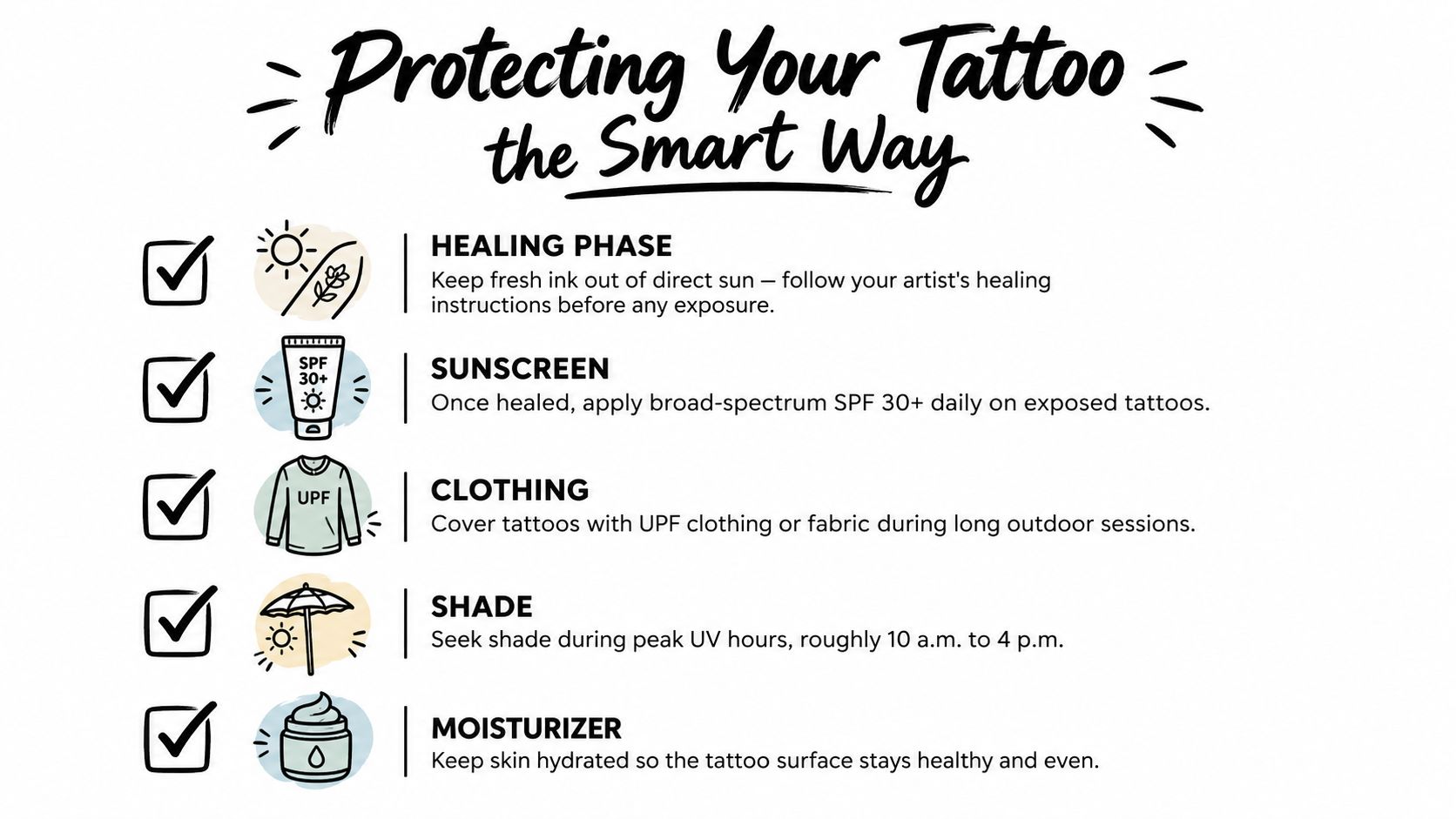
Keep fresh ink out of direct sun according to your artist's instructions. Don't apply sunscreen to an open, peeling, or actively irritated tattoo. Use the cleanser, covering, and moisturizing routine recommended by your professional, and avoid picking or scratching the surface.
The word fully healed matters. The skin should no longer be open or actively peeling before sunscreen becomes part of the routine. If you're uncertain, ask the artist who performed the work rather than guessing based on how the color looks.
After the skin has healed
Once healed, use broad-spectrum sun protection on exposed tattooed skin and cover the area with clothing when practical. Consistency matters more than treating sunscreen as an occasional rescue product after a long day outdoors.
Clients often ask whether a higher SPF automatically stops fading, whether cloudy weather makes sunscreen unnecessary, or whether mineral sunscreen is always better than a chemical formula. The evidence doesn't support those simple guarantees. UV protection addresses photodegradation, but it doesn't control immune-cell movement, aging, friction, or inconsistent application.
A peer-reviewed exploratory study found that an SPF 50+ product containing 2.5% dexpanthenol helped maintain the appearance of existing tattoos while supporting skin hydration. The study didn't establish that one sunscreen formula prevents fading across all pigments, skin types, climates, or exposure patterns (the IARC tattoo background provides the study context).
A straightforward maintenance routine
Cover when possible: Fabric can reduce direct exposure during long outdoor sessions.
Protect healed skin consistently: Apply broad-spectrum sunscreen to exposed tattooed areas as part of ordinary skin care.
Treat cloudy days sensibly: Visible clouds don't mean ultraviolet exposure disappears, so use the same practical protection you would normally use outdoors.
Don't chase product claims: No sunscreen can stop every cause of visual change.
Watch the skin, not just the ink: Persistent redness, swelling, itching, or a rash deserves medical evaluation rather than more layers of product.
For color-specific healing guidance, follow the color tattoo care instructions provided by your artist and adjust only when a qualified professional recommends it.
When to Consider a Touch-Up
Some fading is inevitable after healing because ultraviolet radiation and aging continue to affect both pigment and surrounding skin. A clinical report on nipple and areola tattoos reached that conclusion after noting fading from external stimuli including UV exposure and chronological aging (the clinical report discusses post-healing tattoo fading).
That doesn't mean every older tattoo needs fresh ink. A touch-up makes sense when the design has uneven color, a noticeably weak section, softened fine lines that affect readability, or blurred edges in a high-wear placement. It may not be necessary when the tattoo has matured evenly and still looks balanced.
A sensible touch-up conversation
Start with the artist examining the tattoo in person or through clear, well-lit photos. They can distinguish between pigment loss, line diffusion, scar tissue, and changes in the surrounding skin. That distinction affects whether the answer is a simple color refresh, selective line reinforcement, a redesign, or no intervention at all.
During a touch-up, the artist may work selectively rather than covering the entire piece. They can restore areas that have lost saturation, strengthen important contours, and choose pigment placement that supports the existing design. If the original tattoo is tightly packed or heavily blurred, adding more ink everywhere may reduce clarity rather than improve it.
The right time also depends on your next plan. Someone building a sleeve may prefer to refresh connected elements as the larger composition develops. Someone with a small hand tattoo may need to weigh expected wear and the possibility of future maintenance before adding more detail.
A consultation with Think Tank Tattoo can help you discuss whether a touch-up is appropriate, how the design may age, and what changes are realistic. For Denver clients planning new work, Think Tank Tattoo offers complimentary consultations about design, placement, and long-term planning.
If you're planning a first tattoo, a sleeve, or a multi-session custom piece, visit Think Tank Tattoo to discuss placement, pigment choices, and a design built to age with your skin. Bring an older tattoo photo or a new concept, and the team can help you make practical decisions before the needle touches skin.
Comments