
Color Tattoo Care Instructions: A Complete Healing Guide
You just left the shop with fresh color wrapped on your arm, shoulder, thigh, or back, and it already looks too good to risk. Good. That feeling is exactly why the next few days matter so much. Color tattoo care instructions are about protecting saturation while the skin is still open, swollen, and building a new surface over the ink.
Color work asks more of the skin than black-and-gray. More passes, denser packing, more local trauma, and usually more plasma all mean there's a bigger chance for scabs to pull pigment if you get lazy with aftercare. The short version is simple, though: keep it clean, keep it lightly moisturized, keep it out of sun and water, and don't touch what's trying to heal.
Table of Contents
What to Expect After Walking Out of the Studio - The first 24 hours matter most
The First 72 Hours of Color Tattoo Care - What to look for and what to avoid
Scabbing, Itching, and Keeping Pigment in the Skin - How to handle the itch without pulling color
Knowing What's Normal and When to Call - Normal vs warning signs
Long-Term Color Care and Touch-Up Timing - What usually fades first - A maintenance routine that actually works
What to Expect After Walking Out of the Studio
You're leaving the shop with a fresh bandage on, the skin warm, glossy, and a little angry. That's normal. A new color tattoo behaves like a skin wound while it heals, and major public-health guidance puts complete healing at about 2 to 6 weeks for the surface, with the color continuing to settle deeper after that Health New Zealand.
Color work usually takes more passes and heavier saturation than black-and-gray, so the healing surface has more to do. That means more plasma, a longer peeling phase, and a better chance of losing pigment if you pick, rub, or let it get hammered by sun too early. The first day is about reducing friction and letting the skin stay calm enough to close.
The first 24 hours matter most
Keep the bandage on for the window your artist gave you. For a standard wrap, that's often a few hours, while medical-grade film is sometimes left on overnight if that was the plan from the start. Don't loosen that decision on your own.
Practical rule: if the wrap is leaking through, damaging clothing, or causing a rash, contact your artist before you improvise.
For the rest of day one, wear loose clothing over the tattoo, skip alcohol, and avoid blood thinners unless a doctor told you otherwise. Rest helps more than people think, because swelling and heat are easier to manage when your body isn't trying to recover from a hard night out.
Mild redness, warmth, and a little weeping are expected. A slight sunburn feeling for the first 48 hours is common, especially on larger color pieces. The goal isn't to make it look perfect right away, it's to keep the skin from getting irritated enough to shed color before it's ready.
Here's the visual timeline I give clients when they're staring at fresh work and wondering whether it's normal.
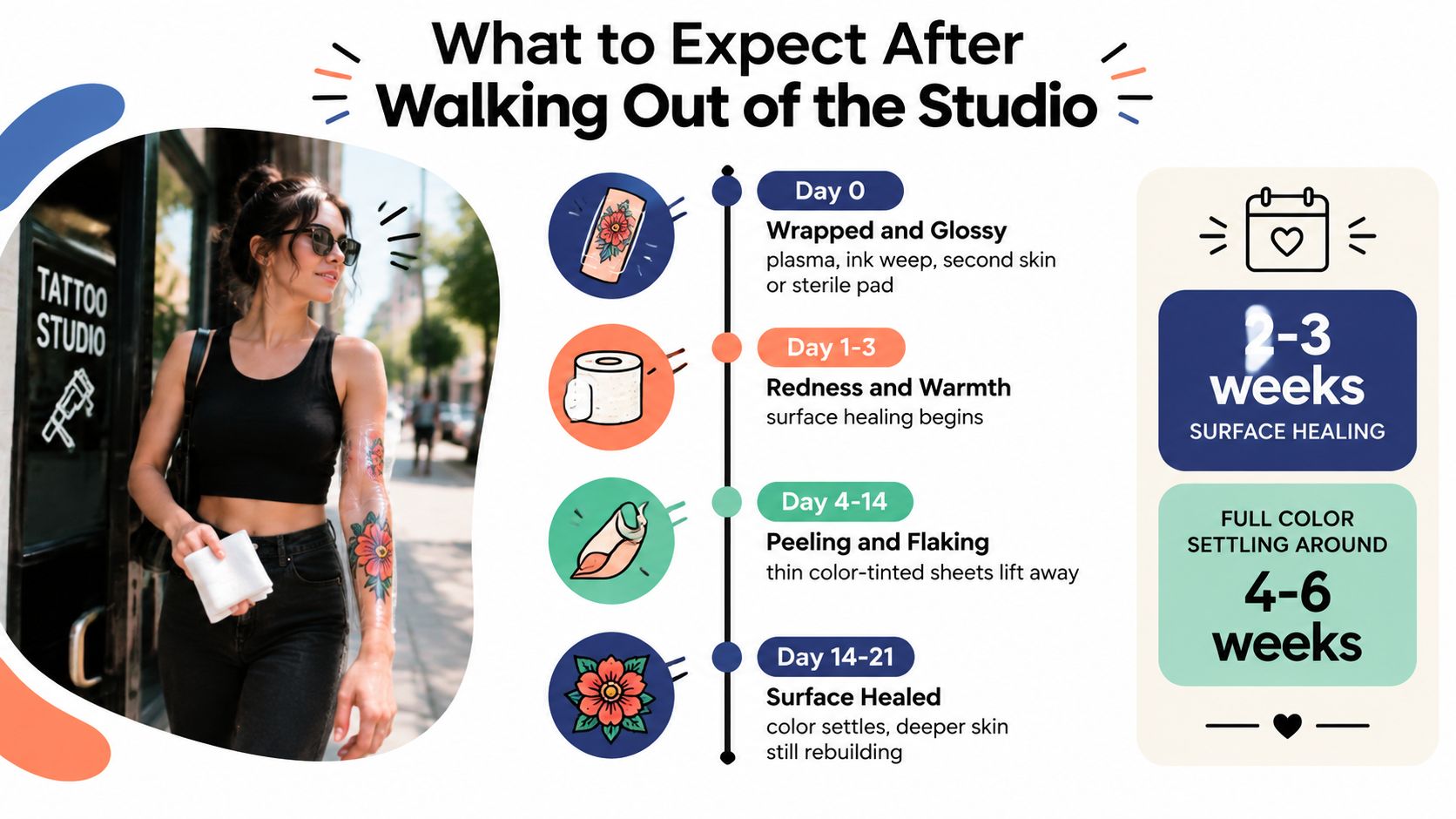
For film-based aftercare, this guide on tattoo aftercare film helps clients understand why the wrap matters and when it stops mattering.
The First 72 Hours of Color Tattoo Care
Day one starts with clean hands. Remove the bandage when your artist told you to, rinse the tattoo with lukewarm water, and wash gently with a fragrance-free soap. Pat it dry with paper towels, not a bath towel, then apply a thin layer of ointment, just enough to add slip without turning the skin slick.
Thin means thin. If the tattoo looks shiny and wet all day, you've put on too much.
Days two and three are about repetition, not experimentation. Wash twice a day, dry it carefully, and use a rice-grain amount of ointment only after washing if the skin still feels tight. The surface should feel protected, not sealed under a heavy film.
For clients who want a simple product list, a fragrance-free lotion with a clean ingredient profile is usually a better long-game fit than a scented body cream. If you want help comparing formula types before you buy, how to choose non toxic lotion is a useful place to start because it focuses on ingredients rather than marketing.
What to look for and what to avoid
A pink-to-red halo around the tattoo is fine early on. Expanding redness, thick yellow discharge, red streaks, or fever are not. Those are signs to stop guessing and get real help.
What costs color fast in the first 72 hours is usually self-inflicted:
Over-applying ointment: A heavy layer traps moisture and slows the skin's normal reset.
Using scented lotion: Fragrance often irritates fresh skin and can prolong redness.
Re-wrapping with plastic wrap: That's a short-term fix, not a healing strategy.
Around day three or four, the skin usually starts feeling tighter and the glossy sheen dulls. That's the transition point away from heavier ointment and toward lighter moisturizing. For many clients, the cleaner option is a light, fragrance-free lotion from a routine discussed in the studio, including this tattoo lotion guide, rather than guessing from a drugstore shelf.
The point is to keep the surface supple without suffocating it. Color stays safer when the skin can breathe, close, and shed in controlled flakes instead of cracking.
Scabbing, Itching, and Keeping Pigment in the Skin
The second week is where people get impatient and ruin good tattoos. Color work often forms slightly thicker micro-scabs than black-and-gray because the pigment load is heavier, and every early flake you pull off can take ink with it. That's why this phase is less about comfort and more about restraint.
How to handle the itch without pulling color
Switch from ointment to a fragrance-free, alcohol-free moisturizer once the surface feels closed and the shine from ointment is gone. For a roughly 4-by-4-inch area, a pea-sized dab is usually enough, applied two to three times a day. You want a soft finish, not a slippery one.
If the itch gets annoying, use a cool compress for a few minutes, not ice pressed straight onto the skin. Tapping the surrounding skin helps more than scratching the tattoo itself, and it doesn't tear the forming scabs. If itching is keeping you awake, a standard non-drowsy antihistamine like cetirizine can be worth discussing with a pharmacist or doctor.
Don't chase relief with friction. Friction is what pulls saturation out of the skin.
The biggest friction traps are predictable. Tight waistbands on a stomach piece, bra straps on side work, a cross-body bag across a chest or shoulder piece, and sleeping directly on the tattoo all flatten the heal. Even a soft shirt can be too much if it keeps catching a scab.
A few habits are essential until the surface is fully healed, usually around day 14:
No picking: If it's ready, it'll fall.
No scrubbing: Loofahs and washcloths are too aggressive here.
No shaving the area: Razor drag can pull flakes and irritate the surface.
No rough clothing: Anything that rubs over and over will lift scabs early.
A color tattoo heals better when the scab can finish its job on its own. That's boring advice, but it works. If you're tempted to “help” it along, you're usually helping color leave the skin instead.
For clients trying to avoid dermatitis-type irritation during this phase, dermatitis relief with HempWell USA is one of the few resource pages that at least speaks to sensitive-skin discomfort instead of pretending every rash is the same.
Sun Protection That Actually Preserves Color
Sun damage is a fading problem first and a burn problem second. UV breaks pigment down faster in densely packed color, especially in bright blends and high-saturation fills where the work is sitting closer to the surface. That's why sunscreen and clothing aren't optional once the skin is sealed.
Here's the practical split. Mineral SPF sits on top of skin with zinc oxide or titanium dioxide, which is the safer choice once a tattoo is fresh but closed enough for sunscreen. Chemical SPF works on healed skin too, but for a healing tattoo I'd rather see a mineral formula because it's less likely to sting or irritate tender skin.
For long-term color care, the American Academy of Dermatology recommends broad-spectrum, water-resistant sunscreen with SPF 30 or more, applied 15 minutes before sun exposure and reapplied at least every 2 hours American Academy of Dermatology guidance summarized in the provided data. On high-saturation color or fair skin, SPF 50 is the safer call once the surface is ready for sunscreen.
The day-to-day rule is blunt:
Cover first: long sleeves, loose pants, or a wide-brim hat for exposed placements.
Reapply often: every 2 hours outdoors, and immediately after sweating or swimming.
Skip direct midday sun: heat and UV together are hard on fresh pigment.
Watch windows too: if the tattoo sits near direct indoor sunlight, sunscreen still matters for the first 12 months.
Some clients want a quick primer on sunscreen mechanics before they buy anything. Everything you need to know about SPF is a decent resource for sorting broad-spectrum coverage from marketing language.
The biggest mistake I see is treating a healed-looking surface as if it's fully stable. It isn't, especially on larger color work. If you're still peeling or raised, keep it covered and out of the sun. The fade you prevent now is the saturation you keep later.
If the tattoo is still warm, shiny, or flaky, clothing beats sunscreen every time.
Knowing What's Normal and When to Call
Healing needs a calm read, not panic. Mild redness, light peeling, and on-and-off itching are expected in the first two weeks. What matters is whether the symptoms stay local and fade, or spread and intensify.
Normal vs warning signs
Symptom | Normal | Call Artist | Call Doctor |
|---|---|---|---|
Redness | Mild, local, fading after the first few days | Spreading redness after day 5 or patchy healing | Red streaking or rapidly worsening redness |
Temperature | Slight warmth early on | Hot to the touch after the first few days | Hot, swollen, and paired with fever |
Drainage | Clear plasma or light weeping at first | Unusual discharge color that keeps showing up | Pus, foul smell, or heavy drainage |
Itching | Comes and goes under 2 weeks | Severe itch with uneven pigment loss | Itch plus rash, swelling, or systemic symptoms |
Appearance | Peeling, matte look, temporary cloudiness | Patchy color loss or blowouts you notice after healing | Deep pain, pus, fever, or red streaks |
If the issue is cosmetic, call the artist first. Saturated color loss, patchy healing, or a blowout are tattoo questions, not medical ones. If the issue looks infectious, call a doctor. Aftercare can support healing, but it doesn't treat infection.
The activity restrictions don't stop just because the tattoo looks less shiny. No swimming pools, hot tubs, saunas, or submerging the piece until the surface is fully sealed. Chlorine and salt water are both rough on unhealed skin, and soaking can soften scabs enough to strip pigment.
For a broader look at healing stages and what's normal versus not, the studio's healing stages guide is useful when you're comparing your tattoo to what you expected.
A lot of color work looks “done” before the deeper skin is finished rebuilding. That's normal too. The skin on top may look settled in a couple of weeks, but the color still sharpens as the remaining healing process finishes.
Long-Term Color Care and Touch-Up Timing
The first aftercare decisions set the tone for how a tattoo ages. Sun exposure, friction, and skipped moisturizing all add up, especially on color pieces where bright pigments can show fatigue sooner than darker ones. If you want the piece to stay vivid, think of aftercare as the first maintenance cycle, not a one-time event.
What usually fades first
Lighter shades tend to show wear sooner than dark ones. Yellows, pinks, and light blues usually fade faster, while deep blacks, dark reds, and navy hold longer. That doesn't mean the lighter colors fail, it means they demand better sun protection and less abuse from friction.
Touch-up timing depends on placement, saturation, and how you live in the piece. Many color tattoos need a first touch-up between 4 and 8 weeks if patchy areas show up once peeling is fully done. After that, a color-brightening session every 2 to 5 years is a realistic maintenance window, depending on sun exposure, location, and how often the tattoo gets rubbed.
A few habits shorten that interval fast:
High-UV environments: outdoor work, sports, and long summer exposure.
Frequent exfoliation: scrubby body washes and aggressive exfoliating gloves.
Laser treatments near the area: pigment can change fast under laser heat.
Friction-prone placements: hands and feet wear faster because they get used all day.
A maintenance routine that actually works
Keep the tattoo on daily SPF once it's fully healed. Clean it gently, moisturize dry skin, and avoid retinol or glycolic acid on the tattooed area. Those products belong elsewhere on the body, not over color you want to preserve.
A tattoo doesn't need a complicated shelf of products. It needs consistency, decent sun habits, and enough respect to stop treating it like normal skin when it isn't acting like normal skin yet. That's the difference between a piece that stays bright and one that slowly turns flat.
Color Tattoo Aftercare Questions Answered
People usually ask the same four things after they leave the chair.
Petroleum jelly is not the move for the full healing window. For the first 48 hours, stick to a thin layer of a water-based, fragrance-free aftercare balm, then switch to lotion once the surface starts tightening and drying. Heavy occlusive layers can hold too much moisture against fresh color.
Swimming is not safe right away. Don't submerge the tattoo for a minimum of 3 to 4 weeks, and longer is better if the skin is still peeling or raised. Chlorine and salt water both work against an unsealed surface, and they can pull pigment from skin that hasn't closed fully.
Sunscreen should not go on a fresh, open tattoo. Once the skin is sealed and no longer weeping, sunscreen becomes part of the routine, not before. For a week-old tattoo that's still sensitive or flaky, clothing and shade are still the better choice.
If small flaking pieces of color look like they fell out, don't panic and don't pick at the area. Early flakes often carry dead surface skin, not lost tattoo depth. If the healed area stays light or patchy after everything has fully settled, that's a touch-up conversation with your artist.
Color healing rewards restraint. The less you force the process, the more saturation stays where it belongs.
If you want a tattoo that heals clean and stays bright, book a consultation with Think Tank Tattoo. The team can walk you through placement, aftercare, and what your specific color work needs once you're home. If you're in Denver and want clear guidance from the start, that's the right place to ask before the healing even begins.
Comments