
Tattoo Healing Advice: A Day-by-Day Aftercare Guide
The film is still on your arm, it's the evening of the appointment, and you're standing in the bathroom trying to remember whether your artist said four hours or overnight. Somewhere in the back of your mind are the two things everyone warns you about, the itch and the flaking, plus a secondhand story about a tattoo that went bad.
Here's the version of tattoo healing advice worth having in writing: what your skin should look like on day 3, day 10, and day 20, which symptoms are ordinary inflammation, and the exact points where waiting stops being sensible. Most aftercare sheets are consistent about washing and moisturizing and vague about everything else, and that vagueness is where people get into trouble. Good aftercare lowers your risk of a secondary infection. It can't promise you won't react to a pigment or to the balm you put on top of it, which is why a timeline and a set of warning signs matter as much as any product list.
Table of Contents
Tattoo Healing Timeline Day by Day
Your tattoo is a wound with a schedule. Find today's date in the table and compare, keeping in mind that the ranges describe a normally healing body rather than a promise to the day.
Stage | What Is Normal | Care Focus |
|---|---|---|
Days 1-3 | Oozing plasma, redness, warmth, tenderness | Gentle wash, thin ointment, no re-bandaging unless advised |
Days 4-7 | Light scabbing, flaking, itching | Moisturize 2-3 times daily, never pick scabs |
Days 8-14 | Thicker scabs, dry or tight skin, flakes lifting away | Keep moisturizing, let flakes shed on their own |
Days 15-21 | Surface closing, texture evening out | Gentle moisturizer as needed, start sun protection |
Weeks 3-4 | Mostly healed; larger pieces may take longer | Full sun protection until skin is completely healed |
Days 1 through 3 are the wettest and least comfortable. Plasma and excess ink weep out, the skin around the linework runs red and warm, and pressing on the piece feels like pressing a bruise. That's inflammation doing its job, and it peaks in the first 24 to 48 hours.
By day 4 to 7 the surface begins to close. You'll see light flaking, sometimes thin sheets lifting at the edges of the design, and an itch that arrives right on schedule. Itching at this point means the skin is regenerating, not that something has gone wrong. The job shifts to moisturizing two to three times a day and keeping your hands off it, because a scab you pick takes ink with it.
Why Your Tattoo Looks Dull Around Week Two
Days 8 to 14 often look worse before they look better. Thicker scabs form and crack over joints, dry skin pulls when you move, and as flakes lift away the color underneath can read milky, patchy, or flat.
The explanation is simple. A layer of dead, dry keratin sits over the pigment and scatters light, so you're looking at your tattoo through a frosted window. Once that layer finishes shedding, usually across the third week, the color comes back. Judging saturation on day 10 is a waste of worry.
When Healing Runs Behind
Days 15 to 21 are the closing stretch: the surface seals, texture evens out, and the skin stops feeling like a scab with a picture in it. Some pieces are finished by day 18. Plenty aren't.
Sleeves, back pieces, and anything with heavy saturation or repeated passes over the same skin carry more trauma and land at the later end of every range. Hands, feet, elbows, and knees heal slower than a forearm or thigh because they flex, rub, and take friction all day. By weeks 3 and 4 most tattoos feel done, and that's when sun protection stops being temporary and becomes a habit.
Your self-check: if today's appearance matches the row you're in, you're on track. If it matches a row on the infection table further down, stop reading timelines and get it looked at.
Immediate Aftercare Steps
The first night sets the tone. Nothing on this list is exotic and none of it requires a specialty product. It requires you to do the boring parts in order.
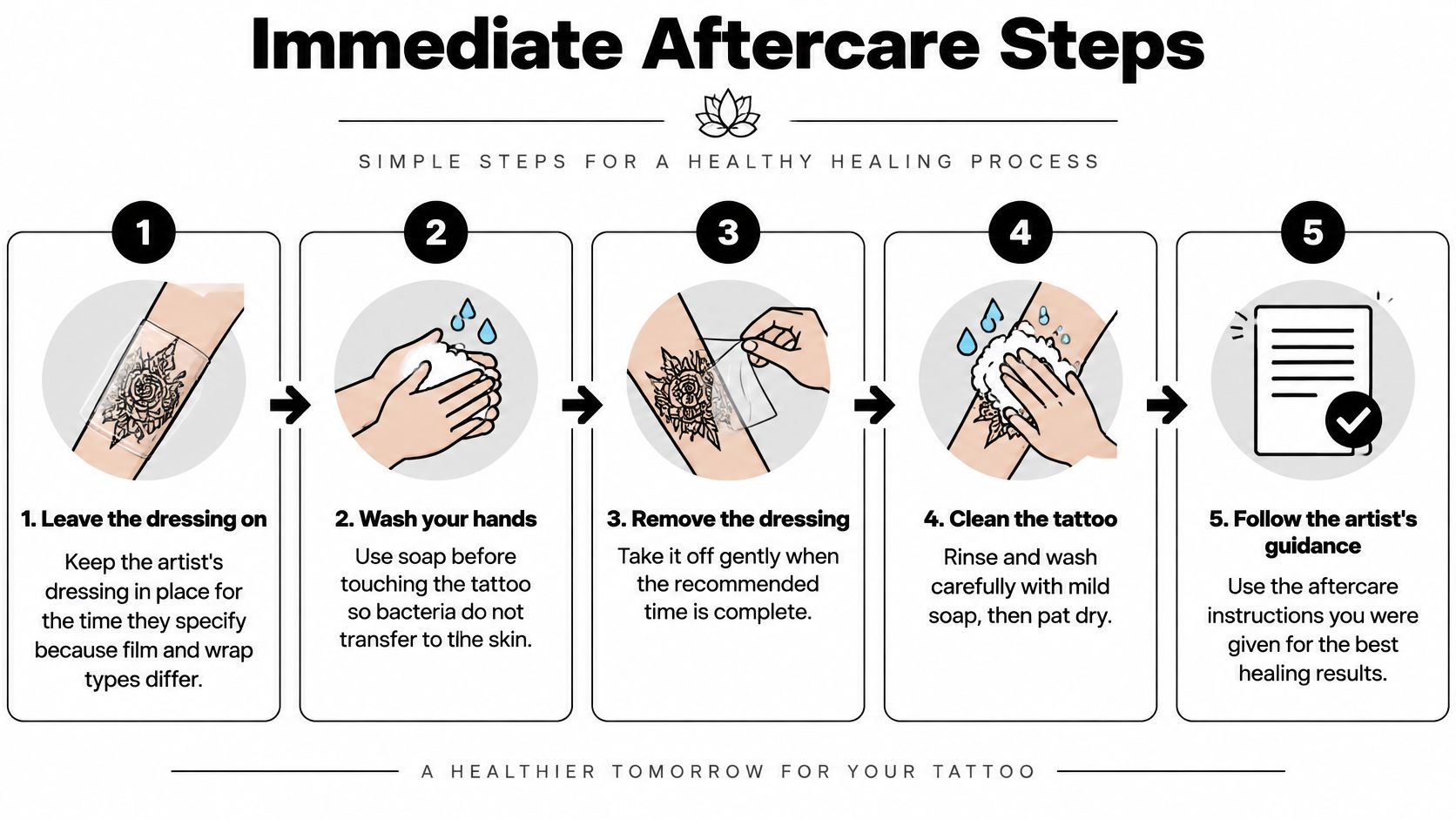
Leave the dressing on for the time you were given. Film and wrap types differ, and so do the instructions that come with them. A clear adhesive film may be built to stay for several days; simple cling wrap comes off within hours. The dressing keeps bacteria and friction off the skin while it's at its wettest and most open. If your artist sent you home under film, this guide to aftercare film through the first days covers removal and reapplication without tearing the surface.
Wash your hands with soap before you touch anything. Hand contact is the most ordinary way bacteria reach a fresh tattoo, and it's the easiest risk to remove. A pump bottle of refillable unscented soap from Fillaree sits by the sink without adding fragrance where it doesn't belong.
Take the dressing off gently. If the film sticks, hold a warm damp cloth against the edge or let lukewarm water run under it rather than pulling. Pulling lifts the flakes forming underneath and can drag ink out with them.
Cleanse with a mild, fragrance-free soap and lukewarm water. Use your palm only. No washcloth, no loofah, no sponge, and no scrubbing. Hot water irritates healing skin, and you're cleaning a wound, not degreasing a pan.
Pat dry with a clean paper towel. Not the bath towel that's been against your body all week and sheds lint into an open surface.
Apply a thin layer of the ointment your artist recommended. Thin means you can still see the skin through it. A heavy layer traps moisture and heat, softens the surface, and stops the skin from breathing, which is the opposite of what you want in the first 48 hours.
Sleep clean and loose. Fresh sheets, no tight straps or waistbands crossing the piece, and avoid sleeping directly on it for the first two nights. Pressure and friction overnight cause swelling and extra weeping.
Three mistakes cover most first-night problems: rubbing with a towel instead of patting, spreading ointment like frosting, and letting the shower run directly on the piece for several minutes. What's normal by bedtime is tenderness, warmth, mild swelling, and a little clear or ink-tinged fluid on the sheet. That's the wound draining, not a complication.
Daily Care Routine and Adjustments by Skin Type and Piece Size
Once scabbing and peeling start, the routine collapses into three moves. Treat the tattoo as a superficial dermal wound and work on restoring the barrier rather than attacking the skin.
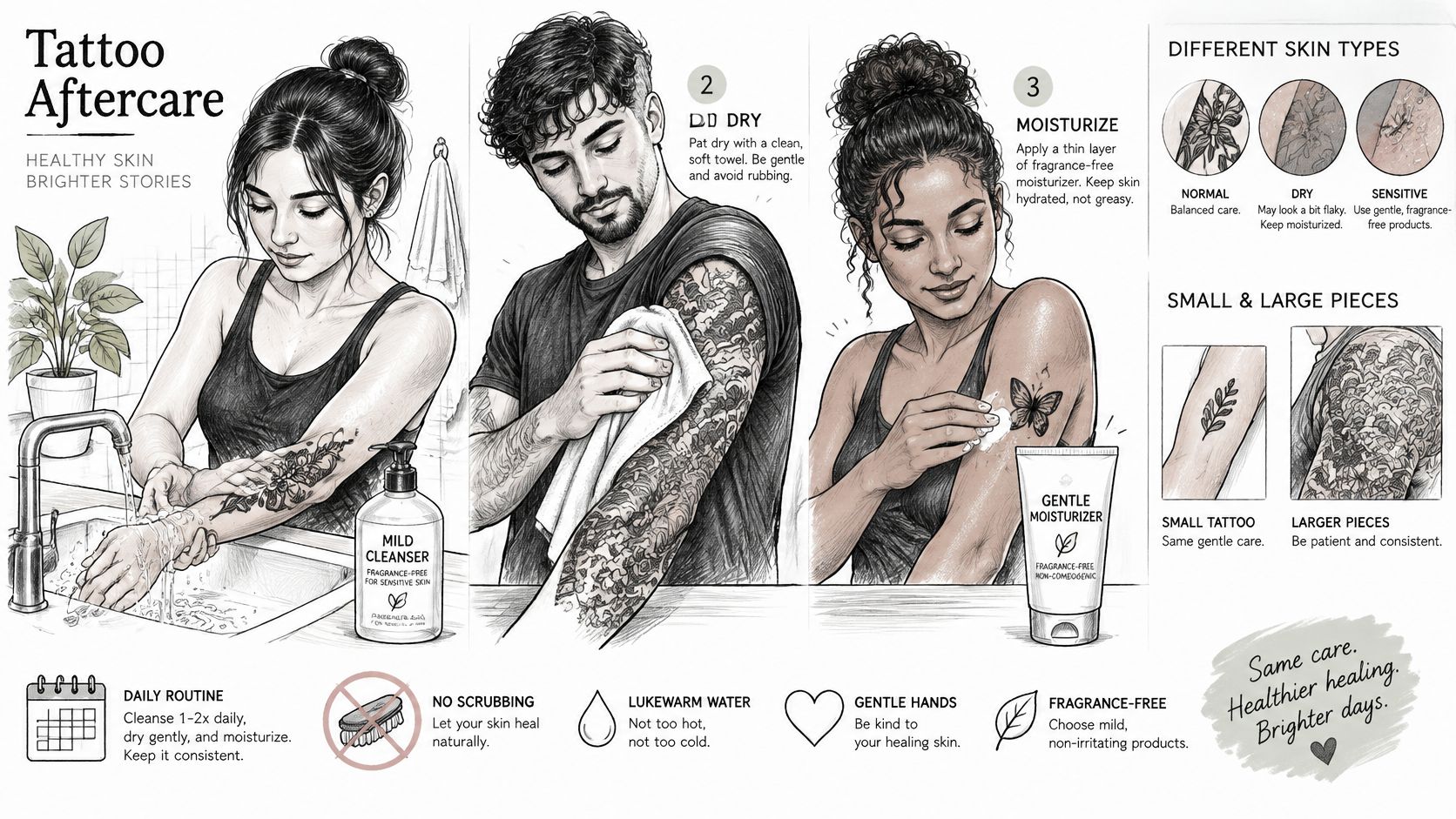
Wash once or twice a day. Lukewarm water, a mild fragrance-free cleanser, rinse without scrubbing, and pat dry with a clean disposable towel. The American Academy of Dermatology's guidance on caring for tattooed skin frames this as a staged protocol: keep the artist's dressing for the period specified, then cleanse gently and let the skin breathe between applications.
Moisturize thinly, two to three times daily. Apply only when the skin feels tight or dry, and use an unscented product. The same AAD guidance advises against routine disinfectants and antibiotic creams, which are unnecessary during uncomplicated healing and can irritate or sensitize skin. Save them for an infection a clinician has assessed.
Keep the product list short. Avoid picking flakes, abrasive clothing, prolonged soaking, swimming, hot tubs, and unprotected ultraviolet exposure until the surface has fully healed. There's a longer list of habits that set healing back, from gym straps to hot tubs, in this guide to what to avoid after getting a tattoo.
Why a Healing Product Can Still Cause a Reaction
Dermatology evidence shows aftercare products themselves can trigger allergic reactions. Reported triggers include fragrance, wool alcohols, panthenol, colophony, and disinfectants, according to a review of tattoo aftercare and contact dermatitis. Acute contact dermatitis delays healing, and the itch and burn that come with it push you to scratch, which opens a door for secondary infection.
So the question worth asking isn't whether a balm is marketed for tattoo healing. It's what's in it. If a product is marketed for tattoo healing, that doesn't make it safer, and the evidence doesn't support the assumption. Minimal ingredients, no fragrance, no essential oils, no exfoliants, and no cycling through five products in ten days. For a wider view of how tattooed skin differs from an ordinary skincare routine, Skin Perfection on tattoos versus skincare is a useful starting point.
Practical rule: if a product stings on application, it doesn't belong on a healing tattoo. Discomfort is information.
Adjusting for Your Skin and Your Piece
Sensitive, eczema-prone, or psoriasis-prone skin. Patch test any new product on unbroken skin 24 hours before it goes near the tattoo, and ask a dermatologist before you start a large piece. Apply a lighter layer than you think you need.
Oily skin. Same routine, less product. Wash twice a day and skip the midday application if the surface already feels slick rather than tight.
Darker skin tones. Healing can look patchy, ashy, or lighter than the surrounding skin for a few weeks. Keep the area moisturized and don't scrub at it to even out the tone, which is how people create the very marks they're worried about.
Sleeves and back pieces. Longer wrap times and far more friction from clothing and bedding. Wear loose cotton, change sheets before the first night, and expect the later end of every timeline row.
Multi-session work. Each session restarts the wound. Confirm the previous session has fully healed before the next one, and stay with the same cleanser and moisturizer so you can tell a product reaction from a healing reaction.
Transparent adhesive film. An itchy rash in a neat geometric shape that traces the film's outline is usually adhesive dermatitis, not infection. It's worth knowing that distinction before you panic, and worth a clinical assessment if it's spreading or blistering.
Occlusion is the quiet risk in all of this. Heavy ointment, tight clothing, and film left on too long trap moisture against the surface, macerating skin that's trying to close and slowing barrier recovery rather than speeding it.
If you'd rather watch the routine than read it, this walkthrough covers the same ground:
Daily checklist: wash, moisturize, scan for warning signs. Three lines, once a day, and nothing more complicated than that.
Normal Healing Versus Signs of Infection
Most healing looks ugly and is fine. A smaller number of tattoos look fine and aren't. Compare what you're seeing against the table, and read the third column carefully.
Sign | Usually Normal | Seek Care When |
|---|---|---|
Redness and warmth | Mild, fading within a few days | Spreading, worsening after day 3, or hot to the touch |
Swelling | Mild, easing within the first week | Persistent or increasing after the first week |
Itching | Common during scabbing and peeling | Intense itch with spreading rash, bumps or blisters |
Drainage | Clear or blood-tinged fluid early on | Pus, yellow-green discharge or a foul smell |
Pain | Tenderness that eases each day | Pain that increases after day 3 or becomes severe |
Whole body | None | Fever, chills, red streaks, or swollen lymph nodes |
Timing carries more weight than any single symptom. Mild redness, swelling, and tenderness in the first few days are ordinary, and the key test is direction: each day should be slightly better than the one before. Redness that moves outward, pain that climbs after day 3, or a rash that first appears in week two belongs in a different category.
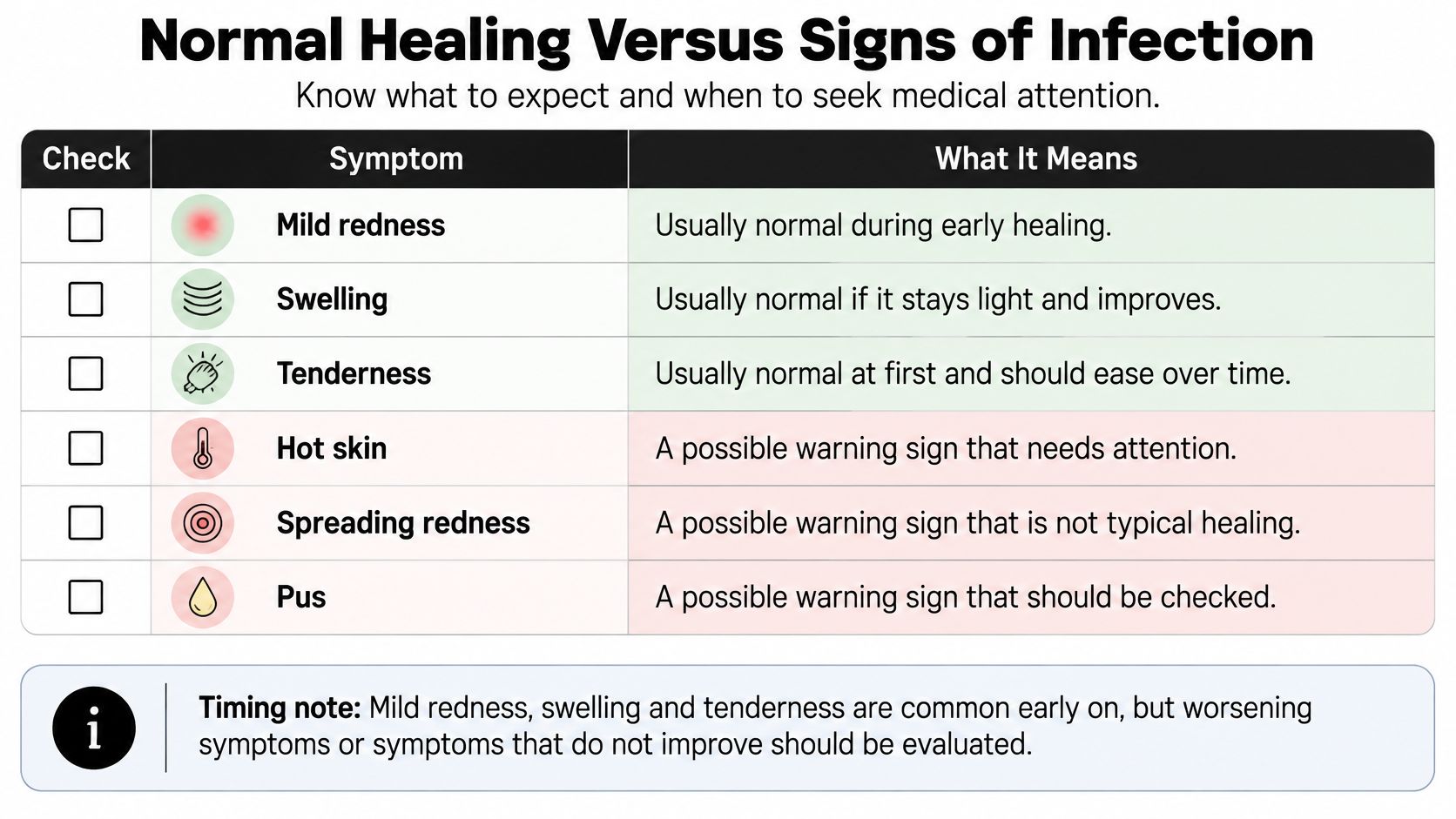
The U.S. Food and Drug Administration's tattoo safety guidance draws the boundary clearly: redness, swelling, warmth, and local discomfort can occur, but failure to heal, a spreading rash, bumps, or fever warrants contact with a healthcare professional. Severe infections can bring high fever, shaking, chills, or sweats and may require antibiotics for months, hospitalization, or surgery. The agency also notes that contaminated ink has caused infections even when artists followed hygienic procedures, because injecting ink into broken skin creates a pathway.
Bacterial complications are common enough not to ignore. A review of tattoo-associated infections estimates them in roughly 1% to 5% of tattooed people, with documented cases including impetigo, folliculitis, abscesses, cellulitis, and erysipelas, and organisms such as Staphylococcus aureus, Streptococcus pyogenes, Clostridium species, and Pseudomonas aeruginosa. Mild cases often resolve or go unreported, so the figure is approximate. For perspective, a 2024 cross-sectional study in Dermatology Research and Practice found that 32% of tattooed participants reported skin itching, 22.7% reported local pain, and 10.5% reported cutaneous infection. These numbers represent a population, not your arm. Use them as a reason to check your trajectory carefully.
Some reactions have nothing to do with hygiene. In a hospital series of 405 patients with tattoo complications, allergic reactions accounted for 37%, bacterial infections for 11%, and papulo-nodular reactions for 13%, with red pigments disproportionately linked to allergy and black tattoos to some non-allergic nodular responses. A raised, intensely itchy plaque appearing weeks or months later is a dermatology question, not a moisturizer question.
Go to a clinician promptly for any of these:
Fever, chills, shaking, or sweats
Red streaks running away from the tattoo
Pus or foul-smelling drainage
Redness spreading faster than you can track it with a pen
Swollen lymph nodes in the armpit or groin near the piece
Trouble breathing or widespread swelling means emergency care, not a next-day appointment. And skip the leftover antibiotics and the bottle of antiseptic from the cupboard; neither treats an infection properly, and both can irritate the skin further. Feeling wrung out for a day after a long session is common enough that artists have a name for it, and what tattoo flu feels like is worth reading so you don't confuse it with something that needs treatment.
Confirm Healing Before Your Next Session
This is the appointment after the appointment: the gap filler, the second session on the same arm, the start of the other side. What you're really asking is whether the first piece has finished healing, and there are five things to confirm before you book.
Match your piece to the last row of the timeline. Weeks 3 and 4 for most work, later for large or heavily saturated pieces. If there's still flaking or tightness, you're not there yet.
Have an artist look at it in person. A photo hides texture. Consultations at our Denver studio are free, and they're the right place to have someone confirm the surface has closed before you're back in the chair.
Ask for written aftercare instructions. A 2015 analysis in the Journal of the Dermatology Nurses' Association found that 12% of participants gave clients only verbal instructions, which makes forgetting or mishearing them likely, and concluded that no single aftercare method had enough evidence to be called universally superior.
Run the warning column one more time. No fever, no spreading redness, no new bumps, no drainage. A session over unhealed or inflamed skin is a bad bet.
Ask which products, and why. Fragrance-free, minimal ingredients, and the same cleanser and balm you used last time. Repeated exposure to the same adhesive, cleanser, or ointment across sessions is exactly how a cumulative contact allergy develops.
If you're documenting a large piece across months, photograph it in the same light and at the same distance each time. Clinicians do something similar, and AI wound photography and measurement explains why consistency makes a comparison useful rather than misleading.
A new session on skin that hasn't finished repairing restarts the wound on a compromised surface. Infection risk climbs, irritation climbs, and the artist is working over texture they can't read accurately. For an action you can take today, note which timeline row your tattoo matches, scan the warning column, and message your artist or a doctor if anything lands on the wrong side. Breathing trouble or widespread swelling skips that step and goes straight to emergency care.
Free consultations at Think Tank Tattoo are the place to bring a healing question, a next-session plan, or a piece you're not sure is ready, and an artist will look at the skin with you before anything gets booked. We've been tattooing on South Broadway in Denver since 2002, we work with clients 18 and older, and appointments are reserved with a $100 non-refundable deposit by phone at (720) 932-0124 or by email at thinktanktattoo@gmail.com. Visit Think Tank Tattoo to see the artists' work and start the conversation.
Comments