
8 Symbols for Protection Tattoos and Their Meanings
You walk in with a sketch of an eye, and the first question is not about size. It is about which tradition that eye comes from. A Turkish nazar, an Egyptian wedjat, and a geometric eye you invent with your artist do not mean the same thing, and they should not be drawn the same way.
That story sets line weight, color, and where the mark sits for decades. A symbol tied to a living religion asks for more care than a personal motif. If the meaning feels borrowed, you will feel it every time someone asks what it is.
Symbols for protection tattoos are older than modern flash. A 2026 academic study of protective motifs notes that cross-shaped and related geometric marks appear in traditions from Japan, South America, North Africa, Taiwan, Borneo, Papua New Guinea, Iraq, and the Balkans, used against the evil eye or similar threats, in some cases before Christianity. The same study points to Samoan tatau, which UNESCO identifies as one of the oldest tattoo traditions still passed from master to apprentice, and to Marquesan designs believed to guard the body.
If you are sorting sacred language before you commit, word study help for small groups is a useful parallel. Slow reading beats a caption you found online. The eight marks below are the ones clients debate at the table. Each one pairs a tradition, a placement, and a caution about aging or meaning.
Table of Contents
1. Hamsa (Hand of Fatima / Hand of Miriam)
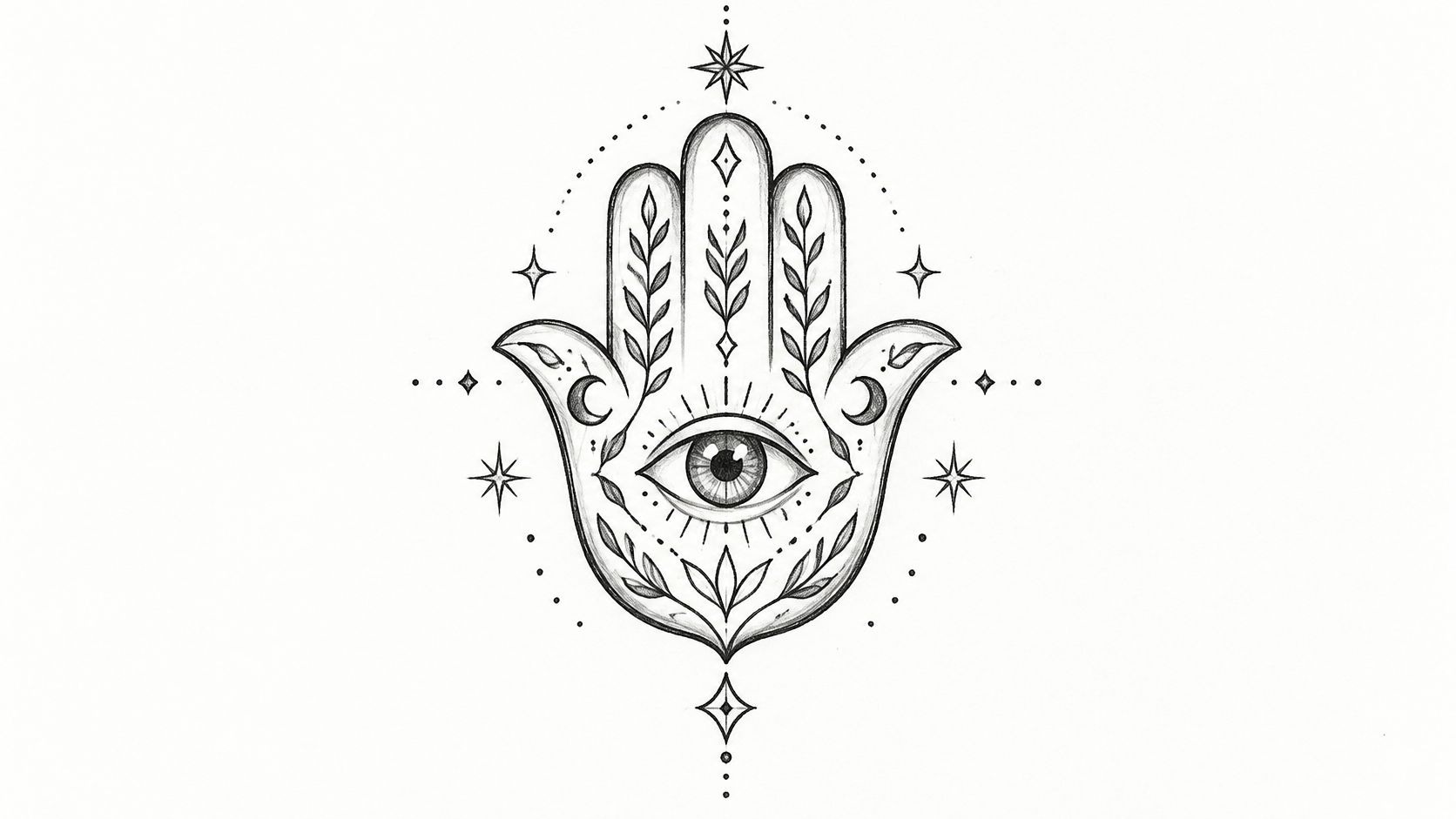
The hamsa is an open hand with five digits, worn across the Middle East and North Africa against the evil eye and bad luck. The name comes from the Arabic and Hebrew word for five. Those fingers get read as the five senses, the five pillars of Islam, or the five books of the Torah, depending on who is telling the story.
In Islamic settings it is often the Hand of Fatima. In Jewish settings it is often the Hand of Miriam. Moroccan, Turkish, Israeli, and Persian decorative arts all use the hand, and studios now redraw it as blackwork or fine line with a center eye. I would not treat those versions as interchangeable. Ask which regional tradition you want the piece to follow, then keep the drawing inside that reading.
Practical rule: Name the tradition before the stencil, or the hand becomes a generic icon.
Placement: Inner forearm or upper arm stays out of daily sun, so the fingers and the eye stay crisp.
The eye: An open eye reads at a distance. A stylized eye looks quieter and holds up better at a small size.
What fails: Tiny celestial dots packed into the palm blur into a gray patch within a few years.
Say you want a reminder during a hard season, not a public statement of faith. A simple black hand on the upper arm, without extra script, usually carries that better than a crowded color piece.
2. Nazar (Turkish Evil Eye Bead)
The nazar, or nazar boncuğu in Turkey, is a blue glass bead of concentric rings, often read as an eye that absorbs or turns aside an envious gaze. You will see it across Turkey, Greece, the Balkans, the Middle East, and parts of Central Asia. As a tattoo it wins on graphic clarity. People recognize it from across a room.
American traditional flash often shows it as a standalone eye with a simple border. Mediterranean and Middle Eastern arm pieces use it as a center. Both can work. The failure mode is color, not the symbol. In a 301-patient dermatology cohort covering 308 tattoo complications, allergic reactions to red ink were 50.2% of complications, and chronic inflammatory reactions to black ink were 18.2%. A classic nazar needs blue, white, and dark blue. Skip red accents if you want fewer color variables, and say that in the consult before anyone orders ink.
Sharp rings are the whole design. If the stencil gaps are uneven, it reads as a target, not an eye. Forearm placement keeps it visible as a daily reminder. A hidden rib piece still means something to you, but it will not function as a public ward.
Color still ages. Blues can soften, and white highlights yellow on some skin. A black-and-grey nazar loses the bead's signature, though it can be the safer palette if you have reacted to color before. Evil eye ring trends for boutiques show how bold the motif stays in metal. Skin needs more breathing room between rings than jewelry does.
3. Eye of Horus (Wedjat)
The wedjat is the Eye of Horus, tied to protection, health, and restoration. In the myth, Horus lost his left eye fighting Set, and Thoth restored it. Ancient Egyptians also used parts of the eye as fractions for measuring grain. That second life is why the curls and markings have fixed proportions. Guessing them makes the tattoo look like a costume.
Protective marking in Egypt is old, not a modern trend. Middle Kingdom mummies dated about 2040 to 1782 BCE carry tattoos linked with Bes, a household deity of childbirth and protection, often on the upper thighs. Dots, lines, and geometry in that tradition were read as safeguards in illness and labor. The wedjat sits in that longer habit of wearing a guardian, not in a generic "Egyptian" font.
How to keep the symmetry honest
Ask for museum-object references if you want historical proportions. An eye alone fits an upper arm or the upper back, where skin is stable and the brow line does not warp. A full Egyptian scene needs more real estate and usually more than one session.
Fine brow feathers and the teardrop curl are the first details to soften. Thicken the main contour and let the small marks stay few. If healing and restoration are the point, pair the research with symbols of healing in tattoo design before you add ankhs you do not want.
A client who travels for work might take the eye alone, black and grey, high on the arm. Adding a cartouche of random letters is the usual way this piece goes wrong.
4. Triquetra
Three interlocked arcs, drawn as one line with no start and no end. That is the triquetra. It shows up in Celtic and early Germanic art, then in Christian use as a Trinity mark. In many modern pagan and Wiccan readings, the points stand for mind, body, and spirit, or past, present, and future. The loop itself is what people mean by unbroken protection.
Pop culture pushed it onto wrist and ankle flash, often with a circle around it. The circle helps. It frames the knot and strengthens the "closed barrier" reading. Without it, a tiny wrist version can look like a pretzel once the arcs soften.
A slightly heavier line beats a hairline on this symbol. The interlock is the design, and a broken crossing kills it.
A 2025 analysis of the Baylor Religion Survey describes tattoos that work as sacred testimonies and personal religious symbols, not only decoration. If your three points are a family trio, say so. If they are the Trinity, say that instead. Do not stack both meanings and hope the viewer picks the right one.
Ankle skin flexes and shoes rub. I would rather put a small triquetra on the inner wrist or the side of the hand's opposite, the outer forearm, where you can check the crossings while it heals. Personalize with three discreet dots or initials outside the knot, not by slicing the continuous line.
5. Celtic Knot (Endless Knot)
Knotwork is a path with no end. In Insular manuscripts such as the Book of Kells, around 800 CE, those paths fill whole pages. Wearers read them as eternity, kinship, and a barrier nothing slips through. The Dara knot, the trinity knot, and the Celtic cross are cousins, not copies. Pick one structure.
Armbands and sleeves are the usual home, in traditional black or blackwork. Large knotwork is a multi-session job because crossings need consistent line weight. Rushing the second session is how one side goes thick and the other goes thin.
On an arm, flow beats perfect mirror symmetry. The pattern should follow the curve of the limb. A flat stencil copied from a book will kink at the elbow. Schedule the sessions close enough that the artist still sees the same healed line, and far enough that the skin is ready.
Watch a short pass on how endless line work is built before you approve a full sleeve.
If the feeling you want is continuity rather than a clan claim, look at unique infinity tattoo designs and then decide whether a Celtic grammar is yours. Copying a ceremonial panel you cannot explain is the caution here. An original knot in that visual language, tied to a bond you can name, ages better as a story and as a drawing.
6. Mjölnir (Thor's Hammer)
Mjölnir is Thor's hammer, described in the Poetic Edda and the Prose Edda as a weapon that guarded gods and people against giants and chaos. In Norse tradition it also blessed and sanctified. Viking Age wearers carried small hammer pendants. The tattoo version should keep that short handle and broad head. Stretching it into a fantasy sledge makes the silhouette weaker, not stronger.
Bold shape, careful add-ons
Forearm and chest are the placements that match the mark. Blackwork holds the head as a solid shape, which is what you still recognize after the edges soften. Norse sleeves often set the hammer beside knotwork or runes. That is fine if the runes are real.
Proportions: Ask for a historical hammer, not a comic-book mallet, if accuracy is the point.
Line weight: Keep the head heavy. A thin outline on a palm-sized chest piece disappears into chest hair and sun.
Runes: Confirm spelling and meaning before the stencil. A wrong rune is not a "stylistic choice."
Say you want defense and steadiness, and you are not trying to claim a modern political scene. A single hammer, no slogan, on the outer forearm usually does that job. Adding a wall of runes you cannot read does not.
7. Vegvísir (Icelandic Viking Compass)
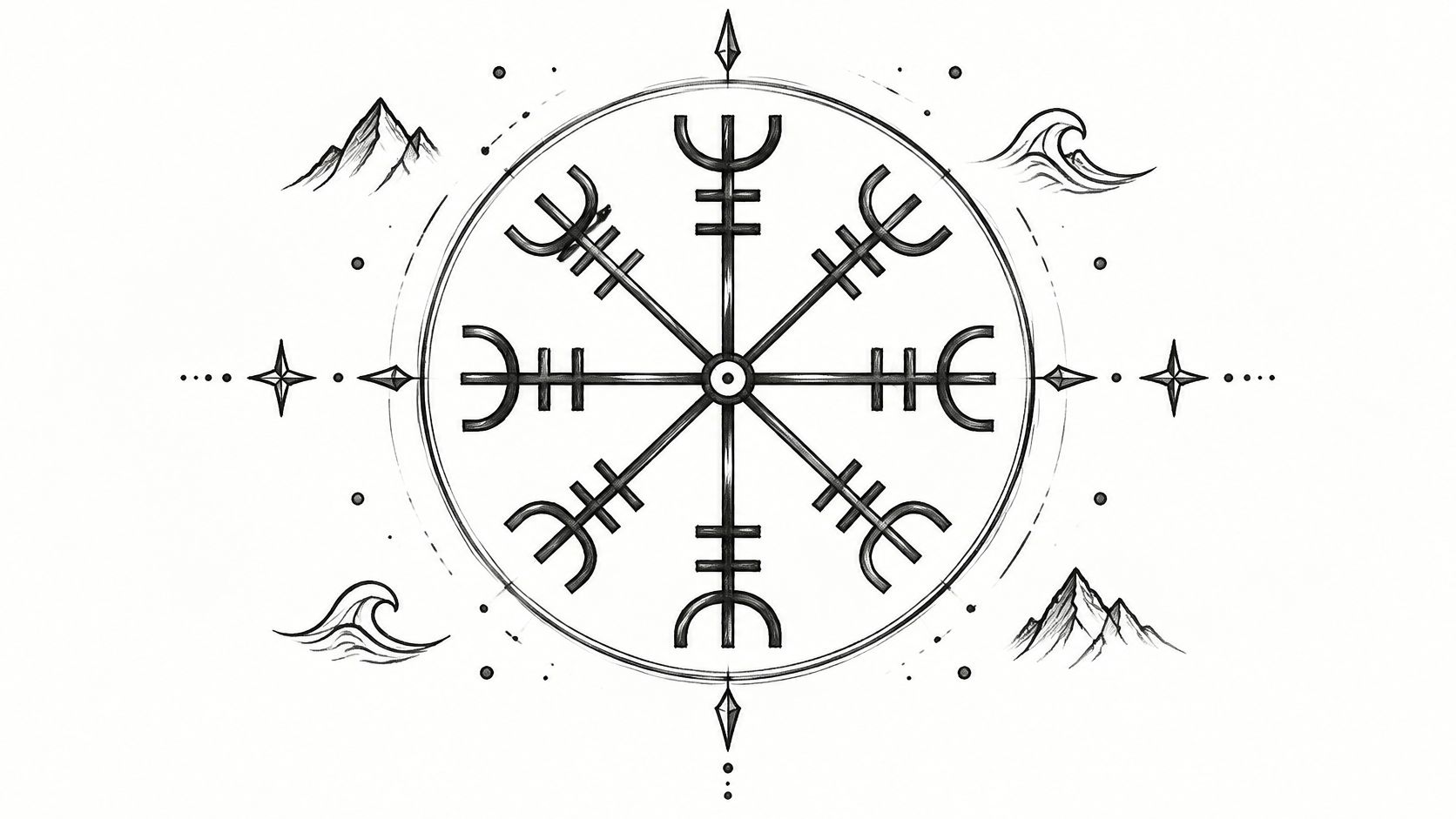
Vegvísir means signpost. It shows up in the Huld manuscript, a 17th-century Icelandic grimoire, described as a charm that guides a traveler through storms and keeps them from losing the way. Eight staves radiate from a center, each ending in a small mark. Its medieval use is debated. It is still one of the most requested Norse-inspired protection tattoos, especially for people who travel or want a sense of direction.
Wrist and forearm fine-line versions are everywhere. Back and chest pieces often wrap the compass in knotwork. Radiating lines are fragile. On a high-friction spot, like the side of a hand or a belt line, they blur into a star.
A New York City survey of 300 tattooed people found that 10.3% reported an adverse reaction, including 6.0% with a chronic color-specific reaction lasting more than four months. Plan the compass so it still reads if you ever need to leave it alone for months. Uniform staves look stricter. Slightly stylized staves look more drawn. A circle border is the practical fix. It frames the symbol and keeps it legible from a few feet away.
A first tattoo for someone who just moved cities might be a palm-width vegvísir on the inner forearm, black line, circle, no mountain scenery behind it. Scenery steals the charm's geometry.
8. Saint Christopher Medal
Saint Christopher is a traditional Catholic patron of travelers, and the medal has been carried as a road charm for a long time. The legend says he carried a child across a river and found the child was Christ. His name means Christ-bearer. The Church revised his universal feast day in 1969, and travelers still honor the patronage. The usual image is Christopher with the child, water at his feet.
Traditional and religious portfolios treat it like a medallion, sometimes with a rosary, a cross, or flowers. Bring the medal or painting you like. Artists cannot match a composition from the words "saint medal."
Small sizes fail when every fold of the cloak is forced in. Ask for a simplified figure, a clear river, and a readable child. An inscription is optional. If you want one, it needs its own band of space or it collides with the rim.
This is a faith tattoo, not a generic travel stamp. If you want the wider set of options, start with tattoos symbolizing faith and then decide whether Christopher is the saint you mean. A client who drives for work might place a modest medallion on the upper arm, inscription in a plain serif, no extra banners. That stays honest and still readable after the black softens.
Protection tattoo symbols at a glance
Item | Origin | Core Protective Meaning | Common Placement | Main Caution |
|---|---|---|---|---|
Hamsa (Hand of Fatima / Hand of Miriam) | Middle East and North Africa; used in Jewish and Muslim traditions | Deflects the evil eye and misfortune | Inner forearm, upper arm, wrist, ankle, chest | Religious and cultural meanings vary; fine details may blur |
Nazar (Turkish Evil Eye Bead) | Turkey, with wider use across the Mediterranean, Middle East, and Balkans | Absorbs or deflects envy and harmful gazes | Forearm; standalone or in larger arm pieces | Blue ink may fade; preserve the bead's concentric rings |
Eye of Horus (Wedjat) | Ancient Egypt | Protection, healing, and restoration | Inner arm, upper arm, ankle, chest, back | Some consider casual use of this sacred symbol culturally insensitive |
Triquetra | Celtic and early Germanic art; later Christian and modern pagan use | Eternity and unbroken protection | Wrist, ankle, behind the ear | Meanings vary by tradition; tiny interlocking lines may blur |
Celtic Knot (Endless Knot) | Celtic and Insular art, including the Book of Kells | An endless path thought to block evil; also signifies connection | Armbands, sleeves, back | Dense, closely spaced knotwork can blur; requires precise linework |
Mjölnir (Thor's Hammer) | Norse mythology and Viking Age amulets | Protection, strength, and defense against chaos | Forearm, chest | Fine runic details may blur; modern pop culture can affect its personal meaning |
Vegvísir (Icelandic Viking Compass) | Iceland; documented in the 17th-century Huld manuscript | Guides travelers and protects them from losing their way | Wrist, forearm, ribs, chest, back | Historical authenticity is debated; small radiating lines may blur |
Saint Christopher Medal | Catholic devotional tradition | Protection and safe journeys for travelers | Medallion-style tattoo; often part of a larger religious composition | Religious imagery deserves thoughtful treatment; small portraits can lose detail |
Choosing Your Protection Symbol With Confidence
A symbol can look right in a reference and wrong on skin. Before settling on one, consider its regional tradition, how its lines will age in your chosen placement, and whether its meaning feels right for you long term.
Bring references to a complimentary consultation. Discuss proportions, line weight, placement, and any personal details you want to add. Personalize the design without changing the symbol's defining features or borrowing a ceremonial mark without understanding its context.
Tattoo reactions are uncommon but possible. The FDA's guidance on tattoos and permanent makeup lists risks including infection, allergic reactions, granulomas, and keloids. Reactions can appear immediately or years later, and contaminated ink can cause infection even when a studio follows clean practices.
Discuss health concerns early: Tell your tattoo artist about prior reactions, autoimmune conditions, and your preferences for color.
Know when to seek care: Spreading redness, nodules, or persistent itching calls for medical advice.
Plan for aging: Strong contours and limited micro-detail tend to remain more legible than intricate lines, especially in small designs.
Choose a symbol whose meaning you can explain and whose design suits the placement. If prayer and scent are part of your protection practice, top Tulasi incense ranked offers a separate ritual, not a substitute for thoughtful tattoo planning.
Think Tank Tattoo is a Denver studio on South Broadway, established in 2002. Its eight artists create custom symbols for protection tattoos, from small designs to larger work. The studio is open to clients 18 and older and offers complimentary consultations. Appointments are booked by calling or emailing the shop. A non-refundable $100 deposit is required to reserve an appointment, and clients should wait for an artist or staff member to direct them before sending it. Visit Think Tank Tattoo to discuss the symbol, placement, and line weight.
Comments