
7 Watercolor Feather Tattoo Styles to Consider in 2026
You've saved a photo of a soft pink-and-blue feather on a stranger's arm, and it looks effortless. What that photo doesn't show is the flaking stage, years of Denver sun, or how a pale wash softened and spread as the skin healed. A watercolor feather tattoo is controlled saturation, spacing between the barbs, and a placement choice that decides how much friction and sunlight the piece will take.
Think Tank Tattoo has been tattooing since 2002, and its eight-artist team lets you compare those trade-offs side by side before you commit. Each style below covers the look, color approach, placement, session scope, longevity, and aftercare, judged by how it heals, fades, and holds up over years rather than how it photographs on day one. Every entry ends with the specific question to ask your artist before booking. If you want general background on cleaning and protecting broken skin at home, this step-by-step home wound care guide covers the basics, though your artist's written aftercare always comes first.
Table of Contents
1. Single Feather with Soft Pastel Color Bleed - How This One Ages
2. Watercolor Wash Feather with Black Ink Linework - Line Weight Is the Real Decision
3. Watercolor Feather with Floral Accents - Keeping It From Getting Crowded
4. Cascading Multi-Feather Fan in Watercolor Blues and Purples - Color Behavior at Scale
5. Watercolor Feather with Bird or Wing Silhouette - Size Protects the Silhouette
6. Feather with Mountain or Landscape Watercolor Wash - Keep the Scene to a Few Elements
7. Quill Feather with Dripping Watercolor Ink and Negative Space - Friction and Skin Sensitivity
1. Single Feather with Soft Pastel Color Bleed
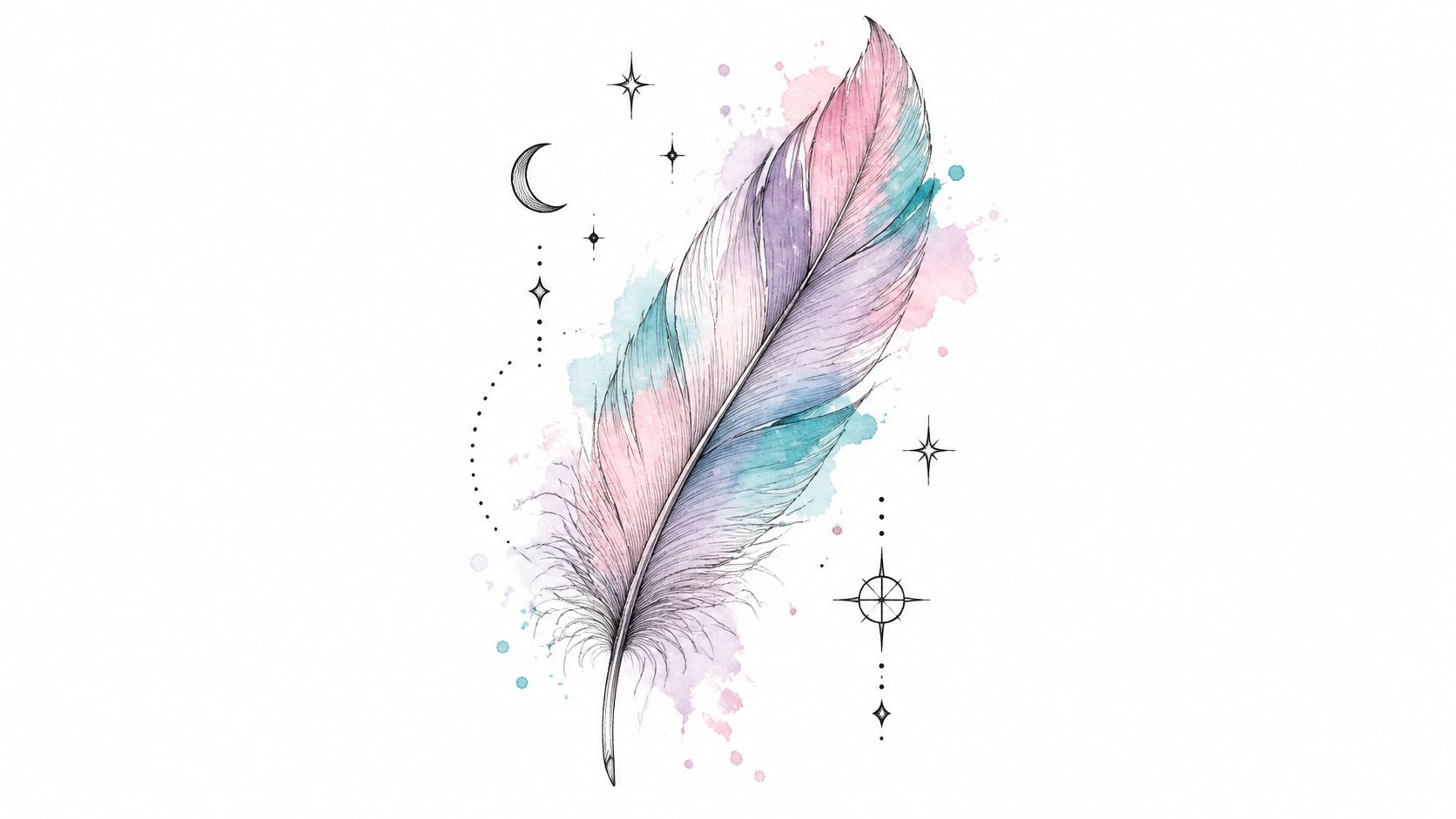
This is the entry point most first-time clients ask for, a single feather lightly outlined in black or dark gray with pastel washes of pink, lavender, or teal bleeding past the edges. The bleed mimics wet paper, so color appears to drift beyond the linework. Say you want a forearm or inner wrist feather with a pink and blue wash. It'll read clearly fresh, but those pale edges are the first thing to lose definition.
How This One Ages
Pastel means low-density pigment. That's the look, and it's also the maintenance reality. Germany's Federal Institute for Risk Assessment guidance on tattoo inks notes that tattooed skin commonly becomes more sensitive to sunlight and some pigments can break down under sunlight, causing faster fading. In Denver, that matters more, not less.
Keep the feather barbs spaced wider than you think you need, so they stay legible after healing instead of merging into one soft shape. Once you're fully healed, use sunscreen with at least SPF 30 on exposed placements. A behind-the-ear version with a single lavender bleed hides from sun better, but hair products and friction become the trade-off. Our overview of the watercolor tattoo style explains how translucent layering works if you want to compare palettes first.
Bring two or three reference palettes to your complimentary consultation, not just one photo. Ask your artist before booking: which parts of this pastel bleed will still read as intentional color in five years, and which parts are you building to fade into skin?
2. Watercolor Wash Feather with Black Ink Linework
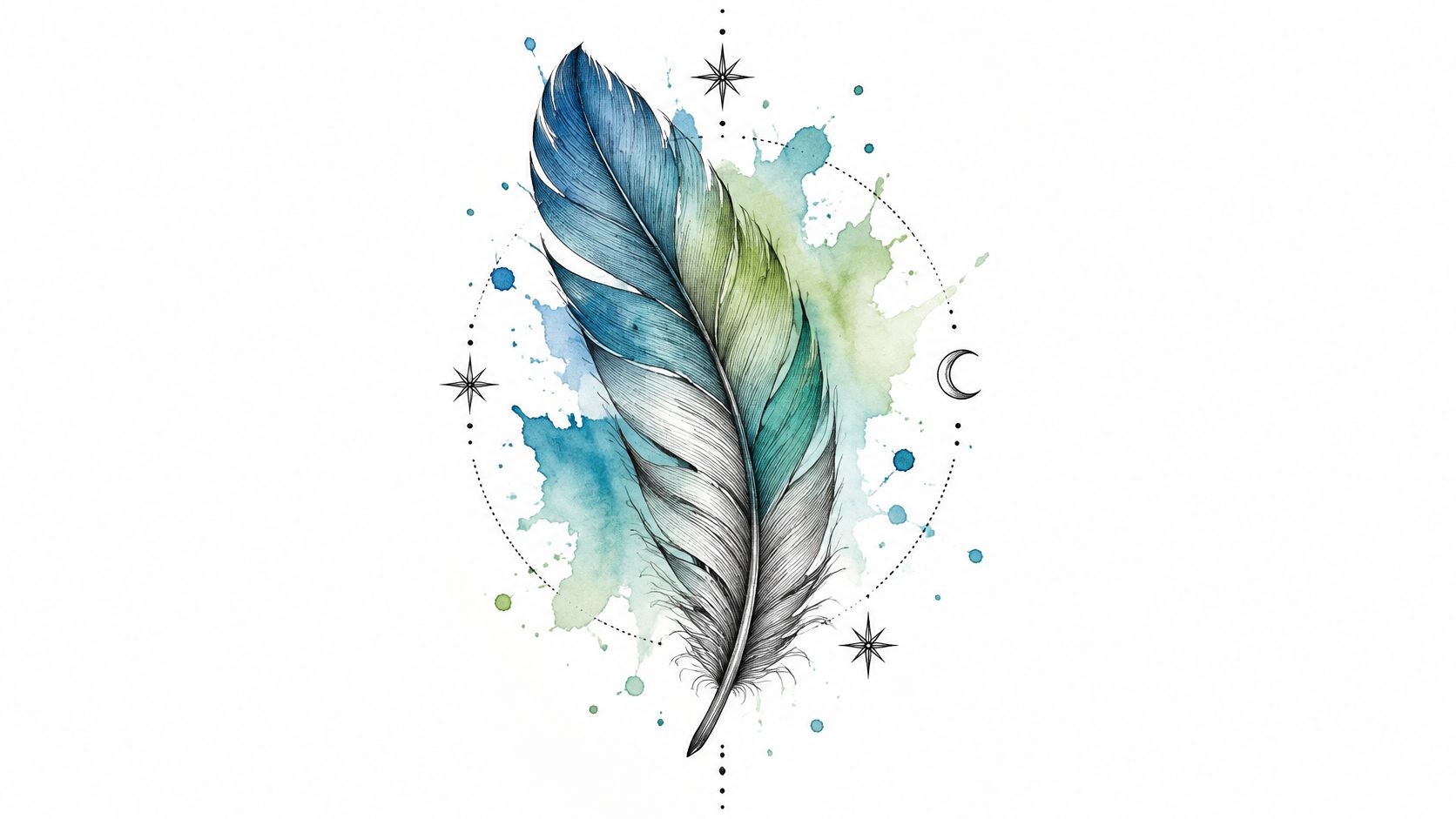
If you want insurance against fading, this hybrid is where I'd point you. A detailed black linework feather sits over a loose watercolor splash, so crisp lines hold the shape while soft color gives it movement. An upper arm feather with a black outline and teal wash, or a calf piece with a bold black feather and orange bloom, will still read as a feather even after the wash lightens.
Line Weight Is the Real Decision
Decide fine-line versus bold-line before you talk color. Fine lines look delicate fresh but can break up on areas that stretch or get sun. Bolder lines hold longer and suit deeper skin tones where pale washes need stronger contrast to show. Also settle how much color sits inside versus outside the outline. Color outside looks painterly, but it has no border, so it softens fastest.
Plan this as a low-density, multicolored composition, not a solid-fill tattoo. Dermatology evidence summarized in a review of tattoo removal and pigment complications shows professional multicolored tattoos are more difficult to remove completely than monochromatic tattoos, with residual pigment sometimes remaining. That's not a scare tactic. It means you shouldn't pick colors assuming they're easily undone later.
Practical rule: Let the black structure carry the design, and treat the wash as atmosphere. If the feather only works while the wash is fresh, it doesn't work.
Settle line weight at consultation before any deposit changes hands. Ask your artist before booking: if the wash faded by half, would this linework still hold the feather together on its own?
3. Watercolor Feather with Floral Accents
A feather paired with watercolor roses, peonies, or wildflowers works when both elements share one palette. The shared color ties them together instead of looking like two stickers placed side by side. This is the version clients usually choose for remembrance, growth, or a personal milestone, for example a shoulder piece with a feather rising from peonies, or a thigh design with lavender sprigs.
That meaning-first motivation fits the broader picture. A peer-reviewed review of U.S. tattoo research reports Pew's finding that 69% of tattooed adults identified honoring or remembering someone or something as a major or minor reason for getting a tattoo. A feather with flowers can carry that job without needing a name or date, though it can hold either if you want it.
Keeping It From Getting Crowded
The failure mode here is clutter. Feathers already have fine interior detail, and petals add more edges competing for attention.
Leave open skin: Keep at least one area of negative space around the flowers so shapes stay separate after healing.
Send a placement photo: Share a clear photo of the area and ask for a stencil draft before you commit.
Think ahead: If you may build a sleeve later, say so now, because flower placement changes.
Our watercolor lotus tattoo guide shows how shared palettes hold floral work together. Ask your artist before booking: where's the open skin in this composition, and which flower details will you simplify so they don't close up as they heal?
4. Cascading Multi-Feather Fan in Watercolor Blues and Purples
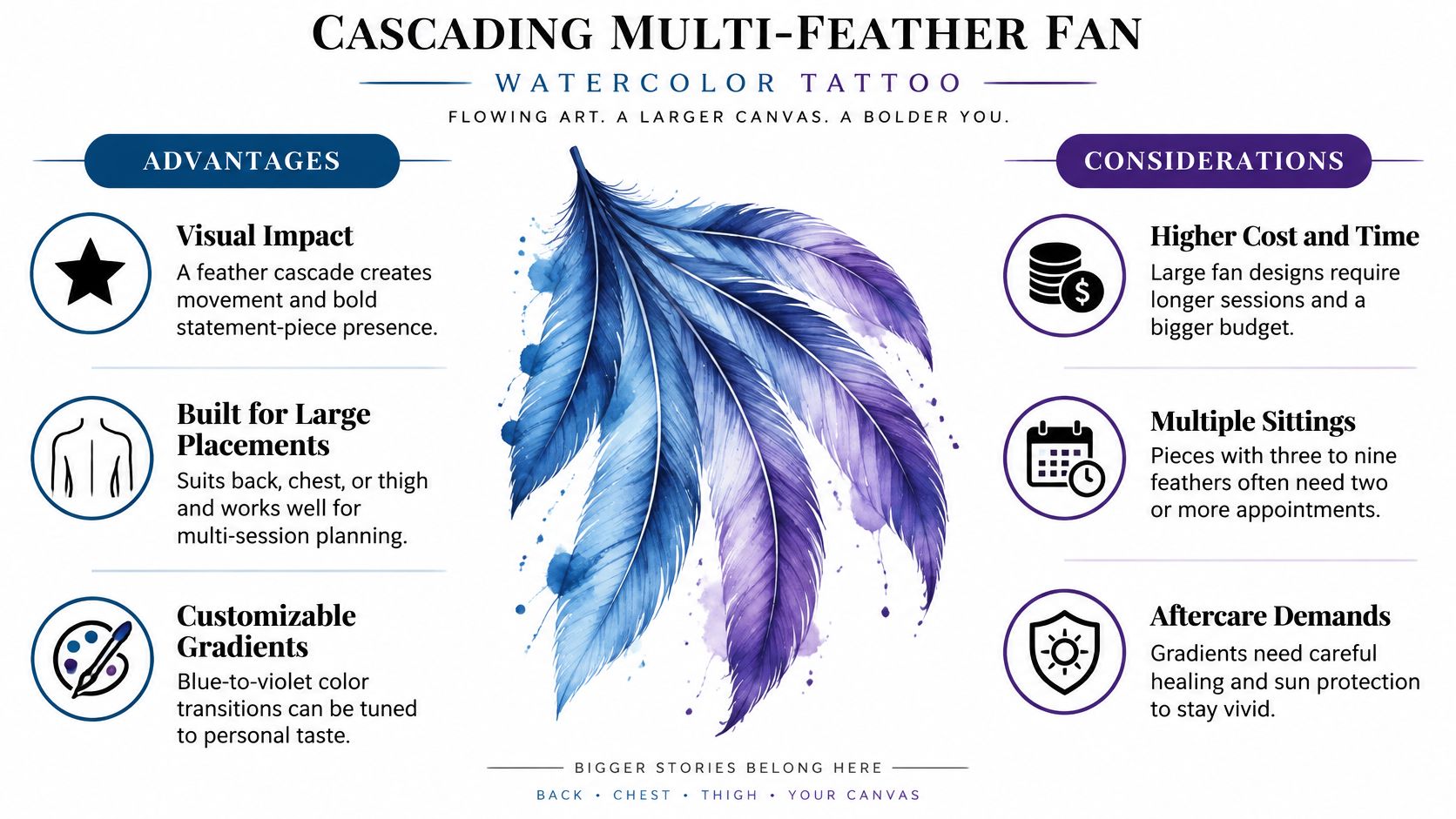
Several feathers fan out from a single point, each in a different shade of blue, indigo, or violet with soft gradients between them. The cascade creates movement across a large area, which is why it suits the upper back, chest, or thigh. Say you want seven feathers fanning across your shoulder blades. That's not a bigger version of a small feather. It's a multi-session project with its own pacing.
Color Behavior at Scale
Blues and purples behave differently from warmer pigments over time and under laser light. A 2023 clinical examination of picosecond laser tattoo removal found blue pigment showed approximately 65.04% clearance, while red showed 48.96%. That doesn't predict how your touch-up will hold, but it does show pigment color isn't interchangeable when you're planning a large, permanent gradient.
Keep feather angles consistent with your body's natural lines, or the fan will look pasted on when you move. Confirm session count, deposit handling, and scheduling for multi-session work upfront, because large fans often need two or more sittings with healing time between them. Our breakdown of tattoos with color covers how layered color is built across sessions.
Ask your artist before booking: how many sittings does this fan need, and where will you place the darker anchors so the gradients don't flatten into one blue mass?
5. Watercolor Feather with Bird or Wing Silhouette
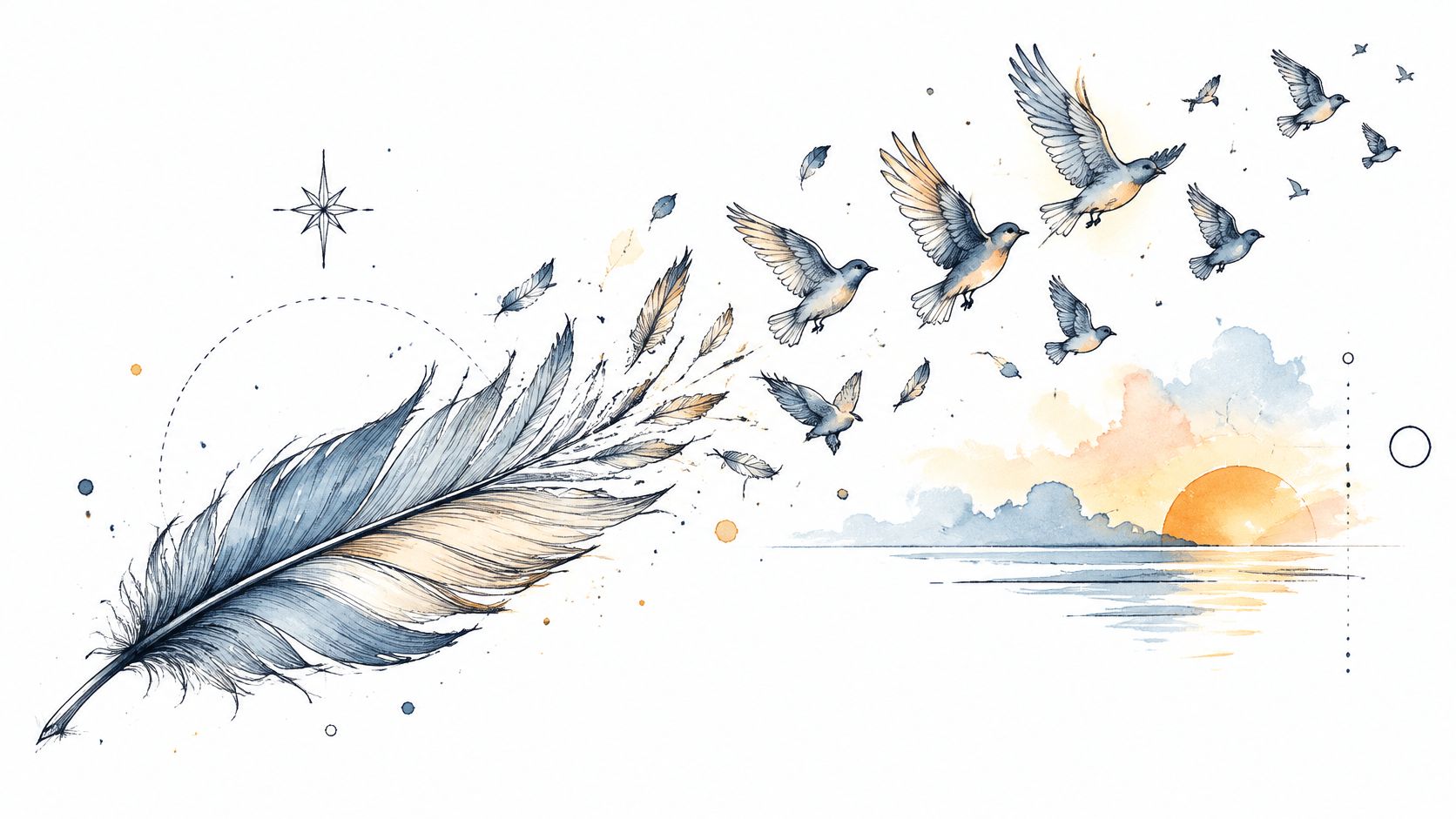
Here the feather transitions into a bird silhouette, a wing, or a small flock lifting away from the tip. It communicates flight and release more clearly than a feather alone, which is why it's requested for memorial pieces and milestone tattoos. A collarbone feather transforming into a sparrow, or a forearm wing over a watercolor sunrise wash, both depend on one thing, the transition point.
Size Protects the Silhouette
Go too small and the birds become dark smudges within a few years. Choose at least 3 inches for the overall piece so the smallest bird still has a clean outline and space around it. Bring a reference photo of the actual bird species or personal symbol you mean, because a sparrow, swallow, and dove carry different shapes and different associations.
This kind of individualized piece is now mainstream, not niche. The Pew Research Center 2023 survey of 8,480 U.S. adults found 32% had at least one tattoo and 22% had more than one. Plenty of clients add a memorial feather to an existing collection, so tell your artist what nearby work it needs to sit with.
A stencil test on your actual body settles arguments a flat drawing can't. Watch how the wing flows when you raise your arm.
Ask your artist before booking: at the size I want, how small is the smallest bird, and will its outline survive healing without closing up?
6. Feather with Mountain or Landscape Watercolor Wash
This design puts a scenic view inside or behind the feather, mountain silhouettes, pine trees, or a sunset sky washed in soft color. For Colorado clients it's an obvious draw, a calf feather with a Rocky Mountain silhouette and sunset wash, or an upper arm feather filled with pines over a blue-green gradient. The risk is trying to fit a whole postcard into a narrow shape.
Keep the Scene to a Few Elements
Limit the scene to three or four elements. A ridgeline, a tree line, and a sky is enough. Add a river, a sun, clouds, and birds, and the feather outline disappears under competing detail, especially after the lightest sky tones soften. Keep the sky wash light and the mountain silhouette dark enough to anchor the composition, the same structure-under-wash principle as the hybrid style.
Placement deserves extra thought if you're outdoors often. Ultraviolet exposure can accelerate premature fading of colored pigments, and a calf or forearm piece on a hiker takes more sun than a piece under a shirt. That doesn't rule those spots out. It means sunscreen after healing isn't optional advice for you, and a slightly deeper palette may serve you better than the palest sunset you found online. Use the consultation to check how the scene reads at the size you want, held at arm's length, not zoomed in on a phone.
Ask your artist before booking: which three elements carry this scene, and what gets cut so the feather shape stays clear at my chosen size?
7. Quill Feather with Dripping Watercolor Ink and Negative Space
The quill version treats the feather as a writing pen, with ink drips running downward and watercolor blooms spreading into open skin around it. It suits literary and artistic clients who want the personal-expression angle front and center. Picture an inner forearm quill with black drips reaching toward the wrist, or a shoulder blade quill with a burgundy bloom. The negative space isn't empty. It's doing the work of making the drips readable.
Friction and Skin Sensitivity
Place drip designs on lower-friction areas like the upper arm or back when you can. Drips are thin, isolated marks. On a wrist or ankle that rubs against cuffs, socks, and watch straps, they heal unevenly and lose their clean taper. Ask to see healed examples of similar drip work, not just fresh photos, because fresh drips always look sharper than healed ones.
If you have sensitive skin, say so plainly at consultation and disclose prior reactions to cosmetics, hair dye, or adhesives. The FDA guidance on tattoo safety states adverse reactions can occur immediately or years later, and infections and allergic reactions may initially resemble one another. A small test doesn't guarantee you won't react later, so persistent or worsening symptoms need medical assessment, not home remedies. Follow your written aftercare closely for the first two weeks.
Ask your artist before booking: can I see healed drip work at least a year old, and which drips would you thicken so they don't break up?
How the Seven Watercolor Feather Styles Compare
The right style depends less on the photo you bring in and more on how each one heals, fades, and reads five years out. Use this table to match a style to your placement, session tolerance, and willingness to protect pale color.
Item | Color Approach | Best Placement | Session Scope | Fade Risk |
|---|---|---|---|---|
Single Feather with Soft Pastel Color Bleed | Pastel washes bleeding beyond light outlines | Forearm, inner wrist, or behind the ear | Small, shorter session | Pastels may fade faster; fine barbs may blur |
Watercolor Wash Feather with Black Ink Linework | Crisp black linework over blue, green, or orange watercolor | Upper arm or calf | Adaptable size and placement | Lower; linework helps maintain readability |
Watercolor Feather with Floral Accents | Shared watercolor palette across feather and flowers | Forearm, shoulder, or thigh | Larger designs may need multiple sessions | Shared palette softens together, so the feather and blooms fade at a similar rate |
Cascading Multi-Feather Fan in Watercolor Blues and Purples | Blue, indigo, and violet gradients | Back, chest, or thigh | Large-scale; often multiple sessions | Gradients need sun protection to stay vivid |
Watercolor Feather with Bird or Wing Silhouette | Watercolor wash within an outlined bird or wing | Collarbone or forearm | Small to medium; keep enough size for bird details | Small bird details blur first if the silhouette is sized too tight |
Feather with Mountain or Landscape Watercolor Wash | Soft watercolor landscape within or behind the feather | Calf or upper arm | Small to medium | Palest sky tones fade first; darker anchors hold the composition |
Quill Feather with Dripping Watercolor Ink and Negative Space | Ink drips and watercolor blooms around a quill | Upper arm, back, inner forearm, or shoulder blade | Standalone or sleeve-integrated | Bloom effects may blur if overworked |
Two patterns matter most when you read this table. The styles with strong dark anchors, black linework or a bold silhouette, keep their shape longest. The styles built on pale washes reward clients who will commit to sun protection and possible touch-ups. Bigger pieces buy you readable detail but cost you more sessions and more healing time.
Ask your artist before booking: which of these fade patterns fits my placement, and what does this style look like healed after a year?
Choosing Your Feather Questions to Settle Before You Book
Pick the family that matches the upkeep you will do. A delicate pastel feather gives the softest first look and shows fading earliest. Hybrid linework gives up some airiness and keeps the feather readable after the light wash settles. A multi-feather piece brings scale and movement, then asks for more sessions, longer healing, and stricter sun habits. The right choice is the one whose aging pattern fits your placement and routine.
Choose placement by friction, sun, and how honest you are about maintenance. Wrists, ankles, and spots behind the ear rub against sleeves, watches, hair products, and skincare. Areas that get regular sun need a real sunscreen habit once healed. If that habit is unlikely, say so during the consult and let the design shift toward deeper tones, clearer spacing, and stronger anchors instead of pretending a pale wash will stay bright on its own.
Bring questions that force decisions before money changes hands.
Line weight: Fine or bold, and what survives best on my skin at this size?
Saturation: Which parts stay translucent, and where are the darker anchors that carry the healed shape?
Spacing: Are the barbs, birds, or drips far enough apart to heal without merging?
Healing and sun: What is the two-week aftercare plan, and what is the long-term sun plan?
Sessions: One sitting or several, and how is scheduling handled between them?
Consultations are complimentary. A $100 non-refundable deposit reserves an appointment, the shop minimum is $100, and you should not send that deposit until an artist or staff member directs you to. We are on South Broadway in Denver, 18 and older only, and booking happens by phone or email at (720) 932-0124 or thinktanktattoo@gmail.com. If you plan to post the healed piece, credit the artist and shop by name; art hashtags and keywords for Instagram help discovery after that, but they do not change how the tattoo ages.
Bring your references, a clear photo of the placement, and your hardest questions about fading, line weight, and spacing, and we will judge the design by how it should look years from now rather than on the day it is photographed. Settle the direction first, then reserve your appointment through Think Tank Tattoo. Before you book, ask your artist: which part of this feather is the anchor that still reads when the lightest wash has softened?
Comments