
How Do Tattoo Cover Ups Work: Design, Ink and Limits
You keep looking at the same tattoo and imagining something else in its place. Maybe it's an old name, a faded symbol, or a design that never looked quite right. You've found replacement ideas you like, but you're not sure whether they can hide what's already there.
So, how do tattoo cover ups work? An artist designs a new tattoo around the pigment already in your skin, using carefully placed shapes, shading, and contrast to make the replacement image read clearly. The important decision isn't just what you want next. It's whether your existing tattoo can support that design directly, or whether selective fading would give you a better starting point.
Table of Contents
How a Cover-Up Hides Old Ink Without Erasing It - Giving the Eye a Different Image to Follow - Why Light Areas Need Careful Placement
Existing Tattoo Factors That Set Your Options - Density and Available Space Often Change the Plan - Texture Requires an In-Person Check
Design Choices That Make a Cover-Up Work - Match the Technique to the Starting Point - Concealment Isn't the Same as a Good Composition
Deciding Whether to Fade or Cover Directly - A Small, Light Tattoo With Soft Edges - Dense or Multicolored Work - Scarred Skin or Uncertain Healing
When Laser Lightening Helps the New Design - Wavelength and Treatment Goals Matter - Recovery Comes Before the Final Drawing
Skin Tone, Color Shifts and Healing Risks - Color Changes Can Alter the Replacement Plan - Separate Expected Recovery From Warning Signs
Book a Consultation and Plan Your Cover-Up - Turn the Assessment Into a Shared Plan
How a Cover-Up Hides Old Ink Without Erasing It
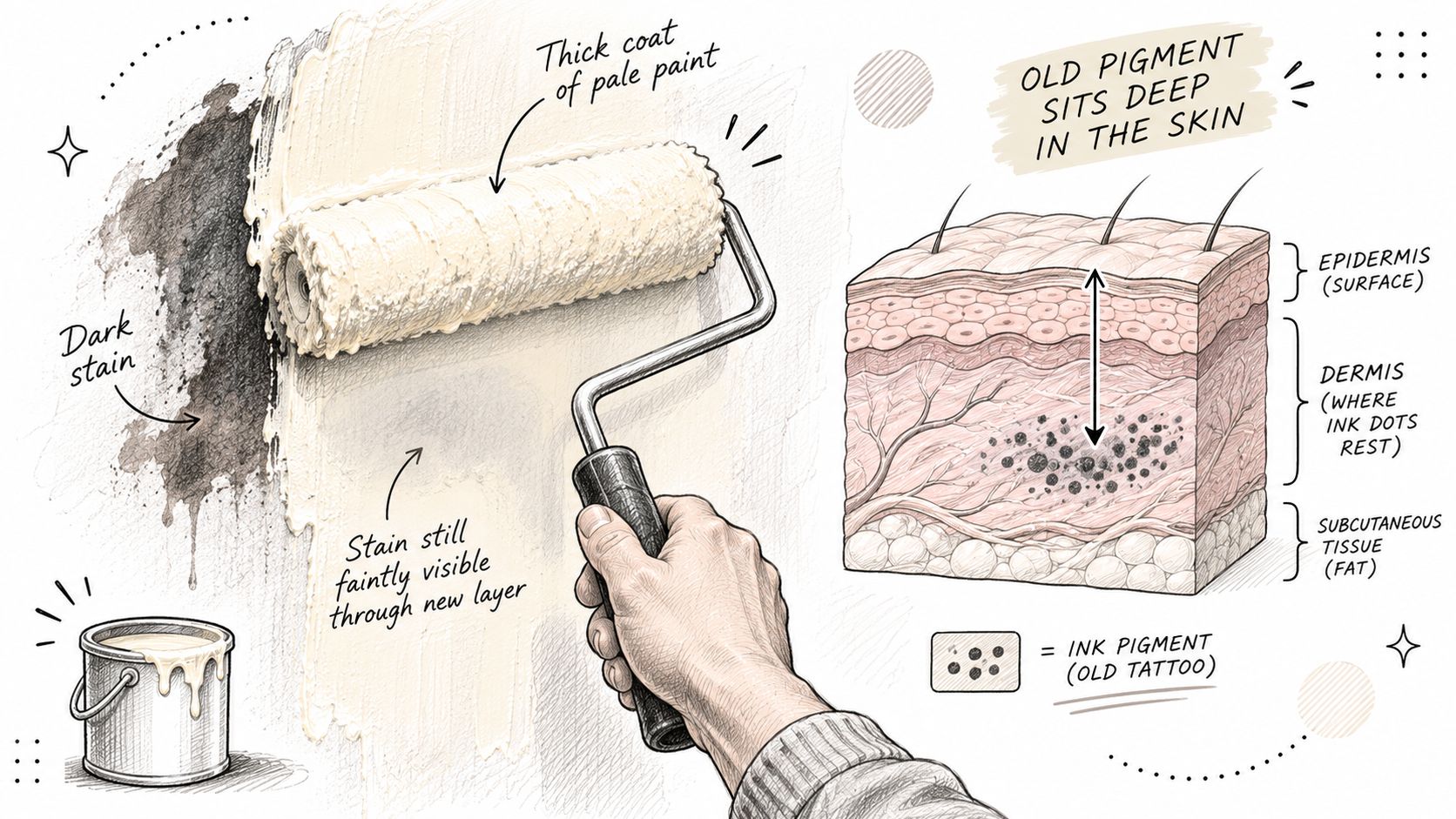
A cover-up is a little like painting over a dark wall stain with a thicker coat. You're trying to stop the old mark from showing through. But the analogy has a limit: tattoo pigment doesn't form a neat, opaque coating over the previous tattoo.
Both tattoos occupy living tissue. As this clinical review of tattoo pigment and removal explains, tattoo ink sits in the dermis, beneath the skin's surface. Adding another tattoo doesn't remove that pigment, so the artist must account for the old image's darkness and edges.
This diagram illustrates the comparison, while showing why skin isn't a painted surface.
Giving the Eye a Different Image to Follow
The artist creates a stronger visual structure through larger scale, heavier outlines, denser shading, and strategically dark shapes. Rather than tracing the old tattoo, they arrange those features so your eye follows a different subject.
Say you have dark lettering and want a floral replacement. A petal's deep shadow might sit over a strong letter stroke, while leaves extend beyond the lettering's original outline. The old darkness becomes part of the flower's internal shading instead of remaining recognizable as a name.
The replacement needs visual weight equal to or greater than the existing image. That doesn't mean every part must become solid black. It means the strongest parts of the new composition must compete successfully with the strongest parts of the old one.
Why Light Areas Need Careful Placement
Pale color alone rarely conceals dense black. Adding white or a light highlight doesn't turn the underlying area into untouched skin.
Artists can still use highlights, negative space, and skin breaks, but they need suitable locations. Those brighter areas belong where the original tattoo is faint enough, or outside its footprint, so old lines don't interrupt them.
The aim is to hide the old tattoo's recognizable structure, not erase its pigment. That pigment continues to influence contrast as the old and new work soften with age.
Existing Tattoo Factors That Set Your Options
Factor | What to check | Effect on the new design |
|---|---|---|
Ink density | Solid black fills versus light linework | Dense areas need a heavier, darker replacement or lightening first |
Color | Black, dark blue, red, yellow, green, or white | Dark pigments dominate lighter colors; white or flesh-colored inks can darken during laser treatment |
Size | Area covered by the old image | A large old image generally needs a larger replacement composition |
Age and edges | How soft or blurred the lines have become | Faint, softened edges can be easier to incorporate |
Placement | Available surrounding skin, movement, and sun exposure | Stretched or sun-exposed skin changes how the design reads over time |
Scarring and skin condition | Raised texture, uneven surfaces, and healing history | Scarred skin can take ink unevenly and needs individual assessment |
Your at-home assessment should identify constraints, not decide whether the tattoo is coverable. Photograph it in natural light and look for the darkest uninterrupted patches, the strongest outlines, and the amount of clear skin between them.
Ink quantity matters more than the tattoo's label or age alone. A heavily filled professional tattoo can present a different fading challenge from lightly inked amateur work. A clinical study examining laser tattoo clearance found that tattoos containing larger quantities of ink required more treatment sessions.
Density and Available Space Often Change the Plan
Compare a faded outline with a densely filled symbol of the same size. The outline leaves open skin where an artist can establish new details. The filled symbol restricts what can appear in its center, even if its outer dimensions look manageable.
Now consider the space around that symbol. On a broad area with untattooed skin nearby, the artist may have room to expand the composition. Beside another tattoo or close to a placement boundary you won't cross, expansion may be much harder.
Age needs the same careful interpretation. An older tattoo isn't automatically easy to cover: what remains visible now matters more than when it was made.
Texture Requires an In-Person Check
Photos help an artist assess layout, but they don't reliably communicate raised scars or changes in skin texture. Tell the artist about difficult healing, persistent irritation, previous touch-ups, and any laser treatment.
A professional assessment checks saturation, color, scarring, and skin condition before promising a result. The outside outline is only part of the problem. What fills that outline, and how the skin underneath has healed, determines which options are sensible.
Design Choices That Make a Cover-Up Work
A workable composition starts with the existing tattoo rather than a finished replacement drawing.
Map the strongest marks. Identify the darkest fills and most recognizable edges, including any blurred pigment outside the main outline.
Choose enough scale. Allow room beyond the original image to establish a new silhouette and a clear focal point.
Place darkness deliberately. Align the replacement's heaviest shadows or shapes with the old marks that need the most concealment.
The subject comes into focus through that process. A flower, animal, or abstract composition works only if its internal structure suits the actual placement of the old ink.
Match the Technique to the Starting Point
Design approach | Works best when | Main limitation |
|---|---|---|
Heavy blackwork or dark outlines | Old tattoo is light or mid-tone | Can look heavy in a small area |
Dense stippling or shading | Old ink is patchy or faded | Detailed work takes time, and fine texture can soften |
Larger scale composition | Old tattoo is small or medium | Needs enough surrounding skin for expansion |
Negative space and skin breaks | Old lines are faint at the edges | Fails where existing pigment remains dark |
Rich color over the old tattoo | Old ink is light or mostly gray | Light colors can't overpower black |
Line weight means how thick or visually strong a line appears. A delicate outline can define a subject on clear skin, but it may not distract from a bold old contour beneath it. A heavier boundary can establish the new subject more convincingly.
Value structure means the arrangement of light, middle, and dark areas. It matters even in a colorful tattoo: if every part becomes equally dark, the replacement may conceal the original but become difficult to read itself.
Concealment Isn't the Same as a Good Composition
Say a dark patch needs covering beneath a planned bird design. Placing it inside a shaded wing may make sense. Placing it beneath a pale chest could create a distracting mark that doesn't belong to the bird.
That distinction explains why an attractive reference image can still be unsuitable. You're not just choosing a subject; you're choosing where its shadows, boundaries, and open areas can go. Our tattoo design advice can help you prepare a direction without locking yourself into an exact drawing.
Practical rule: Bring subjects and moods you like, but leave room for the artist to change their arrangement.
Before your consultation, mark the darkest areas on a photo of your tattoo. Those locations tell you where the replacement will need its strongest features, unless fading changes the starting point.
Deciding Whether to Fade or Cover Directly
The right choice depends on the relationship between your existing tattoo and your desired replacement. Darkness matters, but so do pigment colors, skin type, scar tissue, placement, and how flexible you are about the final design.
A Small, Light Tattoo With Soft Edges
Say you have a faded symbol and want a bold botanical piece extending around it. If the proposed shadows align with the remaining marks, covering directly may be reasonable.
The benefit is avoiding an additional procedure that may not improve the design enough to justify it. Ask to see how the proposed composition uses the existing marks, rather than assuming that any larger image will work.
Dense or Multicolored Work
A compact tattoo with strong black borders and saturated color can limit both shading placement and palette. If your preferred replacement needs a bright central area exactly where the old tattoo is darkest, selective fading may be more useful than adding more pigment.
Recommendation: Discuss which specific sections obstruct the design. Lightening the whole tattoo isn't automatically necessary.
For a large, dark image in a highly visible location, compare complete proposals: a direct cover-up with a heavier composition, and a staged plan that includes fading. Judge them by the final tattoo you'd be willing to wear, not just which route starts sooner.
Scarred Skin or Uncertain Healing
Raised or irritated skin changes the order of decisions. The immediate task is assessing the tissue, not choosing a cover-up style.
An artist may need medical input before proceeding, especially if you report ongoing symptoms. Neither laser treatment nor additional tattooing should be treated as an automatic fix for scarring.
Fading also adds its own uncertainty. The Practical Dermatology discussion of tattoo-removal trends and safety highlights FDA cautions that removal requires multiple treatments with recovery between them, and complete removal without scarring may be impossible. It isn't automatically safer or faster than covering directly.
Ask the artist: Does this design need selected areas lightened, or can it work over the tattoo as it stands?
A useful answer should identify the obstructing areas and explain what fading would change. You should understand the design benefit before committing to the extra procedure.
When Laser Lightening Helps the New Design
Laser pre-lightening reduces the old tattoo's visual strength before the replacement is finalized. The target isn't necessarily clear skin. It's enough reduction to make the intended composition feasible.
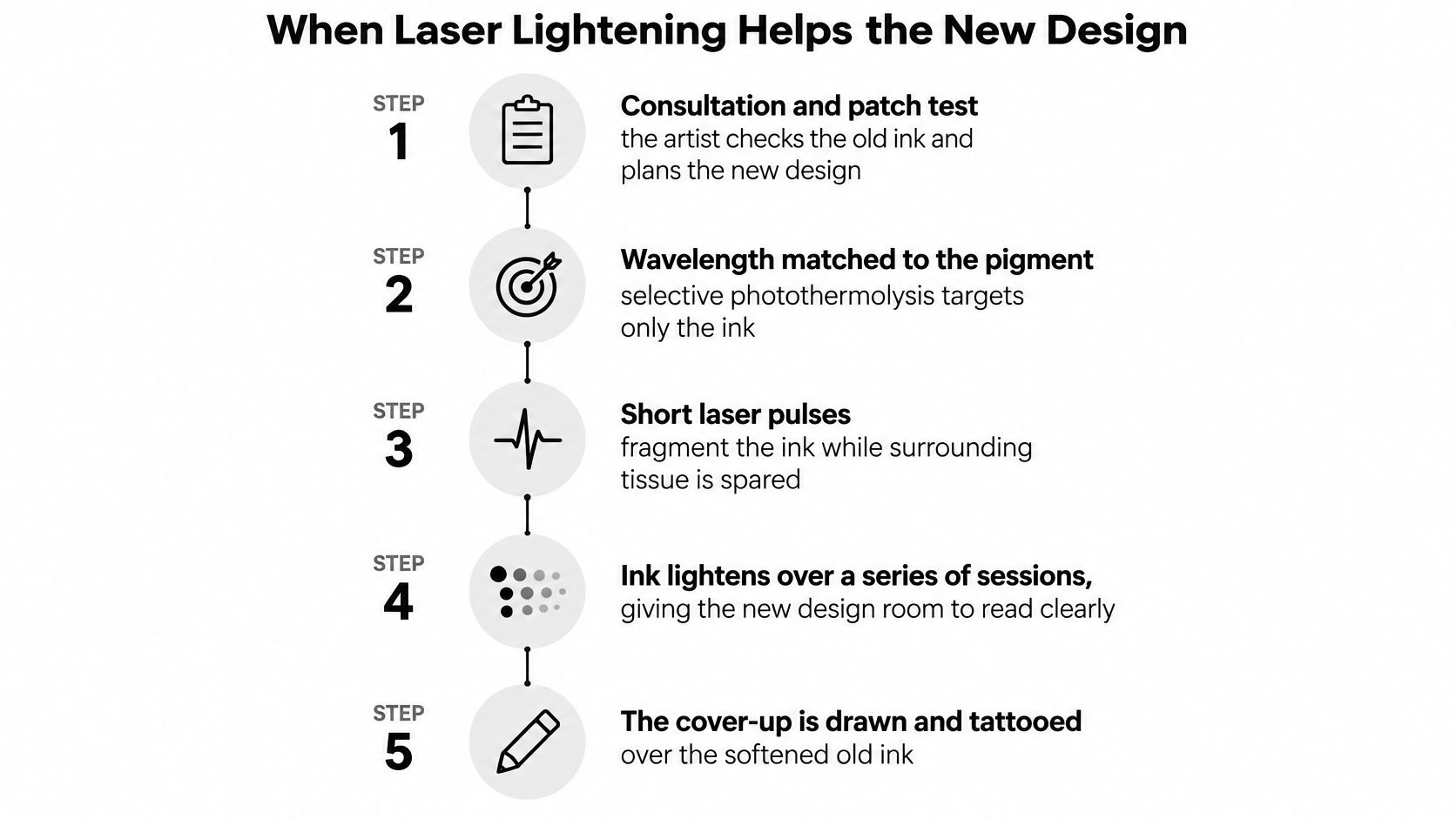
A clinician uses short laser pulses to fragment pigment, which the body gradually clears. This process, called selective photothermolysis, uses wavelengths chosen for absorption by the target pigment while limiting injury to surrounding tissue. It reduces risk rather than guaranteeing that surrounding skin will remain unaffected.
The timeline shows the planning sequence, with recovery and reassessment between treatment and tattooing.
Wavelength and Treatment Goals Matter
The following ranges describe published removal or clearance goals, not guaranteed preparation schedules for a cover-up. A cover-up artist may need less fading, and the stopping point must be assessed individually.
Pigment or tattoo type | Typical laser wavelength | Typical sessions |
|---|---|---|
Black or blue, professional | 1064 nm is commonly useful, particularly for black | Approximately 4–8 sessions to reach at least 75% clearance in many studies, as summarized in the clinical laser review |
Red, orange, or other warm colors | 532 nm is commonly used | No fixed count; response and pigmentary changes require reassessment |
Amateur tattoo, any color | Selected by pigment, not amateur status | Commonly 5–10 removal sessions, compared with 15–20 for professional tattoos, in the review of tattoo-removal optimization |
Professional tattoo, any color | Selected by pigment, not professional status | Longer removal courses are common; this isn't a cover-up fading target |
Different colors within the same tattoo may need different treatment choices. Professional or amateur status doesn't determine a wavelength, and a session estimate shouldn't substitute for examining the pigment and skin.
For a practical overview of treatment considerations, Chernoff Cosmetic Surgery's laser tattoo removal options provide another resource to discuss with a qualified clinician. Coordinate that medical assessment with the cover-up artist's design requirements.
Recovery Comes Before the Final Drawing
Start with consultation and a clinician's decision about whether a test spot is appropriate. Treatment appointments then need recovery intervals, followed by an assessment of the remaining pigment and any skin changes.
The artist should finalize scale, palette, and shading only after that reassessment. Freshly treated skin isn't ready because the tattoo looks lighter. Our guide to tattooing over tattoo removal explains the importance of planning around recovered tissue.
This video offers an additional visual reference for discussing the treatment process.
Pre-lightening deserves consideration when specific dense areas prevent a design you otherwise want. The strongest plan identifies what must change, monitors how your skin responds, and stops according to the cover-up's needs rather than pursuing complete removal by default.
Skin Tone, Color Shifts and Healing Risks
A bigger design doesn't solve every cover-up problem. If the skin develops pigment changes or scar tissue, adding size won't restore an even surface or predictable color.
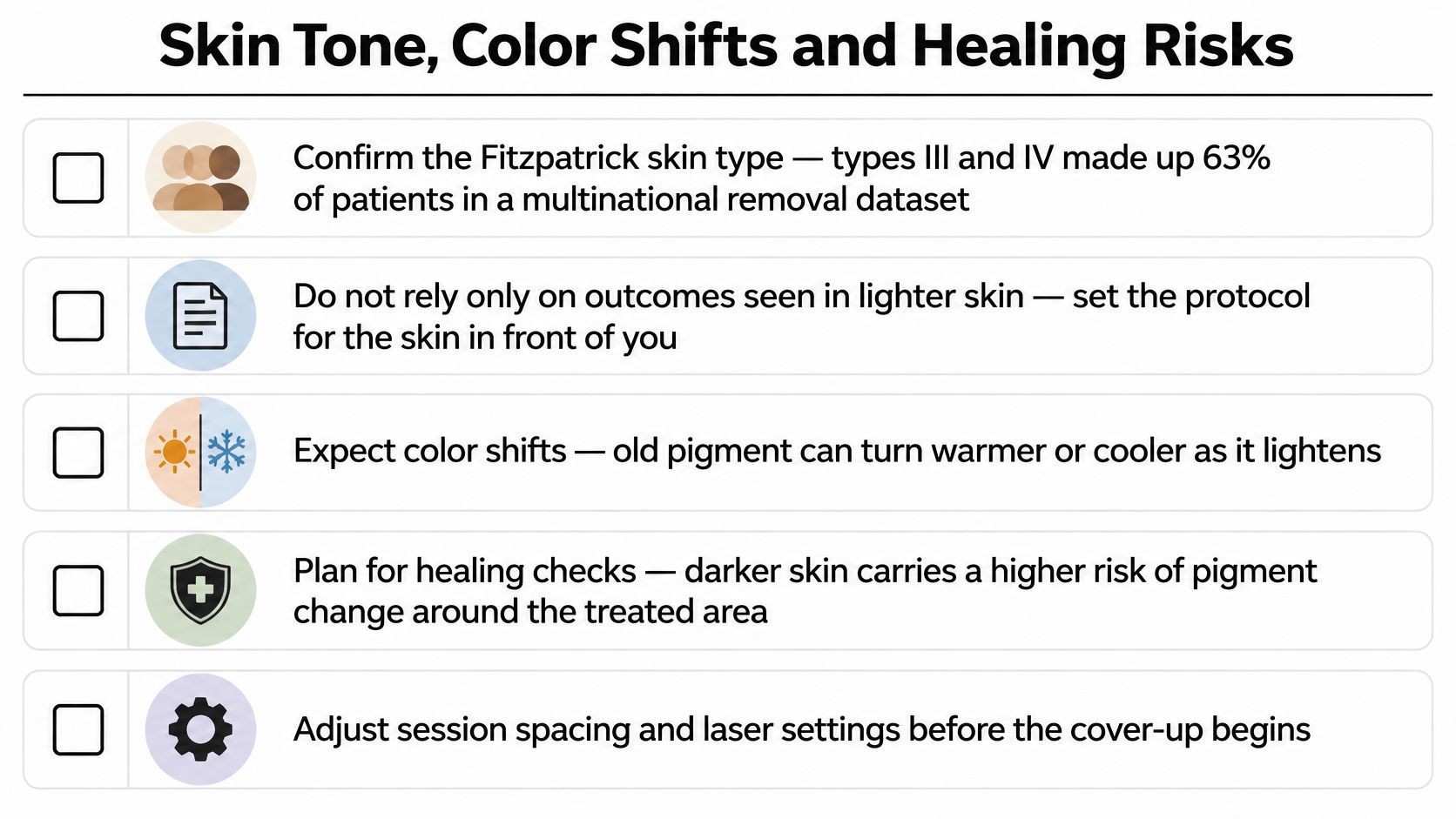
A clinical review of tattoo-removal complications identifies hyperpigmentation, hypopigmentation, ink darkening, and scarring as recognized risks. Hyperpigmentation means an area becomes darker than the surrounding skin; hypopigmentation means it becomes lighter.
Treatment should account for the skin in front of the clinician, not rely on photographs of someone else's result. Skin tone, previous reactions, and healing history all belong in that discussion.
Use this checklist to prepare questions about treatment settings, color response, and recovery.
Color Changes Can Alter the Replacement Plan
Some pigments respond less predictably than others. Yellow, green, and red can be harder to remove than dark blue and black, while white and flesh-colored pigments can darken under laser exposure.
Tell the clinician about any cosmetic tattooing or pale ink added during previous corrections. A patch that becomes darker can obstruct a planned bright area rather than help it.
Choosing between black-heavy and colorful work also involves the appearance of the surrounding skin. Our discussion of black tattoos versus color can help you frame your visual preferences before the artist evaluates what's achievable.
Separate Expected Recovery From Warning Signs
Expected early reactions: Some localized redness, swelling, and soreness can occur after treatment. Follow the treating professional's aftercare instructions and watch for improvement.
Possible infection: Spreading heat or redness, pus, worsening pain, or fever warrants prompt medical assessment.
Texture changes: New raised, thickened, or persistently abnormal areas need review before further laser treatment or tattooing.
Don't try to tattoo over a healing problem. Conservative planning may mean longer recovery intervals, adjusted settings, or a revised palette.
For the final design, stronger value contrast and carefully located skin breaks can support readability without treating every area as a candidate for dense pigment. Healthy, recovered tissue comes before visual concealment.
Book a Consultation and Plan Your Cover-Up
Prepare enough information for a useful conversation, but don't feel you need to solve the drawing yourself. A clear account of the old tattoo and an honest description of what you want are better than an inflexible replacement stencil.
Take clear photos. Use natural light, photograph straight on and from different angles, and include a ruler or coin for scale. Avoid filters that change contrast or skin tone.
Record its history. Note the approximate age, previous cover-ups, touch-ups, laser treatment, and any unusual healing or ongoing irritation.
Bring focused questions. Ask which zones create the biggest constraint, whether selective fading would help, which approaches fit the existing lines, and what concealment is realistic.
Request a written plan. Include the proposed design direction, estimated tattoo sessions, recovery requirements, and any reassessment needed after laser treatment. Estimates should remain open to revision if the skin or pigment responds differently.
Book after you agree. Confirm the scope, scheduling, payment terms, and responsibilities before reserving treatment.
Turn the Assessment Into a Shared Plan
At Think Tank Tattoo, we offer complimentary consultations to discuss your existing tattoo and a possible replacement. An in-person review lets us check saturation, color, scarring, and skin condition before promising a result.
Bring references showing what you like about a design, such as its subject, texture, or overall darkness. Also identify firm boundaries, including how far you're willing to extend the tattoo and whether laser fading is something you'd consider.
Appointments are arranged by calling or emailing the shop. Before paying anything, confirm the written plan and deposit terms: our deposits are non-refundable, and you shouldn't send one until an artist or staff member directs you to do so.
Think Tank Tattoo offers a collaborative consultation to assess your old tattoo and discuss a custom cover-up that fits its actual constraints. Visit Think Tank Tattoo to arrange a consultation and bring your photos, design references, and questions about whether fading first could improve your options.
Comments