
Back Piece Tattoo Cost: 2026 Price Guide
Many published guides put a full back piece tattoo cost at about $1,500 to $5,000, elaborate work at $10,000 or more, and a detailed 30-to-80-hour project at roughly $4,500 to $20,000 before extras. Those bands aren't contradictions. They're different scopes wearing the same name.
A quote for one sitting isn't a finished budget. An artist who charges less per hour but needs more hours, more sessions, or more touch-up time can finish more expensive than a faster artist at a higher rate. If you learn to read hours first and session prices second, you'll compare quotes the way an artist builds them at a consult.
Table of Contents
Back Piece Tattoo Cost Ranges for 2026 - Why the Bands Are So Wide - Planning Ranges by Coverage - How to Use Your Row
How Artist Rates and Quotes Become a Total - Three Ways Artists Package the Same Hours - Questions That Make Quotes Comparable
Size Style and Placement That Add Hours - Surface Area and Density - Color Realism and Existing Work - Placement and Sitting Tolerance
The Real Budget Beyond Needle Time - What Sits Outside the Tattooing Charge - Cash Flow Across Sessions
Three Back Piece Budgets Side by Side - A Black and Gray Upper Panel - A Half Back in Color - A Full Back Realism Project Quoted Two Ways
Reserve the First Session With a Written Estimate - What to Bring and What to Get in Writing
Back Piece Tattoo Cost Ranges for 2026
Start with a planning band you can use before you call a shop. The 2024 pricing guide published by Tattoo Style Guide estimates that a full back tattoo typically costs $1,500 to $5,000, while elaborate designs can reach $10,000 or more. That single sentence explains most of the confusion online. A moderate full back and an elaborate full back share a body part, not a workload.
Other published ranges land in a similar place for ordinary coverage. Sky Rye Design's 2024 to 2025 back tattoo notes put back tattoos commonly at $1,500 to $5,000 or more, with nearly full-back tattoos estimated at $2,500 to $5,000+. Read those as starting bands for work that isn't unusually dense, saturated, or slow. Once realism, packed background, or heavy color enters the design, the upper end stops being a ceiling.
Why the Bands Are So Wide
The range widens because back piece tattoo cost is built from hours, and hours swing a lot. A smaller upper panel might need two or three sittings. A shoulder-to-waist scene with background, layered shading, and color passes can run through most of a year.
Your body size matters too. The same design stretched across a broader back covers more skin. More skin means more linework, more shading, and more time packing color evenly.
Your sitting tolerance changes the math in a quieter way. If you can sit well for longer appointments, the artist finishes more per visit. If you need shorter sits, you don't change the total hours much, but you do add appointments, setup time, and calendar length.
Pick the row that matches your coverage first. Pick the style second. Shopping by style name alone is how a $3,000 plan quietly becomes an $8,000 project.
Planning Ranges by Coverage
Use the table as a map, not a menu. The hours are planning assumptions that let you test a quote for reasonableness before you commit. If an artist quotes far below your row, ask which part of the scope is smaller. If the quote sits far above it, ask which part takes longer.
Back piece planning ranges by coverage
Coverage | Tattooing hours | Sessions | Planning range |
|---|---|---|---|
Upper or lower panel | 8–12 | 2–3 | $1,200–$3,000 |
Half back | 12–20 | 3–5 | $1,800–$5,000 |
Moderate full back | 20–40 | 4–8 | $3,000–$10,000 |
Detailed full back | 30–80 | 6–12 | $4,500–$20,000 |
Elaborate color or realism | 40–80+ | 8–12 | $10,000+ |
Notice how the rows overlap. A dense half back can cost more than an open, moderate full back. A detailed full back at the high end can cost several times a simpler full back, even though both cover roughly the same skin.
That overlap is normal. Coverage tells the artist how much skin is involved. Density tells the artist how much work lives inside that skin. You need both numbers before a budget means anything.
How to Use Your Row
Write down your row and bring it to the consult. Then ask the artist to place your actual design inside it, or explain why it falls outside. A good explanation names a specific reason, such as packed background, a cover-up, or portrait-level detail. A vague answer doesn't help you plan.
Treat the top of your row as your real ceiling, not the bottom. Most clients add detail during design talks, not less. If the top of the row already feels impossible, shrink the coverage now rather than mid-project. A finished panel you love beats an unfinished full back you can't afford to complete.
How Artist Rates and Quotes Become a Total
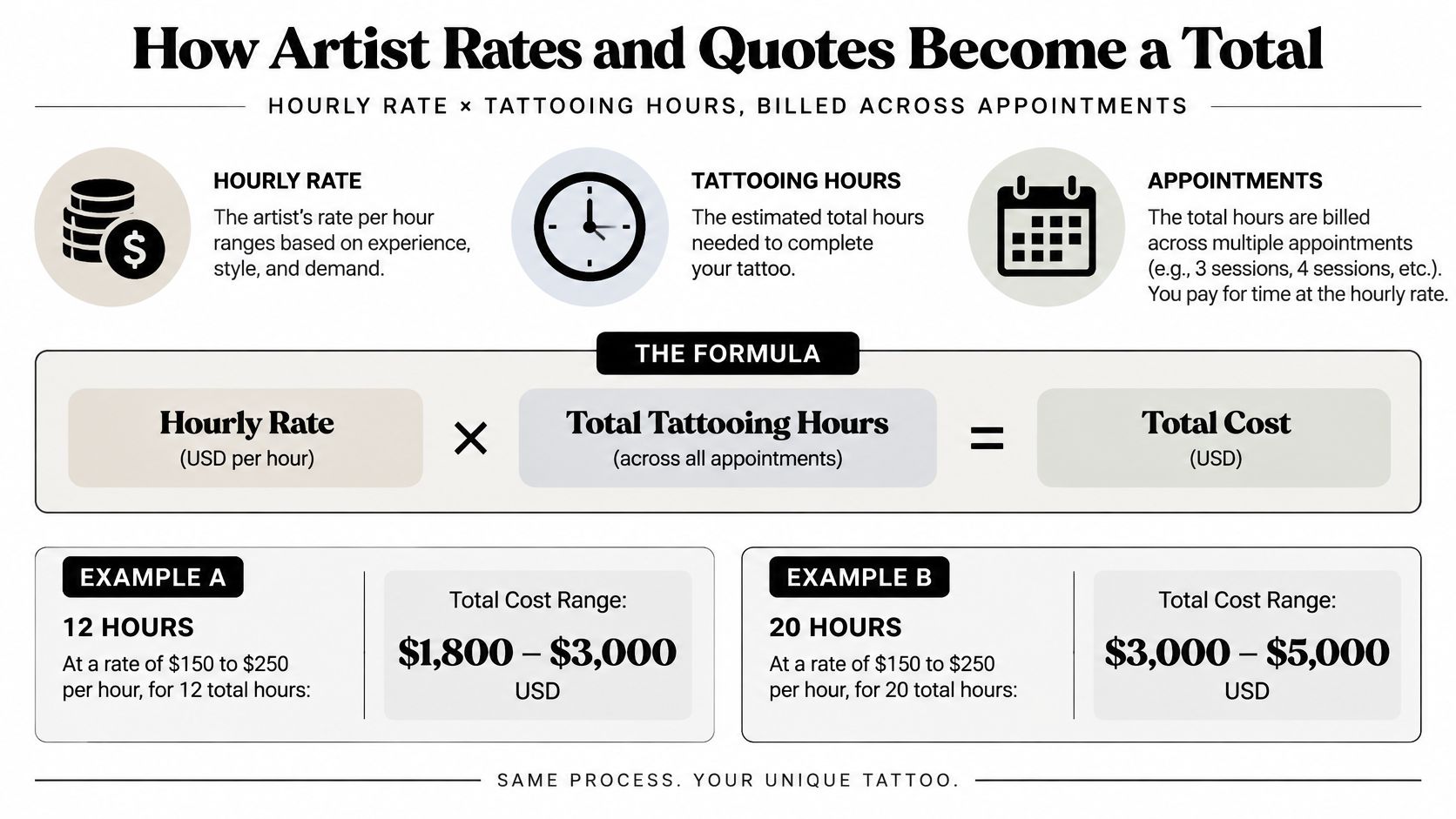
Most back pieces aren't sold from a universal price list. The TattooStudioPro 2026 review of 41 U.S. tattoo studios describes back-piece pricing as usually calculated from the artist's hourly rate multiplied by the number of tattooing hours, rather than from a universal flat price. In that review, 22 studios published hourly rates, the median was $155 per hour, and the most common listed rate was $150, with most rates between $150 and $250 per hour.
Run that formula on two simple examples. A back piece requiring 12 hours of tattooing would produce an estimated tattooing charge of approximately $1,800 to $3,000 before taxes, gratuity, travel, or other fees. A project requiring 20 hours would correspond to roughly $3,000 to $5,000 at the same market rates.
This visual lays out that formula so you can reuse it with any quote you collect.
Three Ways Artists Package the Same Hours
An hourly quote is the easiest to audit. You can multiply it yourself and ask what counts as billable time. A day rate feels simpler, but it hides the hourly math inside a block.
Published guidance in the RevifyHQ state of the tattoo industry 2026 report places common session or day-rate pricing around $800 to $2,000 or more for roughly 4 to 8 hours, while other estimates use $150 to $400 hourly ranges depending on market and artist experience. That report also gives the clearest warning example. A $1,200 day rate for six tattooing hours is effectively $200 per tattooing hour, and it becomes more expensive if the advertised block includes substantial non-needle time.
Hourly, day-rate, and flat quotes compared
Model | What you pay | Main risk | Worked example |
|---|---|---|---|
Hourly | Rate times tattooing hours | Unclear if design or breaks are billed | $200 x 6 hours = $1,200 |
Day or session rate | One price for a 4–8 hour block, often $800–$2,000+ | Setup and breaks shrink needle time | $1,200 for 6 needle hours = $200 per hour |
Flat project quote | One stated total for an agreed design | Scope creep if sessions or touch-ups are unnamed | Ask what happens if hours run long |
A flat quote can protect you, but only when the scope is named. It should state the design, the coverage, the projected session count, and what happens if the work runs long. Without those terms, a flat number is just a guess with confident formatting.
Questions That Make Quotes Comparable
Ask every artist the same questions, word for word, and write the answers down. Our page on current tattoo shop rates and how pricing is structured covers the basics, but your written notes from the consult are what let you compare two artists fairly.
Hourly rate: What's your rate, and does it apply to needle time only or the full appointment?
Hours per session: How many tattooing hours do you expect in each sitting?
Design time: Is drawing and revision time billed, included, or covered by the deposit?
Projected sessions: How many appointments should I budget for, at what spacing?
Touch-up policy: Is a touch-up included, and within what window after healing?
Deposit and minimum: How much holds my date, and what's the refund or rescheduling rule?
As a concrete policy example, Think Tank Tattoo has a shop minimum of $100.00 and requires a $100 deposit before booking any tattoo appointment, and deposits are non-refundable. That's a calendar policy, not a back piece price. Every shop sets its own version, so confirm it before you assume a deposit counts toward the art.
Practical rule: If two quotes can't be reduced to rate times hours, they can't be compared yet. Ask until both can.
Watch how a large project is paced in practice before you decide which model suits you.
Three six-hour sessions at common mid-range rates would land near several thousand dollars before extras. That pace is normal for a back. Anyone promising a detailed full back in one or two sittings owes you a very specific explanation of what gets left out.
Size Style and Placement That Add Hours
Hours, not the word full, set your bill. The GlossGenius guide to tattoo artist earnings reports an average duration of 3.92 hours for large tattoos, compared with 1.35 hours for small tattoos. At the $150 to $250 hourly range reported for many U.S. studios, that large-tattoo duration would imply approximately $588 to $980 in tattooing charges for one large session, before any additional appointments.
A back piece stacks several of those large sessions together. Outlining comes first, then shading, then color if you've chosen it, with healing between stages. Each stage covers the whole canvas again, which is why the hour count climbs faster than most first-time clients expect.
Surface Area and Density
An upper panel, a half back, and shoulder-to-waist coverage are three different jobs. Say you want a traditional eagle across the shoulder blades with open skin around it. The shapes are bold, the background is empty, and the artist moves quickly through each pass.
Now fill that same space with a packed scene. Add clouds, waves, secondary figures, and textured background edge to edge. The coverage didn't change, but the line density tripled, and every added element needs outlining, shading, and finishing. That's the gap between a moderate budget and a detailed one.
Color Realism and Existing Work
Black and gray work usually moves faster than saturated color. Color needs extra passes to pack evenly, plus time switching and blending pigments. A design that looks simple in color can take longer than a complex black and gray piece of the same size.
Realism slows the pace further. Portraits and photorealistic textures demand small, careful value changes instead of bold fills. The artist checks proportions constantly, and mistakes are harder to hide, so the needle moves with more caution.
Existing tattoos change the plan most of all. A cover-up forces darker values, strategic placement of heavy elements over old ink, and awkward negative space around what's already there. Bring clear photos of any existing work to the consult. Guessing from memory produces estimates nobody can honor.
Placement and Sitting Tolerance
Not all back skin feels the same in the chair. The spine, ribs, and shoulder blades are harder to sit through than the flatter mid-back. If those zones carry heavy detail in your design, plan for shorter effective sits there.
Our guide to how long a full back tattoo takes from outline to finish walks through that pacing in detail. The short version is simple. A client who taps out early books more appointments to finish the same hours.
Tell your artist the longest you've ever sat, honestly. An hour estimate built on your real tolerance beats one built on optimism.
Bring printed reference images and name the exact zone you want covered, edge to edge. Point at your back in a mirror if words fail. The artist can estimate hours from a defined area and density. Nobody can estimate hours from a style name alone.
The Real Budget Beyond Needle Time
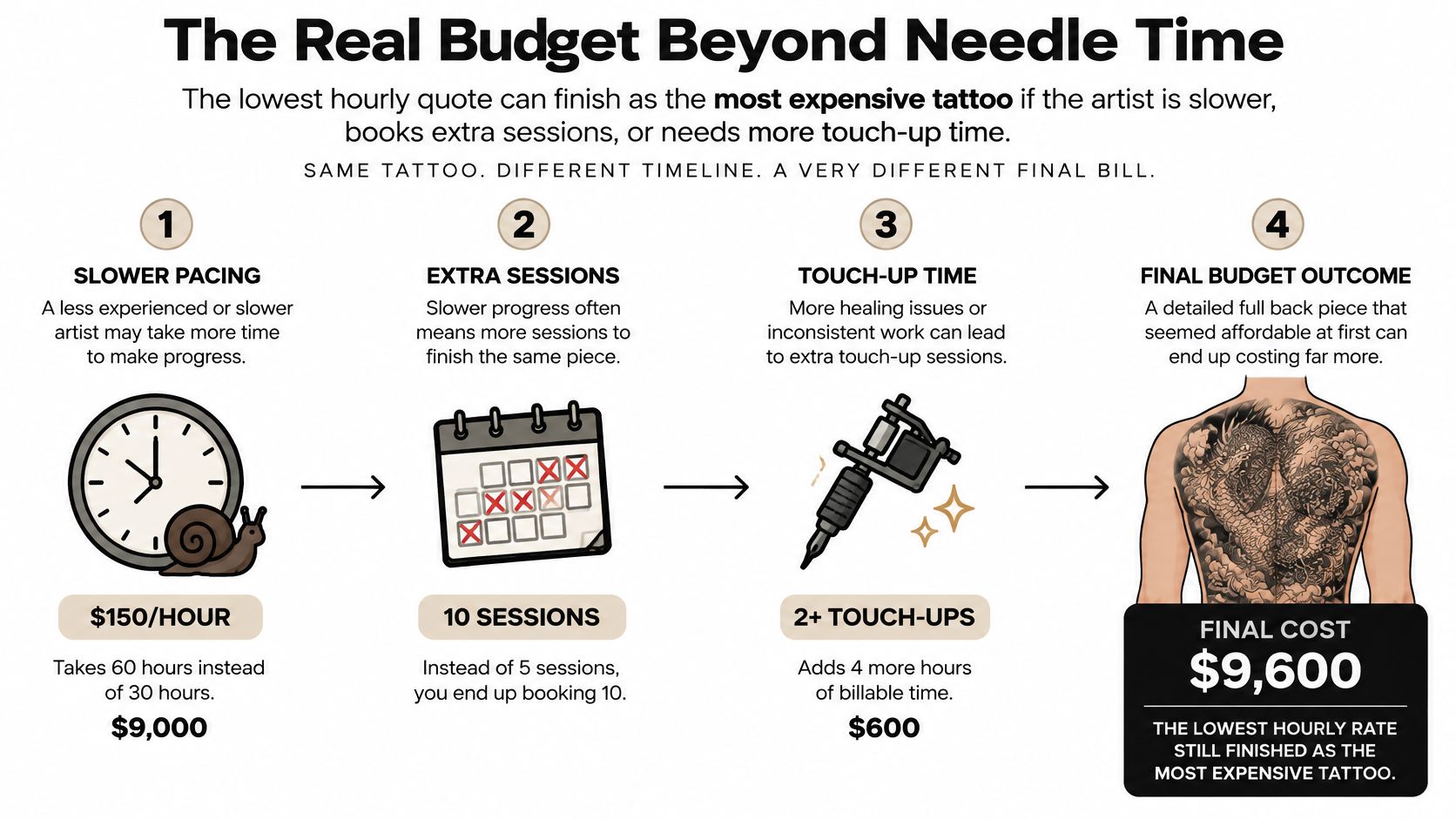
The lowest hourly quote can finish as the most expensive tattoo. The Peachy Tattoos back piece cost guide puts a detailed full-back project at roughly 30 to 80 tattooing hours, commonly divided into 6 to 12 sessions, with 3 to 5 weeks of healing between sessions. At a mid-size-market rate of $150 to $250 per hour, that implies approximately $4,500 to $20,000 before non-tattoo expenses.
That spread is where the cheap-rate trap lives. An artist who works more slowly, requires more sessions, or needs additional touch-up time can produce a higher total than a pricier artist who finishes efficiently. You're buying a finished back, not a rate.
This breakdown shows how a slower pace increases the final figure.
What Sits Outside the Tattooing Charge
Build a second list next to your tattooing estimate. These costs are smaller individually, but they arrive at predictable moments across a months-long project. Clients who plan for them don't stall mid-piece. Clients who ignore them often do.
Costs outside the tattooing charge
Add-on | Typical planning figure | When it hits |
|---|---|---|
Tip | About 15–20% of the tattooing charge | Each session |
Aftercare supplies | A small wash-and-ointment kit | After the first session |
Time off work | One day per long session if the job cannot flex | Session days |
Travel or lodging | Local trips, or lodging for a guest artist | As booked |
Touch-up | Extra hours if included work is not in the quote | After healing |
Tipping is the biggest line clients often forget. On a multi-thousand-dollar project, a customary tip adds up to real money across sessions. Budget it per visit so it never competes with rent week.
Aftercare is small but nonnegotiable. You'll want a fragrance-free wash and a plain ointment your artist approves, plus clean shirts that won't rub a healing back. Skipping supplies to save a few dollars risks a poor heal on a very expensive canvas.
Time off deserves an honest line too. Long sessions leave you drained, and a fresh back piece makes desk chairs, seatbelts, and physical work uncomfortable. If your job can't flex for a day after each sitting, that lost time is part of your true cost.
Cash Flow Across Sessions
Large projects are commonly paid session by session, not all at once. Say your tattooing total lands at $6,000 across four sessions. That's about $1,500 per visit plus tip, spaced weeks apart, rather than $6,000 on day one. The final cost doesn't change, but the affordability picture does.
Healing gaps protect both your skin and your bank account. You can't safely compress sessions to finish faster, so don't book a schedule your calendar can't hold. A piece that heals fully between visits takes ink better at the next one.
Write four numbers on one note before you say yes: tattooing total, tip, supplies, and time off. If that note still works, book with confidence.
Deposits belong in this picture as a scheduling cost, not art payment confusion. A deposit holds your place on a busy calendar. Know whether it applies to your final session or is consumed by drawing time, because shops handle that differently.
Three Back Piece Budgets Side by Side
Ranges stay abstract until you run real scenarios. The three plans below use round planning numbers so you can swap in your own quote. Each one includes the extras, because a budget that stops at the needle price isn't finished.
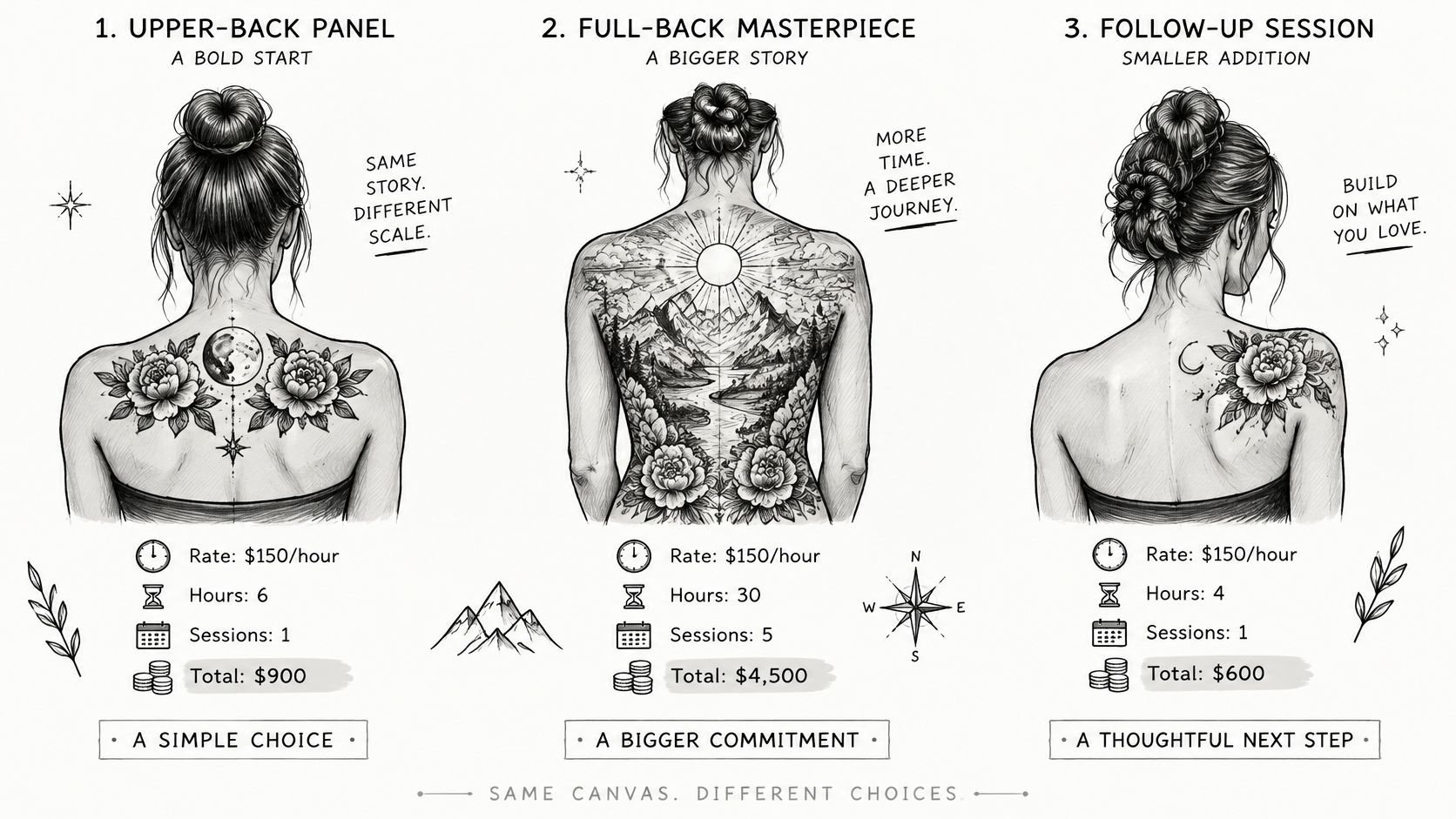
Compare the shape of each plan before you compare the totals.
A Black and Gray Upper Panel
Say you choose a black and gray piece across the shoulder blades, estimated at about 10 tattooing hours. At a hypothetical $175 an hour, tattooing comes to $1,750 across two or three sits. A 20 percent tip adds roughly $350, and a modest supply run covers wash and ointment.
Your cash outlay lands around $2,200 before any time off work. Confirm in writing that the 10 hours include the outline session and final shading pass. Panels fail as budgets when the last session turns out to be extra. This is the right shape if your ceiling is near $2,000 and you want a finished piece, not a down payment on a full back.
A Half Back in Color
Now say you want color from shoulders to mid-back, estimated at 18 hours. At a hypothetical $200 an hour, tattooing totals $3,600. Paid across four sessions, that's roughly $900 per visit plus tip, which many clients find manageable month to month.
The calendar is the catch. With several weeks of healing between visits, this piece runs a season rather than a month. Confirm whether color saturation checks after healing are included or billed as a short extra session. Color that heals light in one patch is a normal fix, but you should know in advance whether you're paying for that hour.
A Full Back Realism Project Quoted Two Ways
This last scenario proves the cheap-rate trap with plain math. Artist A quotes $150 an hour and estimates 50 hours, for $7,500 in tattooing. Artist B quotes $220 an hour and estimates 32 efficient hours, for about $7,040. The higher rate finishes cheaper because the hour count wins.
Add a 15 to 20 percent tip to either path. Add one possible touch-up hour after the final heal, since realism often needs small value corrections once the skin settles. Neither story ends at the needle price, and pretending otherwise is how budgets break in session nine.
When two artists quote the same design, compare estimated hours before you compare rates. Hours are where the money actually moves.
Match yourself to a story. Choose the panel if your budget sits near $2,000. Choose the half back if you can pay steadily by session over several months. Choose full realism only with a written hour estimate, a named session count, and room in the budget for the estimate to be wrong by a session or two.
Reserve the First Session With a Written Estimate
Book a consult only after you've picked a coverage row and a ceiling you can pay session by session. Walking in with those two decisions made turns the conversation from browsing into planning. The artist can then design toward your budget instead of designing a piece you later have to shrink.
For Denver clients, we offer complimentary consultations at 172 S. Broadway, Denver, CO 80209, and we're 18 and older only. You can reach us by phone or email to book, Tuesday through Saturday from 12pm to 8pm at (720) 932-0124. Wait to send any deposit until an artist or staff member directs you to do so. Our tattoo deposit policy explained in full covers how that hold works, and the deposit itself is a calendar hold, not your art price.
What to Bring and What to Get in Writing
Bring placement photos of your own back, style references, and a note of the longest sit you can realistically handle. Bring your questions on rate, hours, design time, session count, and touch-ups too. A useful written estimate names the tattooing hours, the price model, the healing gap between sessions, and what the first appointment will finish.
Ask how long the estimate stays valid, since rates and calendars change. GetBill's guidance on setting estimate validity periods is a helpful reference for why a clear expiry date protects both sides of any quoted work. If your estimate has no validity window, ask for one before you rely on the number months later.
Compare the written estimate against your planning row at home, away from the excitement of the consult. If the hours fit your row and the per-session cost fits your monthly budget, reserve the outline session. That's the moment a back piece stops being a price you researched and becomes a project you've planned.
If you're ready to turn a planning range into a real hour estimate for your back, book a complimentary consultation and bring your references, your coverage row, and your sitting limit. We'll talk through design direction, placement, and session pacing so your first appointment starts with a number in writing. Start that conversation today with Think Tank Tattoo.
Comments