
Tribal Japanese Tattoo: Meaning, Motifs and Custom Design
Most style guides tell you to pick a Tribal Japanese tattoo that looks bold and book the size you want. That's backwards. The popular advice skips the first question, which tradition you're asking for. "Tribal Japanese" isn't one coherent style. It's a loose label that can describe a Japanese composition, a distinct Indigenous tradition inside Japan, Western blackwork borrowed from other Pacific and Southeast Asian communities, or an original hybrid that only uses Japanese flow. If you don't name which one you mean, you can end up with the wrong symbolism, the wrong permissions, and a design that doesn't say what you think it says.
Table of Contents
Three Traditions Hiding Under One Label - Tattoo Traditions Grouped Under the Tribal Japanese Label
How History Shaped the Meaning of Irezumi - From Punishment Mark to Decorative Revival - Why the Reversal Still Affects Your Choice
Japanese Motifs and What Each One Means - Common Japanese Motifs, Meanings and Placements
How Tebori and Machine Work Change the Design - Tool, Pace and Sensation Side by Side
Choosing a Design Without Borrowing Someone's Identity - Three Categories to Sort Your Request
Placement and Visibility Before You Commit - Access and Public Reaction in Japan
Book a Consultation and Bring Your Plan - Your Five Step Preparation List
Three Traditions Hiding Under One Label
“Tribal Japanese” sounds like a single tattoo style. It is not. The label can point to Japanese horimono, Ainu tattooing, blackwork associated with other Indigenous traditions, or a contemporary design that borrows Japanese compositional flow. Naming the source matters: it helps you discuss the design accurately and avoid treating community-specific patterns as generic decoration.
Tattoo Traditions Grouped Under the Tribal Japanese Label
Tradition | Origin and Period | Defining Features | What to Say to an Artist |
|---|---|---|---|
Japanese horimono and irezumi | Japan, documented across many centuries; full-body peak in the Edo period (1603-1868) | Central subject with wind, waves, clouds or foliage; unified composition | Request a named Japanese composition and explain its subject |
Ainu tattooing | Ainu communities of Hokkaido and northern Japan; distinct from later horimono | Tribal custom with its own symbolism | Ask for guidance from knowledgeable sources; do not request a copy of a community mark |
Western tribal blackwork | Modern label applied to Borneo, Aotearoa, Polynesia and Micronesia traditions | Bold bands, repeated shapes, solid black fills | Name the source culture, confirm its meaning, or choose an original design |
Contemporary hybrid | Modern studio work combining Japanese principles with original shapes | Japanese flow and negative space with new imagery | State which elements are Japanese and which are original |
These categories differ in origin, visual language, and cultural context. Horimono and irezumi commonly organize a central subject within a background of wind, waves, clouds, or foliage. The elements connect across the body, so the composition reads as a scene rather than a subject placed in isolation.
Ainu tattooing belongs to Ainu communities in Hokkaido and northern Japan, with symbolism and social functions distinct from horimono. Grouping the two under one undifferentiated “Japanese” label obscures that distinction. Similarly, bold bands and repeated shapes may draw on traditions associated with Borneo, Aotearoa, Polynesia, or Micronesia. Their meanings are tied to particular communities, even when a reference image shows only abstract forms.
Black ink isn't culturally neutral just because a design is abstract.
A contemporary hybrid can use Japanese flow and negative space with original imagery. Describe it as a hybrid, and be specific about which elements are borrowed from Japanese composition and which are newly created. That clarity helps prevent an original design from being mistaken for a traditional one, or a community-specific pattern from being relabeled as Japanese.
In your first message to an artist, name the category you want. For example: “I want a Japanese horimono composition with a koi as the central subject,” or “I want original blackwork using Japanese flow, not a traditional motif.” A clear description gives the artist a design direction and helps you check whether the reference, meaning, and intended use belong together.
How History Shaped the Meaning of Irezumi
Japanese tattooing didn't move in a straight line from punishment to art. It changed meaning several times, and each turn affects what a motif carries today.
Concrete evidence places tattoo use in Japan by approximately 300 B.C., when markings appear to have carried spiritual, social, or decorative meanings, and Nippon's account of this documented history notes that Japan's early chronicles, the Kojiki (712) and Nihon shoku (720), describe tattooing as a practice associated with outlying communities and, in some contexts, punishment. That early split matters. A mark could signal belonging inside one community and distance from the center of power in another.
From Punishment Mark to Decorative Revival
Tattooing later became linked to criminal punishment, when codified markings identified offenders and outcasts. If you stopped the story there, you'd assume a large tattoo only meant exclusion. It didn't stay there.
During the Edo period (1603-1868), decorative tattooing went through a major artistic revival. The late Edo period, especially the first decades of the nineteenth century, became horimono's "golden age". Woodblock printing and illustrated popular fiction in the eighteenth and nineteenth centuries supplied the visual language many clients still recognize, including large-scale compositions, heroes, animals, flowers, and mythological imagery.
Say a client brings in a hero battling a creature, surrounded by waves and peonies. That isn't random decoration. The way the hero fills the back, the way the background moves, and the choice of supporting flowers all come from print culture that taught both artists and wearers how to read a large scene on skin.
Why the Reversal Still Affects Your Choice
Wearers reclaimed decorative tattooing from its punitive past and elaborated it into identity, status, affiliation, and personal expression. That's why the same permanent mark can signal punishment in one period and pride or belonging in another. Meaning depends on period, context, and who is wearing it.
Modern stigma grew from part of that history, including later associations with organized crime and yakuza imagery. You don't need to carry that history as a warning label, but you should know it still shapes how some people react to visible irezumi.
Practical rule: When you pick a motif, ask which era, source imagery, and intended meaning you're picking with it.
Before an artist draws, you should be able to answer three questions in plain language. Where does this subject come from, what has it traditionally communicated, and what do you want it to communicate on you? If those answers don't line up, revise the design now, not after the outline is healed.
Japanese Motifs and What Each One Means
Use this table as a starting lookup, not a shopping list. A strong Japanese piece reads as a sentence, with a subject, supporting elements, and a background that connects them.
Common Japanese Motifs, Meanings and Placements
Motif | Traditional Meaning | Common Placement | Consultation Note |
|---|---|---|---|
Koi carp | Perseverance and determination, from carp climbing waterfalls | Sleeves, legs, back | Ask for a classic koi composition with a clear direction |
Dragon (ryu) | Power, water and good fortune | Back, full sleeve | Often the central subject of large pieces |
Waves (nami) | Natural force and resilience | Background of back and thigh pieces | Usually a background element, not a standalone motif |
Wind and thunder gods (Fujin and Raijin) | Control of wind and thunder; protection | Back, shoulders | Pair with a clear background flow |
Tiger | Courage and strength | Thigh, shoulder | Ask why this animal suits the wearer |
Hannya mask | Jealousy and obsession, drawn from Noh theatre | Forearm, chest | Heavy meaning; discuss the reason before drawing |
Peony | Honor and prosperity | Sleeve, back filler | Works as a companion to a central figure |
Cherry blossom | Transience of life | Shoulder, sleeve filler | Soft flowers often fill space around heavier subjects |
Oni demon | Protection against evil | Chest, back | Check the mask's face and expression with the artist |
Start with one central subject. That might be a koi, a dragon, a tiger, or a paired set of gods. Then choose one or two supporting motifs that deepen the same idea, such as peonies with a central figure or cherry blossoms around a heavier subject. Finally, choose a background, usually waves, wind, clouds, or foliage, that carries the eye across the body part.
Here's a concrete example. A koi climbing a waterfall on the back can start near the waist and move upward toward the shoulder. Wave lines don't just fill empty skin. They show direction and effort, and they let the artist wrap the composition around the shoulder blade instead of stopping it in a hard rectangle. Cherry blossoms could soften the upper edge, but adding a tiger, an oni, and a hannya mask to the same back would turn one clear sentence into three competing stories.
Some motifs need extra care. A hannya mask is visually striking, but its link to jealousy and obsession is heavy. You should have a clear reason for wearing it and discuss that reason before drawing. The same care helps with cultural context beyond tattoo imagery. If you're drawn to how pattern, season, and formality work together in Japanese dress, you can explore kimono culture with Jasumo to see how motif choice carries meaning there too.
At consultation, ask the artist to explain how each motif relates to the others. If an element is only there because it looked good in a separate reference image, remove it or replace it with background that supports the central subject.
How Tebori and Machine Work Change the Design
The tool doesn't just change how a tattoo feels. It changes pace, scheduling, and how a large composition gets built.
This comparison shows the basic mechanical difference before you decide what matters more, speed and uniformity or hand-driven rhythm.
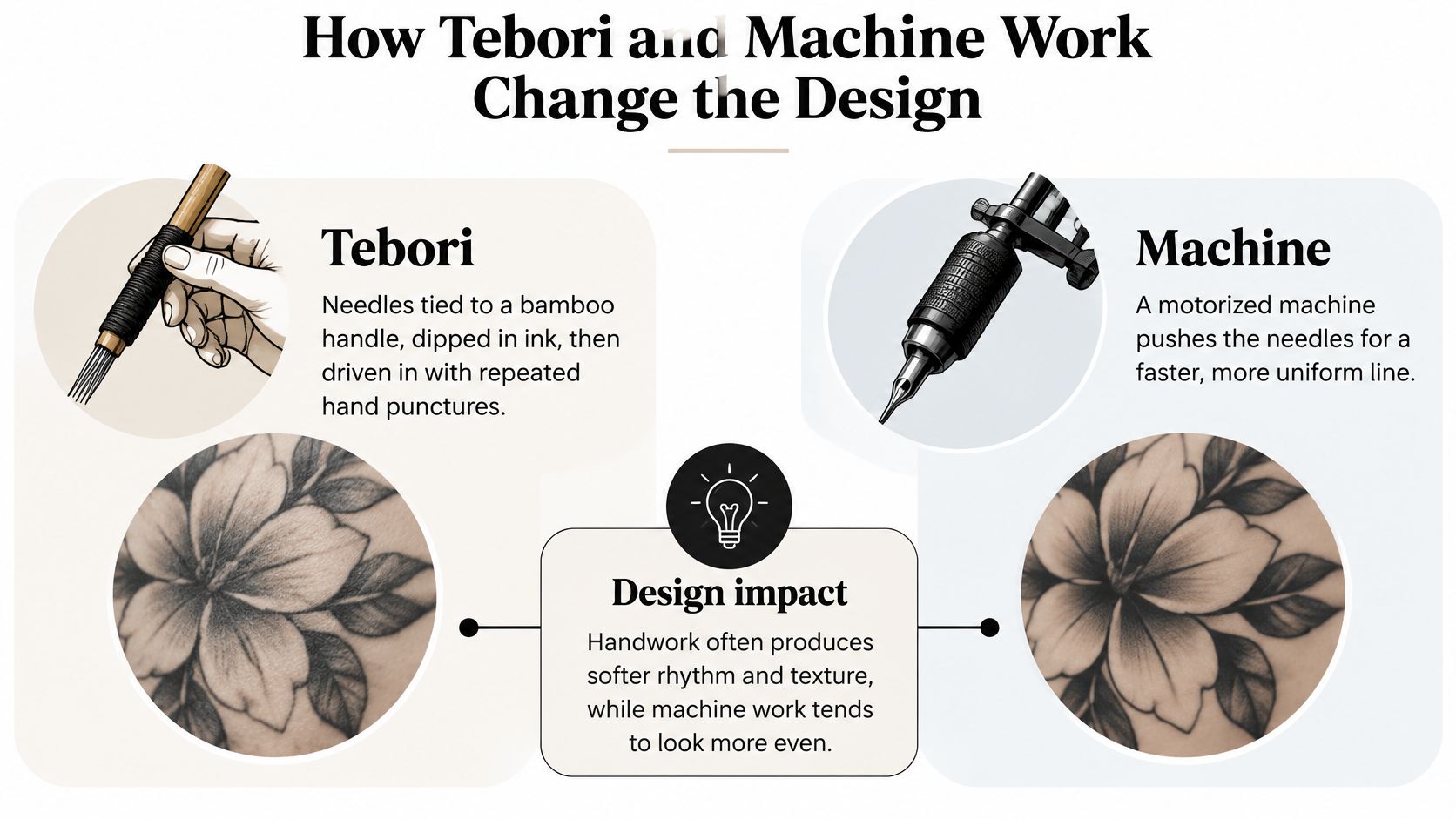
Tebori, meaning "carving by hand", traditionally fixed bundled needles to a bamboo handle, dipped them in ink, and inserted pigment through repeated hand-driven punctures rather than relying on a motorized machine, as explained in Kiryoku's study of horimono and tebori technique. Machine work uses a motor to push the needles, so the artist can usually cover ground faster and keep a more uniform pace across a long session.
Tool, Pace and Sensation Side by Side
Tebori: Hand-driven punctures place pigment through many manual passes. Large pieces need substantially more appointment time and sustained client tolerance.
Machine: A motorized tool supports faster, more even application. Scheduling is usually easier to predict for sleeves and back pieces.
Hybrid: Some artists combine methods for different parts of a project. You need to know which part is done which way before you approve a timeline.
Technique also shapes composition. Historical Japanese designs developed as unified compositions rather than isolated flash motifs, commonly integrating a central subject with wind, waves, clouds, or foliage. That means you shouldn't approve a dragon drawing without seeing the background and negative space plan. The background decides whether the piece flows from shoulder to waist or back to arm, and whether future work can connect cleanly.
Watching the process helps you hear the difference in rhythm and see how the artist controls depth by hand or by machine.
Ask three questions in your first conversation. Will the work be done by machine, tebori, or a hybrid approach? How many hours will each session run? Will the artist provide a flow sketch before the design is finalized? When you're reviewing candidates, compare finished compositions, not only single motifs, and use guidance on finding a tattoo artist for Japanese style work to check how an artist handles background movement across a full body part.
Get those answers early. They change your timeline, your budget, and how much tolerance you'll need across multiple visits.
Choosing a Design Without Borrowing Someone's Identity
“Tribal Japanese” sounds like one style, but it combines labels with different histories. A request for Japanese work can drift toward bold black bands or repeating patterns associated with Indigenous traditions without the wearer recognizing the difference.
In Western tattoo culture, “tribal” has been used broadly for patterns connected to Indigenous peoples in places such as Borneo, Aotearoa, Polynesia, and Micronesia. Japanese irezumi developed within its own history and visual traditions. When a design moves into a commercial setting without its cultural context, its meaning can be weakened or misrepresented.
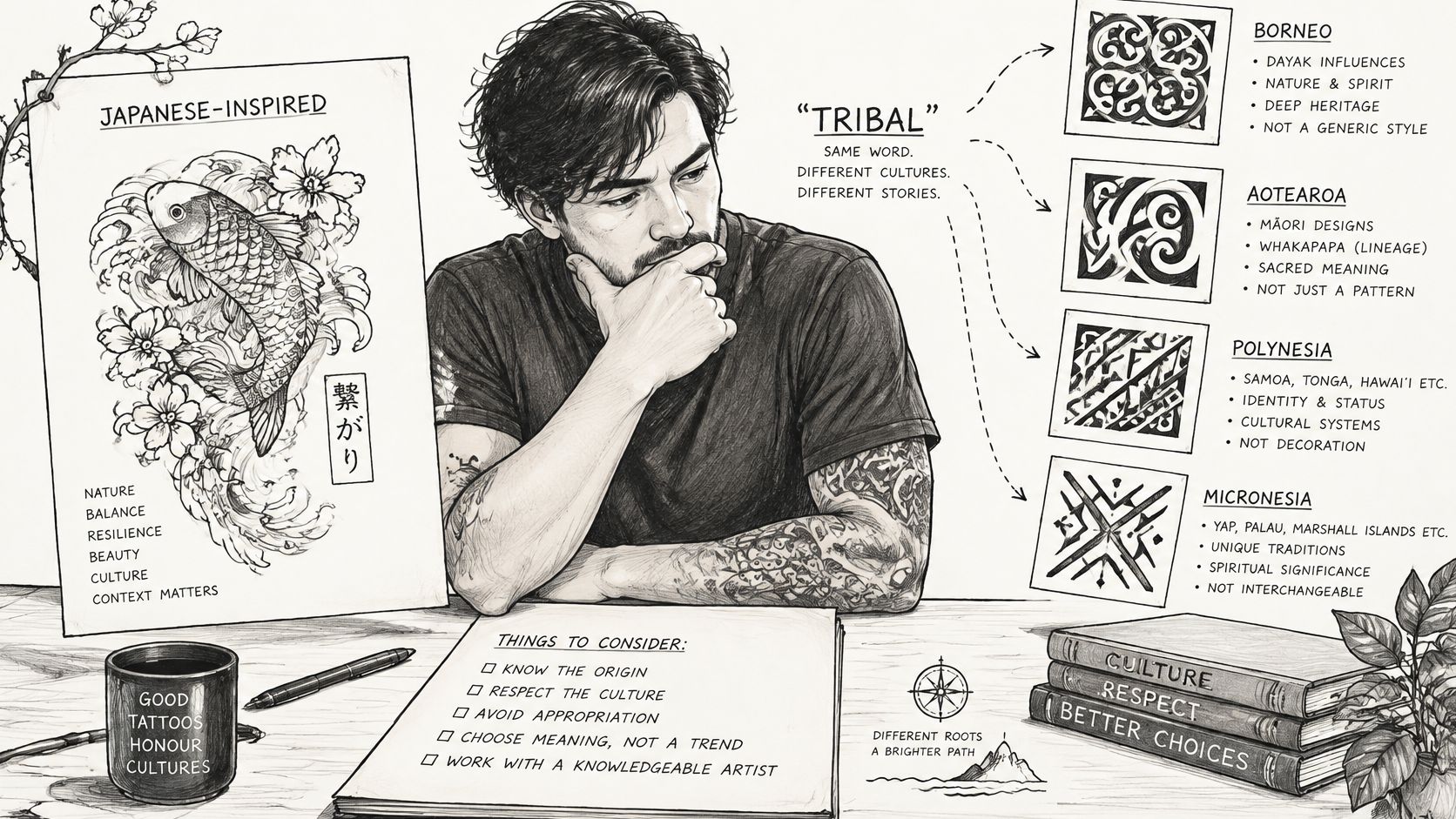
Before choosing a shape, ask whether it belongs to a named tradition or is an original design. That distinction gives you a clearer brief and helps prevent accidental borrowing.
Three Categories to Sort Your Request
Category one includes historically specific motifs with cultural meaning. A named Japanese figure, a traditional subject from print culture, or a community-specific mark belongs here. Ask for a clear explanation of its origin. If you and the artist cannot establish where it comes from, do not copy it.
Category two includes Japanese compositions built around recognized irezumi principles. This is a direct request for a central subject, background movement, and flow that follows the body's contours. It describes a Japanese visual approach, not an Indigenous pattern.
Category three is original abstract work described as tribal. Sharp black shapes, bands, and areas of negative space can be designed from scratch. Call this original blackwork, rather than Japanese or Indigenous work. Accurate labeling avoids implying a cultural identity the design does not have.
Before drawing begins, use this checklist:
Identify the source culture: Name it specifically, or confirm that the design is original.
Separate known from uncertain: Ask which meanings are documented and which are interpretations.
Avoid copied community marks: Do not lift patterns that signal identity, family, status, or belonging.
Walk through provenance: Ask the artist to explain each element's source in plain language.
Seek informed input: If a design represents a cultural tradition, consult someone qualified to speak to it.
“I want Japanese tribal” could mean a Japanese dragon composition, a Japanese-inspired blackwork band, or an original abstract sleeve. Each calls for a different design brief. If your references include Pacific patterning, learn about Polynesian flower tattoos and their specific visual language before combining those references with Japanese imagery. Keeping the traditions distinct gives you a design you can describe accurately, without borrowing someone else's identity.
Placement and Visibility Before You Commit
A tattoo's placement can shape how others read it as much as its imagery does. Size and position affect how often the design is visible, whether clothing covers it, and where it may cause practical friction.
Back pieces and full sleeves give large Japanese compositions room for a central subject and flowing background. Clothing can cover them in some settings, though a sleeve shows whenever you wear short sleeves or roll up a cuff. Thighs and shoulders offer a balance: you can show the work selectively or cover it with clothing. Chest and forearm tattoos are harder to keep out of view, especially forearm work, which is visible during everyday gestures such as reaching or shaking hands.
Access and Public Reaction in Japan
Tattoos in Japan can still face stigma and private venue restrictions. Tattooed visitors may be refused entry to some onsen, public baths, pools, gyms, or other facilities. Some people may also associate tattoos with yakuza history. These reactions vary, so check venue rules rather than assuming a tattoo will be accepted or rejected everywhere.
For travel in Japan, plan for places where you may need to cover a tattoo or choose a tattoo-friendly facility. A respectful design can still create practical inconvenience.
Run this checklist before booking:
Countries and venues: Where will you travel, swim, bathe, or train, and what rules apply?
Work visibility: Can clothing cover the piece during client meetings, in uniform, or at formal events?
Scope: Do you want a full traditional composition or a smaller Japanese-inspired design?
Future additions: How might a later sleeve, chest panel, or back extension connect to this piece?
If you are comparing body areas, use this guide to tattoo placement ideas and visibility tradeoffs alongside your wardrobe and travel plans. For travelers, deciding whether you need a coverable design before the first session can prevent an inconvenient placement later.
Book a Consultation and Bring Your Plan
Bring a written plan, not only saved images. A clear brief helps the artist design one composition instead of stitching together unrelated references.
Your Five Step Preparation List
Choose the tradition: Decide whether you're requesting Japanese horimono, guidance on a distinct tradition, Western tribal blackwork with a named source, or an original hybrid.
Pick the motif structure: Select one central motif and up to two supporting motifs, plus the background element that will connect them.
Gather full references: Bring images that show complete compositions with background flow, not only isolated dragons, masks, or flowers.
Decide placement and coverage: Note where the piece will sit, how you'll cover it at work, and what access issues matter when you travel.
State your time commitment: Write down the session budget and time you can commit, since large pieces run over several visits and technique affects scheduling.
When you review a portfolio, look for finished Japanese-style compositions with clear background flow across a shoulder, arm, back, or thigh. Ask how the artist handles provenance questions for any element. A direct answer is a good sign. Vague reassurance that "it's all tribal" is not.
Before money changes hands, the consultation should produce three things. You should see a flow sketch showing how the composition moves across your body. You should get a session estimate based on size and technique. You should also hear how each motif relates to the others and why each one belongs.
We offer complimentary consultations, and appointments are booked by calling or emailing the shop. Don't send a deposit until an artist or staff member directs you to do so. Confirm booking steps and any deposit requirements directly with the studio through thinktanktattoo.com, then bring your five step plan to that first conversation so the artist can respond to a specific brief.
If you're planning a Tribal Japanese tattoo and want help separating a true Japanese composition from original blackwork or a hybrid, bring your motif choices, placement plan, and provenance questions to a complimentary consultation. Visit Think Tank Tattoo to call or email the shop, book that conversation, and leave with a flow sketch and session plan before you commit to the first outline.
Comments