
Scorpion Tattoos Designs: 8 Styles and Placement Ideas
What if the scorpion tattoos designs that look sharpest on a flash sheet are the ones most likely to blur into a dark blob on your leg? That gap between reference image and healed result is where many clients go wrong. They choose a pose, not a technique.
The scorpion endures because it's naturally graphic. Segmented body, paired claws, a tail that curls into negative space. It reads at a glance. It also carries layered meaning. In ancient Egypt, the goddess Serket was associated with protection and shown in scorpion form or with a scorpion on her head, while Mesopotamian guardians in the Epic of Gilgamesh linked scorpions with thresholds and passage, as the scorpion history overview records. Greek myth later tied Scorpius to Orion, so one rises as the other sets.
That history gives you options beyond aggression. A raised stinger reads defensive. A contained, symmetrical pose reads protective. A constellation treatment reads celestial instead of threatening. If you're refining your own visual language, Design (OCAD) develop your signature artistic style is a useful parallel. Pick the message first, then pick the style that can hold it.
Table of Contents
1. Traditional American (Old School) Scorpion
Start here if you want instant recognition. American traditional builds the scorpion from heavy black outlines, flat color, and a tight palette. Red, yellow, green, black. No fussy blends. No tiny anatomy lecture.
Why It Ages Well
The silhouette does the work. Thick lines give pigment room to settle without closing gaps between legs, claws, and tail segments. Flat color packs stay legible because there's strong value separation between the body and uninked skin. You can identify it across a room, which is the test I use.
A typical use case is a palm-sized forearm piece. The tail curls toward the elbow, the claws face the wrist, and a small banner or rose fills the empty corner so the composition doesn't float. Calf and upper arm work the same way. Flat, stable skin. Limited stretch.
Practical rule: If you can't read the scorpion from ten feet away on paper, it won't read better on skin after healing.
Ask for a flash-style sketch before you commit. Check three things on paper: line weight, palette, and whether a secondary element balances the shape. Decide on the banner now, not mid-session. Adding one later often crowds the stinger.
The reference below breaks down the traditional build.
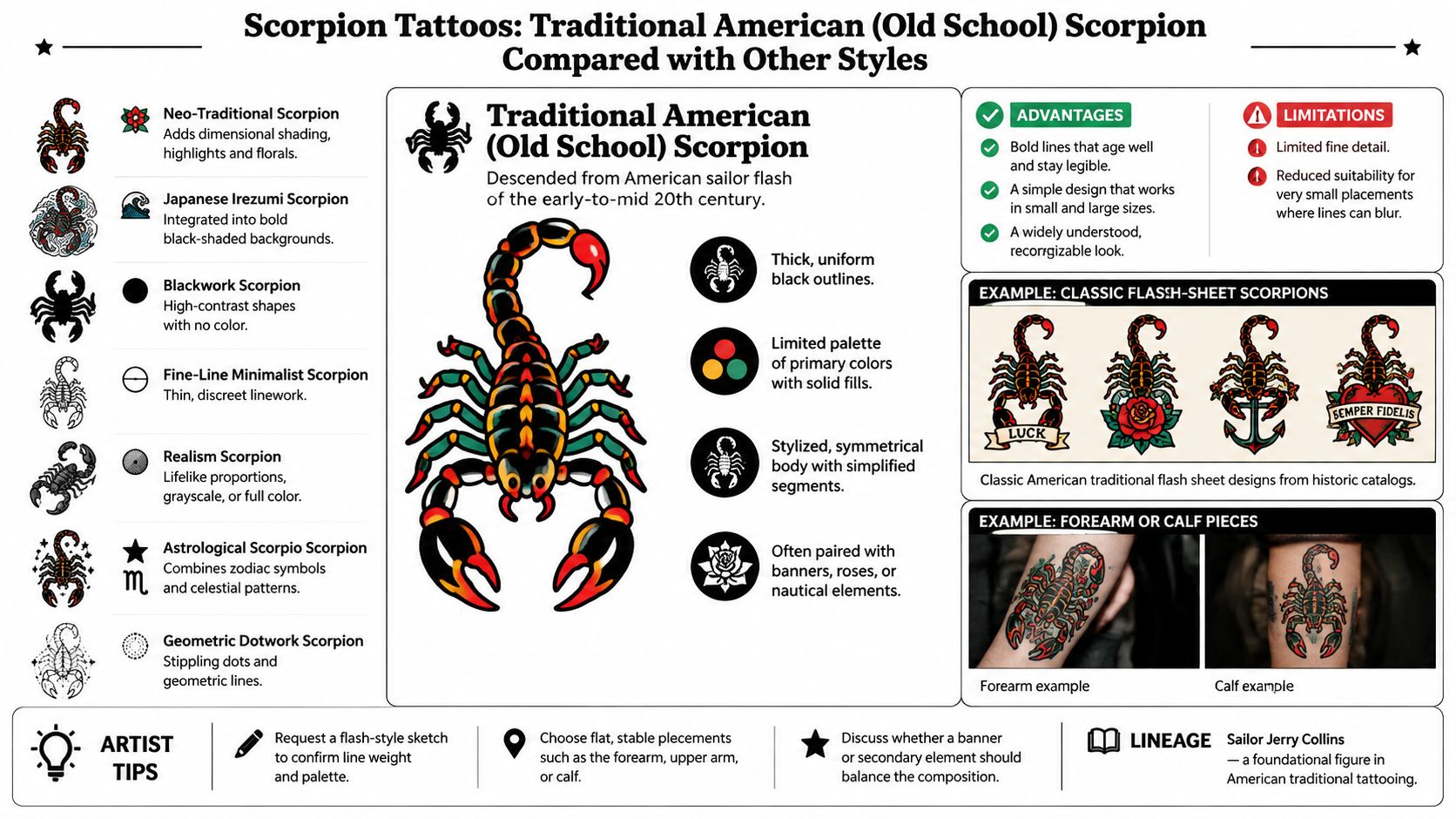
This is the most forgiving style for first tattoos. It's bold, it's quick compared with realism, and touch-ups are straightforward because the shapes are simple.
2. Neo-Traditional Scorpion
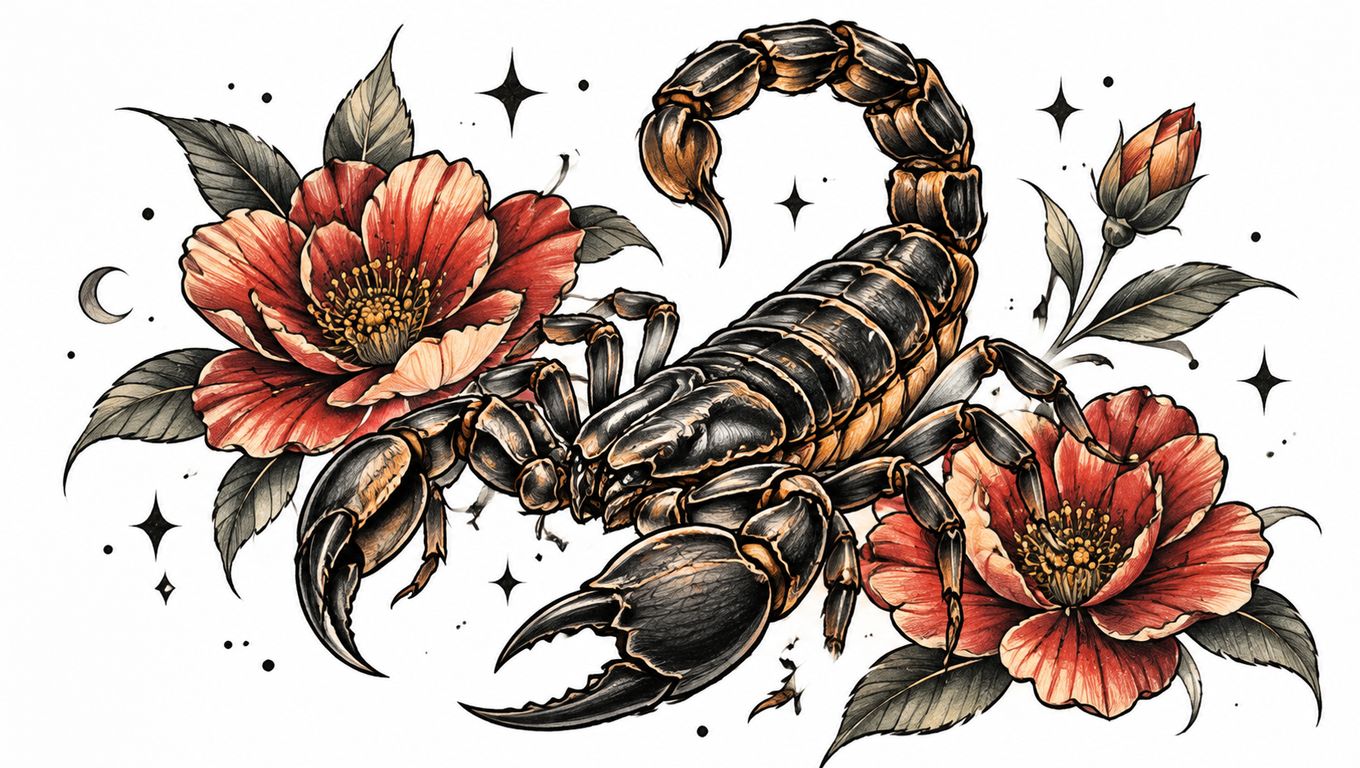
Neo-traditional keeps the bold outline of old school, then adds dimensional shading and richer color. You get blended petals against armor, ornamental filigree behind the tail, and highlights that make the shell look curved. It's the right call when traditional feels too flat.
Picture an upper arm design. The scorpion sits center, claws down, with red florals tucked under the legs and a soft background wash pushing the body forward. The ornament isn't decoration for its own sake. It fills the roundness of the arm and keeps the tail from ending abruptly.
Color Needs a Plan
Use warm color selectively. A 2025 Scientific Reports experiment found simulated sunlight and heat altered the organic orange pigment PO13, causing de-agglomeration and release of soluble compounds, as reported in the Scientific Reports pigment study. That doesn't rule out reds and oranges. It means you shouldn't build the whole scorpion from them.
Anchor with dark contours: Keep black or deep brown carrying the silhouette.
Place warm pigment in accents: Try the stinger, dorsal markings, or florals.
Leave negative space: Uninked skin keeps segments separate if chroma drops.
Check the artist's healed portfolio for consistent saturation. Fresh color always looks loud. Healed work tells you if they pack evenly. Bring references that show your exact ornament level, and budget time for a possible touch-up once it settles.
3. Japanese Irezumi Scorpion
Don't brief this as a single scorpion. Brief it as a scene. In irezumi, the creature moves through waves, clouds, or wind bars, and the background carries the composition across a back, thigh, or sleeve.
That changes everything about scale. The scorpion needs room to twist. The tail should follow a muscle line, not fight it. A back piece might place the body diagonal between the shoulder blades, with wind bars filling the gaps so there's no dead skin breaking the flow. A thigh version can curl the tail around the outer quad.
Watch how large Japanese work uses background to create movement. Then read our guide to choosing a Japanese style tattoo artist before you book anyone. Line consistency over multiple sessions is the skill here.
How to Brief It
Map the full area first: Include where the background starts and stops.
Schedule in sessions: Outline, black shading, then color or grey work.
Test the flow standing up: A stencil that works lying down can distort on a moving shoulder.
I recommend committing to the full composition on paper, even if you tattoo it in stages. Piecemeal additions look patched. Planned negative space and repeating background shapes make later sessions join cleanly. This is a collector's choice, not a walk-in decision.
4. Blackwork Scorpion
Blackwork removes color and bets everything on shape and contrast. Solid fills, graphic segmentation, skin breaks for highlights. Done badly, it's a black sticker. Done well, it's the strongest silhouette on this list.
The mistake I see in briefs is too much black, everywhere. Pack the body solid, pack the tail solid, pack the claws solid, and the anatomy disappears. You need planned voids. Leave skin between tail segments. Carve a light line across the shell. Use stippled or whip-shaded edges to separate legs from the torso.
Placement and Sun
A forearm scorpion with geometric patterning works because the limb is long and the design can stay vertical. Calf and shoulder suit a more curled, compact version. For sun exposed spots, protection matters after healing. UV breaks down pigment over time, and large dark fields show uneven fading quickly.
Read our explanation of what blackwork tattooing involves and bring questions about fill technique to your consultation. Ask how the artist avoids patchiness in large fills. Ask how they will handle gradients if you want them.
Solid black should look smooth at arm's length, not chalky up close and blotchy from across the room.
Aftercare for big black areas is simple but strict. Keep it clean, moisturize thinly, don't pick peeling skin. Pulling a flake early can pull pigment with it and leave a light scar in the fill.
5. Fine-Line Minimalist Scorpion
Fine-line is the most requested small option and the easiest to oversell. A single needle can draw an elegant scorpion for a wrist, ankle, or collarbone. It can't defy how skin heals just because the reference photo was taken on day one.
A dermatology review describes healing through inflammation for up to 10 days, tissue formation for up to 3 months, and remodeling for as long as 1 year, in the dermatology review of tattoo healing. Pigment can migrate during that process. Thin parallel legs and tight tail segments are the first places that visually merge.
Make Small Work
Keep the identifiers big even when the tattoo is small. Exaggerate the claw shape. Widen gaps between legs. Let the tail arc do the storytelling. Fine detail should be an accent, not the only thing proving it's a scorpion.
A typical good use case is a two inch inner wrist piece in profile, with minimal shading and no micro lettering beside it. Behind the ear can work, but hair, glasses, and sun make maintenance harder to judge. Avoid inner fingers and palms. Friction and rapid skin turnover chew up delicate lines.
Choose by healed portfolio photos, not fresh ones. Look for lines that stay separated and consistent after months. If the artist shows only day one work, that's your answer. Go slightly larger than your first instinct. A modest size increase buys years of clarity.
6. Realism Scorpion
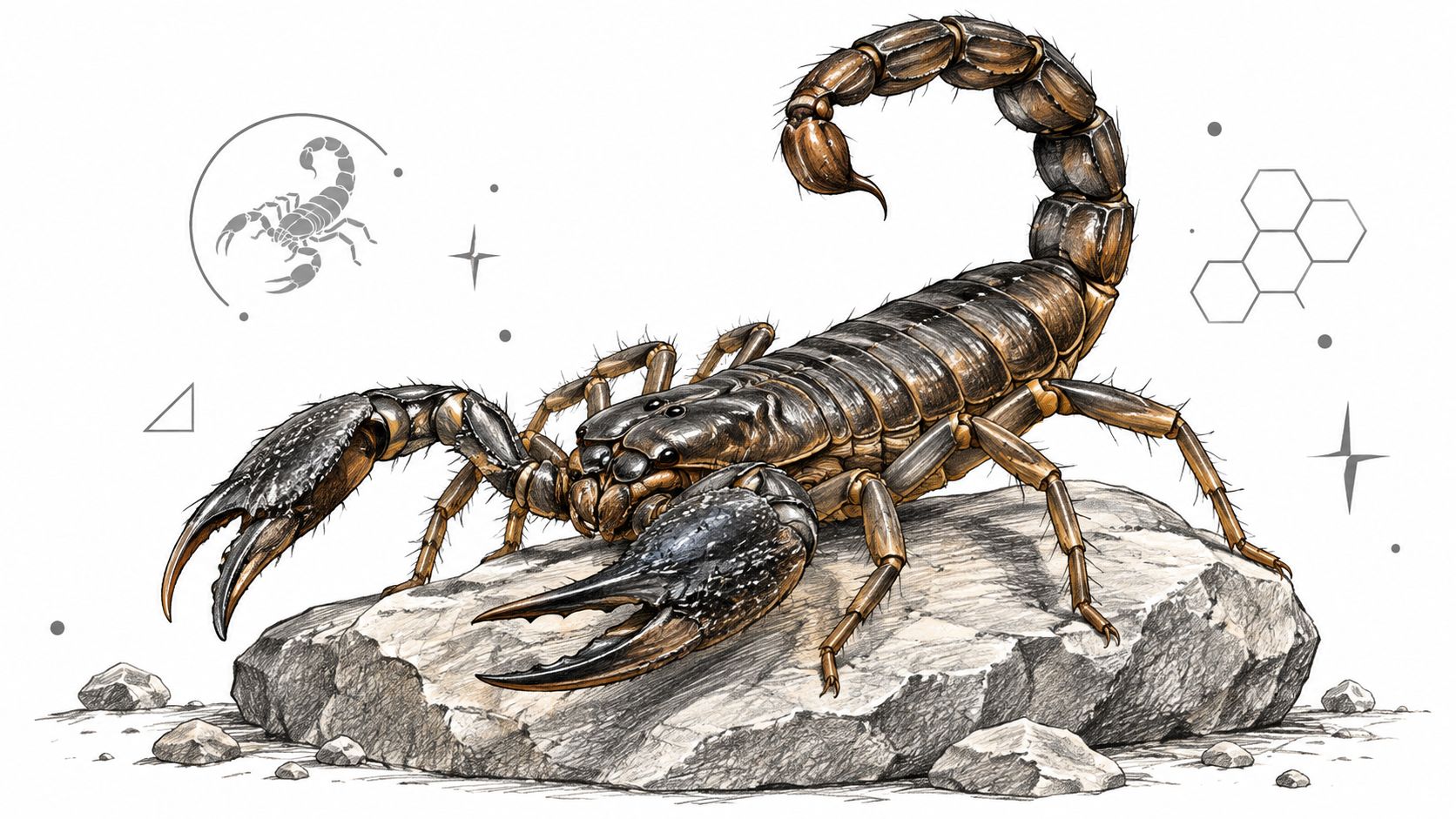
Realism asks the most from everyone. Accurate proportions, shell texture, jointed legs, a stinger that looks three dimensional. Grayscale usually ages more predictably than full color realism, but both need space. Cramming photographic detail into a small area guarantees mush.
Bring high resolution reference photos of one species, not five screenshots of other tattoos. Your artist needs to see how light hits the exoskeleton and where the segments join. Say you want a desert scorpion on the upper arm. A rocky foreground gives contrast under the feet and stops the legs from floating on bare skin.
Pose controls meaning here more than any caption could. A raised, exposed stinger can signal threat, while a curled defensive pose suggests guardedness, a distinction the scorpion tattoo meaning guide lays out. Decide which one you mean. Aggressive isn't automatically more powerful.
Session Reality
Plan for a long sitting or split the work. Ask about the touch-up policy before you start, because soft grey transitions often need strengthening after healing. Protect realism from sun aggressively. When light values fade, depth is the first thing you lose.
7. Astrological Scorpio Scorpion
Decide what you're marking. The astrological sign, the astronomical constellation, or the animal. They overlap, but they aren't identical, and your design will be clearer if you name the priority.
Babylonian astronomers divided the zodiac into 12 equal signs around 500 BCE, each occupying 30 degrees of the ecliptic, according to Britannica's zodiac entry. Modern Western astrology places Scorpio at approximately October 24 through November 21, while precession over an approximately 26,000 year cycle means the sign and the physical constellation have shifted relative to each other.
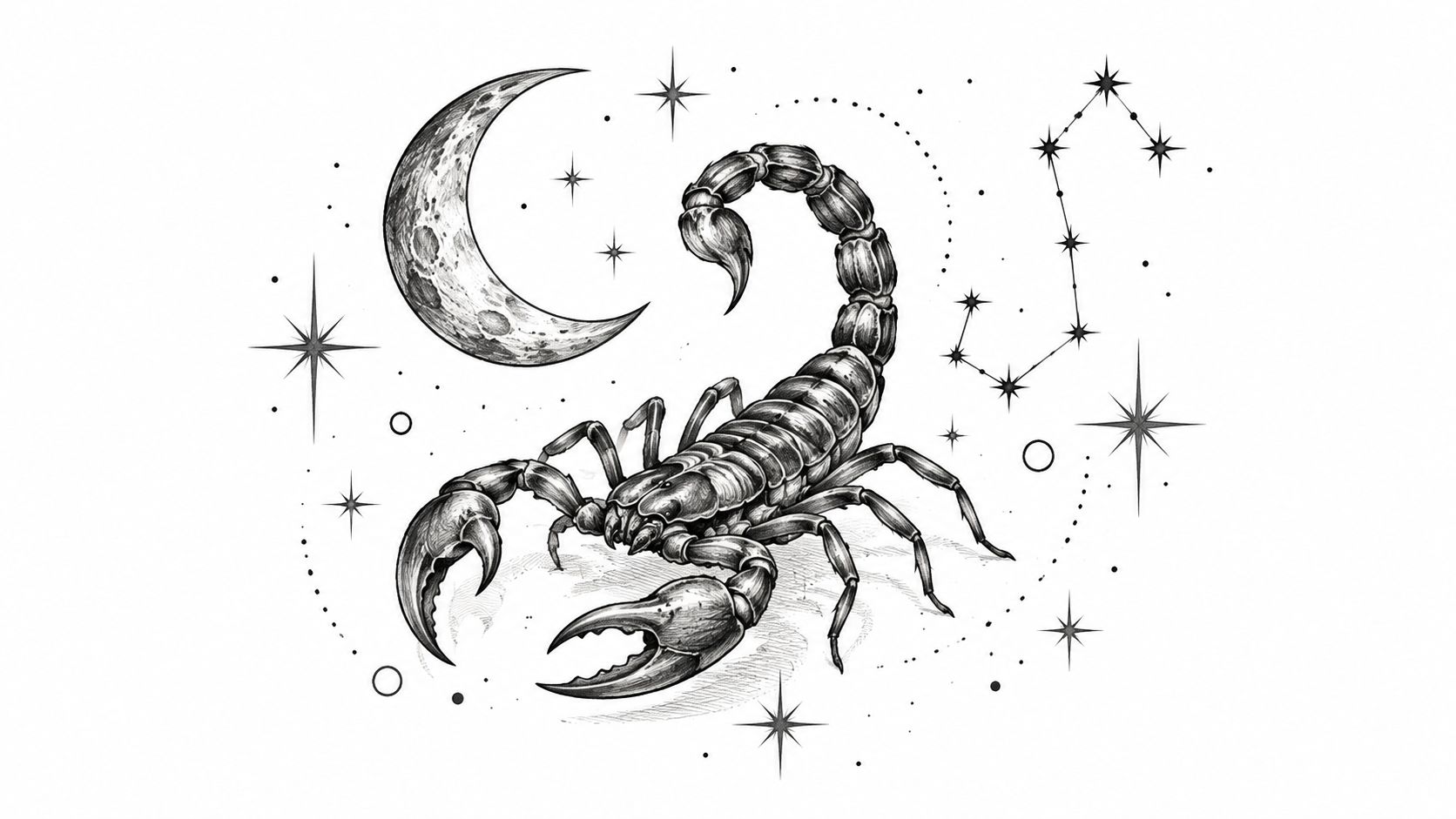
That gives you three clean directions. Use the Scorpio glyph as the focal point with a minimal scorpion beneath it on the collarbone. Build the constellation across a forearm with stars connected by fine lines. Or make the animal dominant and keep celestial elements as background. If astrology is personal for you, Scorpio guidance for love and career may shape the meaning you bring in.
Keep stars large enough to hold. Tiny dots clustered too closely turn into freckles. Tell your artist whether this marks a birth date, identity, or transformation. That answer changes whether the glyph, dates, or constellation deserves the visual weight.
8. Geometric Dotwork Scorpion
Dotwork builds tone from thousands of individual dots. No solid shading passes. Density creates darkness, spacing creates light. Pair that with geometric framing and the scorpion becomes precise, symmetrical, and contemporary.
A sternum piece shows the strength well. The body sits on the center line, claws mirror each other, and a mandala or angular frame expands toward the shoulders. The back and upper arm also suit symmetry. A wrapping forearm design is harder to keep balanced, so the geometry usually needs to stay simpler there.
Spacing Is the Whole Conversation
Dot spacing: Too tight and it heals into a solid smudge. Too loose and it looks unfinished.
Stencil check: Confirm alignment standing, arms relaxed, before any dots go in.
Edge definition: Keep a clean line or clear skin break around the silhouette.
Our breakdown of the dotwork tattoo style explains the technique in more detail. Use it to compare portfolios. Look for even dot size and smooth gradients where stippling fades into skin.
Artist check: Zoom in on healed dotwork photos. Dots should stay round and separate, not bleed into grey clouds.
This style rewards patience. It is slow to apply, especially at larger sizes, and correcting a crooked geometric frame mid-piece is difficult. Approve the sketch, approve the stencil, then let the rhythm build.
Scorpion Tattoo Styles at a Glance
Style | Best Placement | Aging & Durability | Best For |
|---|---|---|---|
Traditional American (Old School) Scorpion | Forearm, upper arm, or calf | Bold lines and solid colors remain legible over time | A recognizable, classic design with strong outlines |
Neo-Traditional Scorpion | Upper arm, chest, or back | Color blends may soften and need touch-ups | A classic look with richer color, shading, and ornament |
Japanese Irezumi Scorpion | Back, thigh, or sleeve | Well-saturated shading ages well | Large, flowing compositions with waves, clouds, or wind bars |
Blackwork Scorpion | Forearm, calf, or shoulder | High contrast stays visible; heavy fills may need touch-ups | A bold, graphic design without color |
Fine-Line Minimalist Scorpion | Wrist, ankle, behind the ear, or collarbone | Fine lines may blur over time, especially in high-friction areas | A discreet, simple tattoo or first tattoo |
Realism Scorpion | Upper arm, back, or chest | Fine detail may soften and need refreshing | A lifelike, highly detailed scorpion |
Astrological Scorpio Scorpion | Wrist, collarbone, or forearm | Keep symbols simple for lasting clarity | A personal design combining scorpion imagery with zodiac symbolism |
Geometric Dotwork Scorpion | Sternum, back, upper arm, or forearm | Dense dotwork may blur or lose clarity over time | A precise, textured design with geometric patterns |
From Idea to Ink: Getting Your Scorpion at Think Tank Tattoo
Every style here lives or dies on execution. Match the design to the placement. Choose an artist whose healed portfolio proves that specific technique. Talk through composition, size, and sun exposure before a needle touches skin. That conversation prevents most regrets I hear about.
Safety belongs in that conversation too. Medical literature records immediate and delayed reactions ranging from irritation and infection to hypersensitivity and granulomatous changes, and an MRI safety review describes fewer than ten documented cases in its historical database, as summarized in the medical review of tattoo complications. That's context, not a reason to panic. Disclose tattoos to imaging staff, follow licensed hygiene practices, and get medical advice if anything unusual happens.
At Think Tank Tattoo in Denver, we offer complimentary consultations so you can refine concept, placement, and sizing first. Our eight artists are Jake Bray, Jason Lukach, Dj Chilcote Jr, Sky James, Eric Griffin, Lewis Stewart, Kevin Waltz, and Aimee Hwang. We've worked since 2002 from a 3,000 square foot open studio at 172 S. Broadway, Denver, CO 80209, built for collaboration between artists and clients.
Booking works like this. Call or text (720) 932-0124, or email thinktanktattoo@gmail.com. We're open Tuesday through Saturday, 12pm to 8pm, for clients 18 and older. Appointments require a $100 non-refundable deposit and our shop minimum is $100, but don't send a deposit until an artist or staff member directs you to do so.
Bring reference images, your placement shortlist, and honest answers about sun exposure and how visible you want the piece to be. If you're saving video references or building a concept reel, ClipNova's AI video creator is one tool people use to organize visual ideas. What matters most is that your references show style, pose, and scale clearly.
Ask direct questions. How will the legs stay separate? Where's the negative space? What changes if we go one inch smaller? A good artist welcomes those questions and answers with a drawing, not a shrug. That's how you leave with a scorpion built to stay readable for decades.
Ready to turn one of these scorpion tattoos designs into a custom piece built for your placement and style? Visit Think Tank Tattoo to start with a complimentary consultation and talk through your concept with our Denver artists. Bring your references and questions, and we'll help you refine the design before you book.
Comments