
Beach Scenery Tattoos: 7 Designs, Placements, and Ideas
You want a beach tattoo that still reads as a beach two years from now, not a soft blur of teal and beige. Most disappointing pieces fail for predictable reasons. The scene was too small for its details, the style couldn't carry fine lines, or the placement fought the way the skin bends and creases. This roundup covers seven beach scenery tattoos, from a curling ocean wave and a palm silhouette to a sea turtle and a lighthouse. Each design gets the same check. What it means, which style carries it, the smallest size where the key detail stays legible, and which body areas hold it over time.
A literature review of tattoo prevalence found estimates ranging from 0.18% to 63.9% worldwide, and from 5.2% to 35.3% in developed countries, with a rising trend among younger age groups, per a PubMed record of that review. Those ranges don't isolate beach motifs. They do show how many people can turn a shoreline, a move, or a wish for calm into a custom piece.
Table of Contents
1. The Great Wave (Hokusai-Inspired Ocean Wave)
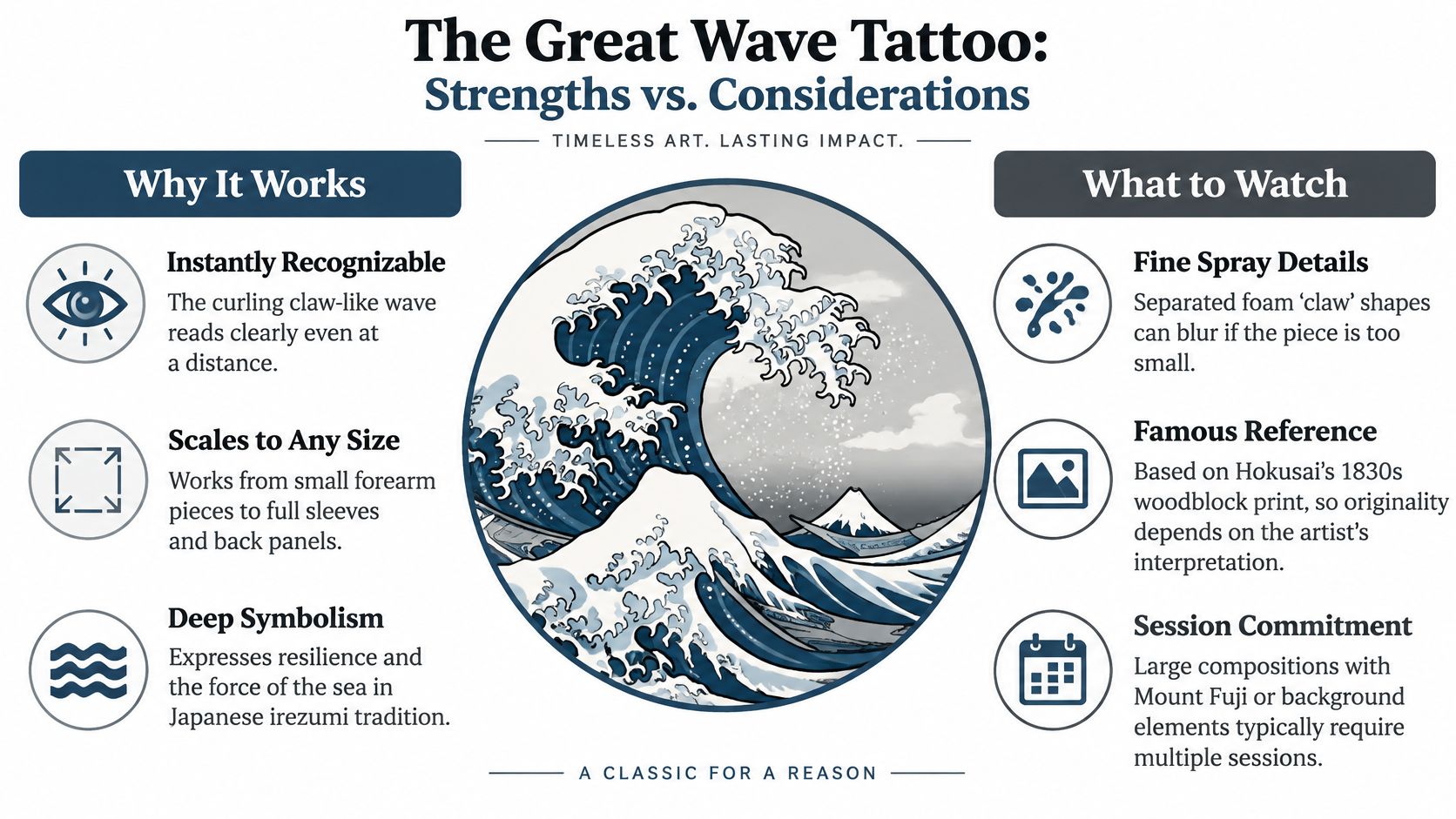
The Great Wave is the curling wave in Katsushika Hokusai's The Great Wave off Kanagawa (c. 1830–1832), with foam fingers over Mount Fuji or open water. It means power, movement, and respect for the sea, not a quiet postcard.
Style, size, and placement
Irezumi, neo-traditional, and black-and-grey carry it because bold outlines keep each foam finger separate. Pale spray fades first. Shorter than a full outer forearm panel, the fingers merge into one claw. I recommend the outer forearm or the outer thigh so the wave reads as one composition. A wrist can't hold Fuji and the full curl, so switch to a simpler original wave, the same limit covered in wave tattoos on the wrist.
Reference: Say whether you want the Hokusai print or your own wave in that style.
Flow: Ask to bend the spray with the arm or thigh so the curl follows the muscle.
Sessions: Wave plus background is multi-session work. One sitting means a simpler curl.
A cropped curl with no room for the foam looks like a splash, not a scene.
Watch how the lines move before you lock the crop.
Say the print goes on an outer thigh long enough that Fuji stays separate, and you book two sessions. To tie the shape to real water, understand how ocean waves develop, then cut extra spray that won't stay sharp.
2. Palm Tree Silhouette
A palm, or a short row of them, against a horizon is the simplest beach scene that still says vacation, freedom, and island time. Blackwork and American traditional hold. Fine line looks crisp on day one and softens when fronds touch.
The gap that keeps it readable
Negative space between fronds is the design. If leaves touch on the stencil, they heal as one dark mass. A small silhouette can sit on the inner wrist or ankle. Separate leaves need a calf or upper arm. More shape options sit in our palm tree tattoo designs notes.
Practical rule: If you can't see gaps between the leaves on the stencil, the piece is too tight or too small.
A population-based study found that 67.5% of tattooed participants reported moderate-to-heavy lifestyle sun exposure, compared with 61.3% of people without tattoos, and tattooed participants were also more likely to use sun protection, according to JEADV Clinical Practice. Sunscreen helps, and it can also keep you outside longer. A pale palm on a bare forearm needs heavier lines than one that lives under a shirt.
Say you want one palm on an inner ankle after a move inland. Keep it a silhouette, skip tiny coconuts, and cover it on long hike days.
3. Sea Turtle
A sea turtle over sand or a low wave stands for longevity, navigation, and a bond with the ocean. People choose it after coastal travel or because the animal matters to them. Fine line, watercolor, and realism can all do it, and each one fails in a different spot. Realism needs scutes. Watercolor needs a touch-up plan. Fine line needs length so flippers don't turn into sticks.
The shell fails first. On a short curve, like the side of a hand, the pattern collapses. Forearm, shin, and shoulder blade give a long, smooth run.
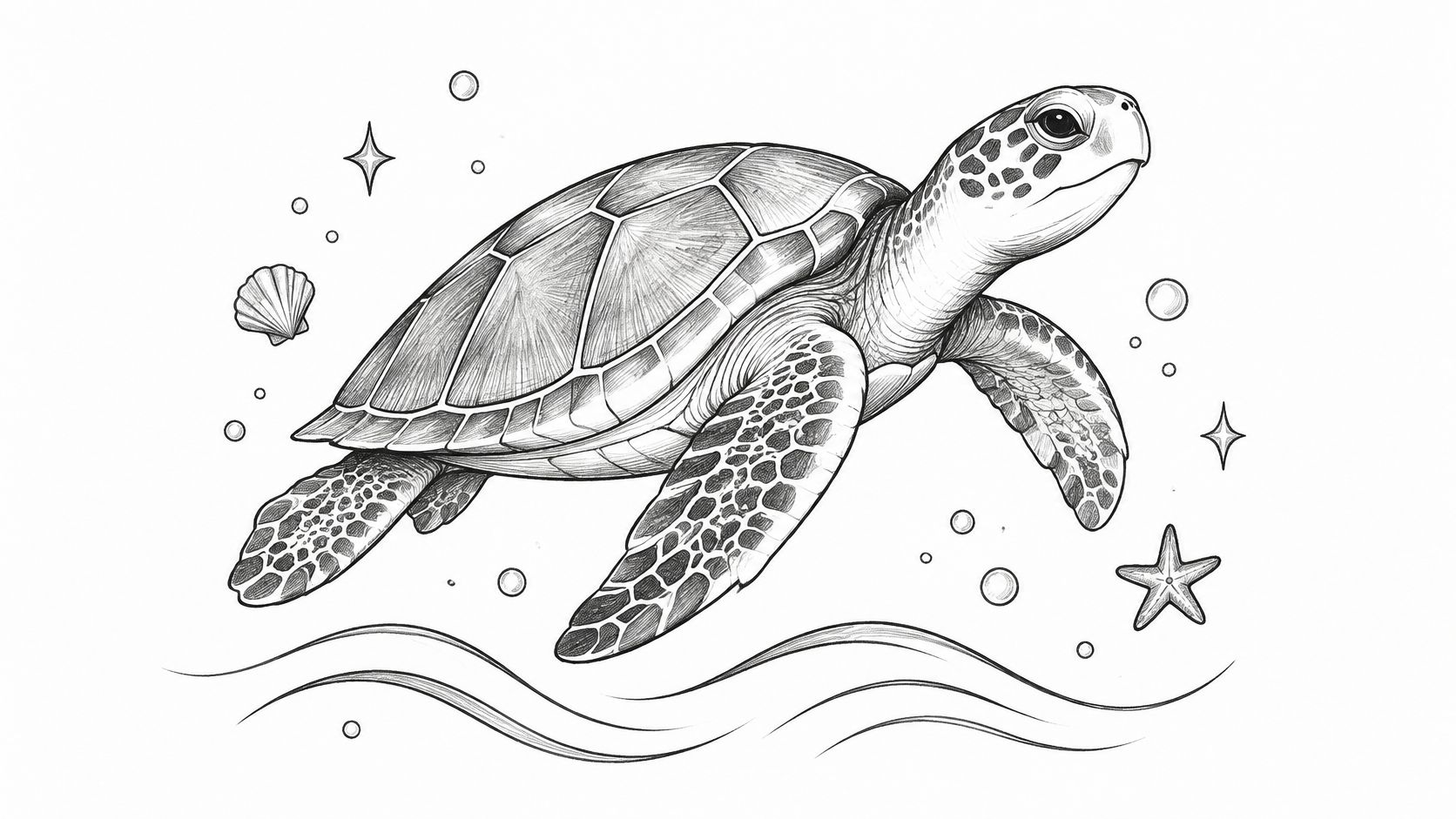
That drawing keeps shell, flipper, and water as separate lines. Scale those gaps up, because skin closes small gaps as it heals.
Shell first: Lock the pattern and the head-to-flipper ratio before any color.
Watercolor: Ask how it should look after one summer, and whether a touch-up is part of the plan.
Healing: Stay out of pools and the ocean until the skin is settled, then cover exposed spots in hard sun.
Marine animals follow one rule, the same one behind 3D shark tattoos. The body has to be long enough that fins read as fins. If the turtle is tied to a real coast, explore Oahu's sea turtle habitats so the setting isn't generic. A shoulder-blade turtle about as wide as your hand can hold a simple scute pattern in black and grey. A coin-sized turtle on the ankle can't.
4. Lighthouse and Waves
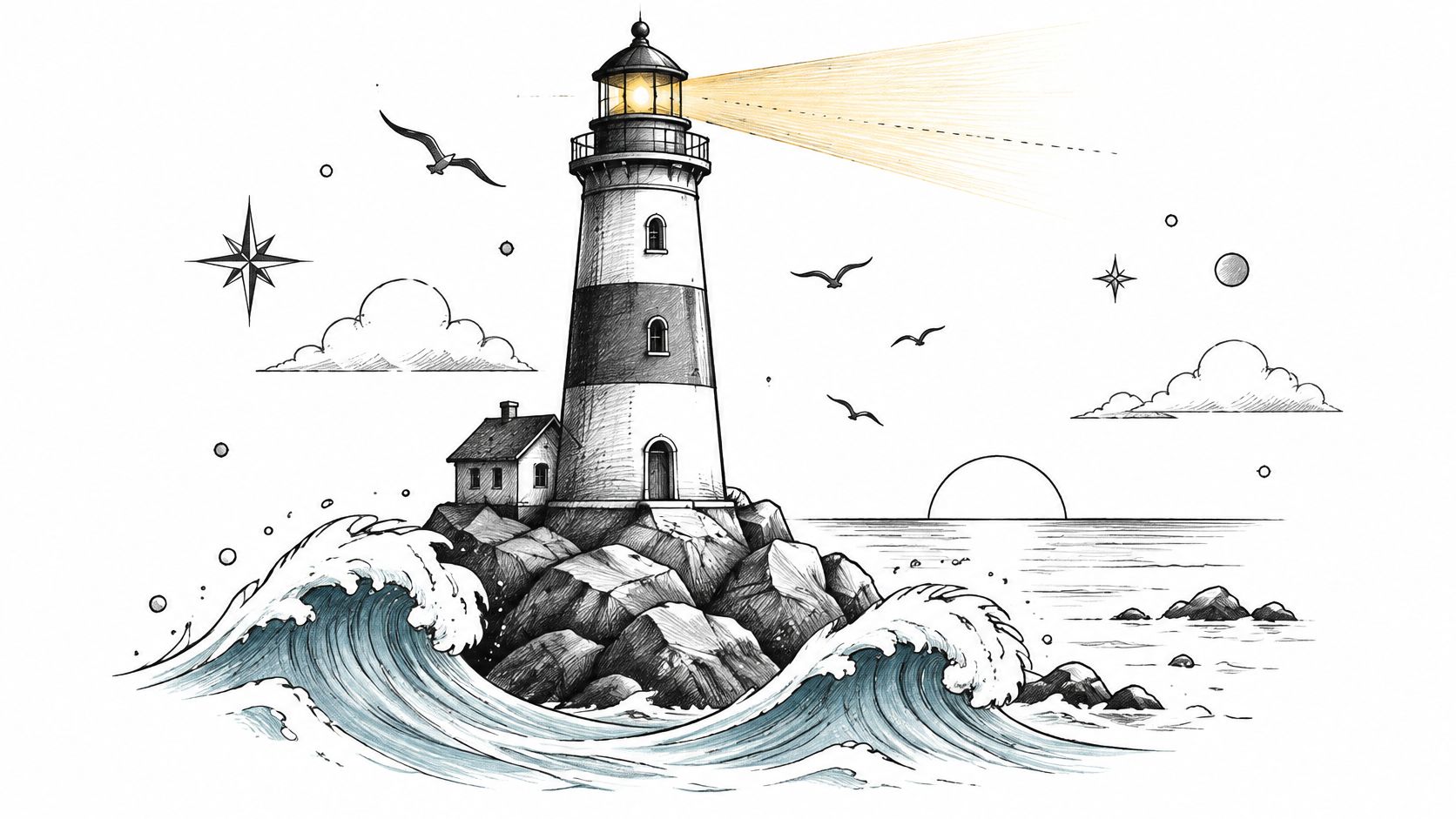
A lighthouse on rock, with waves at the base, means guidance, safety, and getting home. It fits travelers and anyone who has relocated. The tower is a strong vertical shape, so American traditional and nautical bold line carry it better than hairline window detail.
Sailor tattooing supplies the roots. A Kitsap Sun museum feature traces the trade from Captain James Cook's 1769 observations in Tahiti through the late 18th century, when roughly one-third of British sailors and one-fifth of American sailors reportedly carried at least one tattoo, to the 1891 electric tattoo machine and, by 1900, a studio in every major American city. Lighthouses sit in that later shore vocabulary, beside ships and anchors, as a mark of return.
The tower has to stay a simple solid shape, like this drawing, before you add waves.
Sizing and placement check
I want a bold outline and a simple lantern, not a railing that only exists in the stencil photo. The lantern room and the wave line are the two details that fail first, so the piece needs enough height to keep them separate. Outer thigh, calf, or upper back give the waves room without dumping detail into a knee crease. A wrist tower becomes a peg with a dot of light.
Pick a real lighthouse if the coast matters, and drop the gulls and tiny rocks.
Say the piece marks a move to Denver and sits on the calf. Draw the tower, two waves, and open water. That is the whole brief, and the tower still reads at arm's length years in.
5. Scallop Shell (Venus-Inspired Seashell)
A scallop shell, alone or with a strip of shore, carries the classical pull of Sandro Botticelli's The Birth of Venus (c. 1484–1486). Birth, renewal, and beauty. Fine line, dotwork, and minimal black work suit a single fan. The ridges are the test, not the outline.
Ridge check
If the fan is only a couple of centimeters wide, the ribs heal into one grey wedge. I want the shell large enough that several ridges still separate at arm's length. That means more than a coin, and often closer to palm width once you add water. Pair it with one wave or a horizon if you want the mark to read as a place, not a symbol floating alone. Don't stack pearls, starfish, and script in the same small piece.
A shell without readable ridges is just a fan-shaped stain.
Sun cover slows fade on those fine ribs, especially on an arm that stays bare. Dotwork on the upper arm, ridges as spaced dots, and no micro-lettering inside the fan is a clean build. Inner wrist only works if you accept a bold silhouette with two or three ribs, not a full Venus scene.
6. Sunset Over the Horizon
A sun on a flat ocean line, with a few wave bands or one palm, is the calm version of a beach. Watercolor, blackwork, and minimal work all get asked for. The feeling is dusk. The build problem is the gradient.
Color, sun, and reactions
Keep the horizon line heavier than the sky. Peach and gold bands go first. A solid sun disk and two dark wave lines outlast a soft wash on an open calf.
A dermatology study notes that the longevity of UV-reactive tattoo ink may depend on ultraviolet exposure, but the evidence came from a single-patient observation and has not established lifelong durability, per a PMC case report. Don't treat UV accents in a sunset as carefree. On an exposed forearm, shoulder, or calf, keep standard opaque pigment separate from anything that only shows under blacklight, and plan on touch-ups.
In a beach study of 144 tattooed sunbathers, 42% reported tattoo complaints, and among those complaints 52% were sun-related, including swelling, itching or stinging, pain, and redness, while sunlight-related reactions have occurred in up to 20% of tattoo cases and are especially described with traditional yellow and red pigments, per this clinical paper. A red-yellow-orange sky isn't an automatic no if you get sun rashes or you've reacted to pigment. It is a screening talk, plus a dermatologist if a reaction doesn't settle. Fresh tattoos stay out of sun and tanning beds, because exposure can add odd color, fade, or cracking.
The mood belongs to a real evening, the kind you get on an intimate evening aboard a wooden schooner, not a stock orange circle.
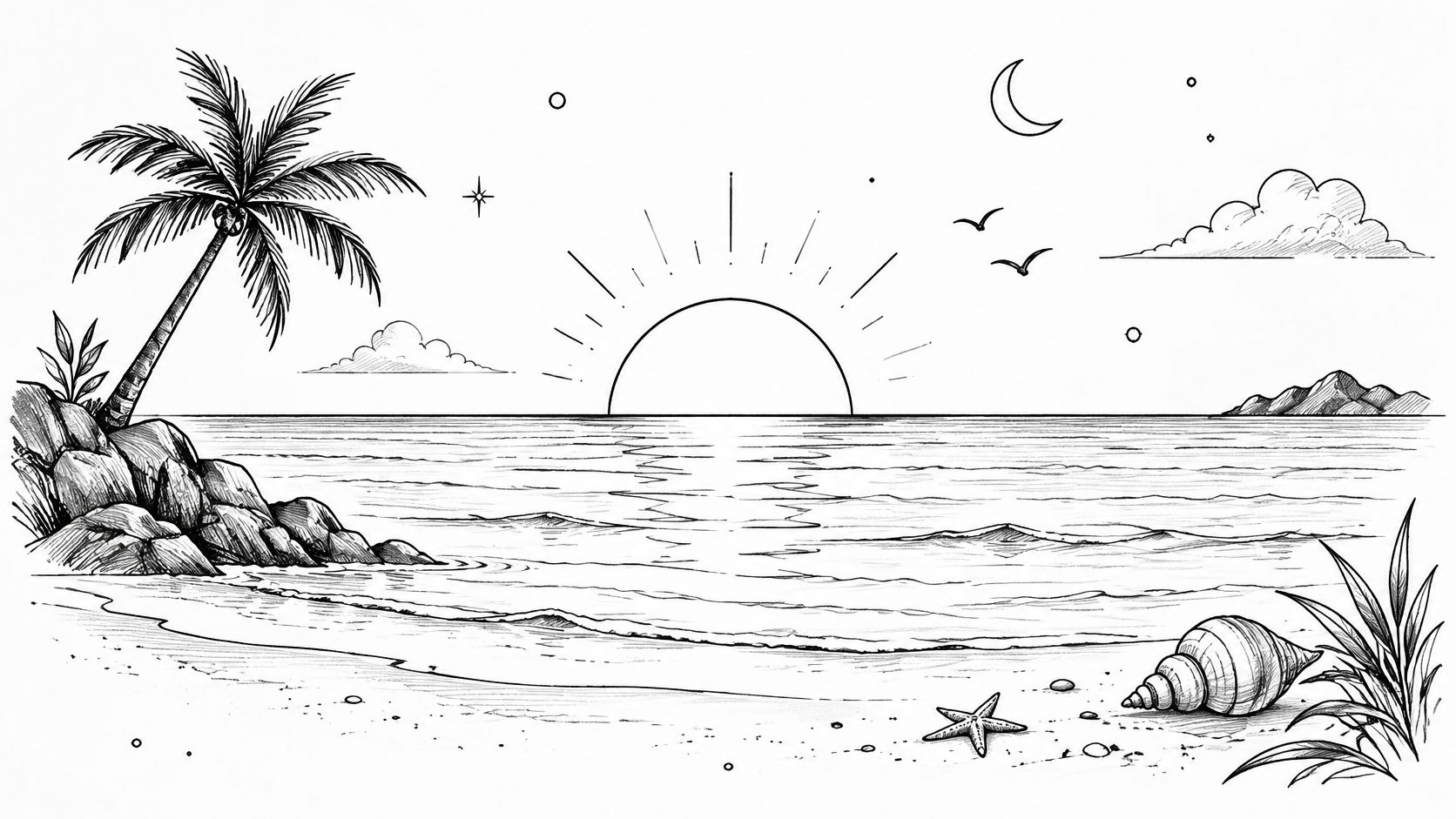
Use that drawing as a map of shapes, then decide which lines get bold. A blackwork horizon on the inner bicep, covered by a shirt at work, with one touch-up after the first year of Colorado sun, is a sane plan.
7. Surfboard and Wave (Surf Culture)
A surfboard with a wave, sometimes a palm, is surf culture in one frame. It fits people who surf, travel, or still claim a coast after moving inland. Traditional, neo-traditional, and bold line work. A single-needle rail looks sharp in a photo and breaks up on skin.
The board is the portrait
Pick a real outline. A fish, a longboard, and a shortboard are different shapes. Use a thick rail line, simple fins, and one curl. Skip a logo you need a magnifier to read. Upper arm or thigh fits the board plus a wave. A wrist turns the board into a stick.
The global tattoo market was estimated at approximately USD 2.44 billion in 2025 and is projected to reach USD 5.86 billion by 2035, a 10.2% compound annual growth rate, while North America accounts for 42% of the market, 46% of millennials and 32% of Gen Z have adopted tattoos, and customized and fine-line work are important demand trends, according to Business Research Insights. I still won't put hairline rails on a board just because fine line is in demand. Bold custom line holds the shape you ride.
Say the piece is a neo-traditional shortboard on the outer upper arm, nose toward the shoulder, one wave behind it. Add a palm only if the arm still has length after the board is drawn.
How the seven beach scenery tattoo designs compare by style, placement, and main trade-off
Item | Style Notes | Best Placements | Main Trade-off |
|---|---|---|---|
The Great Wave (Hokusai-Inspired Ocean Wave) | Traditional Japanese, neo-traditional, black-and-grey | Outer forearm, calf, thigh, upper back, ribs | Fine spray details may blur at small sizes; larger compositions take multiple sessions |
Palm Tree Silhouette | Blackwork, fine line, traditional | Inner wrist, ankle, upper arm, calf | Common design; delicate fronds may fade or spread |
Sea Turtle | Fine line, watercolor, realism | Forearm, shin, shoulder blade, upper back | Shell details need space; watercolor may require touch-ups |
Lighthouse and Waves | American traditional, nautical, neo-traditional | Upper arm, outer thigh, calf, back | Full scenes need space; small lantern details may blur |
Scallop Shell (Venus-Inspired Seashell) | Fine line, dotwork, minimalist | Inner wrist, ankle, collarbone, behind the ear | Fine ridges can blur at small sizes; dotwork may need touch-ups |
Sunset Over the Horizon | Watercolor, blackwork, minimalist | Forearm, calf, upper back, ribs | Gradients and thin horizon lines may fade; larger scenes need space |
Surfboard and Wave (Surf Culture) | American traditional, neo-traditional, bold line | Upper arm, thigh, calf, back | Can look generic without personal details; small fin details may blur |
Choose Your Beach Scene and Book a Consultation
Pick the one beach scene that matches your story, then confirm three decisions before you book. You need the style that will hold the details, the minimum size where the key element stays legible, and the placement that fits how the design will be seen and how the skin moves.
Style: Bold line or black-and-grey if the spot sees a lot of sun.
Size: The key detail has to read at arm's length, not only in the stencil photo.
Placement: Outer arm, calf, thigh, or back for full scenes. Wrist and ankle for simple silhouettes only.
A wave needs a full panel so the curl reads. A palm needs gaps. A turtle needs a shell you can still parse. A lighthouse needs a thick tower. A shell needs ridges. A sunset needs a horizon darker than the sky. A surfboard needs a real outline. If the reference only works as a phone wallpaper, it's too detailed for the spot you chose.
The U.S. tattoo artist industry generated approximately USD 1.6 billion in revenue in 2023, according to Accio's industry summary. That figure doesn't choose your scene. It does mean you can work with an artist who redraws a coast for your arm, your sun habits, and how often you swim or hike.
Bring reference images and a short list of personal details to a consultation with one of the eight artists at Think Tank Tattoo, including Jake Bray, Aimee Hwang, and Kevin Waltz. We talk through design direction, placement, and timing in our 3,000 square foot studio at 172 S. Broadway, Denver, CO 80209. The shop has been open since 2002, Tuesday through Saturday, 12pm to 8pm, and we tattoo clients 18 and older. Call or text (720) 932-0124, or email thinktanktattoo@gmail.com. Appointments are booked by phone or email. We offer complimentary consultations. A non-refundable $100 deposit is required before any tattoo appointment, and the shop minimum is $100. Don't send a deposit until an artist or staff member directs you to.
Think Tank Tattoo builds custom beach scenery tattoos in Denver, from a single palm silhouette to a multi-session wave or lighthouse. We size and place each piece so the detail you care about still reads after sun, swimming, and ordinary movement. Visit Think Tank Tattoo to meet the artists and book a conversation about your coast.
Comments