
Custom Tattoo Design Prices in Denver: 2026 Guide
A client arrives with reference images, a placement in mind, and two quotes that seem to describe different tattoos. Before judging either price, check what each estimate covers.
The Kin Ink 2025 global tattoo pricing guide lists broad benchmarks: $50-$150 for small, simple tattoos, $150-$450 for medium tattoos, $800-$2,000 for half sleeves, and $2,000-$6,000 for full sleeves. These are not Denver studio quotes. A typical quote may use estimated hours and the artist's rate, with separate charges and a shop minimum, though artists structure pricing differently.
Custom tattoo design prices remain ranges until the artist sees the design. Compare the full job, including drawing time, revisions, sessions, deposits, and touch-ups. A lower quote can cost more if rushed design work or missed revisions leave you paying to correct a choice you regret.
Table of Contents
Custom Tattoo Prices by Size at a Glance - Compare the scope, not just the outline
Artist Rates and Shop Minimums Set the Floor - Shop minimums are a separate policy
Six Factors That Move a Custom Quote - Ask what's driving the hours
What a Custom Quote Actually Includes - Separate the deposit from the total
Four Denver Scenarios Worked Out in Hours and Dollars - Large projects need a completion plan
When a Cheaper Tattoo Ends Up Costing More - Compare the decision, not just the purchase
Get an Accurate Quote Before You Book - Prepare a request the artist can price - Leave with a usable agreement
Custom Tattoo Prices by Size at a Glance
Two clients bring in similar-sized sketches. One wants an open, bold design; the other wants tightly packed detail and custom lettering. Their quotes come back far apart, and both want to know whether the price is fair.
Start with size benchmarks, then look at the work behind them. The following ranges come from Kin Ink's 2025 global tattoo pricing guide, not a Denver studio's current price list.
Tattoo type | Typical price range | What it usually involves |
|---|---|---|
Small, simple tattoo | $50-$150 | Limited detail and relatively little design development |
Medium tattoo | $150-$450 | More space for composition and custom elements |
Half sleeve | $800-$2,000 | An arm section planned as a connected design |
Full sleeve | $2,000-$6,000 | Full-arm composition and extended design work |
These are starting benchmarks, not quotes. They don't establish what a particular artist must charge or guarantee that a complex custom project fits inside the range. The description matters as much as the dimensions.
Compare the scope, not just the outline
A small drawing isn't automatically a quick drawing. Detailed linework, custom typography, and specialized color work can make a compact design more involved than a larger, simpler composition.
Think about the estimate through three questions:
How much work is involved? Ask what the artist must develop, prepare, and execute.
Who's doing it? Compare relevant portfolios rather than treating artists as interchangeable.
How will it be scheduled? Find out whether the estimate covers the finished piece or only the first appointment.
Denver clients should use broad price guides as a starting point for conversation, not as a ceiling. Local booking demand and artist reputation can shift the estimate, while the actual drawing determines whether the comparison makes sense.
A fair comparison starts with the same design scope, the same placement, and the same definition of “finished.”
Artist Rates and Shop Minimums Set the Floor
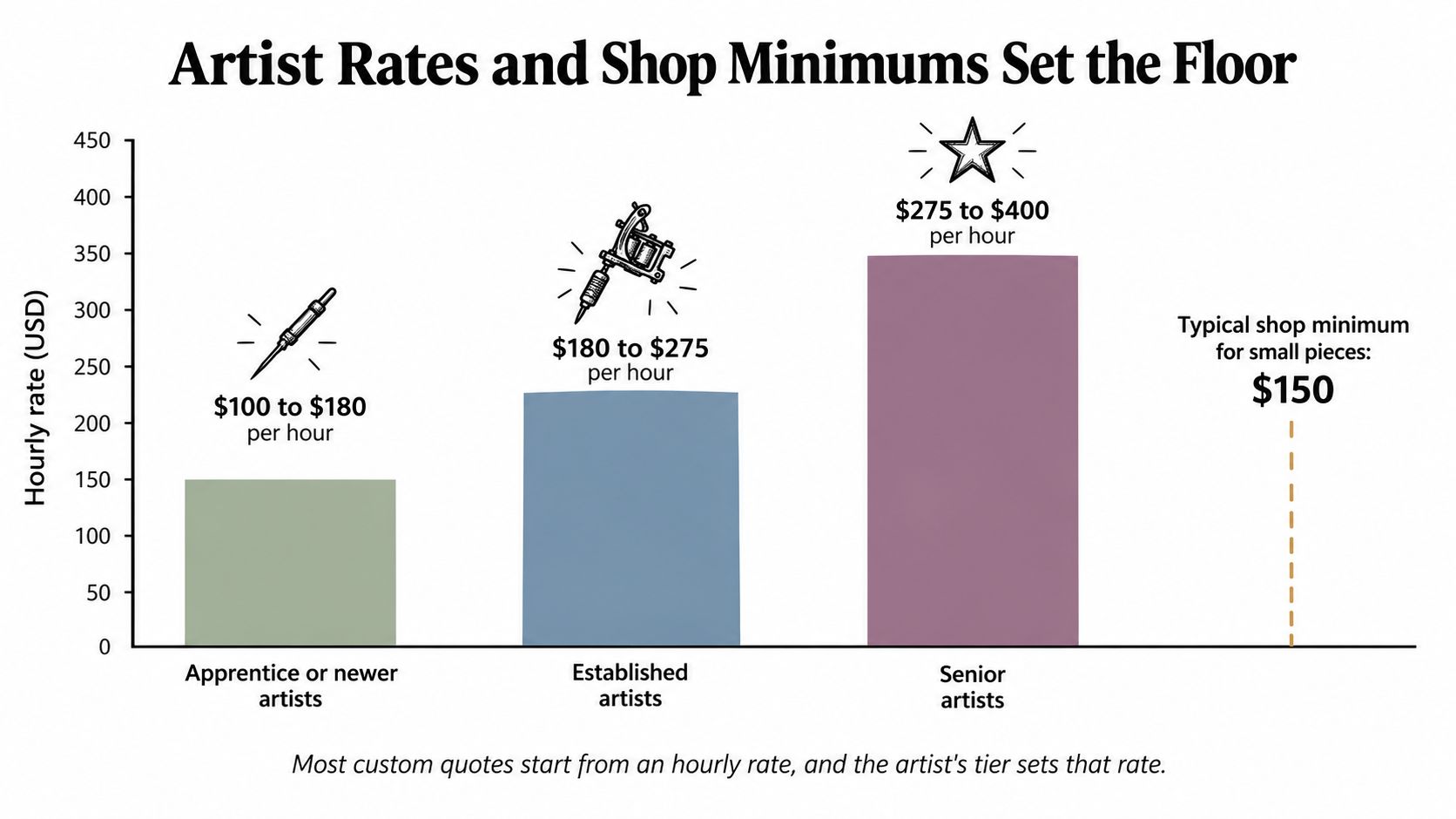
You bring a small custom design to a Denver studio and ask for a quote. The artist's hourly rate helps set the starting point, but it won't tell you the full cost until the artist sees the design and explains how the studio charges. Tatulogue's published U.S. hourly-rate and studio-minimum benchmarks give approximate reference figures; studios and artists set their own rates.
Artist level | Approximate hourly rate | How it may affect a quote |
|---|---|---|
Apprentice or newer artist | $100-$180 per hour | Lower published tier; review relevant work closely |
Established resident artist | $150-$250 per hour | Reference range for established custom artists |
Senior or highly booked specialist | $250-$400 per hour or an open-ended higher rate | Published range has no fixed upper limit |
Guest or specialist artist | $300-$500 per hour or an open-ended higher rate | Published range has no fixed upper limit |
Shop minimums are a separate policy
Tatulogue's published benchmark for shop minimums is $80-$150. A minimum is the studio's floor charge, not another fee to add automatically to an hourly estimate. Ask whether it replaces a lower calculated total, applies to each appointment, or follows another studio policy. The artist or shop must confirm its current pricing.
Even a brief tattoo appointment takes preparation and setup. A custom quote may also account for drawing time, revisions, placement decisions, and aftercare guidance. Ask what the quoted amount covers, how many revisions are included, and whether a deposit is credited toward the tattoo. For work split across appointments, confirm whether the estimate covers the whole design or only the first session. Ask whether touch-ups are included or charged separately, too.
Before booking, get clear answers:
Rate structure: Is the price hourly, fixed for the piece, or set per session?
Billable time: Which parts of the appointment count toward the charge?
Minimum policy: How does the shop minimum apply to this project?
A higher rate alone does not guarantee a better result. Check the artist's portfolio for the style you want, and use this guide to choosing a tattoo artist to assess the fit. A lower hourly rate can still mean a higher total if the artist expects more billable time. Compare the proposed process and what happens if the design needs changes, not just the rate. Budget for a well-planned result; fixing a tattoo you regret can cost more than the original savings.
Six Factors That Move a Custom Quote
An artist needs more than a subject to estimate the work. “A rose on my arm” leaves too many decisions open; a reference, approximate dimensions, placement, and color direction make the conversation useful.
These are the factors to discuss. Treat the comparisons as questions for your artist, not automatic surcharges.
Size changes the scope. Compare a compact version of a design with an enlarged version. Ask whether enlargement means simply scaling the drawing or adding texture, background, and other elements that change the workload.
Detail changes the execution. Fine lettering and a bold symbol may occupy the same space but ask different things of the artist. If the quote feels high for something small, ask which details account for the time and whether simplifying them preserves the idea.
Placement changes the plan. Don't assume an upper-arm estimate transfers unchanged to a hand, elbow, or rib placement. Have the artist explain whether the proposed location changes positioning, stencil preparation, execution, or the recommended design.
Color changes the brief. A full-color rose and a black-and-grey rose aren't interchangeable requests. Ask what the proposed palette adds to the process instead of assuming that every color tattoo carries the same premium.
Session count changes the commitment. A single appointment and a staged project require different scheduling and payment plans. Confirm whether preparation is included each time and whether the artist anticipates finishing a defined section at each visit.
Revisions change the agreed scope. Adjusting a leaf is different from replacing the central subject after approval. Ask where ordinary refinement ends and a new drawing fee begins.
Ask what's driving the hours
These choices can combine. A compact, detailed, colorful design in a highly visible location deserves more discussion than its small footprint might suggest.
Practical rule: Ask which design decision drives the estimate. That gives you something useful to adjust without bargaining over craftsmanship.
If the budget doesn't fit, ask for a revised scope rather than asking the artist to rush. Removing background detail or changing the composition may be more workable than shrinking every element.
Use the video as another conversation starter, then confirm how your own artist handles the project.
What a Custom Quote Actually Includes
A custom tattoo is partly a creative-service purchase. You're paying for an agreed process and result, not just the period when the machine is running. That's why a useful estimate separates the work from the payment terms.
The checklist below is a way to question a quote, not a promise that every studio includes every item.
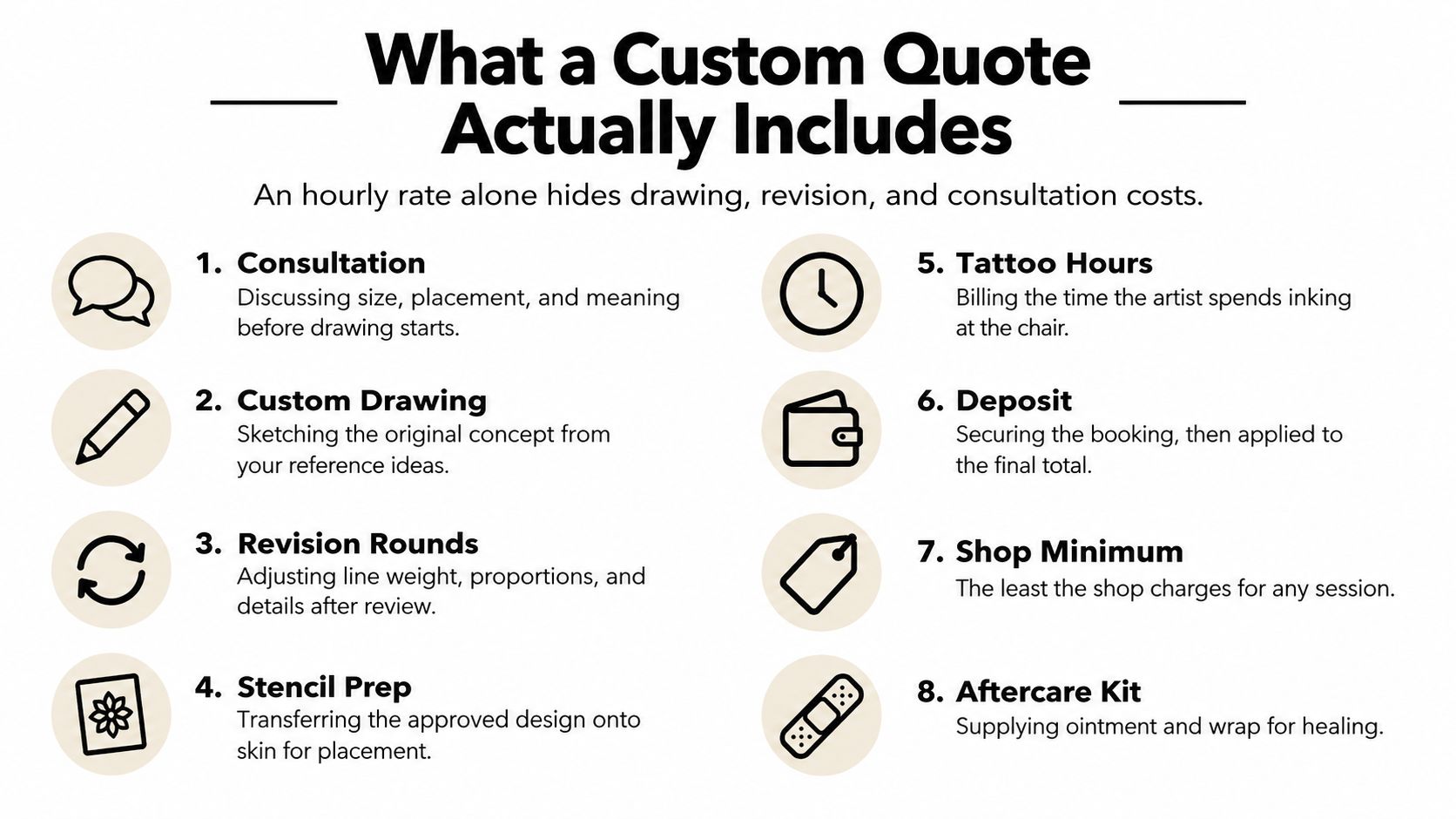
Line item | What it covers | Question to ask |
|---|---|---|
Non-refundable deposit | Reserving the appointment under the booking terms | Is it applied to the final price? |
Consultation | Design direction, placement, and timing discussion | Is the consultation free? |
Drawing or design time | Custom sketch and stencil preparation | Is design billed hourly or as a fixed fee? |
Revisions | Changes to the proposed or approved design | What revisions are included? |
Tattooing hours | Execution time for each session | What are the estimated hours per session? |
Shop minimum | The studio's floor charge | How does it apply to this project? |
Touch-up | Any agreed work after healing | Is it included, and what conditions apply? |
Final balance | The remaining payment | At which session or milestone is it due? |
Separate the deposit from the total
Non-refundable and applied toward the price describe different things. A deposit can be credited toward the tattoo while still being non-refundable if you cancel under the stated policy. Get both terms in writing rather than assuming either one.
Likewise, don't assume that aftercare supplies, unlimited revisions, or touch-ups are included just because an infographic or a general checklist mentions them. Ask the studio to specify exactly what it provides.
The useful insight in this discussion of tattoo quote transparency is to compare the complete service rather than the advertised rate. For a staged project, that means clarifying how unfinished work is billed and what happens if the concept changes.
Ask for a realistic total range and payment milestones. A clear estimate names the billable work, expected appointments, minimum policy, and circumstances that could change the balance.
Four Denver Scenarios Worked Out in Hours and Dollars
A first-time client might bring in a small lettering idea and expect “small” to mean inexpensive. The quote still depends on the hours the artist expects to spend, the agreed rate, and how the studio applies its minimum. Use estimated billable hours multiplied by the agreed hourly rate, then add any separately disclosed charges. Include drawing time only if the artist bills for it.
These are hypothetical budgeting exercises, not actual client projects or Denver market averages. They use the established-artist rate range discussed earlier, with assumed hours and session counts.
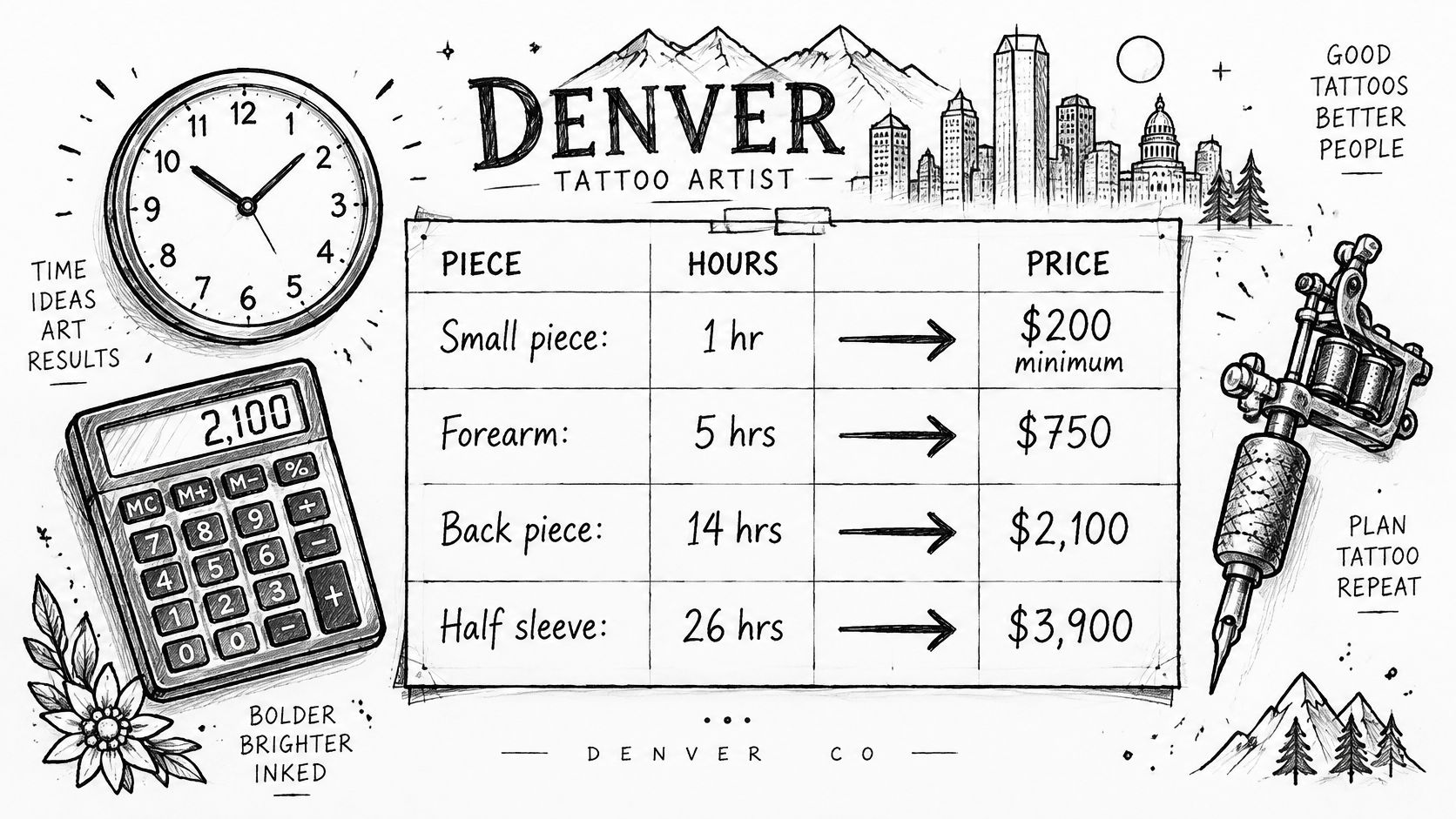
Scenario | Assumed total billable hours | Illustrative labor calculation |
|---|---|---|
Small lettering, one session | 1.5 | 1.5 × $150-$250 = $225-$375 |
Medium floral, two sessions | 6 | 6 × $150-$250 = $900-$1,500 |
Half sleeve, four sessions | 20 | 20 × $150-$250 = $3,000-$5,000 |
Full sleeve, eight sessions | 45 | 45 × $150-$250 = $6,750-$11,250 |
The lettering example shows why the artist's time estimate matters more than the “small” label. It is not a standard price for every lettering tattoo. Confirm that the artist expects the work to take the assumed billable hours before using the calculation.
The floral and sleeve totals exceed the earlier size benchmarks because these examples assume more labor than broad size ranges may cover. Verify the hours before accepting the arithmetic as a budget. Ask what is included in the quote, including drawing, revisions, and any touch-up terms, so you can compare the full commitment rather than the tattooing rate alone.
Large projects need a completion plan
Neds Marketing's tattoo pricing guide gives 60 hours as an upper-end figure for large custom work, including consultation, approval, finalization, and execution. As a hypothetical calculation, if all 60 hours were billed at $150-$250 per hour, labor would total $9,000-$15,000. That example shows why a large project needs a clear completion plan; it is not the same as the 45-hour full-sleeve scenario in the table.
For a substantial piece, agree on what each stage should accomplish and how the artist will estimate the remaining work. The discussion of how long a tattoo takes can help frame appointment timing, but your artist's estimate should reflect your design and sessions.
Bring the closest scenario to your consultation. Ask the artist to replace the assumptions with their estimate, explain what could change the total, and set out how payments correspond to the project's stages.
When a Cheaper Tattoo Ends Up Costing More
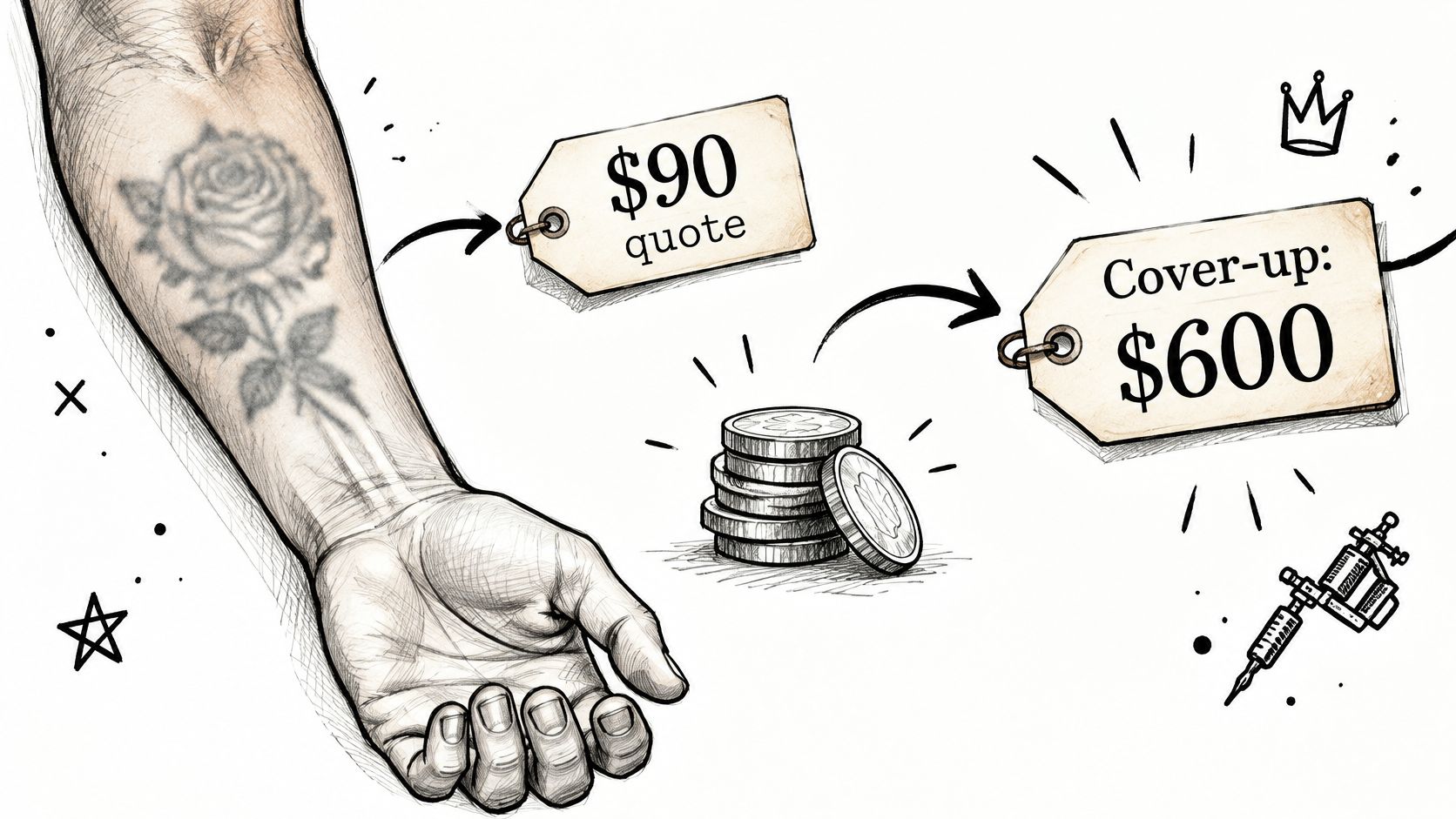
A low quote can look like a saving until the design needs correction or a cover-up. The 2023 Pew survey cited by CNN found that about 25% of tattooed U.S. adults regretted at least one tattoo, but that figure measures regret, not what people paid or spent fixing the result. CNN reporting on tattoo removal describes one removal case that took more than six years and cost several thousand dollars. It is one case, not a typical budget estimate.
Compare the decision, not just the purchase
For example, say one artist quotes a low price for a hand tattoo, while another charges more to discuss placement, draw the design, and allow an agreed revision. The difference is not a guarantee of better work. It is a difference in what the quote may include and how much opportunity you have to resolve concerns before the tattoo is permanent. Ask what drawing time, revisions, sessions, deposits, and touch-ups are covered; confirm any separate fees before booking.
A correction or cover-up also needs an artist's assessment before you can budget for it. The design, existing ink, placement, and required sessions all affect the quote. Don't assume a cheap original tattoo plus an estimated fix will be less than a considered first choice.
Names, trend-driven imagery, and hard-to-hide placements deserve extra thought. Ask whether you like the composition itself, or mainly the reference photo, and whether you would still choose the placement after the excitement of booking passes.
Paying more helps only when you know what additional planning or expertise the quote includes.
Fine detail, color, and placement may also affect future correction options. Treat removal or a cover-up as a costly possibility, not an easy fallback.
Before you commit, ask how the artist handles concerns about finished work and get touch-up eligibility, conditions, and deadlines in writing. The survey is U.S.-focused, but permanence belongs in any tattoo budget.
Get an Accurate Quote Before You Book
An artist can give you a more useful estimate when you bring a clear brief rather than a folder of unexplained pictures. You don't need to solve the design yourself. You do need to explain what matters and where you're flexible.
Prepare a request the artist can price
Write a compact brief. Include approximate dimensions in inches, placement, color or black and grey, and must-have elements. This gives the artist a defined starting point.
Choose a small reference set. Note what you like about each image: line weight, composition, palette, or subject. References should communicate preferences, not leave the artist guessing which details you want.
Arrange a consultation. Discuss design direction, placement, and timing before committing. Ask whether the consultation is complimentary rather than assuming every studio follows the same policy.
Request a written estimate. Ask for the expected billable hours, appointment structure, minimum policy, and exclusions. A written range gives you something concrete to review without relying on memory.
Set the design boundaries. Confirm whether drawing and revisions are included and what triggers a new fee. Be candid if you're still deciding between substantially different concepts.
Compare the full commitment with your budget. Include any separately quoted charges and the cost of returning for the planned appointments. If the range is uncomfortable, ask about changing the scope before booking.
Confirm the reservation terms. Review the tattoo deposit policy and clarify cancellation, rescheduling, and credit toward the final balance in writing.
Leave with a usable agreement
If the artist can't narrow the range yet, ask what decision or information is missing. Perhaps you need to settle the placement, choose between color approaches, or approve a more developed composition.
Don't mistake a precise-looking number for a complete agreement. You should understand what's included, what could change, and when payment is expected. Get the written total range and payment schedule before committing to the design.
Bring your reference images and placement ideas to Think Tank Tattoo, a custom tattoo studio on South Broadway in Denver offering complimentary consultations. Request a consultation by phone or email to discuss design direction, timing, and a realistic price range before reserving your appointment.
Comments