
8 Concept Tattoo Ideas for Every Style
You've saved a rose, a dragon, a delicate drawing, and a sleeve you can't stop looking at. You like each one, but you're not sure which belongs on your body, or how to make it yours rather than someone else's tattoo.
Strong concept tattoo ideas balance a recognizable visual language, a placement that supports the composition, and a personal detail. That detail might be a flower from your childhood garden, an animal's particular posture, or the handwriting on a family recipe. You don't need to fit your whole life into the design. You need a clear starting point and an artist who can translate it.
Treat studio research as preparation for that conversation. A local recommendation guide, such as this discussion of top custom tattoo studios in Bournemouth, can help you frame questions about custom work, but Denver clients should compare local artists' portfolios and consultation options.
Think Tank Tattoo's consultation-based approach provides a useful example: discuss style direction, placement, and timing before committing to a permanent design. Bring references that explain your preferences, not a picture you expect someone to duplicate. From bold traditional imagery to quiet single-line drawings, choose the approach that fits both your subject and how you want to wear it.
Table of Contents
1. Traditional American (Old School) - Match the Motif to the Available Space
4. Fine-Line Tattooing - Design Beyond the Close-Up Photograph
5. Blackwork and Ornamental Patterns - Test the Pattern in Motion
8. Minimalist Single-Line Tattoos - Simplify Without Losing Identity
Turn Inspiration Into a Tattoo Worth Keeping - Test Placement and Scale Together - Ask for Adaptation, Not Duplication
1. Traditional American (Old School)
Choose Traditional American when you want a clear silhouette and a strong graphic presence. Think of an anchor framed by a swallow, a rose crossed by a dagger, or a pin-up portrait with a carefully shaped banner. Build the design around bold black outlines and a restrained color palette rather than filling every available space with detail.
For a personal version, start with a familiar motif and change something meaningful. Ask for an anchor paired with a flower connected to your hometown, or a swallow arranged around a keepsake rather than a standard banner. Keep the classic visual structure while making the subject specific to you.
Compare the outline, shading, and color treatment in these traditional and neo-traditional examples.
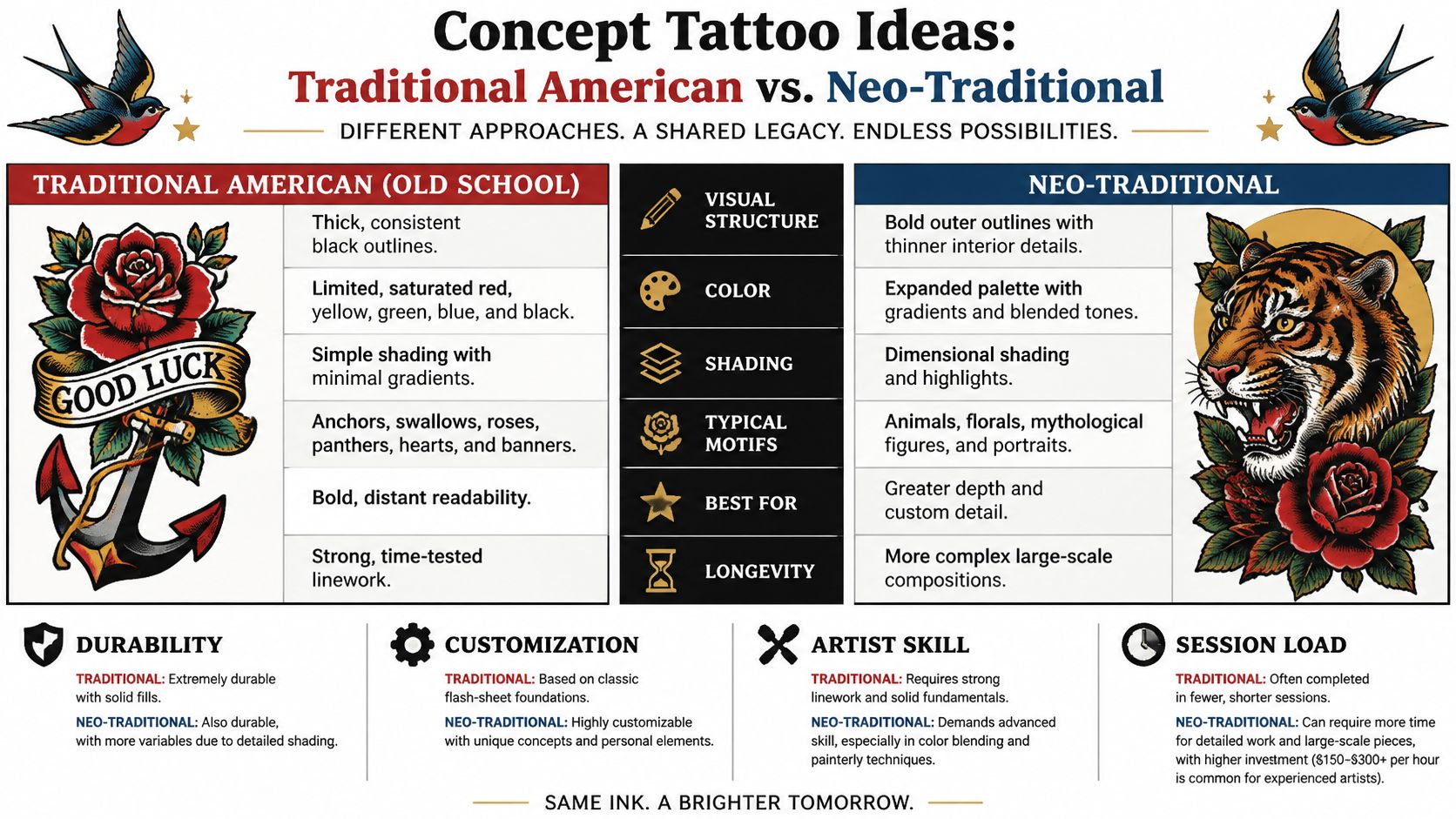
Match the Motif to the Available Space
Try a vertical dagger-and-rose composition on the forearm or calf. For a wider arrangement, ask the artist to test a shoulder or thigh placement rather than compressing the image into a narrow strip.
Lettering: Choose a short inscription and let the artist establish readable letter size and spacing.
Color: Select colors that support the focal subject instead of giving every element equal emphasis.
Future additions: Leave intentional gaps if you want a collection of separate traditional pieces.
Think Tank Tattoo's guide to American traditional tattoos and their bold-line legacy offers a starting point for discussing this direction. Ask for custom flash with recognizable structure, not a copied design with your initials inserted.
2. Neo-Traditional
A fox surrounded by mountain flowers gives you several decisions to make: how expressive the face should be, how much botanical detail to include, and whether the color should feel earthy or theatrical. Choose neo-traditional when you want bold structure with room for richer shading and ornament.
Keep the fox as the dominant subject. Let the flowers frame its face and follow the outer contour instead of covering important features. If the plants connect to a place you've lived, bring photographs so your artist can interpret their recognizable shapes.
The same approach works for an ornamental skull, a bird portrait, or a mythological animal. Personalization doesn't require adding more objects. A distinctive pose, expression, or color relationship can do more than a crowded collection of symbols.
Composition check: Step back from the draft. You should recognize the main subject before you notice the decorative details.
Decide Where Detail Belongs
For an upper-arm piece, ask the artist to test how the subject wraps around the shoulder. Keep essential features where they can be understood together, and let leaves, fabric, or background shapes turn around the body.
For a sleeve or back piece, discuss the whole composition before starting an isolated section. Bring references showing the shading density you like, including examples you find too dark or too elaborate.
Plan session length, healing intervals, and the order of work with the artist. Don't assume a detailed design can be reduced to fit a smaller appointment or placement. If the available space is limited, simplify the ornament before shrinking the central subject.
3. Japanese Irezumi
Plan the whole composition before choosing individual motifs. For a Japanese-inspired sleeve or back piece, decide whether the central subject will be a koi, dragon, tiger, phoenix, or another image your artist is equipped to interpret. Then discuss how waves, clouds, flowers, and open skin will connect the design.
A koi moving through water provides a useful starting scenario. The fish establishes direction, while the surrounding water can continue around the arm instead of stopping at the edge of a flat illustration. Bring your personal connection to the subject, but ask the artist about cultural context and appropriate combinations rather than assigning every motif a convenient meaning.
This illustration shows how a koi, flower, and flowing water can share a clear composition.
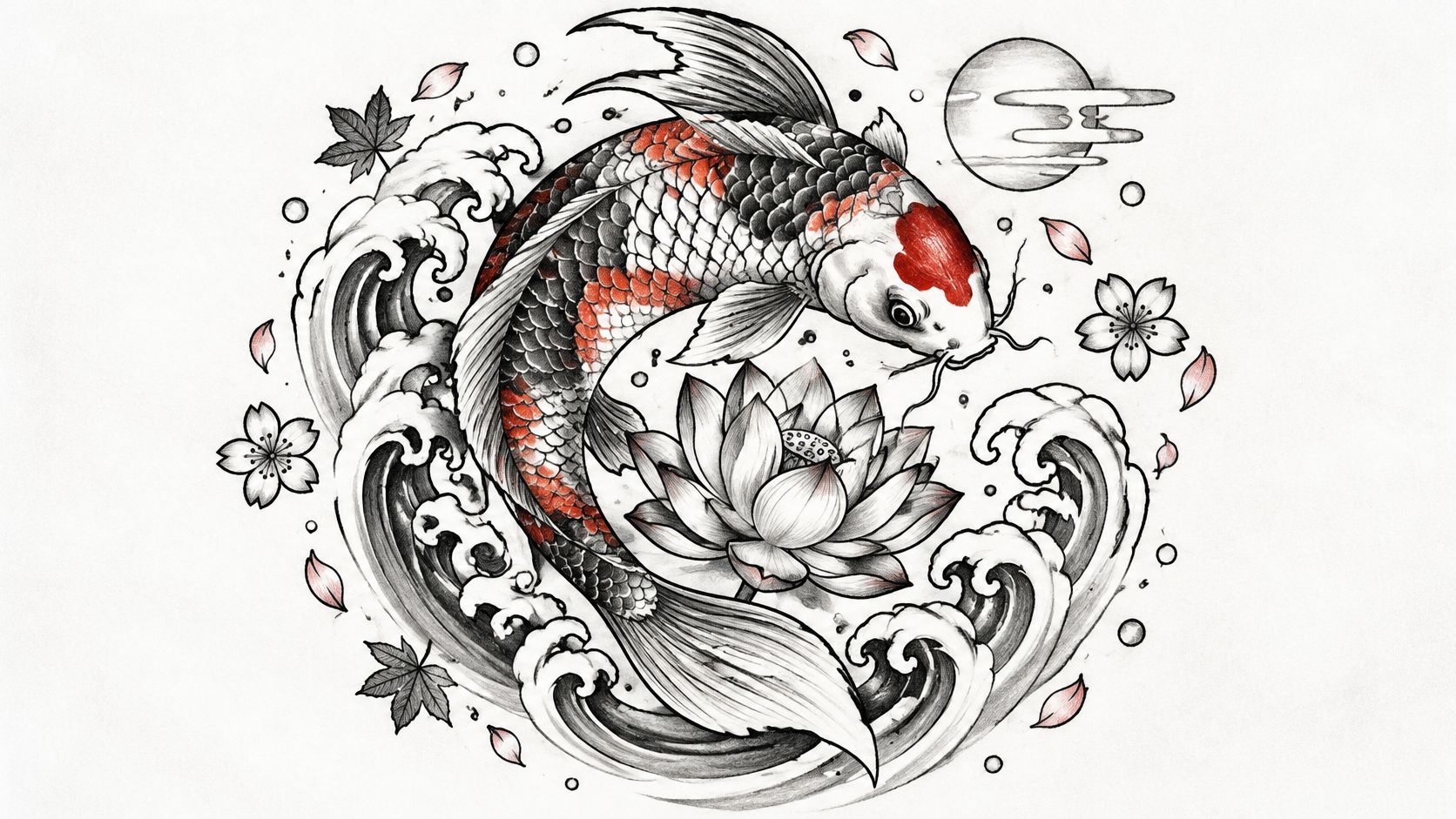
Choose Boundaries Before Details
Discuss where the piece begins and ends, particularly around the wrist, neckline, and chest. Those boundaries affect clothing visibility and how you'll connect future work.
Back placement: Test the main subject at a scale that supports its silhouette and surrounding movement.
Sleeve placement: Review the design from multiple angles, not just the outward-facing view.
Future expansion: Tell the artist if you eventually want connected chest, shoulder, or back work.
If a bird-based composition interests you, bring Think Tank Tattoo's Japanese phoenix tattoo designs into the discussion as a direction to explore. Ask how your preferred imagery would work as a unified custom piece, including the background, planned sessions, and healing schedule.
4. Fine-Line Tattooing
Bring the actual plant, photograph, or handwritten note that matters to you. Fine-line work is a strong direction for a restrained illustration, but restraint means choosing what to leave out, not shrinking an elaborate drawing until it fits.
For a botanical memorial, ask the artist to preserve the plant's distinctive stem and leaf arrangement. Remove minor veins or overlapping petals if they make the design difficult to recognize at the intended size. A clear sprig can express the memory without reproducing every detail of the original photograph.
Use this botanical illustration to compare the balance between delicate outlines and open space.
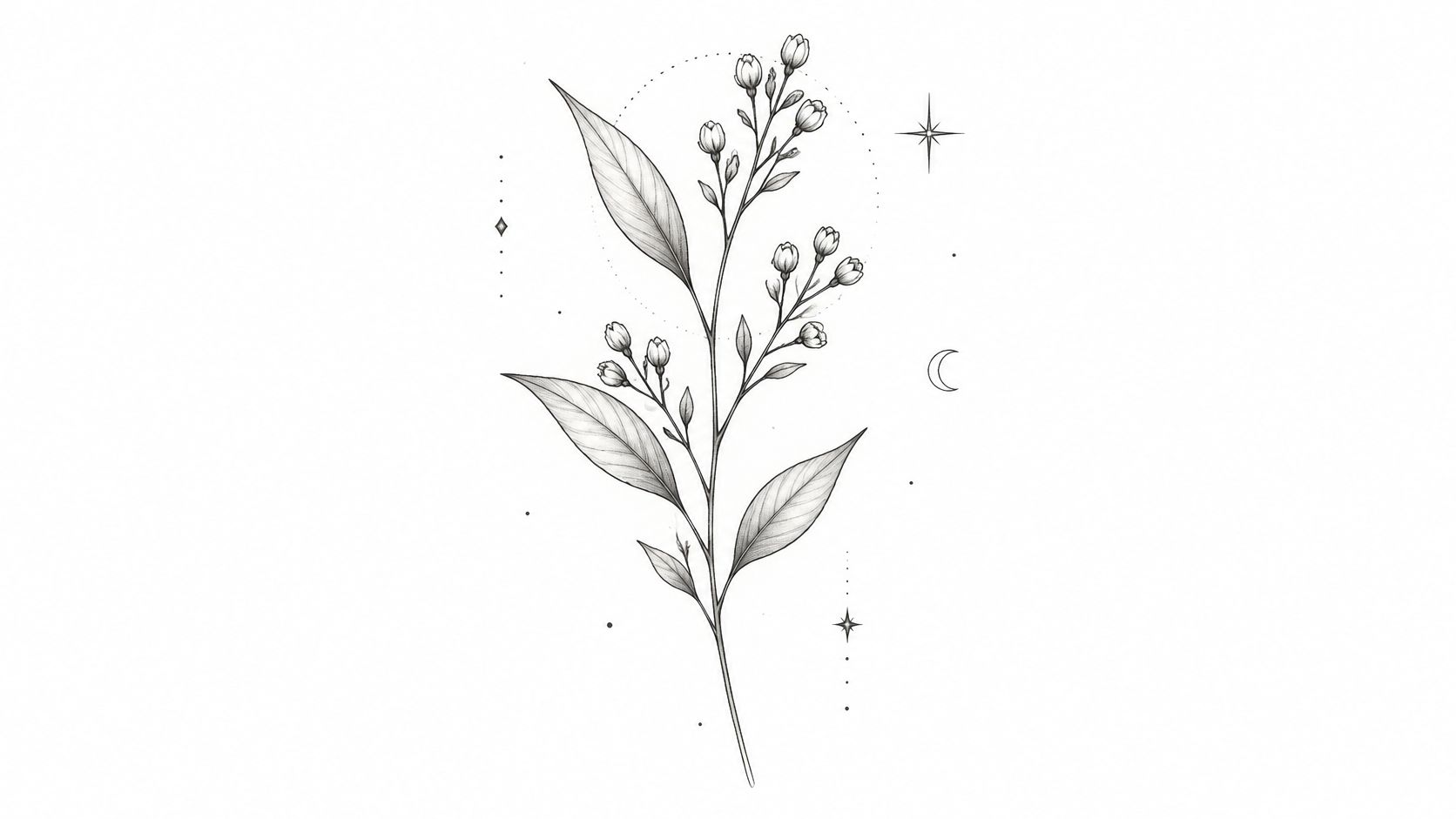
Design Beyond the Close-Up Photograph
Ask to see the draft at actual placement size, then view it from a normal conversational distance. The main shape should remain understandable without a phone camera's zoom.
Dermatology literature identifies sun exposure during and after healing as a contributor to tattoo fading and other skin changes, supporting a long-term approach to design and aftercare. Don't treat delicacy as a guarantee that a design will stay visually unchanged.
Discuss friction from sleeves, watch straps, footwear, or equipment before selecting the placement. For handwriting, let the artist adjust spacing and scale while preserving the features that make the writing recognizable.
Choose an artist whose healed work reflects the result you want. Ask how they assess the tattoo after healing and when they recommend a touch-up, rather than assuming every fine-line piece needs the same follow-up.
5. Blackwork and Ornamental Patterns
Start with the shape of the black areas, then design the spaces between them. For an abstract blackwork sleeve, bring references for rhythm, density, and movement instead of a collection of unrelated symbols. Ask the artist to sketch how broad shapes will travel around your arm.
A strong custom direction might pair sweeping black sections with open channels that reveal the skin beneath. If you prefer ornament, use repeated petal, arch, or leaf shapes to establish a visual pattern. Decide whether you want the result to feel balanced and symmetrical or deliberately irregular.
Don't borrow culturally specific imagery because it looks graphic. Discuss its origin and meaning with an appropriately knowledgeable artist, or develop a nontraditional abstract pattern instead.
Negative space isn't unfinished skin. Ask the artist to plan it as carefully as the black fill.
Test the Pattern in Motion
For an armband, review the join around the full circumference. For a chest or back design, check the central alignment with your body relaxed rather than holding a posed position.
Ask how the pattern will look when you bend, reach, or turn. If existing tattoos interrupt the placement, incorporate those boundaries into the draft instead of treating them as an afterthought.
Black ink doesn't remove the need for a health discussion. A systematic review examined both microbiological and non-microbiological tattoo complications, supporting a consultation that addresses more than appearance. Disclose previous reactions and persistent irritation, and seek medical advice about unexplained lesions or active dermatitis before proceeding.
For a cover-up, get an individual assessment. Don't assume solid black shapes can solve every existing tattoo or scar-related constraint.
6. Geometric and Dotwork
Compare a crisp geometric outline with a softly stippled interior. Choose geometric work for the arrangement of shapes, and dotwork for the texture you want within or around them. You can combine both without turning the design into an inventory of every pattern you like.
For example, place an animal portrait inside a geometric frame and use dot shading to separate the subject from the border. Keep the face readable on its own. If the frame is more visually prominent than the animal, simplify it or increase the subject's scale.
A compass-and-flower arrangement offers another direction, provided the surrounding symbols support your meaning rather than filling empty areas.
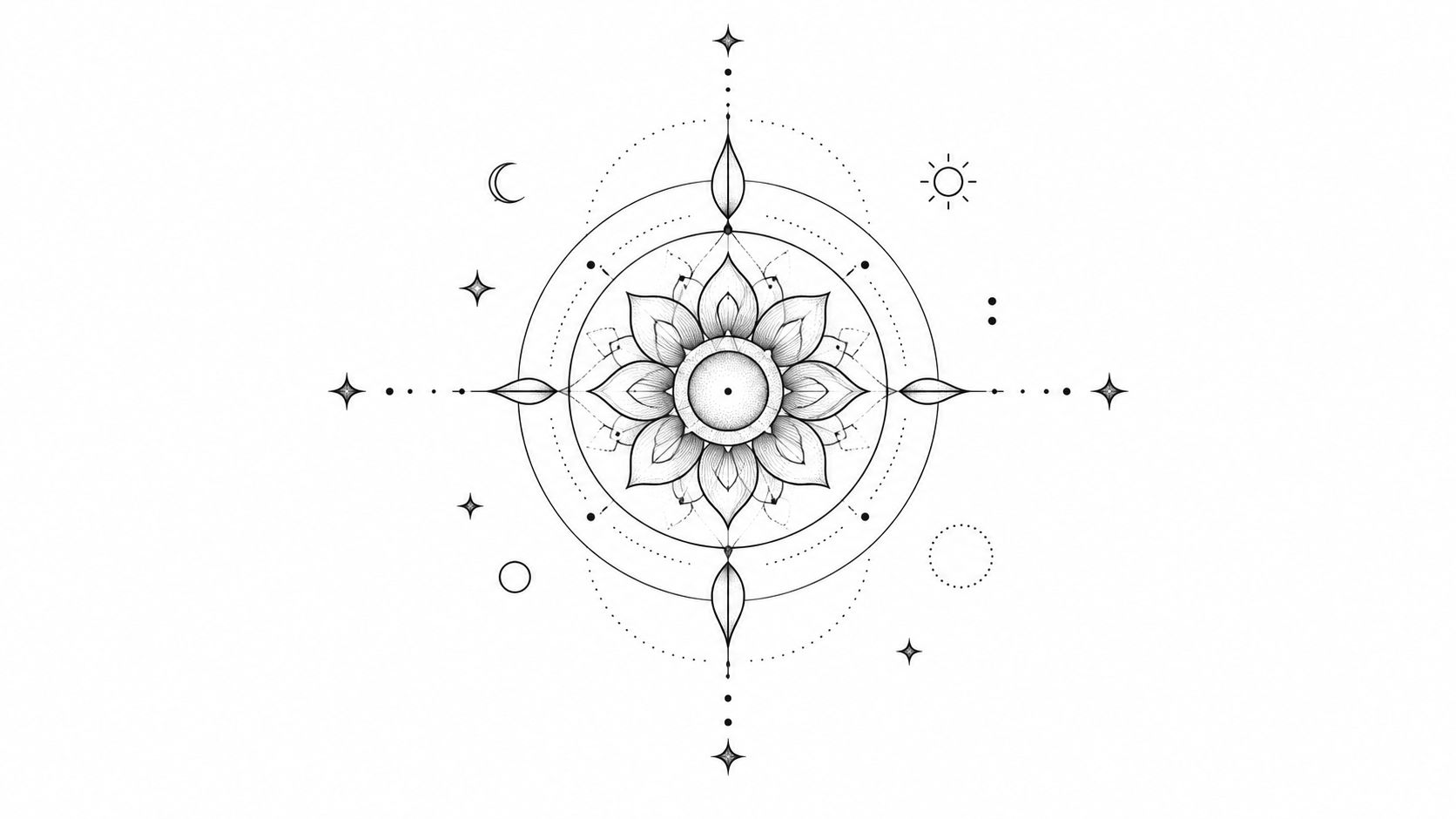
Fit Symmetry to Your Body
A pattern drawn symmetrically on paper still needs adjustment for a curved placement. Ask the artist to check its center, outer edges, and visual balance while you stand naturally.
Upper back: Compare a centered arrangement with a broader pattern extending toward the shoulders.
Forearm: Decide which view should show the complete focal shape and which elements can wrap.
Detail density: Ask how dot spacing and dark sections will remain distinct at the chosen scale.
Use Think Tank Tattoo's guide to the dotwork tattoo style to help identify the textures you want to discuss. Get a session estimate for your actual design rather than assuming dotwork always takes a particular amount of time.
Personalize through proportion, subject, and pattern development. Don't attach a borrowed spiritual meaning to a shape just to justify liking its appearance.
7. Watercolor Tattoos
Your favorite part of a watercolor reference might be the loose color rather than its flower, bird, or animal. Separate those preferences before the consultation. Tell the artist whether you want a recognizable subject with a painted background or an abstract composition where color is the main feature.
For a personal concept, bring a photograph with a meaningful palette: a scene from home, a familiar garden, or a painting you made. Ask the artist to interpret the color relationships, not reproduce every visible object. A defined botanical silhouette with selective washes can communicate more clearly than several subjects surrounded by competing splashes.
Use the video as a visual reference, then identify the specific edges, color transitions, and linework you want to discuss.
Keep a Recognizable Structure
Ask the artist to show you what remains if you mentally remove the palest washes. A silhouette, dark accent, or deliberate line can provide structure without turning the design into traditional outlined work.
Portfolio priority: Choose an artist whose healed color work you like, not just whose fresh photographs look bright.
Try the composition on the calf, upper arm, or back if the washes need room to spread visually. Don't choose a smaller placement and then insist on retaining every splash.
Discuss pigment choices if you've experienced previous reactions. A peer-reviewed review describes tattoo-related inflammatory, allergic, infectious, and MRI-associated concerns, so raise relevant medical issues before selecting the palette. Plan sun protection after healing and ask how the artist evaluates color changes before recommending future touch-ups.
8. Minimalist Single-Line Tattoos
A continuous-line drawing of your dog doesn't need every strand of fur. It needs the head angle, ear shape, or posture you'd recognize immediately. Choose single-line work when a small set of distinctive contours can carry the subject.
Unlike fine-line illustration, where separate strokes can describe leaves, texture, or shading, this concept relies on a continuous or near-continuous path. Ask the artist to identify which features must remain and which can disappear. For a loved one's profile, the relationship between the forehead, nose, lips, and chin may matter more than decorative additions.
Personal meaning can come from an ordinary gesture. A familiar sleeping position or the outline of someone holding a cup can feel more specific than a generic symbol of love.
Simplify Without Losing Identity
Bring the original photograph alongside examples from the artist's own portfolio. Explain what makes the subject recognizable to you, then let the artist redraw it in their line language.
Line weight: Balance subtlety with a visible, deliberate outline.
Spacing: Leave room around crossings, loops, and closely parallel sections.
Placement: Test a vertical animal silhouette on the calf or a horizontal profile on the forearm.
Scale: Enlarge the design when reducing it would erase the distinguishing feature.
Don't assume fewer lines automatically mean an easier or quicker appointment. Ask for an estimate based on the actual composition and placement.
Consider your skin as part of the plan, too. Research examining pigment depth, skin characteristics, age, and tattoo location reinforces the value of individualized assessment. Discuss anticipated body changes and existing skin concerns rather than choosing placement solely for its appearance in a reference image.
8 Concept Tattoo Styles Compared
Tattoo Style | 🔄 Implementation Complexity & Resources | Visual Approach | 📊 Expected Outcome & Longevity | ⭐ Key Advantages | 💡 Ideal Use Cases |
|---|---|---|---|---|---|
Traditional American (Old School) | Low–moderate; bold outlines, solid fills, often based on flash | Thick black lines, limited saturated colors, classic motifs | Bold, readable designs that generally age well | ⚡ Durable linework; recognizable style and symbolism | Anchors, swallows, roses, lettering, and classic sleeves |
Neo-Traditional | Moderate–high; requires skill in shading and color blending; may take longer | Bold outer lines, finer details, blended colors, dimensional shading | More depth and customization; complex color may soften over time | Rich detail while retaining a bold structure | Large custom pieces, florals, animals, portraits, and sleeves |
Japanese Irezumi | High; specialized artist, multiple sessions, and substantial coverage | Cohesive large-scale imagery shaped to body contours | Unified, striking compositions with cultural and symbolic depth | Strong visual flow and suitability for sleeves or back pieces | Themed sleeves, back pieces, or body suits |
Fine-Line Tattooing | Moderate; needs precise technique and careful size planning | Thin lines, minimal shading, delicate detail | Subtle results; fine lines and tiny details may blur over time | ⚡ Often quicker sessions; understated and versatile | Small botanicals, symbols, handwriting, and minimalist illustrations |
Blackwork and Ornamental Patterns | Moderate–high; large solid fills may require lengthy sessions | High-contrast black shapes, patterns, symmetry, or negative space | Strong silhouettes that typically hold contrast well | Bold impact and versatility across sizes | Armbands, mandalas, ornamental sleeves, and abstract designs |
Geometric and Dotwork | High for detailed work; precision and longer sessions are common | Symmetrical shapes, clean lines, and stippled shading | Balanced, precise designs; dot clarity depends on spacing and execution | Customizable patterns with a modern, structured look | Mandalas, sacred geometry, geometric sleeves, and symbolic designs |
Watercolor Tattoos | High; requires color expertise and careful design; touch-ups may be needed | Soft color washes, blended gradients, loose edges, often with fine lines | Expressive painterly effect; color may fade or lose definition over time | Vibrant, artistic appearance and broad customization | Florals, animals, abstract compositions, and expressive color pieces |
Minimalist Single-Line Tattoos | Low–moderate; short sessions, but drawing skill is important | Continuous or near-continuous lines with ample negative space | Simple, understated designs; thin lines may fade or spread | ⚡ Quick to complete and easy to personalize | Small portraits, animal outlines, symbols, and minimal botanicals |
Turn Inspiration Into a Tattoo Worth Keeping
Choose the visual style first, then select a subject that works within it. A rose can become a bold traditional emblem, a detailed neo-traditional focal point, or a restrained line drawing. Decide which treatment you want to wear before combining references.
Next, identify the personal detail that matters most. It might be a particular flower, an animal's expression, a remembered object, or a color relationship. Tell the artist why it matters, but don't insist that every memory becomes a separate symbol.
Test Placement and Scale Together
Ask the artist to check the design against your body's shape while you're standing naturally. Review how much will be visible in everyday clothing, where the subject wraps out of sight, and what happens when the area moves. If you're planning a collection, discuss the space future tattoos will need.
Treat scale as a design decision, not a preference for something small. Increase the size when important features need separation, or remove detail if the placement is fixed. Ask for an alternative so you can compare clarity with complexity.
Use this concise consultation checklist before committing:
Line durability: Which outlines, gaps, or lettering need more room?
Color longevity: What should you expect from the chosen palette, and how should you protect it after healing?
Session length: How will the artist divide the work into manageable appointments?
Healing time: How should you schedule work, exercise, travel, and clothing around recovery?
Visibility: Will the design sit where you want it in both everyday and professional settings?
Future touch-ups: How does the artist assess healed results and discuss later maintenance?
Ask for Adaptation, Not Duplication
Bring references with specific observations: you like this outline weight, that amount of open skin, or the movement in another composition. Ask the artist to combine those preferences into an original design rather than tracing someone else's finished tattoo.
Before booking, explain previous tattoo reactions, relevant medical concerns, and any scarred or persistently irritated skin near the placement. Get medical guidance where appropriate, and make sure you understand the studio's aftercare instructions and whom to contact if problems develop.
The best concept tattoo idea isn't the trendiest one. It's the design you still want when the novelty fades, built around a subject, style, and placement that suit you. A custom consultation helps turn that preference into a clear, workable plan without expecting you to arrive with the finished artwork.
Think Tank Tattoo offers complimentary consultations to discuss custom design direction, placement, and timing. Bring your references, preferred body area, and the detail that makes the idea personal, then visit Think Tank Tattoo to arrange a conversation about your piece.
Comments