
8 Inner Arm Tattoo Ideas for Meaningful Designs
You're looking at your inner arm and trying to decide whether the idea in your head belongs there: a small word you'll see every day, a flower that follows the forearm, or a design with room to grow into a larger piece. The inner arm is naturally visible to you, easy to personalize, and simple to cover with many everyday garments. Its long surface can suit everything from a quiet fine-line detail to a more substantial composition, but it's also a moving part of your body, not a flat page.
These inner arm tattoo ideas pair visual inspiration with practical choices about scale, orientation, personalization, durability, and healing. A few design details that look crisp on a screen may need more space on skin; a piece placed across a crease will move differently from one centered on the forearm. Start with a concept that matters to you, then work with an artist to adapt it to your arm.
Table of Contents
1. Minimalist Script Words and Quotes - Make the lettering readable
3. Constellation and Celestial Patterns - Decide what the stars represent
4. Coordinates and Date Tattoos - Choose the format before the font
5. Colorado Mountain and Landscape Silhouettes - Choose the landscape's level of detail
6. Mandala and Dotwork Ornamental Designs - Treat the stencil as a fit test
7. Heartbeat and ECG Line Tattoos - Decide between a real trace and a symbolic one
8. Small Symbolic Icons and Semicolon Tattoos - Make the symbol yours
1. Minimalist Script Words and Quotes
A short word, name, date, or personal motto can sit naturally along the inner forearm or bicep, where you can read it up close. For example, a loved one's name in cursive can follow the forearm's length, while a brief phrase on the inner bicep can stay more private under many short sleeves.
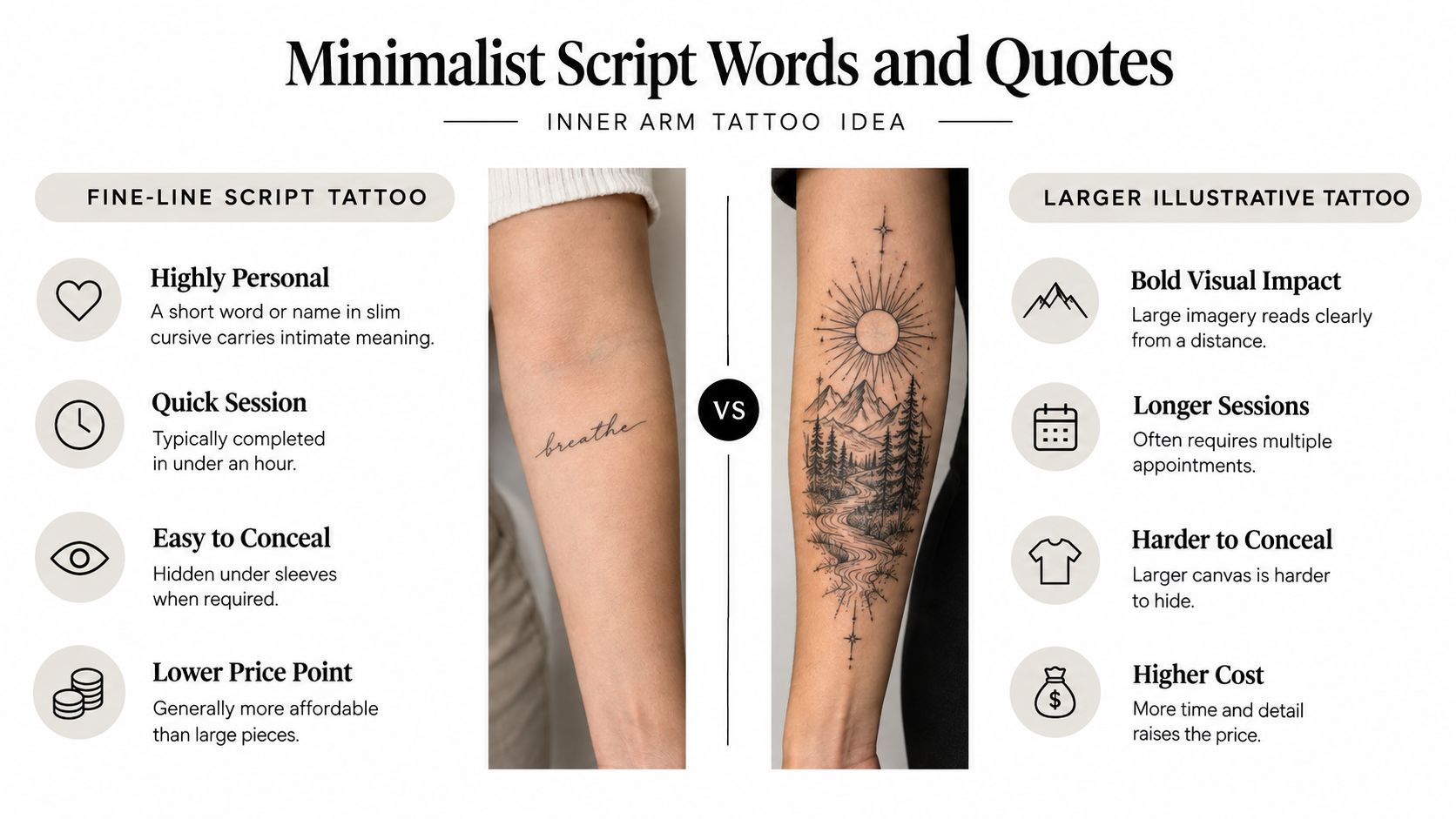
Make the lettering readable
Script succeeds when the letters have room to remain distinct. Very fine strokes and tightly connected letters can look elegant in a mockup but become difficult to read if the design is too small or densely packed. Ask your artist to show the lettering at the intended size, and consider a slightly sturdier line weight than you first imagined.
Write the text by hand and live with it for a few days before booking. Then ask for a stencil test on the arm, checking the word with your arm relaxed and flexed. If you're comparing decorative lettering styles, this guide to calligraphy tattoo designs can help you identify the visual direction you want to discuss with your artist.
Practical rule: Confirm every letter, accent, and line break before the stencil goes on. A meaningful phrase still needs to be spelled and arranged exactly as intended.
A short Latin motto, a family name, or a date can carry personal meaning without requiring a large design. If you want to add a small decorative flourish, keep it subordinate to the text so the words remain the focus. For lettering inspiration outside tattoos, engraving tips for fonts and metals can also prompt useful questions about type style and spacing.
2. Fine-Line Botanical Designs
Botanical tattoos suit the inner arm because stems and leaves can follow its natural length. A small wildflower cluster might travel from the wrist toward the elbow, while a single birth flower with a stem and leaves can sit vertically on the forearm. Colorado clients might choose a columbine or Indian paintbrush to connect the design with a place they call home.
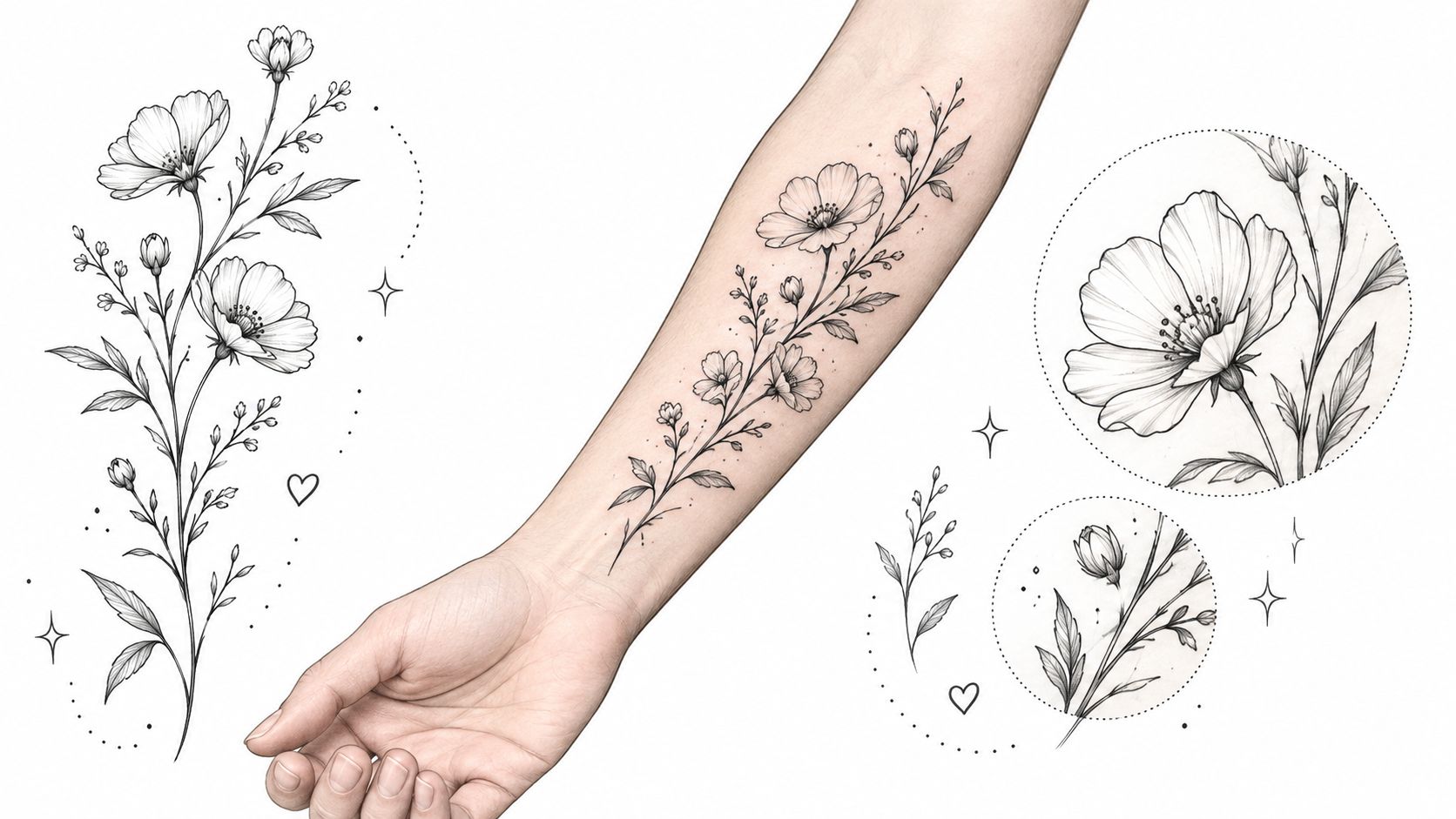
Let the plant breathe
A fine-line flower depends on clean separation between petals, leaves, and stem. If every detail is compressed into a tiny space, the design may lose its clarity as the lines soften over time. Ask the artist which features need stronger outlines, and where negative space can keep the plant from reading as a dark cluster.
A trailing stem can look graceful along the forearm, but it shouldn't be forced into a straight line if your arm's shape calls for a gentle curve. Check the stencil from more than one angle, including with your elbow bent. That helps you see whether the bloom faces you, faces outward, or sits somewhere between.
Botanical detail needs breathing room. If a petal, leaf, or fine vein matters to the design, give it enough space to stay distinct.
Choose a reference that shows the plant clearly, rather than relying on a small, blurry image. A real flower photo can help the artist distinguish a recognizable species from a generic floral motif, while a more stylized drawing may be better if you want a simplified look. Discuss how the lines and open areas will work together, and ask your artist about touch-up expectations once the tattoo has healed and settled.
3. Constellation and Celestial Patterns
A constellation, moon phase, or small sun-and-moon design can run vertically along the inner arm without needing a broad canvas. Orion's Belt or the Big Dipper can follow the inner bicep, while a mapped night sky can sit on the forearm as a personal record of a meaningful evening.
Decide what the stars represent
A constellation can be a familiar symbol or a personal map. If you want the sky from a specific place and date, bring a star chart or a sky-mapping app reference that shows the location and the view you want. For instance, a Denver night sky can mark a birthday or a major life event without adding text.
The main trade-off is scale. Tiny dots and very fine connecting lines may be hard to distinguish if placed too close together, so ask the artist to test dot size and spacing on your arm. You can choose solid lines for a more graphic look or dotted lines for a lighter, map-like effect. Both can work, but the pattern should remain legible at the size you will wear.
For a familiar constellation, check that the arrangement matches the reference you intend to use. If you're drawn to a particular sign or star group, this piece on star and constellation tattoo ideas can help you refine the subject before a consultation.
A moon phase can make the design feel more decorative, while a constellation alone keeps it spare. Leave enough open skin between motifs to prevent the composition from feeling crowded. If you add a date or initials, keep those details secondary so the celestial pattern remains easy to read.
4. Coordinates and Date Tattoos
Coordinates turn a place into a compact design. Latitude and longitude can mark a birthplace, a home, or a location tied to a defining memory, while a date can commemorate a wedding or another personal milestone. A small serif font on the inner forearm feels formal; a bolder numerical style on the inner bicep can read more directly.
The essential studio step is verification. Check every digit against a reliable map or other source before the appointment, and decide whether you want the coordinate format to include degree symbols and direction letters. Those characters affect spacing, so the artist should see the complete text before building the stencil.
Choose the format before the font
Coordinates can look like a quiet line of text or a more technical mark. A moderate stroke width generally gives numerals more visual presence than delicate hairline lettering. If the design feels too plain, a small compass rose or a simple divider can add structure, but extra decoration shouldn't crowd the numbers.
A wedding date, for example, might sit in a clean line with no ornament, while coordinates for a favorite place could include a tiny directional mark. If you're combining both, decide which should lead. Two equally prominent lines can compete for attention, especially on a narrow part of the arm.
Check the source, then check the stencil. A coordinate tattoo is only as accurate as the information and spacing you approve before the session.
Look at the placement with your arm resting naturally and with the wrist turned. A line that seems perfectly straight while your arm is rotated may look angled in its everyday position. The artist can adjust the orientation to make the text feel intentional from the view you care about most.
5. Colorado Mountain and Landscape Silhouettes
A mountain range or pine-tree line can turn a local memory into a compact scene. A Front Range silhouette can run horizontally across the inner forearm, while a single pine with a mountain outline can fit the inner bicep. The arm's width matters here: a long ridge needs room to read as a landscape rather than a row of cramped peaks.
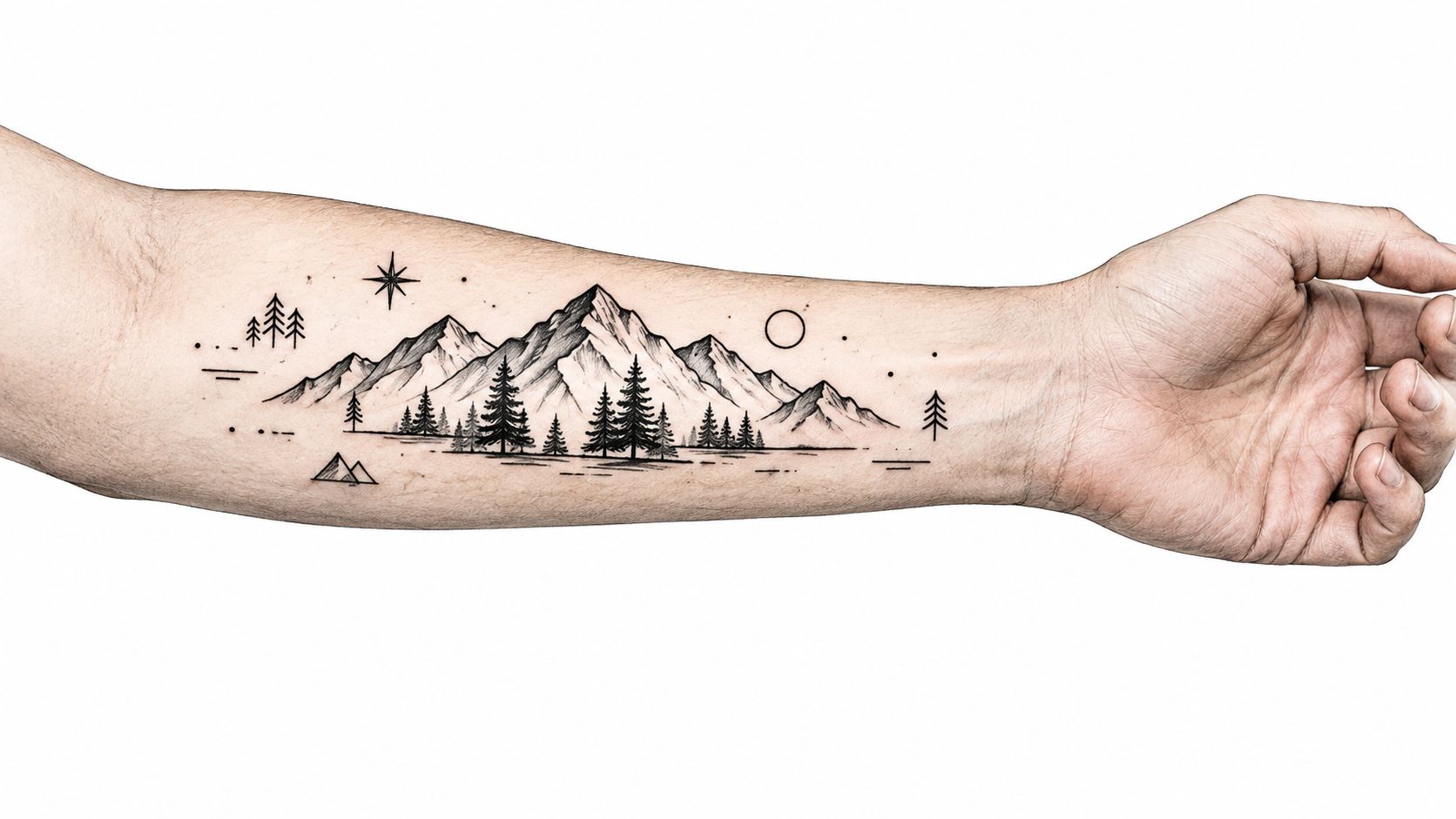
Bring a photograph of a specific view, trail, or peak if you want the design to refer to a real place. The artist can simplify the reference into linework or a dark silhouette, depending on whether you want a delicate outline or a stronger graphic shape. For more Colorado-inspired directions, explore tattoos inspired by Colorado nature and landmarks.
Choose the landscape's level of detail
A simple ridge line is easier to scale down than a scene with tiny trees, shaded slopes, and distant peaks. If the composition includes both mountains and forest, decide which feature should draw the eye first. A few bold shapes with open space between them can feel clearer than many fine details packed into a narrow strip.
The inner forearm gives the artist a longer surface, but the design still needs to work around the arm's curve. Test the stencil from the front and side, and see how much of the artwork remains visible when your hand turns. This is especially important if you want the piece to read as one uninterrupted horizon.
A scene can also leave room for later additions, such as a small sun, a trail marker, or another natural element. Mention that possibility early rather than placing the first tattoo wherever it happens to fit. A planned composition makes future expansion easier without making the original piece feel incomplete.
6. Mandala and Dotwork Ornamental Designs
Mandala and dotwork designs rely on symmetry, rhythm, and careful spacing. A compact mandala can sit at the center of the inner forearm, while an elongated ornamental pattern can travel toward the elbow. The flatter part of the arm can make a centered motif easier to assess, though the design will still curve as the arm turns.
Treat the stencil as a fit test
Ask to see the stencil on your skin before the session begins. Check the center point, the spacing between repeated elements, and how the outer edges sit around the arm's curve. A pattern that looks symmetrical on paper may appear compressed from one viewing angle if too much of it wraps around the side.
Dot size also matters. Extremely small dots can lose definition as the tattoo softens, so ask the artist how they'll balance delicacy with readability. The same applies to fine geometric lines: if they're packed too closely together, the pattern may become visually dense over time.
A mandala can be a standalone focal point or the beginning of a larger ornamental composition. If you may later extend it toward the wrist or upper arm, discuss that direction now. Leaving room around the central motif can make an eventual addition feel connected rather than crowded.
Watch the pattern with your arm relaxed and flexed. The inner elbow moves and creases, so critical details placed directly across that fold may not sit as consistently as those on the forearm. Keep important symmetry away from the crease unless the artist has designed the pattern specifically to accommodate movement.
7. Heartbeat and ECG Line Tattoos
An ECG line can represent a child's birth, a loved one, a medical experience, or another moment that changed how you see your life. Running the trace lengthwise along the inner forearm gives it room to rise and fall, while a small heart icon can make the subject immediately recognizable.
Decide between a real trace and a symbolic one
If you want to reproduce an actual ECG, bring a clear image of the original. The artist can use it to preserve the distinctive pattern, then adapt the line thickness and spacing for skin. If you're choosing a symbolic heartbeat instead, treat it as an illustration rather than an exact medical record, and focus on a rhythm and shape that feel meaningful to you.
Long, fine lines can look clean, but the trace needs enough scale to remain distinct. A tiny peak or tightly repeated pattern may be hard to read if compressed. Consider how the design will sit when your hand turns, and whether you want the line to face you or other people.
Let the personal meaning guide the design, but let the artist set the scale needed for a clear, wearable result.
The inner arm can feel sensitive during tattooing, so discuss placement and session planning with your artist rather than assuming a long line will be quick or easy. If the design marks grief, recovery, or a difficult medical event, you can also talk through the imagery at your own pace during the consultation. You don't need to include every detail of the story for the tattoo to feel personal.
8. Small Symbolic Icons and Semicolon Tattoos
A small symbol can carry a personal meaning without taking up much space. Anchors, arrows, feathers, and compasses are familiar choices, while a semicolon is often selected as a mental health awareness symbol associated with a continuing story. On the inner wrist or forearm, a simple icon can stay visible to you while remaining relatively easy to cover.
The trade-off is that “small” can become “too crowded” quickly. A symbol with a clear silhouette is usually easier to recognize than one built from many tiny details. Give the shape breathing room, and ask the artist to test the stencil at the size you're considering before deciding.
Make the symbol yours
Personalization can come from placement, orientation, or one carefully chosen addition. A compass might point toward a meaningful direction; an anchor could pair with an initial; a semicolon might stand alone or sit beside a date. Keep add-ons limited so the main symbol remains clear.
If the design uses a cultural or religious symbol, learn its meaning and context before choosing it. A motif can carry significance beyond the personal interpretation you have in mind, and an artist can help you discuss the visual reference respectfully. For a broader creative prompt, browse meaningful wall art and consider what kind of image you'd want to carry with you rather than display on a wall.
A small icon can also be the first piece in a future collection. Leave some open skin around it if you might add related imagery later. That gives a future artist options for building a composition without making the original tattoo feel boxed in.
8 Inner Arm Tattoo Ideas Compared
Tattoo Design | 🔄 Implementation Complexity | ⚡ Time and Maintenance | 📊 Expected Outcome | ⭐ Key Advantages | 💡 Ideal Use Cases |
|---|---|---|---|---|---|
Minimalist Script Words and Quotes | Low; careful spelling, spacing, and placement are essential | Often under 1 hour; fine lines may need protection or touch-ups | Subtle, personal lettering; very thin strokes may blur over time | Meaningful, discreet, and relatively affordable | Names, short quotes, dates, or personal mottos |
Fine-Line Botanical Designs | Low to high, depending on detail and size | Small pieces may take one session; intricate designs can require multiple sessions and touch-ups | Delicate floral imagery; dense details may soften over time | Flexible sizing and rich personal symbolism | Flowers, memorials, growth, or nature-inspired designs |
Constellation and Celestial Patterns | Low to moderate; accurate star placement requires planning | Usually a short session; small dots may need touch-ups | Minimal star maps or celestial motifs; tiny dots can fade or spread | Customizable to a meaningful date, place, or milestone | Births, weddings, travel, or night-sky tributes |
Coordinates and Date Tattoos | Low; all numbers and symbols need verification | Usually quick; moderate line weight supports longevity | Clear, compact text with limited visual detail | Precise, personal, and easy to customize | Commemorating a location, wedding, or significant date |
Colorado Mountain and Landscape Silhouettes | Low to moderate; detail and shading affect complexity | Small or medium designs may take one session; simpler shapes generally age well | Readable landscape imagery when detail and solid areas are restrained | Strong local meaning and adaptable sizing | Colorado roots, outdoor memories, or favorite landscapes |
Mandala and Dotwork Ornamental Designs | Moderate to high; symmetry and placement require precision | Dense or larger pieces may need several sessions; may need touch-ups | Striking geometric patterns; dense dotwork can lose contrast | Visually distinctive, customizable, and symbolic | Symmetry, balance, spiritual motifs, or ornamental designs |
Heartbeat and ECG Line Tattoos | Low to moderate; an exact trace needs a clear reference | Often a short session; fine lines may require maintenance | Minimal ECG trace with personal significance | Can reproduce a meaningful real-life heartbeat pattern | Births, memorials, or significant medical events |
Small Symbolic Icons and Semicolon Tattoos | Low; simple shapes are straightforward | Usually quick; small bold designs generally need little maintenance | Compact, recognizable symbol; tiny details may blur | Affordable, discreet, and strongly symbolic | Mental health awareness, personal values, or reminders |
Turn Your Idea Into a Tattoo That Fits
Choose the concept that feels closest to your story, then refine its scale, orientation, symbolism, and durability before booking. A design that works on a screen may need different proportions once it's placed on a curved, moving arm. Ask your artist to assess the stencil with your arm relaxed and flexed, and to explain how the composition will read from the angle you care about.
Bring useful source material to the consultation. That might be a handwritten phrase, a verified date or coordinate, a clear botanical or scene reference, or an original ECG image. Explain what matters most: a detail that must remain recognizable, a preference for privacy, or room to connect the piece to a future sleeve. A collaborative design process helps the artist make those priorities visible in the finished composition.
Plan for movement and long-term changes in the skin. Tattoo pigment can gradually migrate into deeper skin layers, creating a softer appearance, and aging, sun exposure, friction, and stretching can also affect how a tattoo looks. That's why adequate negative space and clear linework matter, especially for lettering, tiny dots, and details that sit near a bend in the arm. If you're considering the inner elbow, ask how the design will handle repeated flexing and clothing friction.
Keep skin health in the placement conversation, too. Don't tattoo over a mole or a suspicious lesion, and ask a dermatologist about any spot you're unsure about before your appointment. Leave visible, uninked skin around marks you want to monitor. If a mole changes color, shape, or size, bleeds, or itches persistently, seek medical evaluation rather than treating the tattoo appointment as a substitute for medical advice.
Follow your artist's aftercare instructions, protect the area from sun and friction, and give the tattoo time to heal before judging the final appearance. Ask what healing changes are expected and when to contact the studio with a concern. Think Tank Tattoo offers complimentary consultations at its Denver studio, where you can discuss custom design direction, placement, and timing. Appointments require a non-refundable $100 deposit, the shop minimum is $100, and clients must be 18 or older.
Bring your reference images, text, dates, or other meaningful source material to Think Tank Tattoo for a complimentary consultation about your inner-arm design. The team can help you refine the concept for your anatomy, movement, and plans for the tattoo.
Comments