
Tattoo Aftercare Bandage: How to Choose and Use It Right
You've just left the shop, your tattoo feels tender, and there's already fluid collecting under the covering. Your jacket sleeve keeps brushing it, you've got work tomorrow, and you're wondering whether to leave the bandage alone or get it off before bed. The right tattoo aftercare bandage depends on your skin, your placement, and what you'll be doing while it heals, not whatever timeline someone posted online.
Table of Contents
Why the Right Bandage Matters From the Moment You Leave the Shop - Leave with a plan, not just a covering
Film Dressing vs Gauze vs Uncovered Healing - Tattoo bandage options at a glance - Match the method to your actual day
Removing the First Bandage and Cleaning the Tattoo - Clean hands come before removal - Keep the first product application restrained
How Long to Keep a Tattoo Bandage On and When to Change It - Make decisions from what you can see and feel - Replacement needs a clean setup
Telling Normal Healing, Adhesive Reaction, and Infection Apart - Adhesive reactions are real, but the numbers need context - Run a practical symptom check
Matching the Bandage to Body Location and Piece Size - Check the placement before committing - Large work needs planning beyond one sheet
Quick Tattoo Bandage Rules and When to Get Help - Know when the studio isn't enough
Why the Right Bandage Matters From the Moment You Leave the Shop
Walking out onto South Broadway with fresh work, you're not carrying a finished, maintenance-free piece of art. Tattooing repeatedly punctures the skin, leaving an open, healing surface. Your covering is a wound-care dressing, and its immediate job is to limit contact with clothing, dirty hands, and contaminated surfaces.
That matters during ordinary moments. You pull on a sweatshirt, buckle into the car, or reach down to adjust the wrap because it feels strange. None of those actions needs to become a crisis, but each is a reason to leave a properly applied dressing alone rather than constantly checking the tattoo with your fingers.
Published estimates of post-tattoo infection prevalence range from 0.5% to 6%, and a microbiological study found contamination in 4.7% of opened skin-care product samples, including Staphylococcus and Bacillus species, as discussed in this peer-reviewed review of tattoo aftercare and product contamination. Those figures aren't your personal odds, but they're a good reason not to treat an old jar of balm as automatically safe.
Leave with a plan, not just a covering
Before heading home, make sure you can answer these questions:
What's on my skin? Identify whether it's adhesive film or a conventional sterile dressing.
What ends its useful life? Know the planned removal time and the conditions that require earlier removal.
What happens afterward? Get the cleaning, product, and replacement instructions before you need them.
Who handles a problem? Your artist can clarify aftercare; a clinician assesses suspected infection or a significant skin reaction.
A bandage buys protection. It doesn't replace a clean routine or medical treatment.
It's understandable to care about how the tattoo will look long-term. If you're also considering changes to older work, Ideal Face & Body's Beverly Hills tattoo removal before and after resource is a separate reference for that decision, not a guide to treating a fresh tattoo.
Right now, keep your priorities simple: protect the new wound, avoid unnecessary handling, and know what your artist expects you to do next.
Film Dressing vs Gauze vs Uncovered Healing
Adhesive film isn't automatically better, and uncovered healing isn't automatically more natural or safer. Choose the approach you can maintain without irritating your skin or exposing the tattoo to repeated contact.
Transparent polyurethane film gives you visibility without taking the covering off. I'd consider it when the surrounding skin tolerates adhesive and the placement allows a dependable seal. Its drawback is that a convenient covering becomes inconvenient fast if you develop an itchy adhesive outline or can't keep the edges attached.
A sterile non-stick pad or gauze dressing secured with medical tape is a different tool. Ask for a non-stick contact surface, not an improvised piece of household fabric. This approach can be useful when full-area adhesive exposure isn't suitable, although the securing tape still matters if you've reacted to medical adhesives before.
Uncovered care belongs in a deliberate aftercare plan, usually after the initial dressing comes off. It avoids continued adhesive exposure, but leaves you responsible for controlling contact with sleeves, shoes, bedding, and work surfaces. Don't choose it because a leaking film has annoyed you and you haven't thought through the alternative.
Tattoo bandage options at a glance
Option | Material | Typical wear time | Best for | Main drawback |
|---|---|---|---|---|
Adhesive film | Transparent polyurethane dressing with adhesive edges | Product-specific, provided the seal and skin remain suitable | Clients who tolerate adhesive and can maintain coverage | Irritation or loss of the seal |
Sterile non-stick dressing | Non-stick pad or gauze secured with suitable tape | Short initial coverage under the artist's instructions | Clients needing an alternative to full-area film | Less visibility and continued tape exposure |
Uncovered healing | No dressing after the initial-care stage | No wear time; ongoing cleaning and protection | Clients able to avoid rubbing and contamination | No physical barrier against accidental contact |
Match the method to your actual day
Tell your artist about the uniform you wear, the exercise you've planned, and any past tape reactions. A desk worker with a loosely covered upper arm has different practical constraints from someone whose new foot tattoo sits inside a work boot.
My recommendation is to change the routine before forcing the wrong dressing to cope with it. Skip the activity that compromises coverage, arrange clothing that doesn't rub, or discuss a different dressing strategy. Don't assume a stronger adhesive or extra tape will solve a poor placement match.
Removing the First Bandage and Cleaning the Tattoo
Set up your sink before you start peeling anything. Have mild fragrance-free soap, a clean disposable towel, and the aftercare product your artist recommended within reach. You shouldn't be opening cupboards with wet hands while the tattoo is exposed.
For a conventional initial dressing, New York City's tattoo guidance specifies removal after approximately 3–5 hours, followed by gentle washing. That's a conventional-dressing instruction, not permission to apply the same schedule to every adhesive film.
Clean hands come before removal
Wash your hands, then remove the dressing using its product-specific directions. With adhesive film, work slowly rather than yanking it upward; follow the removal technique your artist demonstrated. If something resists, stop pulling hard and check the instructions instead of trying to finish through pain.
The cleaning technique should be gentle, as shown below.
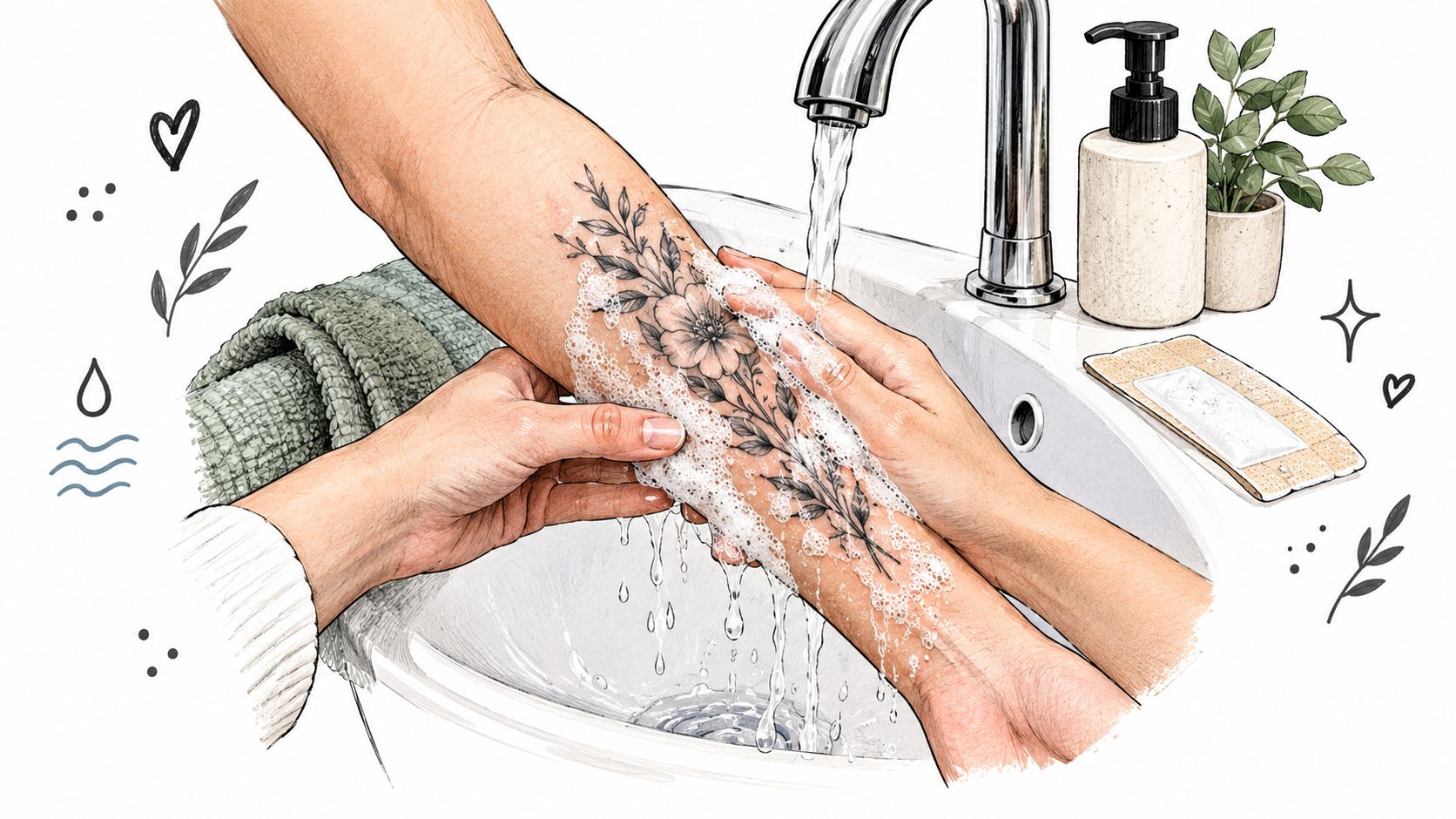
Use cool or lukewarm water and your clean hands to wash away surface residue. Don't scrub with a washcloth, sponge, or brush, and don't pick at crusts to make the tattoo look cleaner. Cleaning a healing surface isn't the same as polishing intact skin.
Pat the area dry with the clean disposable towel. Rubbing is unnecessary friction, and a towel that's been hanging in the bathroom isn't the tool I'd choose for this job.
Keep the first product application restrained
Use the specified product. Follow your artist's recommendation for a mild moisturizer or aftercare ointment rather than mixing products.
Apply a thin layer when instructed. A heavy coating isn't an upgrade to the plan.
Keep film preparation separate. If you're applying a replacement dressing, follow that product's directions rather than assuming moisturizer belongs underneath.
Discard the used covering. Don't reuse a sticky sheet or a removed pad.
Practical rule: Prepare everything first. Clean, dry, and finish the routine without repeatedly touching the tattoo.
Keep the studio's tattoo aftercare instructions available while you work, especially if your artist has given you a replacement-film plan. If those instructions are unclear, ask before improvising.
Your tattoo doesn't need aggressive cleaning to prove you're taking care of it. It needs gentle handling, appropriate products, and a routine you can repeat consistently.
How Long to Keep a Tattoo Bandage On and When to Change It
Watch the condition of the dressing, not just the clock. A comfortable film with an intact seal is a different situation from a sheet leaking onto your shirt, even if both went on at the same time.
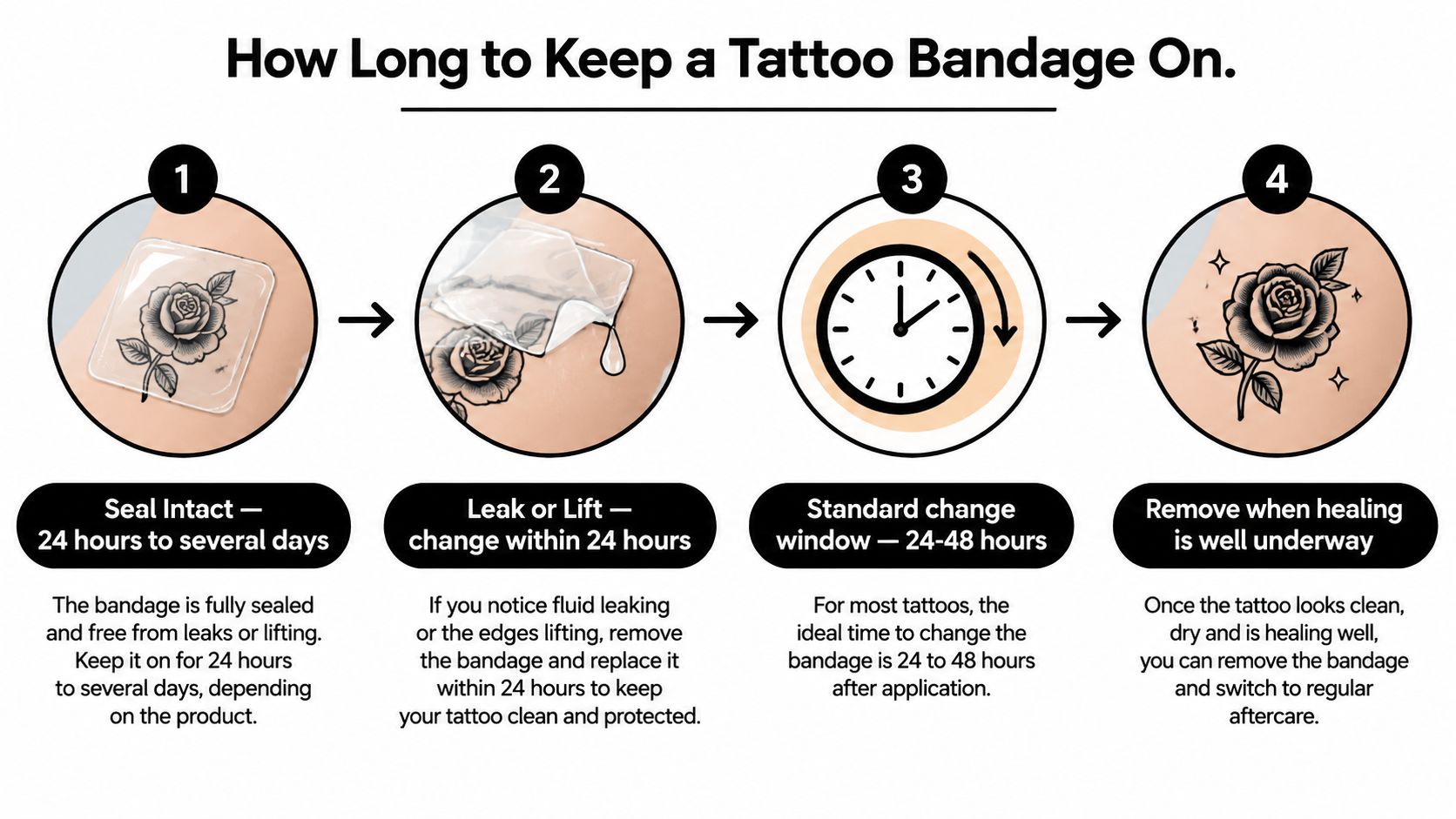
The European Academy of Dermatology and Venereology's tattoo aftercare guidance says film or polyurethane bandages may remain for 24 hours or several days if comfortable and not leaking, and should be changed when wound fluid escapes. That conditional guidance is more useful than a universal deadline.
Use the graphic as a reminder to inspect the dressing, not as a fixed schedule. A failed seal needs attention when it fails, and neither a standard change window nor a tattoo that merely looks better overrides your product instructions.
Make decisions from what you can see and feel
Some fluid beneath film doesn't automatically mean you need to peel it off. Inspect the surrounding seal and your symptoms. Leave a comfortable, contained dressing alone unless your product or artist's instructions say otherwise; don't puncture it to drain the fluid.
Fluid is escaping. Treat that as dressing failure. Remove or change it according to your aftercare plan rather than patching over the leak.
An edge has lifted. A loose outer corner isn't the same as a channel reaching the tattoo. If coverage is compromised, don't rely on the original wear deadline.
Water is trapped after a shower. Don't leave outside water enclosed against the healing surface. Follow the removal and cleaning routine.
Sweating makes the dressing uncomfortable or loose. Stop the activity and inspect it. Don't press compromised adhesive back down and call it fixed.
Replacement needs a clean setup
A fresh dressing makes sense only when your instructions allow replacement and you can prepare the area properly. A clean new sheet isn't enough if your hands or the surrounding skin haven't been cleaned.
If you're traveling, plan access to a sink and supplies before the bandage needs attention. Don't replace film in a dirty restroom just to stay covered; ask your artist what uncovered-care backup to use if clean reapplication isn't practical.
If you want a visual demonstration alongside your written instructions, use this video without treating it as a substitute for your dressing's directions.
Telling Normal Healing, Adhesive Reaction, and Infection Apart
An itchy bandage isn't an infection diagnosis. It also isn't something you should automatically tolerate until the scheduled removal time. The pattern and direction of symptoms matter more than one isolated sensation.
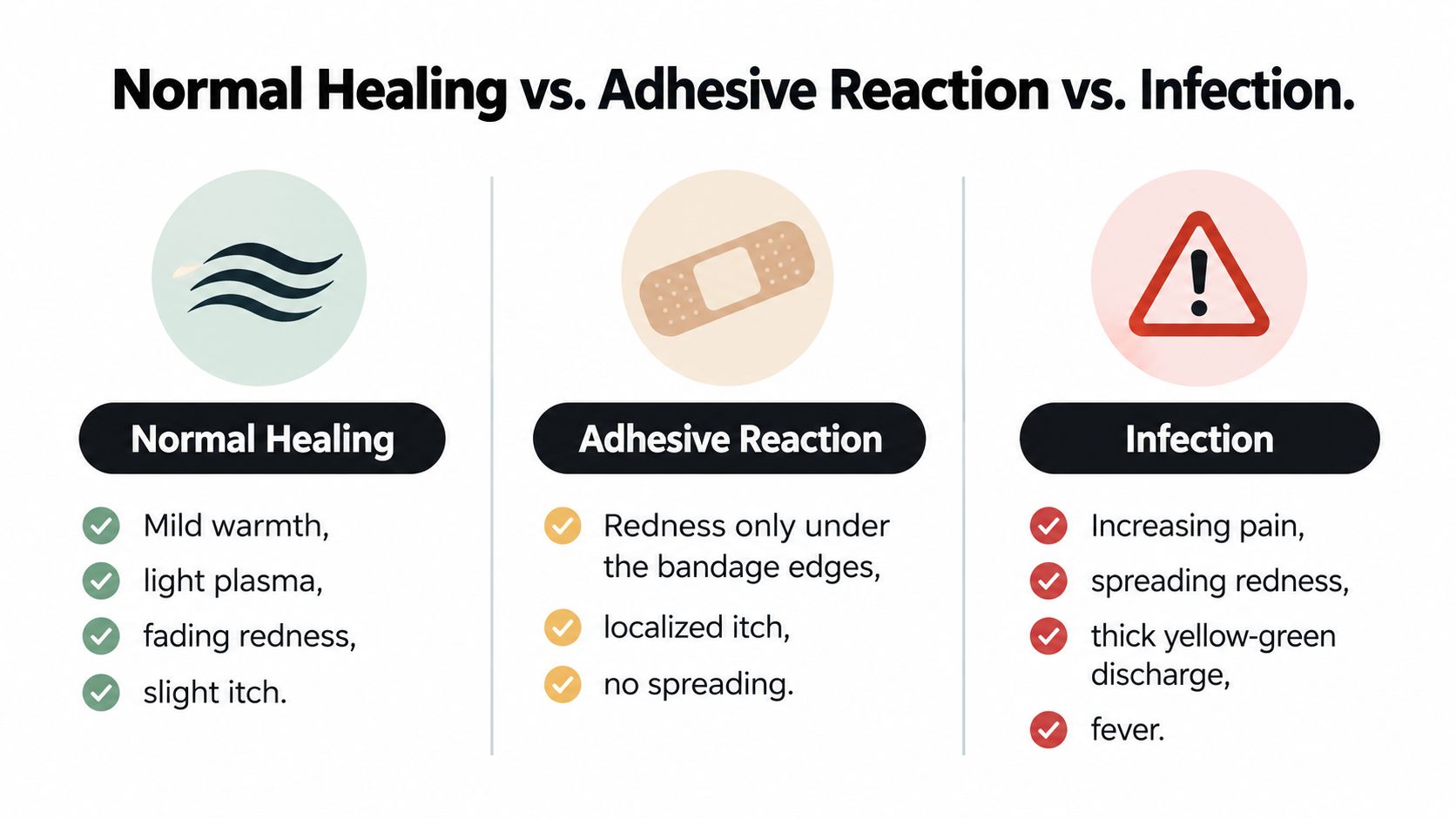
Expected early wound response should gradually improve. A sharply outlined, intensely itchy rash matching the adhesive can suggest irritation or allergy, while spreading warmth, worsening pain, pus, or systemic symptoms calls for medical assessment. These distinctions help you decide what to do, but they don't let you diagnose yourself from a photo.
Adhesive reactions are real, but the numbers need context
A 2025 systematic review of surgical adhesive reactions found 83 cutaneous reactions among 7,580 patients, or 1.09%, with rates ranging from 0.5% to 14% across included studies. Those patients received 2-octyl cyanoacrylate surgical adhesive, not tattoo film, so those figures must not be presented as tattoo-bandage allergy rates.
Products beneath or around the dressing can also cause trouble. A dermatology review of tattoo-associated skin reactions identifies fragrance, wool alcohols, panthenol, and colophony as potential triggers for allergic contact dermatitis. Don't assume the adhesive is responsible if you've also introduced a new balm.
Use this comparison to organize your observations, not to rule out a problem. An adhesive reaction isn't necessarily confined to the edges, and overlapping symptoms deserve clinical judgment.
Run a practical symptom check
Check the trend. Is discomfort settling, or are pain and swelling increasing?
Check the shape. Does the redness closely follow the dressing outline, or is it spreading beyond the covered area?
Check the sensation. Intense itching and burning deserve attention, particularly with blistering.
Check beyond the tattoo. Fever, chills, nausea, or feeling unwell changes the urgency.
After removing a suspected irritating dressing, wash gently and avoid reapplying the same adhesive. Don't layer fragranced products or disinfectants over the rash without clinical advice.
For readers comparing body-art aftercare with cosmetic tattooing, Bonna Beauty's guide to tattoo healing for Sydney clients is a separate resource for that context, not a replacement for assessment of a worsening reaction.
Don't wait for every warning sign to appear before seeking help.
Matching the Bandage to Body Location and Piece Size
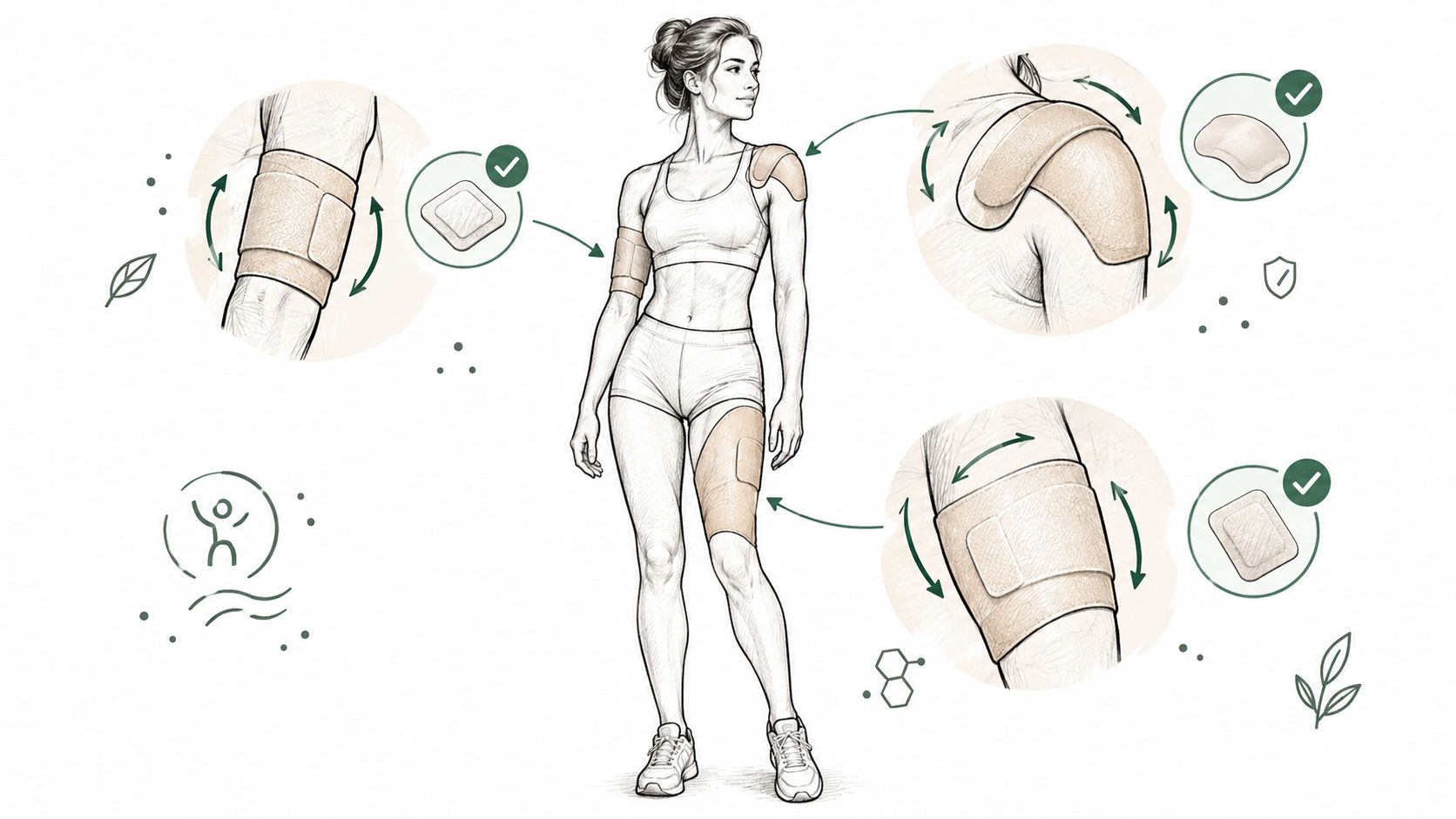
For a broad thigh or upper-arm piece, I'd consider film if the surrounding skin tolerates it and the artist can establish a reliable margin. For an elbow, knee, or rib placement, I'd pay more attention to how the covering behaves when you move. Test the fit in a normal position, not just while you're stretched out on the tattoo chair.
Transparent polyurethane dressings allow oxygen and water vapor to pass while restricting larger contaminants such as bacteria and proteins, as described in this wound-dressing evidence summary. That's useful design, but general wound-care evidence isn't proof of a tattoo-specific success rate.
Check the placement before committing
Thighs, upper arms, and broad back areas. Consider film when there's enough suitable surrounding skin for adhesion. Plan clothing and sleeping positions that won't repeatedly rub the margins.
Ribs, elbows, and knees. Move gently before leaving the shop. If bending pulls the film or opens a crease, discuss a non-stick dressing rather than forcing the sheet to stretch.
Hands, fingers, and feet. Tell your artist about handwashing, gloves, footwear, and manual work. Ask for a realistic fallback plan if coverage won't hold.
Placement changes how you apply a covering, as this illustration shows.
Large work needs planning beyond one sheet
A sleeve or back piece needs an aftercare plan you can physically carry out. If you can't comfortably reach the area, discuss how you'll clean it and whether you'll need help with an approved replacement dressing. More surface area doesn't justify improvising overlapping film without instructions.
For multi-session work, tell your artist how the previous section healed before the next appointment. Report adhesive trouble, removal difficulties, and any clinical treatment rather than repeating a method that didn't suit you.
For Denver clients, Think Tank Tattoo provides aftercare guidance as part of its custom tattoo service. Use that conversation, or the equivalent conversation at your chosen studio, to settle placement, coverage, and your daily routine before you leave. Personalizing the plan means giving the artist useful information, not expecting them to guess what happens at your job.
Quick Tattoo Bandage Rules and When to Get Help
The useful question isn't whether you're a film person or a traditional-aftercare person. It's whether your current method still suits the wound, your skin, and your surroundings. A sensible plan can include initial coverage followed by uncovered care without treating either approach as a belief system.
Keep the essentials where you can find them, ideally alongside the written instructions you received:
Clean hands first. Make that the default before removal, washing, or product application.
Follow the specific plan. Use the artist's and product's directions, with clinical advice taking priority when a medical problem develops.
Watch coverage conditions. Don't preserve a failed or irritating dressing just to reach its planned removal time.
Stop covering when healed. Don't keep adding bandages as a precaution once the tattoo no longer needs them.
Keep supplies simple. Use the recommended cleanser and aftercare product instead of experimenting with a cabinet full of alternatives.
Know when the studio isn't enough
Seek prompt medical assessment for pus, spreading redness or warmth, fever, chills, severe or worsening pain, marked swelling, or foul drainage. Those are reasons to stop self-treating, not reasons to add a thicker layer of ointment.
Your artist can clarify how a dressing was applied and what the intended routine was. They can't replace a clinician's examination or prescribe treatment for infection. If symptoms are rapidly worsening or you feel systemically unwell, don't delay care while waiting for the shop to answer.
For a non-urgent bandage question, explain the placement, dressing type, what changed, and whether discomfort is improving or worsening. That gives your artist something useful to respond to instead of a message that only says the tattoo looks strange.
Visit Think Tank Tattoo for custom tattoo planning and clear aftercare guidance in Denver. Bring your placement ideas, work routine, and adhesive-sensitivity concerns to a complimentary consultation so you can discuss a practical bandage plan before your next session.
Comments