
8 Finger Tattoos Pros and Cons Before You Book in 2026
“Keep it tiny and delicate” is popular finger-tattoo advice. It's also advice that can leave you with lettering you can't read or a symbol that needs repeated attention. Small doesn't mean easy, especially on skin that bends, grips, washes, and rubs against objects throughout the day.
Finger tattoos are easy to love because you see them constantly. A meaningful initial, a simple star, or a commitment band can become part of your everyday appearance without covering much skin. But that visibility also makes uneven fading, blurred edges, and a poorly chosen placement harder to ignore.
The useful way to weigh finger tattoos pros and cons is to turn each trade-off into a consultation decision. Choose the exact surface, not just the finger. Compare line weights at actual size. Think about your work duties before choosing an appointment date.
A free consultation at Think Tank Tattoo in Denver gives you space to discuss those choices before committing. Bring references, explain how you use your hands, and ask what the artist would change for better long-term legibility. The right plan isn't necessarily the smallest design. It's the design you'll still recognize and enjoy after the fresh-tattoo photograph.
Table of Contents
3. Challenging Healing and Friction Exposure - Make Aftercare Practical
4. Minimalist Designs and Quick Sessions - Judge the Stencil at Actual Size
5. Visibility and Personal Expression - Test Ordinary Life, Not Just Photos
6. Professional and Social Perception - Discretion Has a Cost
7. Difficult Removal and Cover-Ups - Price the Exit Before Committing
8. Symbolic Placements on the Ring Finger and Knuckles - Fit the Design to a Moving Hand
Deciding on a Finger Tattoo You Will Still Love Later - Bring Decisions to the Consultation
1. Faster Fading and Blurring
A delicate star can look crisp when fresh and less defined after everyday wear. Fingers give you very little room to absorb those changes, so even modest pigment loss or softened edges can alter the whole design.
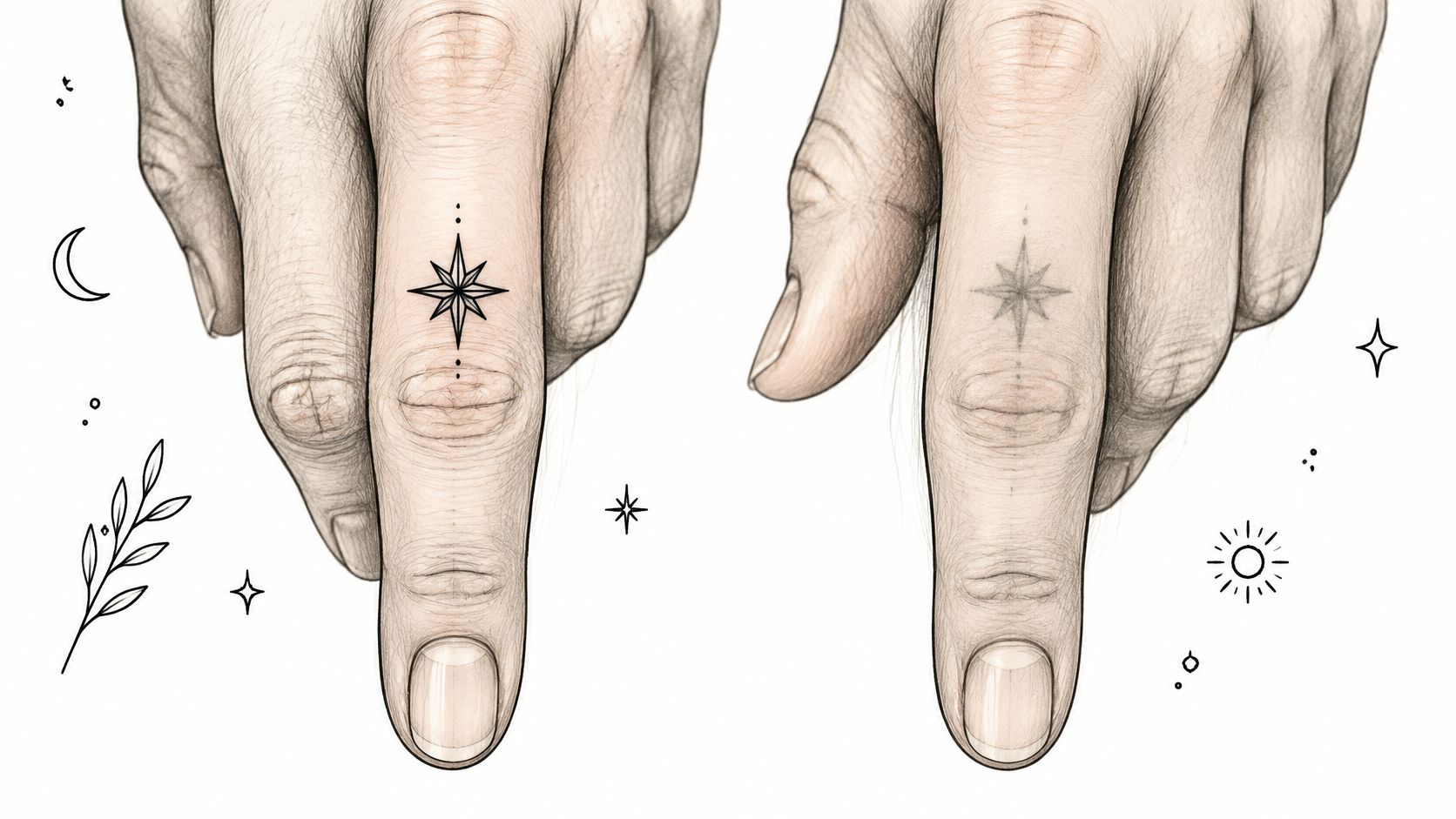
The exact surface matters. Dermatologist and artist guidance in Allure's finger-tattoo guide identifies palm-side joints as particularly vulnerable to fading, while the tops of fingers generally hold ink better. A symbol on top of a finger and the same symbol inside a bending crease aren't equivalent choices.
Choose Space Before Detail
Say you want a small north star beside a knuckle. Keeping every narrow point may require a larger stencil or a different placement. Simplifying the star is usually a better compromise than squeezing its lines together.
Compare line weights: Ask to see a sturdier version beside the delicate reference.
Protect negative space: Leave clear gaps inside letters and between separate marks.
Discuss maintenance: Ask when the artist evaluates healed work and how touch-ups are handled.
Think Tank Tattoo's explanation of why tattoos fade over time offers useful background for that conversation. Once the skin has fully healed, use broad-spectrum sunscreen on exposed hands and reapply according to the product's directions.
There's no reliable finger-specific expiration date. Don't book around a promise that the tattoo will stay perfectly sharp for a particular number of years.
2. Higher Pain Levels
A small finger tattoo can hurt more than its size suggests. The skin has little cushioning over bone, and sensitive spots vary by placement. Your tolerance and the amount of repeated work also affect how the session feels.
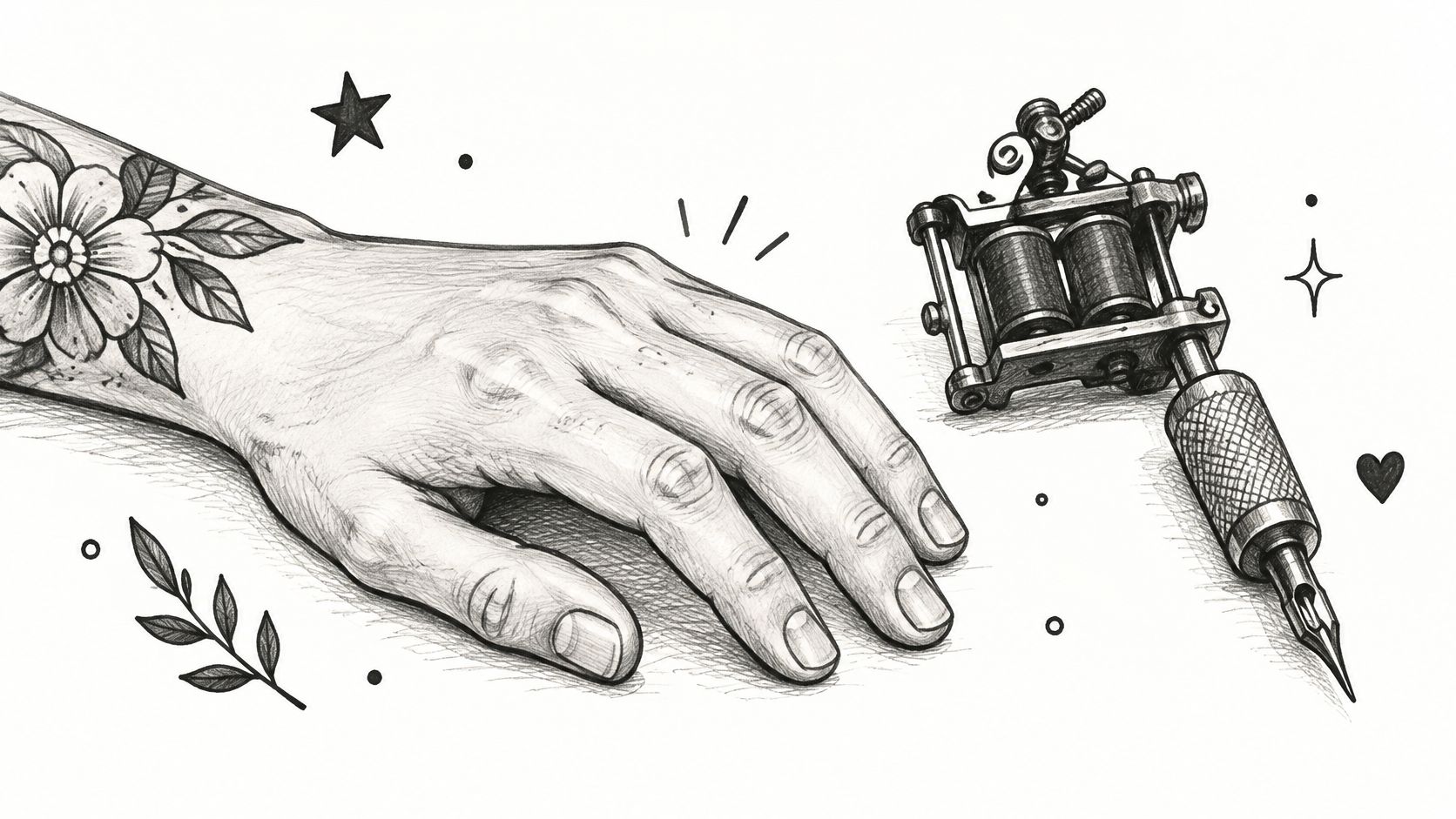
A simple outline on the top of a finger is a different commitment from a filled band wrapping around its sides. At the consultation, compare the exact design and placement, not just the tattoo's size. If you want less repeated work, ask whether a simpler design would suit the spot. Keep the placement you want, rather than choosing a poor one just to shorten the appointment.
Prepare for Steady Hands
Eat beforehand, arrive hydrated, and book when you're rested rather than rushing from a demanding shift. Avoid alcohol. Tell the artist if you're anxious or prone to feeling faint.
A standalone symbol may feel more manageable than lettering across several fingers, especially if this is your first tattoo. Agree on a signal for a pause, and support your hand so you're less likely to pull away when a spot stings.
Discuss numbing products with the artist before applying anything. The product needs to suit both your skin and the artist's process.
Tattooing and laser removal are different experiences. If future removal is part of your decision, treat ways to manage tattoo removal pain as a separate conversation with a qualified removal provider.
3. Challenging Healing and Friction Exposure
Your appointment may be brief, but your hands still have jobs afterward. Washing dishes, lifting weights, handling tools, and wearing work gloves can all make protecting a fresh finger tattoo difficult.
Book around what your hands must do, not just when the studio has an opening. A cook facing repeated washing and glove changes needs a different plan from someone who can temporarily reduce hands-on tasks.
The aftercare discussion should address the activities you really do.
Make Aftercare Practical
Follow the artist's instructions for the specific dressing used. Clean gently, pat dry with clean material, and apply only a thin layer of the recommended fragrance-free aftercare product. Don't leave the skin heavily coated or continuously damp.
Reduce rubbing: Adjust gym sessions, tool use, and chores that press directly against the tattoo.
Avoid soaking: Skip pools, hot tubs, and prolonged immersion until the skin has healed.
Plan protective equipment: Discuss required work gloves beforehand, because trapped moisture and friction can complicate care.
Think Tank Tattoo's guide to what to avoid after getting a tattoo can help you identify conflicts before booking.
A clinical review in The Permanente Journal describes tattoo complications including allergic reactions and bacterial infections. Choose a professional studio with single-use needles and sound barrier practices, and disclose eczema, psoriasis, pigment allergies, immune suppression, or poor wound healing.
Spreading redness, worsening pain, pus, fever, or persistent raised itching need medical assessment. Don't treat them as ordinary fading or wait for a touch-up appointment.
4. Minimalist Designs and Quick Sessions
A clear crescent, an initial, or a simple geometric mark can suit a finger beautifully. The limited canvas encourages you to identify the part of an idea that matters most.
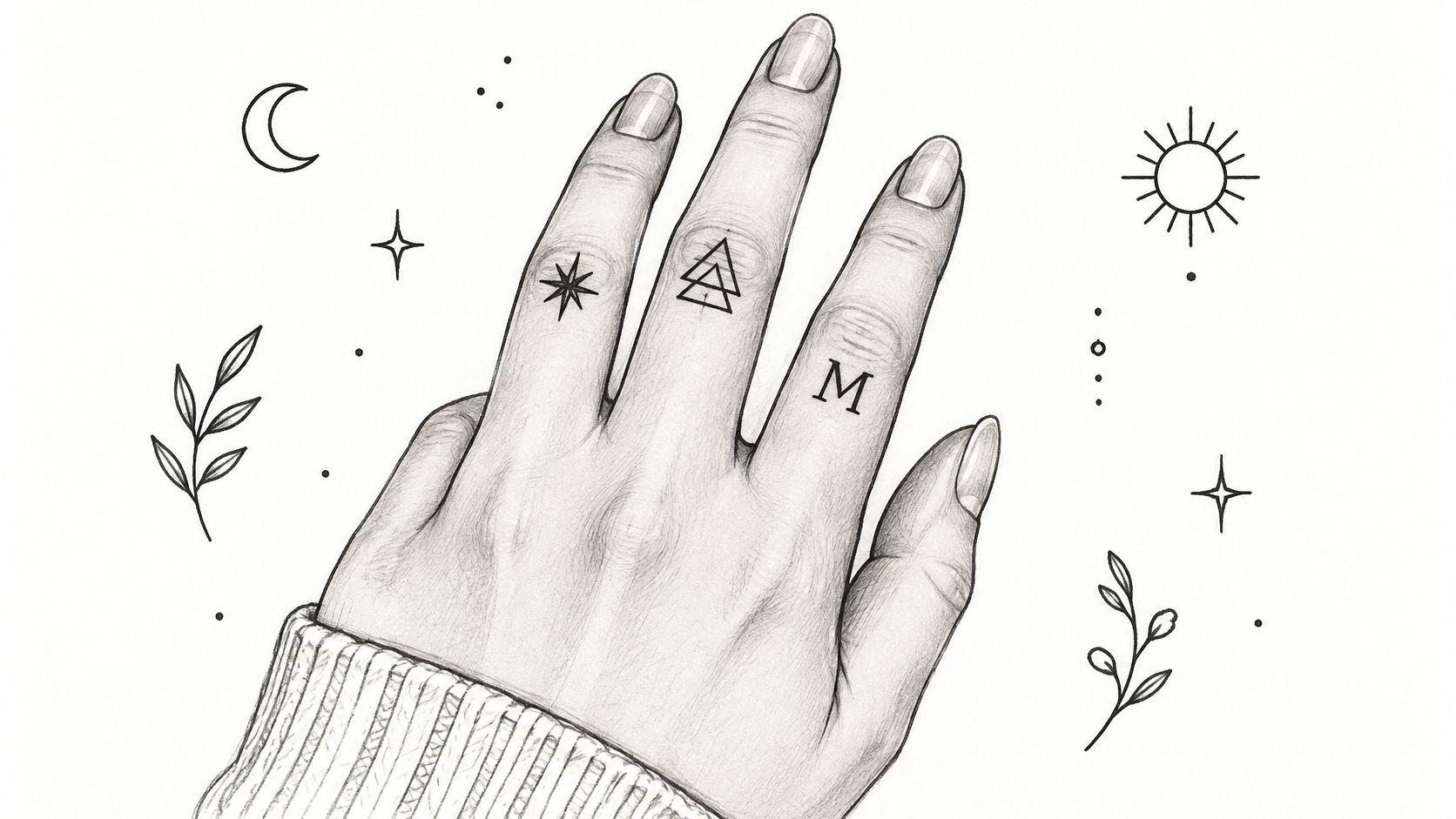
Minimalist and microscopic aren't the same thing. A bold symbol can be minimal without being fragile. A tiny constellation filled with narrow connecting lines may look simple on a screen but become crowded at finger scale.
Judge the Stencil at Actual Size
Suppose you want a birth date inside your ring finger. The full date may demand cramped numerals, while an initial or a simpler commemorative symbol leaves more breathing room. If every character matters, moving the date elsewhere may be the better choice.
Ask the artist to place the stencil, then look at it with your hand relaxed and from normal viewing distance. Don't approve it only through a close-up phone photograph.
Choose a clean silhouette: The main shape should read without inspecting tiny interior details.
Simplify lettering: Open letterforms and generous spacing matter more than decorative flourishes.
Start selectively: A standalone design lets you evaluate the placement before expanding across your hand.
A compact piece may require less tattooing time than a large composition, but preparation, sterile setup, and design work still matter. Small doesn't automatically mean cheap, so ask for a quote rather than estimating by size.
The benefit is focus. You can make a strong visual statement with little ink, provided you're willing to remove details that the placement can't support.
5. Visibility and Personal Expression
A memorial initial on your finger is somewhere you'll encounter it while making coffee, typing, or reaching for a door. That everyday visibility can be the strongest reason to choose the placement.
The same visibility can feel tiring if you dislike questions about personal meanings. You don't owe strangers an explanation, but you should be comfortable with the possibility that they'll ask.
A finger tattoo can be personally meaningful without being publicly understandable. Choose how much of the story you want the design to reveal.
Test Ordinary Life, Not Just Photos
Use a temporary tattoo or a skin-safe cosmetic drawing to test the proposed placement before booking. Wear it through ordinary routines rather than judging it only with your hand posed for a picture.
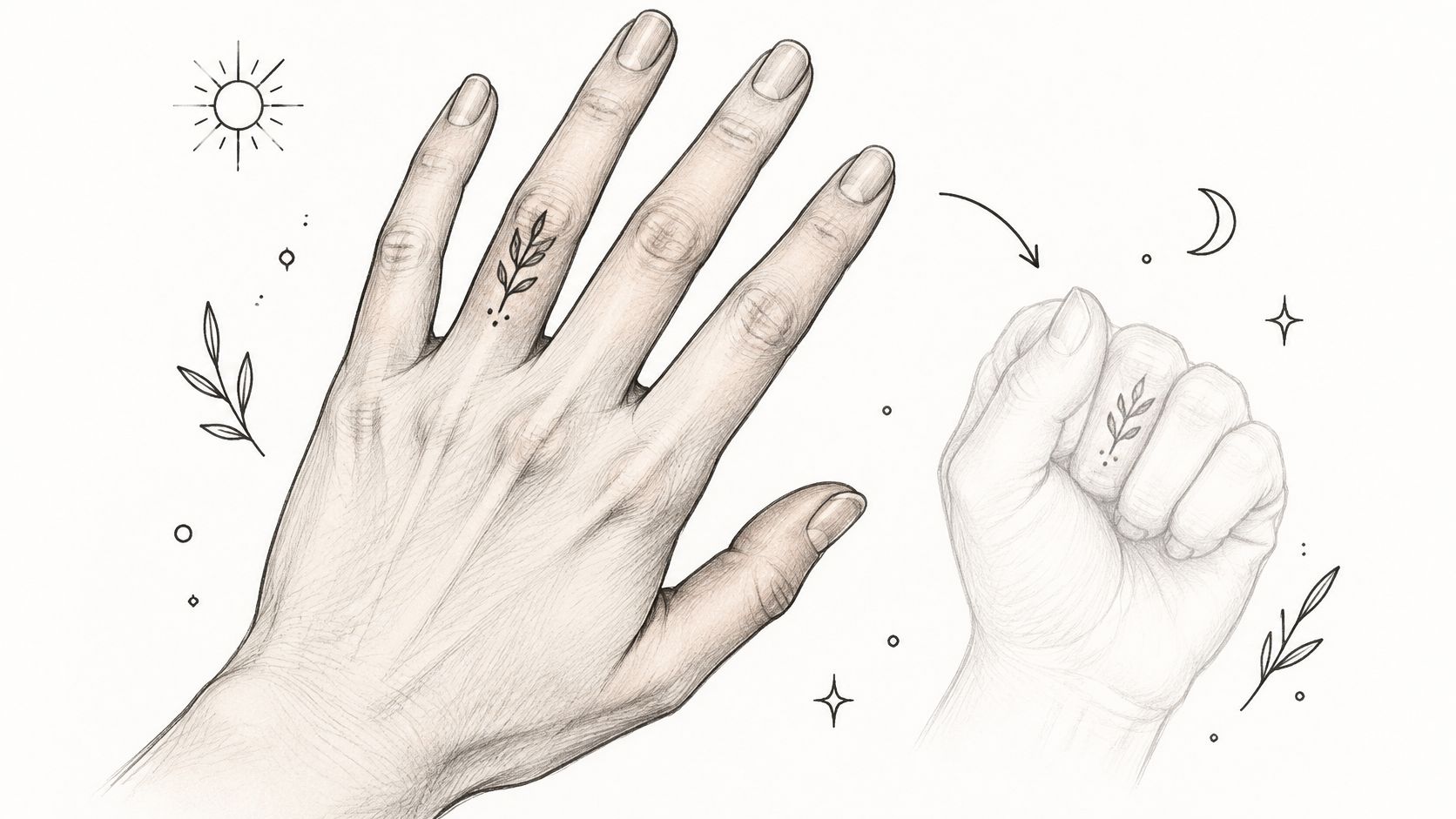
For example, compare a botanical sprig on top of the finger with a simplified leaf along the side. The first stays more visible; the second may feel quieter, but neighboring fingers can cover or rub against it.
Notice whether you enjoy seeing the mark repeatedly. Check how it looks holding your phone, presenting your hand, and resting naturally.
Don't confuse less visible with reliably hidden. Side-finger tattoos can appear during gestures, and closing your hand won't conceal every design. If privacy is essential, choose a placement covered by clothing rather than relying on hand position.
Bring that temporary-placement experience to the consultation. Saying the symbol felt too exposed is much more useful than asking for something vaguely discreet.
6. Professional and Social Perception
Check your workplace's written appearance policy before choosing a visible hand tattoo. Don't rely on a colleague's experience, an informal assurance, or the assumption that a small tattoo won't count.
The practical question is whether you can wear this placement without constantly managing it. Consider your present job, the roles you may apply for, and any settings where you're required to maintain a particular appearance.
Discretion Has a Cost
Say you work in a client-facing role and want a ring-finger initial. Moving it to the inner surface may reduce visibility in some positions, but it also puts the design where rubbing and wear can be harder to avoid. A compromise made for work can create a maintenance problem.
Ask the artist to show the proposed stencil with your hand open, relaxed, and holding an everyday object. If the design remains visible in positions you use at work, treat it as visible.
Read the actual policy: Look for wording about hands, visible tattoos, imagery, and covering requirements.
Separate covering from healing: Makeup, adhesive coverings, or constant glove wear aren't automatic solutions for fresh skin.
Consider another site: An upper-arm or torso placement may preserve the design without the same visibility concerns.
Social reactions also depend on the imagery, not just the location. Bold lettering across the knuckles communicates differently from a small leaf, even if both have private meanings.
You don't need everyone's approval. You do need an honest view of the compromises you're prepared to make. If hiding the tattoo would become a daily task, moving it before tattooing is easier than managing it afterward.
7. Difficult Removal and Cover-Ups
A finger tattoo is small, not easily reversible. If you dislike the result, a cover-up needs enough room to conceal the existing shape while still producing a readable new design.
A pale initial might allow a carefully planned revision. A dense dark band leaves fewer options, and repeatedly adding ink can turn an uncertain design into a larger problem.
The JAMA Dermatology tattoo-removal cohort study reported a median of 10 Q-switched laser sessions, with a range of 2–18 sessions, across the tattoos studied, not fingers specifically. That's a useful warning against treating removal as a quick fallback.
Price the Exit Before Committing
A tattoo-removal industry report from Removery gives an average small-tattoo removal cost of $1,500–$2,000. That isn't a quote for your finger, but it shows why the original tattoo's small size shouldn't determine your expectations about reversal.
Before adding more ink: Have an artist assess whether the problem needs a touch-up, redesign, lightening, or removal. Those are different decisions.
For example, an unreadable word may not become readable just by making every line darker. The artist might recommend changing the composition or speaking with a removal specialist before attempting a cover-up.
Think Tank Tattoo's guide to how to fix a bad tattoo outlines options worth discussing before another session.
Ask a qualified laser provider about likely response, healing intervals, residual pigment, and possible skin changes. Don't accept a guaranteed outcome based only on a photograph. If your plan depends on easy removal later, reconsider the design now.
8. Symbolic Placements on the Ring Finger and Knuckles
A ring-finger tattoo can mark a commitment without a separate piece of jewelry. Knuckle lettering can make a personal message part of the way you present your hands.
Symbolism doesn't remove the placement's practical limits. A continuous band travels across surfaces that experience different amounts of rubbing and flexing, so it may not age evenly around the whole finger. Discuss that before deciding a ring with no visible join is essential.
Fit the Design to a Moving Hand
For a commitment tattoo, bring the ring you wear and show the artist where it sits. Decide whether the tattoo should appear above it, below it, or without jewelry. Don't plan to wear a ring over healing tattooed skin.
A partial band or top-facing symbol may provide the meaning you want without requiring a line around every surface. That's a design choice, not a lesser version of the idea.
Check relaxed alignment: Lettering should make sense when your hand rests naturally.
Check a closed fist: Separate characters can shift visually when the fingers bend.
Keep forms open: Simple, bold letters give the artist more room than ornate, tightly packed script.
For paired symbols across both hands, approve each mark independently as well as together. Your hands won't always be displayed side by side.
A meaningful date may also work better as a larger tattoo elsewhere, paired with a small finger symbol. Keep the meaning; change the format when necessary. The consultation should help you preserve what matters without forcing every detail onto a surface that can't comfortably hold it.
How the Eight Finger Tattoo Trade-Offs Compare at a Glance
Use this comparison to decide what to discuss at your consultation: line weight, placement, healing time, and how visible the tattoo should be. Each choice has a cost, so settle the practical details before approving the design.
Item | Key Upside | Key Downside | Best For |
|---|---|---|---|
Faster Fading and Blurring | Bold, simple designs can make a striking small tattoo | Ink may fade, spread, or blur; touch-ups may be needed | People comfortable with ongoing maintenance and simplified designs |
Higher Pain Levels | Small pieces often allow shorter sessions | Fingers and knuckles can be especially painful and tender | People prepared for brief but potentially intense discomfort |
Challenging Healing and Friction Exposure | Careful aftercare can support healing | Frequent hand use can irritate the tattoo or cause ink loss | People able to protect and care for their hands during healing |
Minimalist Designs and Quick Sessions | Small designs can fit into a shorter appointment, though price still depends on the design and preparation | Limited space restricts detail, and tiny text may become illegible | First-time clients or people seeking simple symbols and lettering |
Visibility and Personal Expression | Highly visible placement can express personal meaning | Difficult to conceal and may attract unwanted attention | People who want a visible, meaningful design |
Professional and Social Perception | Can make a clear personal statement | May affect impressions or conflict with workplace policies | People whose work and social settings are accepting of visible tattoos |
Difficult Removal and Cover-Ups | A thoughtful design can be a lasting personal mark | Removal is challenging, and cover-up options are limited | People confident in their design choice and placement |
Symbolic Placements: Ring Finger and Knuckles | Ring-finger and knuckle designs can carry strong symbolic meaning | Knuckles are visible and painful; ring-finger designs may need adjustment | People seeking meaningful bands, dates, initials, or bold lettering |
At the consultation, ask to see the design at its intended size. If it includes fine lines or small lettering, discuss whether a bolder, simpler version will stay readable as the ink changes. Choose a placement you can protect while it heals, especially if work or daily tasks involve frequent hand use.
Visibility is also a practical choice. Decide whether you're comfortable having the tattoo in view at work and in social settings, and whether you can accept limited cover-up options later. For ring-finger or knuckle designs, settle the exact placement and the amount of detail before the session. A clear choice now helps match the design to the way you use your hands.
Deciding on a Finger Tattoo You Will Still Love Later
The strongest reason to get a finger tattoo is that you want to live with it visibly. The weakest reason is that it seems small enough not to require much thought. Choose it as a permanent placement with ongoing maintenance needs, not as a low-commitment trial.
Start by separating your priorities. If precise lettering matters most, you may need more space than a finger provides. If the finger placement matters most, simplify the lettering or choose a symbol that stays recognizable with softer edges.
Bring Decisions to the Consultation
Arrive with a short explanation of the meaning, reference images, and a willingness to change the format. Show the artist where you want the tattoo, describe your job, and mention hobbies that involve gripping, gloves, water, or repeated friction.
Ask to compare the design at actual size rather than approving an enlarged digital drawing. Discuss the proposed line weight, the gaps between elements, and what the artist expects to remain legible as the tattoo ages.
If you're still exploring imagery, you can generate tattoo concepts with starryai. Treat those images as starting points for a conversation, not ready-to-tattoo plans. A convincing digital image doesn't establish whether its lettering, anatomy, or tiny details will work on your finger.
Choose the version you can maintain and comfortably wear, not just the version that looks most delicate on a screen.
Budget for the possibility of touch-ups, and ask about the studio's policy before booking. Plan healing around your actual responsibilities, including work gloves, washing requirements, exercise, and chores. Once healed, protect the tattoo from sunlight and avoid treating repeated reworking as a cure for unsuitable placement.
Think Tank Tattoo offers complimentary consultations on South Broadway in Denver to discuss design direction, placement, and timing. Use that conversation to get a realistic recommendation, including whether your idea belongs on a finger at all.
You should leave knowing what will be tattooed, why that placement makes sense, how you'll care for it, and which compromises you're accepting. A good finger-tattoo decision includes permission to go bolder, move the design, or wait.
Think Tank Tattoo offers custom tattoo planning and complimentary consultations to help you work through finger placement, line weight, and appointment timing. Visit Think Tank Tattoo to arrange a consultation, and bring your references, a photo of your tested placement, and questions about healing around your work routine.
Comments