
How Does Tattoo Pricing Work? Rates, Minimums and Deposits
You've picked a design, saved reference images, and started contacting artists. One studio gives you an hourly rate, another quotes the whole piece, and a tiny tattoo costs more than you expected. Without knowing what each quote includes, you're not comparing the same service.
So, how does tattoo pricing work? A studio prices the appointment around its billing method, the time and preparation your design requires, and the costs of doing the work professionally. The useful question isn't just how much an artist charges. It's what work that price covers and how reliably they can estimate the time.
Table of Contents
How Tattoo Quotes Are Built From Minimums, Hourly and Day Rates - Match the rate to the scope
Why a Small Tattoo Still Costs Near the Minimum - The difference between working hours and billable hours
What Changes the Price of a Custom Tattoo - Why the same size can produce different totals - What the studio must recover
Deposits, Minimums and What Happens to Your Money - Before sending payment - Why non-refundable terms matter
Budgeting for Large or Multi-Session Work - Turn the estimate into a payment schedule
Tipping, Touch-Ups and Costs Outside the Quote - Questions that reveal the full bill - Existing tattoos need their own assessment
Confirm Your Quote Before You Book - Prepare a quote the artist can stand behind
How Tattoo Quotes Are Built From Minimums, Hourly and Day Rates
Most studios quote tattoos using a shop minimum, an hourly rate, a day rate, or a flat project price. Knowing which unit applies tells you more than the headline number.
At Think Tank Tattoo, our shop minimum is $100. That's the lowest charge for an appointment, not a promise that every small tattoo will cost that amount.
The four pricing units and when each applies
Pricing unit | How it is billed | Best fit |
|---|---|---|
Shop minimum | Lowest charge for any appointment | Small, simple designs |
Hourly rate | Billable time at a set rate | Custom, detailed or uncertain-length work |
Day rate | Flat fee for a reserved full session | Large sleeves, backs and full-day pieces |
Flat project price | One fixed total for a defined design | Repeatable flash or small pieces with a known scope |
For market context, Zarla's tattoo pricing guide places established U.S. artists commonly around $150 to $250 per hour, major-city rates at $200 to $400 or more, Denver estimates around $150 to $250 per hour, and full-day sessions broadly at $800 to $2,000. These are benchmarks, not regulated prices or our studio's rate sheet.
Match the rate to the scope
An hourly quote works well when the artist can't confidently fix the duration before developing the design. Its usefulness depends on the session estimate behind it: a lower rate doesn't guarantee a lower total.
Using Zarla's worked example, six hours at $200 per hour totals $1,200 before applicable taxes or gratuity. Ask what counts as billable time, including how the artist treats stencil placement, breaks, and design adjustments.
A day rate reserves a substantial session, but you still need to understand the usable tattooing time and what happens if you stop early. A flat project price offers more certainty, provided the design, placement, and revision boundaries are defined.
This visual summarizes the pricing categories; use your written estimate, rather than an illustration, to confirm actual rates.
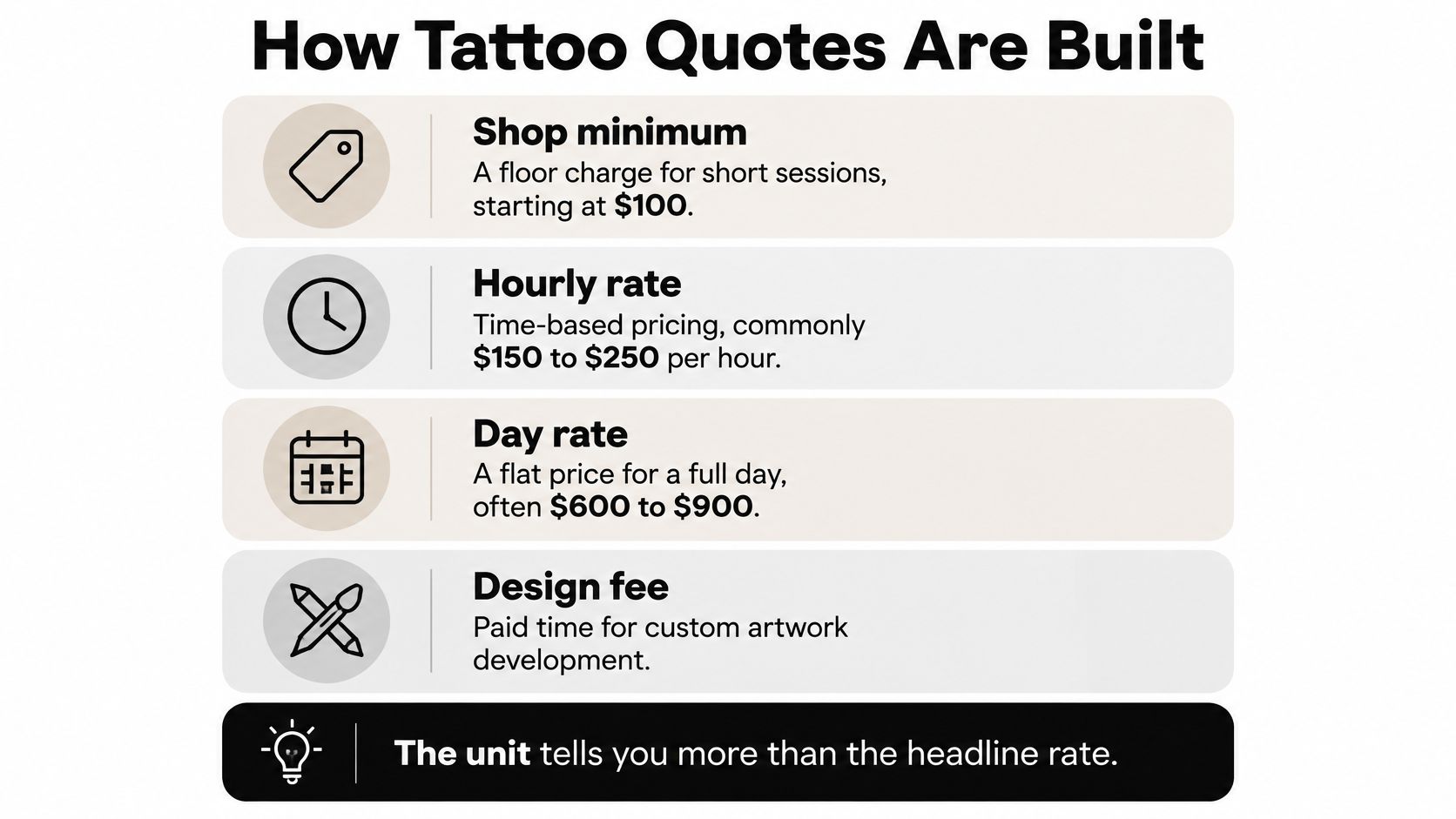
The business principle is cost recovery. AmaJova's resource on pricing your services with confidence offers useful context for understanding why professional service prices must account for work beyond the visible appointment.
Before comparing quotes, ask:
Which unit applies? Minimum, hourly, daily, or fixed project price.
What's included? Design preparation, touch-ups, taxes, aftercare products, and how the deposit is credited.
What could change it? Additional detail, placement changes, revisions, or extra session time.
Why a Small Tattoo Still Costs Near the Minimum
A short tattoo still requires a complete appointment. Tatulogue's tattoo cost guide explains why a 20-minute tattoo can't always be priced by prorating an hourly rate, and places common U.S. shop minimums around $80 to $200, with most published studio samples at $100 or more.
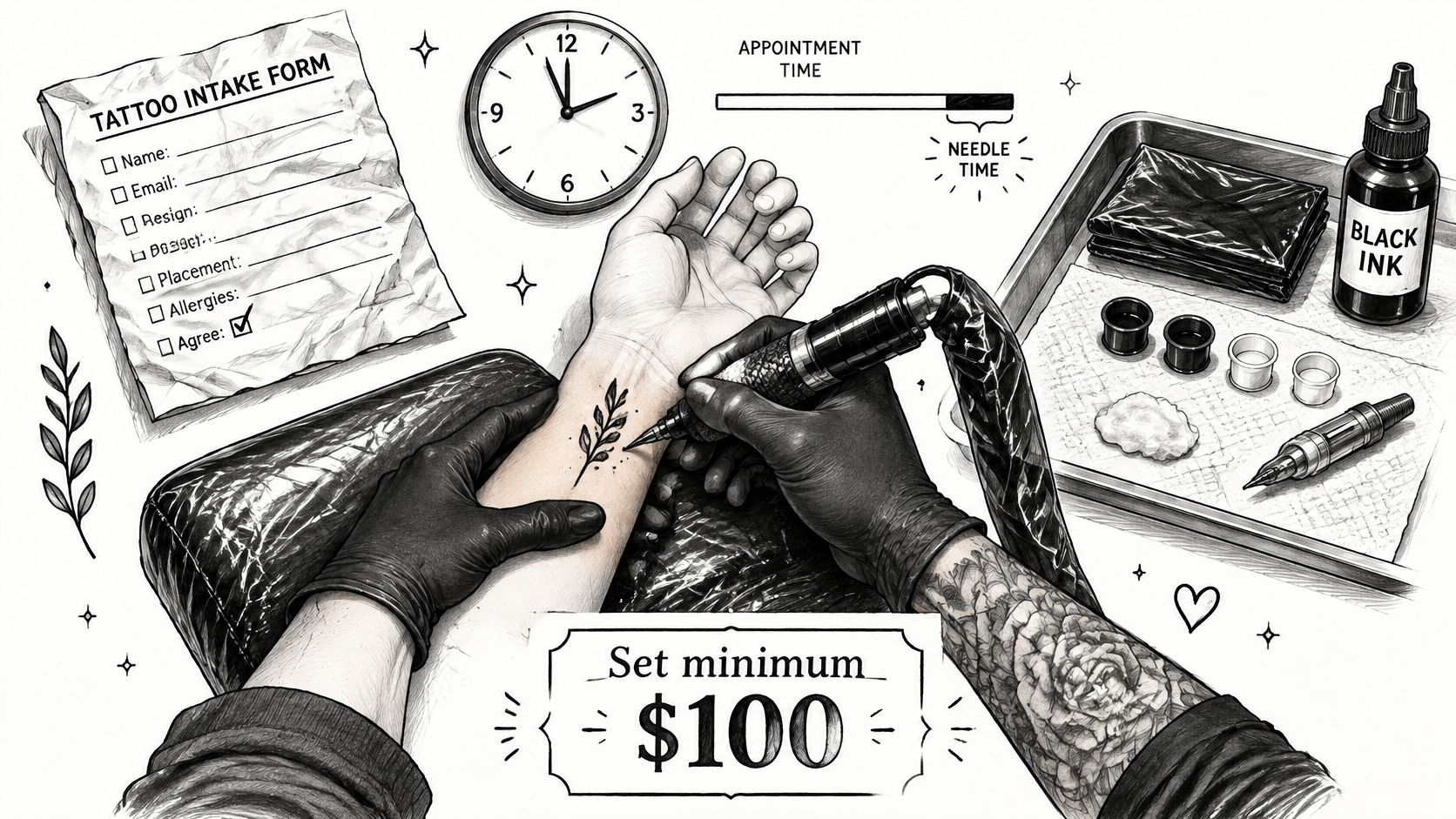
Before tattooing starts, someone handles intake, prepares the station, sets protective barriers, and positions the stencil. The appointment also requires single-use needles or cartridges, ink caps, gloves, documentation, cleaning, appropriate instrument processing, and aftercare instructions.
Those tasks don't shrink in direct proportion to the design. A tiny outline uses less tattooing time than a larger composition, but the artist can't skip preparation or cleanup.
The difference between working hours and billable hours
A practical pricing equation is:
Hourly rate = (annual operating costs + target pre-tax pay) ÷ annual billable tattoo hours
StyleSeat's tattoo pricing guide illustrates this with $24,000 in annual costs plus $66,000 in desired pay, divided by 900 tattooing hours, producing a $100 hourly rate, and distinguishes those billable hours from an example of 1,800 total working hours.
The remaining work includes drawing, consultations, scheduling, cleaning, and administration. Unless the studio charges separately for those tasks, the artist must recover their cost through booked tattoo appointments.
Practical rule: Judge a minimum by what the appointment includes, not by how little ink the design uses.
A minimum isn't a surcharge added because the artist dislikes small work. It establishes a floor below which an appointment may not cover its own labor and supplies.
For a small custom design, simplifying the artwork may reduce tattooing time without reducing the final price below that floor. Choosing existing flash can reduce design development, but it doesn't eliminate station preparation.
For a Denver appointment, ask whether the minimum includes consultation, stencil revisions, and aftercare guidance. We offer complimentary consultations, so you can discuss whether your idea is suitable before committing to an appointment.
What Changes the Price of a Custom Tattoo
Design and booking factors and how they change the quote
Factor | Effect on the quote | Example |
|---|---|---|
Size and session length | Adds billable hours; large pieces may need several sessions | Full sleeve priced by the day rate or across multiple sessions |
Detail and linework | Slows each pass and raises total hours | Fine botanical linework versus bold lettering |
Color | Adds time for packing and blending | Full-color piece versus black-and-grey at the same size |
Placement | Affects comfort, healing considerations, and tattooing speed | Ribs and hands often take longer than upper arms |
Artist experience | Helps set the hourly rate | Established artist at a higher rate than a newer artist |
Session count | Each appointment adds setup and possibly a minimum | Multi-session back piece booked in blocks |
Size matters, but coverage and detail density are more useful than dimensions alone. An open composition with generous negative space requires different work from a densely shaded design occupying the same area.
Fine botanical linework calls for careful positioning and controlled passes. Color saturation adds packing and blending work, while a design with limited shading may leave more skin untouched.
Why the same size can produce different totals
Consider a palm-sized black-and-grey design on the forearm versus a full-color piece of the same size on the ribs. The second can require more time because of saturation, body contour, positioning, and the client's ability to remain comfortable and still.
Placement isn't a universal surcharge. It changes how the artist works: stretching skin, maintaining access, adjusting your position, and planning manageable sittings.
Artist experience affects the rate, but comparing experience only through hourly pricing misses the point. Look for an artist whose healed work matches the style you want, then compare the estimated time and scope.
A useful custom quote explains which design choice adds the most time, not just which artist charges the least per hour.
What the studio must recover
Rent, sanitation equipment, disposable supplies, insurance, licensing, and administrative work are business costs, not optional extras. The tattoo-industry regulatory document available through CORE explains how licensing, sanitation, and training obligations contribute to studio overhead.
Session count matters because each return visit requires another prepared appointment. Splitting work into shorter sittings may suit your comfort and schedule, but it doesn't automatically reduce the project's total cost.
Ask the artist: What session length are you estimating, and which part of my design drives that estimate most? If you need to reduce the budget, discuss lower detail density, less saturated coverage, or a different composition rather than shrinking everything until it becomes difficult to tattoo clearly.
Deposits, Minimums and What Happens to Your Money
Think Tank Tattoo requires a $100 deposit before booking any tattoo appointment, and deposits are non-refundable. Don't send a deposit until an artist or staff member directs you to do so.
The deposit secures appointment time and supports the preparation attached to that reservation. It isn't the same thing as the shop minimum: the minimum sets the lowest appointment charge; the deposit concerns booking and payment.
Our tattoo deposit policy is the relevant starting point before you pay. Confirm how the deposit will be applied to your appointment balance, particularly when you're reserving a project that extends across several visits.
Before sending payment
Confirm the amount and timing. Make sure the payment request comes from the artist or studio staff and that you understand when it's due.
Ask whether the deposit is credited toward the session, the completed project, or a particular appointment balance.
Clarify cancellation and rescheduling terms. Find out what happens if you need to change the date and whether another payment would be required.
Get the estimate, accepted payment method, and any separately charged design work in writing.
Keep the receipt. Save the payment confirmation alongside your appointment details.
A deposit may be smaller than the first session's charge. Don't arrive assuming that paying it has settled the appointment, and don't add it to your total budget as an extra fee unless the studio's terms treat it that way.
Why non-refundable terms matter
When an artist reserves your appointment, they may turn away another booking and begin custom preparation. Cancellation can leave both unpaid work and an opening that's difficult to refill.
For broader context on documenting advance payments, AurenWell on deposits and invoicing discusses the importance of clear payment terms. That's general service-business guidance, not a substitute for a tattoo studio's own policy.
Before paying anything, you should know what you're reserving, what remains payable, and what happens if your plans change. A receipt confirms payment; written terms explain what that payment means.
Budgeting for Large or Multi-Session Work
Estimated costs for common tattoo scenarios
Scenario | Pricing unit | Estimated cost |
|---|---|---|
Small flash design | Shop minimum | $100 floor at our studio; final design quote may be higher |
Two-hour custom piece | Hourly at $150 to $250 | $300 to $500 |
Six-hour session | Hourly at $150 to $250 | $900 to $1,500 |
Full-day session | Day rate | $800 to $2,000 |
Four 4-hour sessions for a sleeve | Hourly, billed per session | $2,400 to $4,000 |
Aftercare products per session | Retail purchase | $35 to $75 |
The tattooing totals are illustrative arithmetic using the market benchmarks, not studio quotes or predictions of how long your design will take. For the aftercare allowance, survey data reported by DataIntelo put average spending at $35 to $75 per new tattoo session in 2025.
For a sleeve or back piece, ask for a planning range with explicit assumptions. Design development, body contour, detail density, saturation, healing intervals, and recurring booking arrangements prevent size alone from establishing a reliable total; IBISWorld's tattoo-studio industry analysis provides wider context for the labor involved in personalized work.
Turn the estimate into a payment schedule
Request a session forecast. Ask for the likely appointment count and length, plus what might push the project beyond that estimate.
Multiply the low and high estimated billable hours by your artist's quoted rate. Use the actual rate you receive, not an internet average.
Add non-tattooing purchases. Include the aftercare products you'll need and any confirmed charges outside the session price.
Set a spending milestone for each appointment, with room for additional time if the artist identifies that possibility.
For design-specific planning, our guide to sleeve tattoo cost can help you prepare the questions to bring to a consultation.
Budget against the likely project total, not just the amount needed to reserve the next appointment.
Your schedule should identify when the deposit is paid, when it's credited, and when each remaining balance becomes due. Coordinate those payments with travel, time off, and the artist's proposed healing intervals.
This budgeting illustration shows how separate work stages can contribute to a project; its figures aren't a personalized estimate.
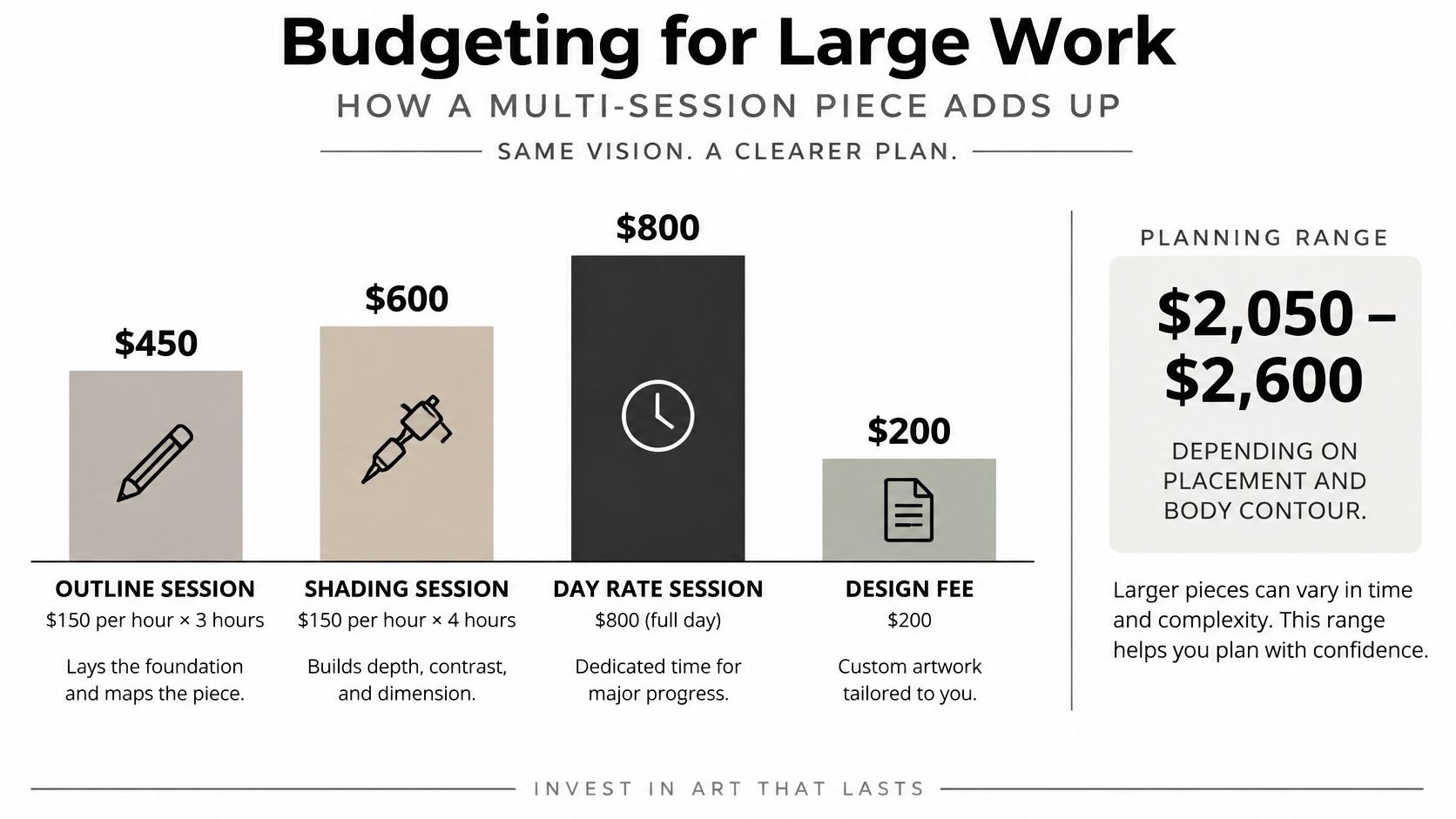
Write down your planned total, the assumptions behind it, and each payment date. A realistic range is more useful than a precise-looking total that ignores unfinished design decisions.
Tipping, Touch-Ups and Costs Outside the Quote
The headline quote may describe tattooing only. Before booking, identify which other charges are included, optional, or payable separately so you don't mistake a session estimate for an all-inclusive bill.
Gratuity is customary in many studios, but it usually sits outside the minimum or hourly rate. Ask how the studio handles tips and which payment methods are available rather than assuming gratuity has already been added.
Questions that reveal the full bill
Touch-ups after healing: Is a follow-up included, is there a time window, and what conditions apply? Ask whether a separately booked touch-up carries an appointment minimum.
Consultation and artwork: If a studio charges for design development, establish whether that charge is credited toward tattooing and what revisions it includes.
Aftercare purchases: Find out what you'll receive at the appointment and what you'll need to buy separately. Don't buy a collection of products before hearing your artist's instructions.
Taxes and payment charges: Ask whether the estimate includes applicable taxes and whether your chosen payment method changes the amount due.
Rescheduled work: Confirm what happens to any design fee or reserved-session payment if the appointment moves.
Existing tattoos need their own assessment
A cover-up or redesign isn't a fresh tattoo placed over an occupied area. Existing pigment limits the artist's options and may require a larger composition, denser coverage, or additional planning.
Request an estimate specifically for the existing tattoo, with clear photographs and an in-person assessment when needed. Don't use a quote for similarly sized fresh work as your budget.
Keep a written record of the studio's answers. The important distinction is included work versus separately authorized work, so neither you nor the artist has to rely on assumptions at checkout.
Confirm Your Quote Before You Book
A useful quote connects the artwork you want with the appointment you're reserving. We offer complimentary consultations to discuss design direction, placement, and timing before you commit.
Our website is a starting point for reviewing the studio and preparing your inquiry.
Prepare a quote the artist can stand behind
Request a consultation. Describe the subject, style, placement, and timing you have in mind.
Bring reference images, an approximate target size, and your color preferences. Explain what you like about each reference rather than asking the artist to copy another tattoo.
Request an estimated session length and planning range. Ask which decisions still need to be resolved before that range becomes more dependable.
Compare the written estimate with the booking, payment, and touch-up terms. Ask staff to clarify any missing item before you authorize payment.
Book by calling or emailing the shop. Email thinktanktattoo@gmail.com, or call or text (720) 932-0124 with questions before committing.
Our guide to questions to ask a tattoo artist can help you organize the conversation. Give the artist enough information to assess the work, including existing tattoos near the placement and any schedule restrictions.
You can also watch this video while preparing for your consultation.
Appointments are reserved with a deposit only after staff direct you to pay. Before confirming, make sure the pricing unit, estimated duration, included work, and remaining balance are clear enough to put in writing.
We offer complimentary consultations to help you turn a tattoo idea into a defined design direction and a practical pricing conversation. Visit Think Tank Tattoo and request your consultation today, bringing your references, preferred placement, and budget so we can discuss the next step.
Comments