
Simple First Tattoo Ideas: 8 Beginner-Friendly Designs
Which is the riskier first tattoo: a bold, palm-sized flower on your forearm, or a hairline sprig of lavender smaller than a grain of rice? Most first-timers pick the second and assume they've played it safe. In practice, the delicate one is the piece I'd worry about at year five.
Simple doesn't mean tiny. A simple tattoo carries one idea, one closed shape, and no interior detail fighting for space. Size and placement decide whether that simple idea still reads after the ink settles and the skin turns over.
The eight designs below are the ones I'd hand a first-timer without hesitation. Each comes with a realistic size range, a placement that suits its shape, and the exact line to say at the consultation so you're not guessing. Three things drive every recommendation: how many parts the design has, how small it can go before detail collapses, and whether the skin underneath stays flat and out of the sun.
Table of Contents
2. Minimalist Single-Line Drawing - What to Bring and What to Say
3. Small Script Word or Phrase - Lettering Rules That Save the Piece
5. Constellation or Dotwork Cluster - Where Dotwork Breaks Down
6. Tiny Symbolic Icon - Make It Yours Without Adding Clutter
7. Mountain Silhouette - Ask About the Ink, Not Just the Drawing
1. Fine-Line Botanical Sprig
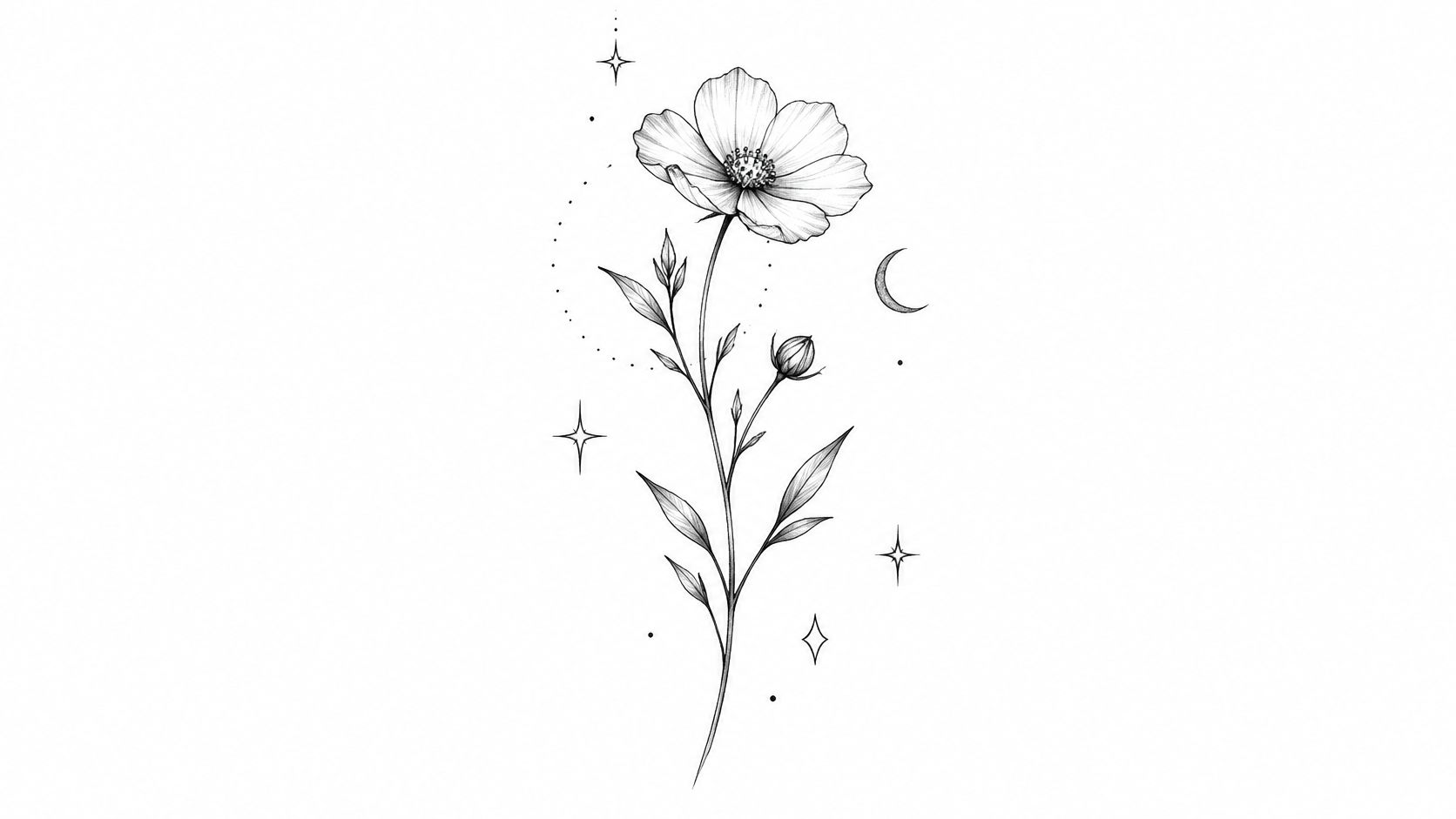
One stem, three leaves, one bloom. A botanical works as a first tattoo because the subject is a single closed shape with open skin around it, and that open skin is what keeps the design readable once the ink spreads.
The trade-off is that fine-line work forgives nothing. Every wobble shows, and two lines drawn a millimeter apart will eventually touch. The FDA's tattoos and permanent makeup fact sheet notes that tattoos can fade and that reactions may occur immediately or years later, which is the practical argument for setting the spacing at the stencil stage rather than repairing it a decade on.
Minimum Viable Size
I won't draw a botanical with internal detail below about 1 inch. A single leaf silhouette can go smaller, a wildflower with petals and a visible stem cannot.
Size it for the site: a birth flower on the inner wrist wants 1.5 to 2 inches so the petals stay separated.
Choose plants with negative space: eucalyptus, lavender, and single wildflower stems beat peonies and roses, which pack petals into a small area.
Plan the second pass: fine lines soften during healing, and a touch-up at four to six weeks is normal, not a failure.
Sizing rule: If you have to zoom in on the stencil to see the leaves, the tattoo is too small.
Thin lines aren't automatically better. The question is how long you want the detail to survive, which is the whole argument in this comparison of fine line versus bold line tattooing.
2. Minimalist Single-Line Drawing
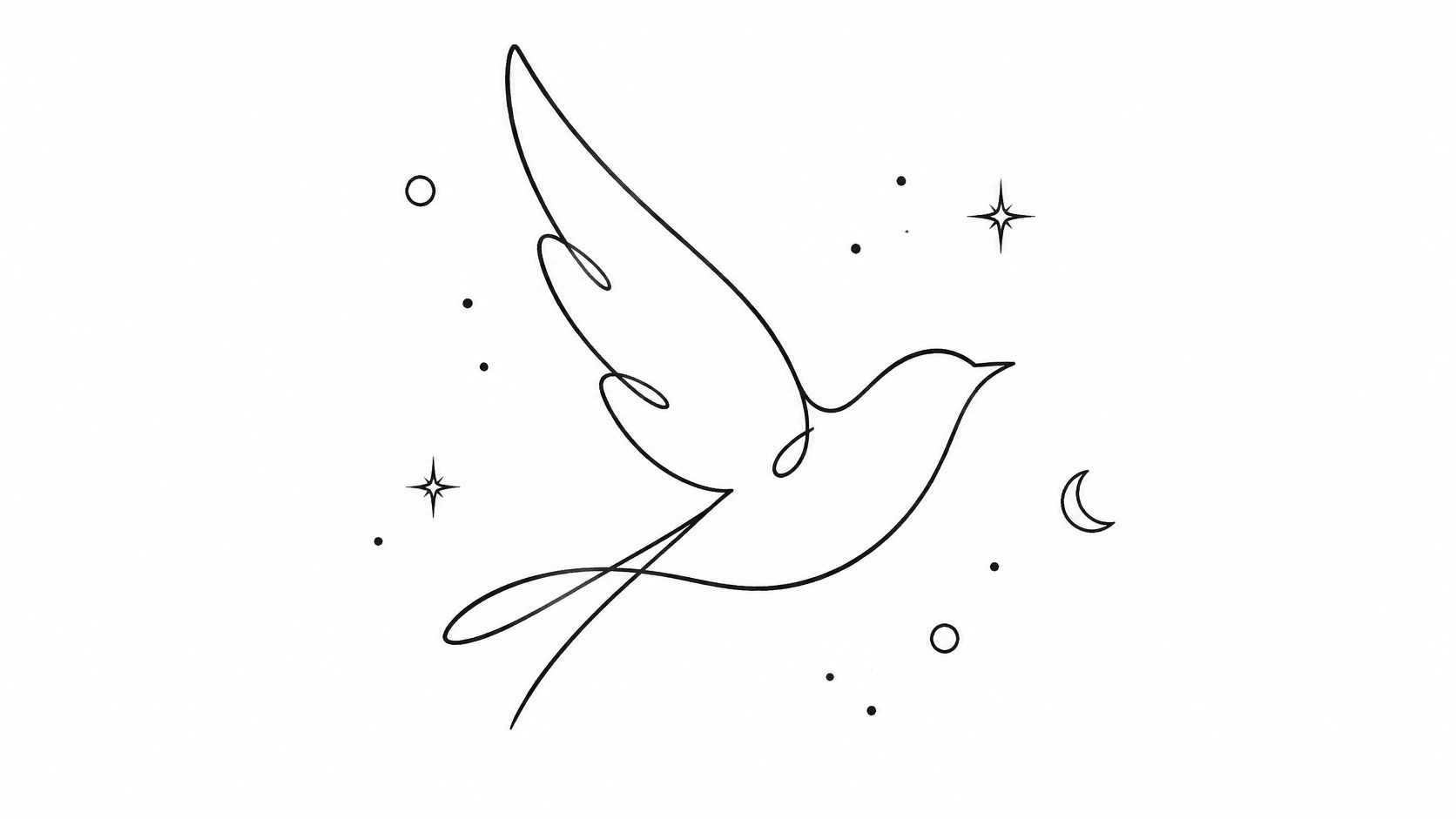
A continuous line is the cheapest-looking idea on paper and one of the hardest to fake on skin. The style leans entirely on gesture, so the artist has no shading to hide behind and you have no detail to distract from a bad contour.
That's also why it suits a first tattoo. A single-line dog portrait on the forearm, a face profile on the shoulder, or a one-line wave on the ribs takes under an hour and costs far less than a shaded piece at the same size.
What to Bring and What to Say
Bring outlines, not finished artwork. A photo of your dog is useful; a fully rendered digital drawing of your dog is not, because the artist has to strip it back to one stroke anyway.
Ask for a stencil test before the appointment. Seeing the shape at final size on your actual arm tells you more than any mockup. Expect the artist to thicken the line slightly, since a stroke that looks elegant on a screen can disappear at 2 inches on a moving forearm.
Ask your artist to draw the same shape at two line weights and show you both on skin. The heavier one usually wins.
If you sketch your own concept first, these budget-friendly iPad art pen picks make it easier to produce a clean single stroke worth bringing in.
Here's how a continuous line behaves on a curved body part, and why the shape has to be redrawn rather than resized:
3. Small Script Word or Phrase
Script is the design most likely to be regretted and the easiest to get right, because the risk sits in the lettering, not the meaning. One word or one date in a single style reads as a decision. A paragraph in ornate script reads as a draft.
Lettering Rules That Save the Piece
Write it by hand first: seeing your own handwriting tells you whether the word matters enough to keep.
Read it at arm's length: view the printed text at true tattoo size, not at phone-screen zoom.
Avoid moving ground: the inner elbow, palm, and sides of the fingers stretch and blur lettering faster than anywhere else on the body.
Test three fonts: a clean serif, a simple script, and one alternate. If the choice is agonizing, the font is too decorative.
A workable example: a daughter's name in fine script on the inner forearm at 1.5 inches, in a single weight, with no flourishes on the capital. It's legible, personal, and easy to extend into a larger piece later.
Text is the one category where the artist should push back on your file. If they don't, ask why.
During the consultation, ask for the phrase set at the exact size you want and taped in place. Spacing does the work in lettering, and a half-inch of extra width often fixes what looks like a font problem.
4. Geometric Shapes
What does a circle ask of your skin? Symmetry, and skin doesn't give it for free. Geometric tattoos attract first-timers because they look clean and modern, then go wrong when the shape sits on a curved, moving surface and reads lopsided.
The fix is placement, not complexity. A small triangle on the ankle, a circle with a center dot on the wrist, or three triangles stacked on the upper arm all work when the skin underneath is relatively flat.
Specify Dimensions, Not Vibes
Bring numbers to the appointment. "About the size of a quarter" is vague; 1 inch across, oriented point-up is a brief the artist can draw to.
Choose flat ground: outer forearm, calf, and upper arm hold symmetry better than the ribs or shoulder cap.
Approve the stencil twice: once on paper, once on skin, before the needle touches you.
Keep interior detail minimal: a shape within a shape is fine, a shape within a shape within a pattern is not a first tattoo.
Practical rule: the more precise the style, the less design it needs. One shape, drawn correctly, beats four shapes drawn nearly right.
Geometric work also scales up cleanly. A single triangle at 1 inch today becomes an anchor point for a larger composition later without needing to be covered.
5. Constellation or Dotwork Cluster
Say you want the sky over the night you met someone. That's a good instinct and a bad literal brief, because a real star chart comes with uneven gaps, faint points, and clusters too tight to tattoo.
Dotwork fixes this by treating the pattern as texture rather than data. A constellation of seven stars on the shoulder blade, a scattered dot field on the forearm standing in for a favorite place, or a small Big Dipper on the wrist all stay subtle at 1 to 2 inches.
Where Dotwork Breaks Down
Dots placed too close merge into a smudge as the skin ages. That's the single most common failure in this category, and it's decided at the drawing stage.
Give the artist the accurate data: the date, time, and location if the pattern is a genuine star map, then let them edit it for skin.
Ask about dot spacing in plain terms: how far apart will these sit, and what will they look like in ten years?
Protect the crispness: the sun is what turns fine dots into a gray patch, so sunscreen on the area matters more here than on a bold outline.
A constellation should read as stars, not freckles. If the points are touching at stencil size, the design needs more room.
Flat, low-friction placements hold dotwork best. The shoulder blade and outer forearm beat the ankle or the ribs for a first piece.
6. Tiny Symbolic Icon
A small heart, anchor, moon, arrow, or key communicates one idea instantly, which is exactly why it's the most common first tattoo. The scale of the audience is measurable: the FDA's consumer update on tattoo safety reports that approximately 30% of Americans have at least one tattoo, rising to about 40% among adults aged 18 to 34.
That popularity is also the risk. An unmodified clip-art anchor looks like everyone else's, and a solid shape squeezed too small turns into a black blob. The same FDA page notes that no color additives are approved specifically for injection into the skin, which is one more argument for a simple black icon over a tiny multi-color one.
Make It Yours Without Adding Clutter
Ask for one custom detail: a slightly asymmetric arrowhead, a hairline gap in the moon, a key bit shaped like a letter.
Set a floor on solid areas: below roughly half an inch, filled shapes blur at the edges, so keep pure black masses small and simple.
Review size at the consultation: a crescent behind the ear reads at 0.5 inch, an anchor on the inner wrist wants closer to 1 inch.
For meaning-first symbol choices, this guide to symbol tattoos and what they represent is a better starting point than a mood board.
If you're weighing a symbol tied to identity or faith, the broader list of first tattoo ideas for women with meaning shows how the same icon changes character across placements.
7. Mountain Silhouette
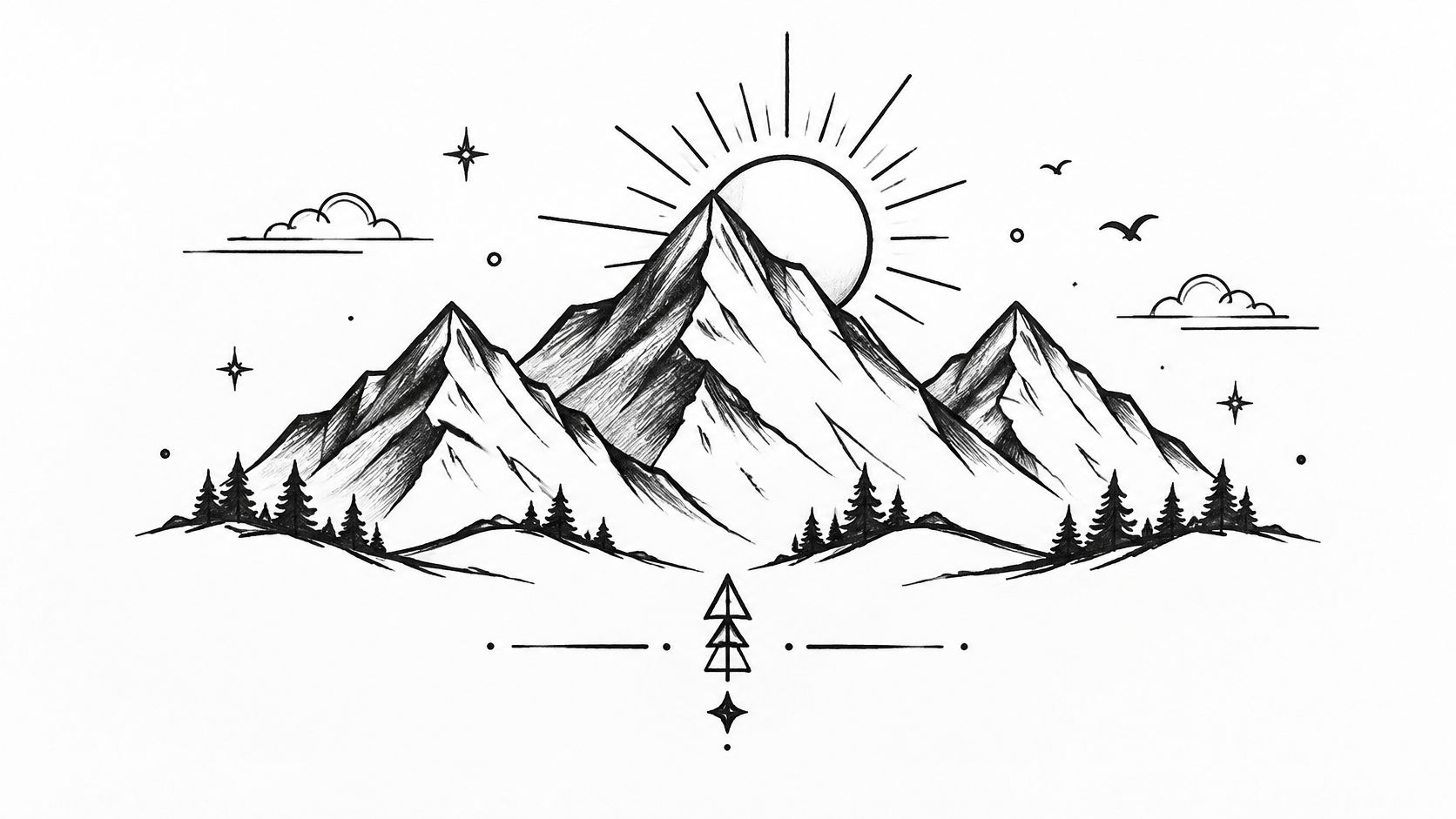
A mountain range is the one design on this list that gets better as it gets bigger. The shape is bold, the silhouette reads from across a room, and Colorado clients have an obvious reference point on the horizon.
A three-peak silhouette on the outer forearm at 2 to 3 inches, a small outlined range on the ankle at 1.5 inches, or a mountain and sun combination on the calf all work. Solid fills last longer than outlines because there's no thin line to soften, but more black ink means more surface area for a reaction, which is worth a conversation.
Ask About the Ink, Not Just the Drawing
The FDA's advisory on tattoo inks reports that infections have resulted from contaminated ink even when artists followed hygienic procedures, and that contaminated products have been recalled. It also warns that infection symptoms can resemble allergic reactions, which can lead to misdiagnosis.
So ask which ink brand and batch the studio records, and who to contact if healing looks wrong at day ten. A clean-looking shop doesn't remove every risk, but a shop that can answer those two questions does remove the sloppy ones.
Ask before booking: which ink brand and batch number go on my file, and what do I do if the redness gets worse after week one?
8. Tiny Animal Silhouette
A solid animal silhouette is the most forgiving shape you can put on a body. One side profile, no interior detail, no shading gradient: a small bird in flight on the shoulder, a cat profile on the forearm, or a paw print on the ankle at 1 to 2 inches reads instantly and ages cleanly.
What Makes or Breaks It
Bring a reference with a strong, clean side profile. A photo shot in dim light with the animal half-turned gives the artist nothing to trace, and invented anatomy is how silhouettes end up looking like the wrong species.
Ask about the minimum size for a legible shape before you fall in love with a spot. A bird the size of a fingernail loses its beak and tail; the same bird at 1.5 inches on the outer arm or calf keeps every part distinct.
If the animal carries a memory, there's a whole vocabulary for it, and this collection of memorial tattoos for pets shows how simple silhouettes carry that weight without turning into portraits.
For broader animal concepts beyond a silhouette, these tattoo designs of animals cover the styles that scale up well later.
8 Simple First Tattoo Ideas at a Glance
Design | Typical Size | Best Placements | Longevity Notes | Best For |
|---|---|---|---|---|
Fine-Line Botanical Sprig | Usually 1–3 inches tall | Wrist, ankle, forearm, or ribs | Fine lines may blur over time; open spacing and simple detail help | A delicate, personal design with nature symbolism |
Minimalist Single-Line Drawing | Small; sized to keep the outline readable | Forearm, shoulder, or ribs | Line thickness may need adjustment; visibility can be reduced by darker skin tones or heavy hair | A subtle, modern design of a meaningful subject |
Small Script Word or Phrase | Short text, date, or initial; flexible sizing | Wrist, collarbone, ankle, or behind the ear | Small or tightly spaced letters may blur; leave enough room between characters | A personal message, name, or date |
Geometric Shapes | Small single shape or cluster | Wrist, finger, behind the ear, or another relatively flat area | Close lines can lose clarity; curved areas may affect symmetry | A clean, balanced design that is easy to customize |
Constellation or Dotwork Cluster | Small cluster of dots | Ribs, shoulder blade, upper back, or wrist | Dots may spread or fade, especially with sun exposure; adequate spacing supports clarity | A subtle design tied to a star map, date, or place |
Tiny Symbolic Icon | Usually under 2 inches | Inner wrist, behind the ear, or ankle | Tiny solid fills may lose definition; avoid overly small details | A simple, recognizable symbol with personal meaning |
Mountain Silhouette | Flexible; compact single peak or range | Forearm, calf, or upper back | Bold shapes tend to hold up; thin lines and solid fills may fade or blur | A landscape or place-inspired design, especially with a Colorado connection |
Tiny Animal Silhouette | Usually 1–2 inches | Shoulder, forearm, ankle, outer arm, or calf | Bold shapes remain readable; very small or finely edged silhouettes can lose definition | A pet, wildlife, or animal with personal significance |
From Idea to Ink, Book Your Free Consultation
The pattern across all eight ideas is the same. One subject, one closed outline, honest sizing, and placement on flat skin that doesn't stretch or sit in the sun. A fine-line sprig, a single-line bird, a short word, a triangle, a constellation, a small icon, a mountain range, and an animal silhouette all succeed or fail on the same three decisions.
Size is where first-timers get talked into mistakes, usually by themselves. The instinct is to go small because small feels reversible. It isn't reversible, it's just less legible, and legibility is the only thing you'll care about once the piece is healed.
The consultation is the step that turns a saved screenshot into a working drawing. An artist looks at your anatomy, your lifestyle, and how much sun the placement sees, then adjusts scale, line weight, and spacing before anyone books a chair.
Think Tank Tattoo offers complimentary consultations with any of our eight artists, Jake Bray, Jason Lukach, Dj Chilcote Jr, Sky James, Eric Griffin, Lewis Stewart, Kevin Waltz, and Aimee Hwang. Appointments are booked by phone or text at (720) 932-0124 or by email at thinktanktattoo@gmail.com. Once staff direct you to send it, a $100 non-refundable deposit reserves the appointment, and the shop minimum is $100.
Clients must be 18 or older. We're open Tuesday through Saturday, 12pm to 8pm, at 172 S. Broadway in Denver, a 3,000 square foot studio built for exactly this kind of unhurried design conversation. Bring two or three concepts from this list and we'll narrow them to one that fits your body and your plans.
Simple first tattoo ideas only work when the drawing is built for skin rather than for a phone screen, and that's the conversation Think Tank Tattoo has with first-timers every week at our Denver studio on South Broadway. Bring the sprig, the silhouette, or the half-formed idea you've been sitting on, and our artists will size it, place it, and refine it with you before anything is booked. Visit Think Tank Tattoo to see the studio, the artists, and how to start a complimentary consultation.
Comments