
10 Anime Tattoos for Men to Inspire Your Next Piece
You've found the character, scene, or symbol you'd happily carry on your skin, but the reference image is only the beginning. The key decision is how to translate it into a design that fits your style, body, work life, and expectations years from now. The strongest anime tattoos for men aren't simple image transfers. They're deliberate choices about composition, scale, contrast, color, placement, and personal meaning.
The ideas below cover understated first tattoos, bold statement pieces, full sleeves, lettering, creatures, weapons, eyes, transformations, and action-driven designs. Each one comes with practical guidance on what helps the tattoo age well and what to discuss before the needle starts. If you're in Denver, Think Tank Tattoo offers complimentary consultations to discuss design direction, placement, and timing.
Table of Contents
1. Classic Manga Character Portraits - Make the reference work for the artist
2. Full-Color Anime Sleeve Designs - Build the sleeve in phases
3. Japanese Kanji and Anime Fusion - Treat lettering as artwork
4. Minimalist Anime Line Tattoos - Choose simplicity on purpose
5. Anime Combat and Action Scenes - Design for movement and viewing distance
6. Anime Demon and Mythical Creature Designs - Give the creature room to breathe
7. Anime Weapon and Symbol Tattoos - Choose the symbol that still matters later
8. Anime Eye and Gaze Designs - Protect the pattern and contrast
9. Anime Transformation and Power-Up Sequences - Plan the sequence before the first appointment
10. Anime Quote and Dialogue Tattoos - Make the lettering readable
Turn Your Favorite Scene Into a Tattoo Plan - Prepare for a design consultation - Plan the practical details
1. Classic Manga Character Portraits
A character portrait works best when the face carries the design. Naruto Uzumaki's whisker marks, Goku's sharp battle expression, Sasuke's eyes, or Luffy's recognizable features can create a strong tattoo without adding unnecessary background elements. Black-and-gray treatment often suits manga artwork because it emphasizes line quality, facial structure, hair texture, and contrast instead of relying on color to make the subject recognizable.
The trade-off is unforgiving detail. A portrait can look excellent on paper and lose its identity if the face is too small, the reference is blurry, or the artist tries to preserve every printed line. A practical starting point is a larger portrait, often around 4 to 6 inches, because facial features and expressive eyes need room to remain clear. That sizing guidance comes from the design requirements of this style, not a guarantee that every body placement will support it.
Make the reference work for the artist
Bring high-resolution images showing the character from the angle and expression you want. If you're combining references, label what you like in each one. One image might provide the hairstyle, another the eyes, and a third the clothing or pose.
Discuss whether the artist will reproduce the panel faithfully or adapt it for skin. A skilled portrait specialist may simplify hair strands, enlarge important facial features, or adjust contrast so the tattoo reads from a normal viewing distance. Review guidance on choosing a portrait tattoo artist before booking.
Practical rule: If the face is the point of the tattoo, don't force it into a tiny space just to keep the piece discreet.
A black-and-gray Naruto portrait on the upper arm can be easier to conceal and expand later than a highly detailed face on the wrist. For additional anime tattoo inspiration, browse Timebomb Tattoo & Piercing's anime work, then bring references to a consultation rather than treating any image as a template.
2. Full-Color Anime Sleeve Designs
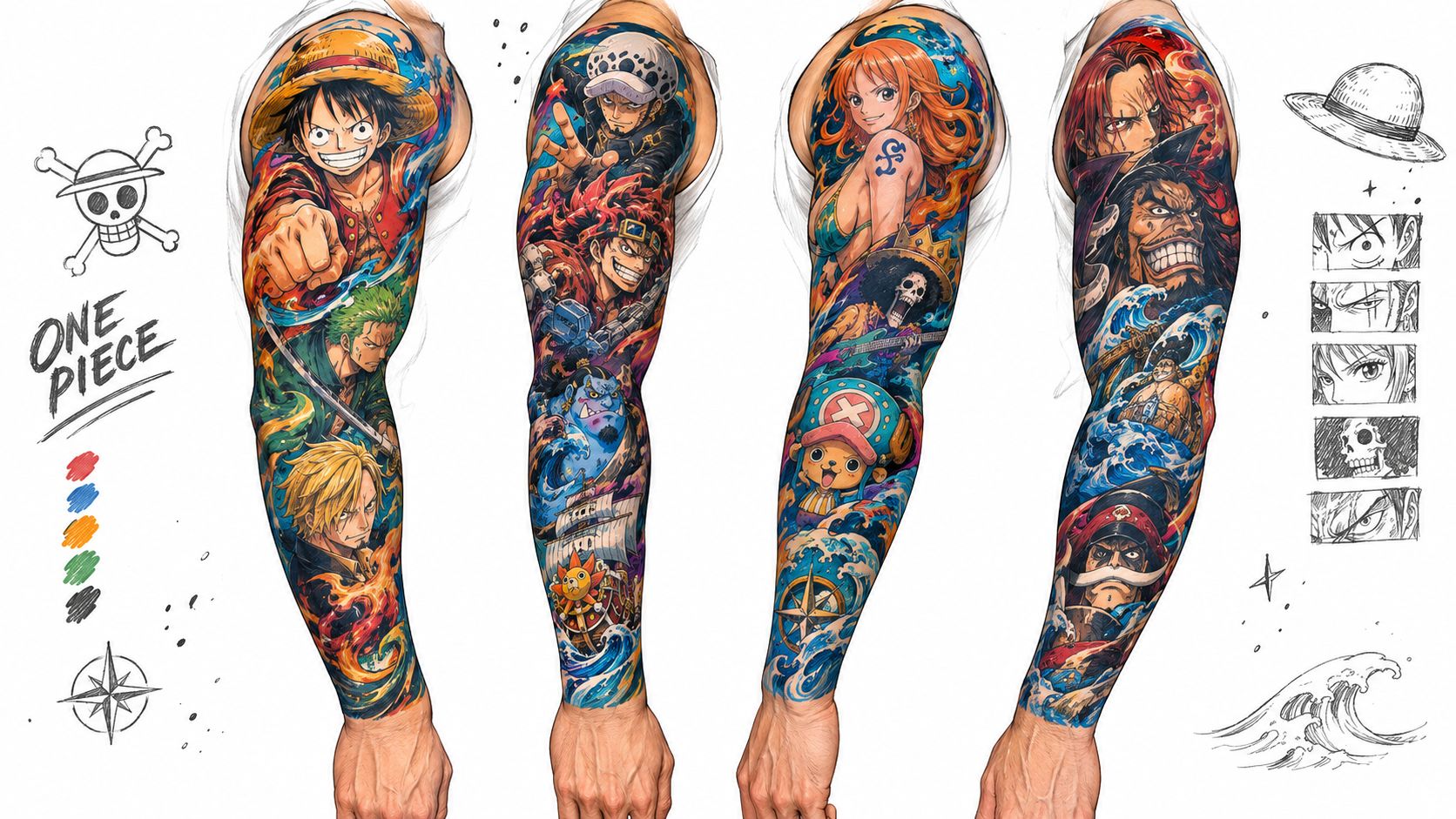
A full-color sleeve needs a composition planned for the entire arm. A Dragon Ball Z design might follow Goku's transformation with energy effects and clouds, while a My Hero Academia concept can connect heroes through costume shapes, motion, and recurring colors. Choose the visual anchor first, then build supporting elements around it. The result should read as one scene from shoulder to wrist, rather than separate stickers.
Color adds impact and demands maintenance. Bright tones such as yellow, pink, and light blue can fade faster than black ink, especially with sun exposure, according to tattoo longevity guidance from Men'sXp. Use sun protection and moisturizer after healing, and discuss whether future touch-ups fit your budget and schedule.
Build the sleeve in phases
Start with the main character or scene. Then choose connectors that control scale and movement, such as clouds, speed lines, flames, foliage, symbols, manga panels, or planned negative space. These elements can fill gaps while preserving visual breathing room.
Bring the artist a clear reference set and explain which details matter most. A tattooer may simplify dense effects, adjust contrast, or enlarge important features so the artwork remains readable as it ages. Review this guide to planning a tattoo sleeve before placing isolated pieces that could restrict later expansion.
Most artists schedule color sleeve sessions 4 to 6 weeks apart so the skin can heal fully between sittings. Confirm the order of sessions during consultation, including which areas will receive the strongest color and when touch-ups may be needed.
3. Japanese Kanji and Anime Fusion
Kanji can add meaning to an anime design, but it shouldn't function as random decoration. A character such as 火, associated with fire, could support a Naruto-inspired elemental concept, while 龍, associated with a dragon, might be integrated with Shenron imagery from Dragon Ball. The visual contrast between calligraphic strokes and modern character art can produce a striking composition when both elements have enough room to breathe.
The central risk is accuracy. A copied symbol may be rotated, stylized beyond recognition, or presented without the meaning the wearer intended. Translation websites and fan posts aren't enough for a permanent design. Confirm the exact wording, meaning, orientation, and cultural context before the stencil is prepared.
Treat lettering as artwork
Kanji has structure, stroke balance, and visual rhythm. Thickening or compressing a character to fit a narrow placement can change its appearance and compromise legibility. An artist experienced with lettering can help decide whether the text should remain traditional, become part of a weapon or flame effect, or sit separately from the anime figure.
You can also combine a symbol with a silhouette rather than a detailed portrait. A dragon moving behind the character can make the composition feel intentional, while a small kanji mark beside an unrelated face can look added at the last minute. For direction on Japanese-inspired lettering, review these calligraphy tattoo design ideas.
Ask someone qualified to verify the text before you approve it. The consultation should cover the symbol's meaning and how much adaptation is appropriate, not just its appearance.
4. Minimalist Anime Line Tattoos
Minimalist anime tattoos reduce a character to the features that make him recognizable. A few lines can suggest Naruto's profile, while Goku's distinctive hair shape may work as a compact emblem. These designs suit first-time clients who want a personal reference without committing to a large portrait or colorful scene.
Minimalism isn't the same as shrinking a detailed tattoo. It requires editing. The artist must decide which contour, expression, accessory, or gesture carries the identity and which details can disappear. If too many fine lines are packed into a small area, the design may lose clarity as the skin changes over time.
Choose simplicity on purpose
A 2 to 3 inch design can be appropriate for a restrained concept, but its success depends on the line weight, placement, and amount of detail. A single-line profile may survive better than a tiny face filled with hair strands and internal shading. Ask to see the design at the intended size, not only enlarged on a screen.
The forearm, wrist, or ankle can make the tattoo easy to see, but visibility has consequences. A wrist design may be exposed more often to sunlight and friction than an upper-arm piece. A forearm tattoo may be visible at work, depending on your clothing and workplace expectations.
A minimalist tattoo should communicate one clear idea, not hide a full illustration inside a small outline.
Bring a simple reference board and explain whether you want a recognizable character, a private symbol, or a graphic shape that only you understand. That answer will guide the artist more effectively than asking for “something small.”
5. Anime Combat and Action Scenes
Action scenes are among the most ambitious anime tattoos because movement has to remain readable on a curved body. A Goku versus Vegeta composition, Naruto's Rasengan meeting Sasuke's Chidori, or a signature attack can convey rivalry, discipline, and intensity through overlapping figures, directional lines, energy effects, and controlled negative space.
The most common failure is compression. A fight scene with two characters, weapons, facial expressions, clothing details, and energy effects needs enough surface area to separate the elements. A design that looks exciting in a screenshot may become a dense patch of ink when reduced to the forearm.
Design for movement and viewing distance
Bring several references, including video clips or sequential images of the scene. The artist can study the body positions, hand placement, costume folds, and direction of movement instead of relying on one paused frame. Ask whether the scene should wrap around the arm or remain a contained panel.
For action tattoos, the planning guidance calls for a design of at least 5 by 5 inches when the composition needs visible scene detail. That isn't a universal rule, but it illustrates the relationship between scale and readability. You may need to remove a secondary character or simplify the background to protect the central action.
A good consultation should answer three questions:
What is the focal point? Decide whether the viewer should notice the faces, the attack, or the clash of weapons first.
How will the body move? A scene can look distorted when the arm bends, so placement should account for both relaxed and flexed positions.
What can be removed? Fewer elements often create a stronger battle tattoo than a crowded reproduction.
6. Anime Demon and Mythical Creature Designs
Dragons, demons, yokai, and other mythical creatures give you more freedom than a strict character portrait. A Dragon Ball dragon, a Demon Slayer demon, or Naruto's Nine-Tailed Fox can be adapted around the body with scales, tails, horns, smoke, flames, and traditional Japanese-inspired movement. These subjects also work well for men who want a bold piece without placing a human face at the center.
Creature tattoos need a clear visual language. Decide whether the design should follow the anime's exact appearance, draw from Japanese folklore, or combine both approaches. A demon mask, dragon body, and background pattern can become visually confused if the artist doesn't know which source should dominate. This guide to Japanese demon mask tattoos can help you compare traditional references with contemporary interpretations.
Give the creature room to breathe
The planning guidance recommends 5 to 8 inches as a useful minimum range for preserving creature detail. The right size still depends on the creature's anatomy and the chosen placement. A dragon wrapped around an upper arm needs different proportions from a fox spirit across the chest or a demon mask on the calf.
Black-and-gray shading can make scales, fur, and facial planes readable without creating a wall of color. Full color can make flames, eyes, and markings more immediate, but it also demands disciplined contrast and realistic aftercare. Ask the artist to show how the design will use skin breaks between the creature and its background. Negative space is what keeps a complex mythical subject from becoming muddy.
7. Anime Weapon and Symbol Tattoos
A weapon or emblem can be more understated than a character while remaining instantly meaningful to fans. Ichigo's Zanpakuto, the Survey Corps emblem, and the Straw Hat Crew Jolly Roger each carry a connection to a specific story. These designs work on their own or as anchors for a larger sleeve, chest piece, or collection of related symbols.
The advantage is focused composition. A sword, shield, staff, or logo usually has a stronger silhouette than a full scene, so the artist can prioritize clean edges and recognizable proportions. The disadvantage is that small internal details may disappear if the design is treated like a tiny logo. Engravings, insignia lines, handles, and decorative marks need enough spacing to remain distinct.
Choose the symbol that still matters later
Ask yourself whether you're attached to the object, the character who uses it, or the story it represents. That distinction affects the design. A sword may be rendered realistically, shown in a manga-panel pose, or surrounded by the character's signature energy. An emblem may work better as a clean black mark than as a shaded illustration.
Bring a high-resolution reference and identify which details are essential. Discuss whether the weapon should follow the anime's proportions exactly or be adapted to fit your anatomy. Placement matters too. A long blade may follow the forearm or calf, while a round emblem can sit naturally on the upper arm or chest.
Design decision: Preserve the silhouette first, then protect the internal details that make the symbol specific.
If you plan to expand later, tell the artist now. A standalone sword placed without future composition in mind can make a later sleeve feel crowded or force awkward angles.
8. Anime Eye and Gaze Designs
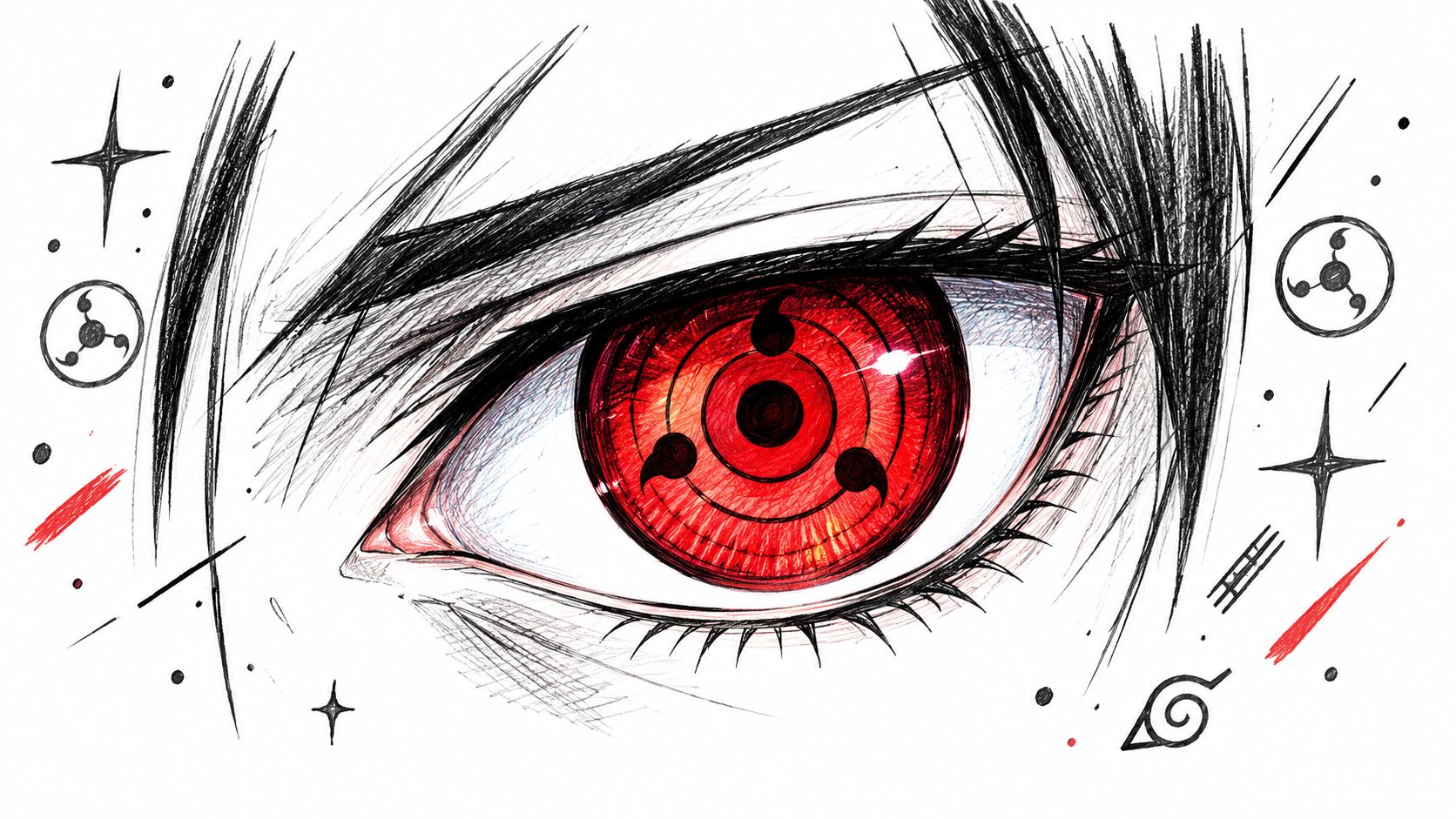
Anime eye tattoos create intensity through controlled detail. Sasuke's Mangekyo Sharingan, a Byakugan-inspired eye, or another supernatural gaze can represent power, perception, identity, or transformation. Choose a close-up eye, a floating emblem, or an eye integrated into a larger portrait based on the statement you want the tattoo to make.
Eyes expose inconsistencies quickly. The iris pattern, pupil, eyelid, reflections, and surrounding lines must work together. Compressing too many details into a small design can muddy the pattern, while simplifying too far can remove the features that make the reference recognizable.
Protect the pattern and contrast
Discuss a minimum size of 3 to 4 inches if the iris pattern needs to stay clear. Placement also affects the result. A forearm or upper arm offers a steadier canvas than a high-friction area and leaves space for energy effects or framing if you expand the concept later. Show your artist the reference at the intended scale before finalizing the placement.
Color can make a powered eye vivid, but the design still needs to heal with readable contrast. Ask how the artist will preserve the fine iris lines during the session and whether the chosen saturation may soften as the tattoo settles. Because the pattern depends on crisp separation between the pupil, iris, and highlights, ask whether a touch-up is likely after the first year. Let the healed result guide that decision rather than scheduling restoration automatically.
9. Anime Transformation and Power-Up Sequences
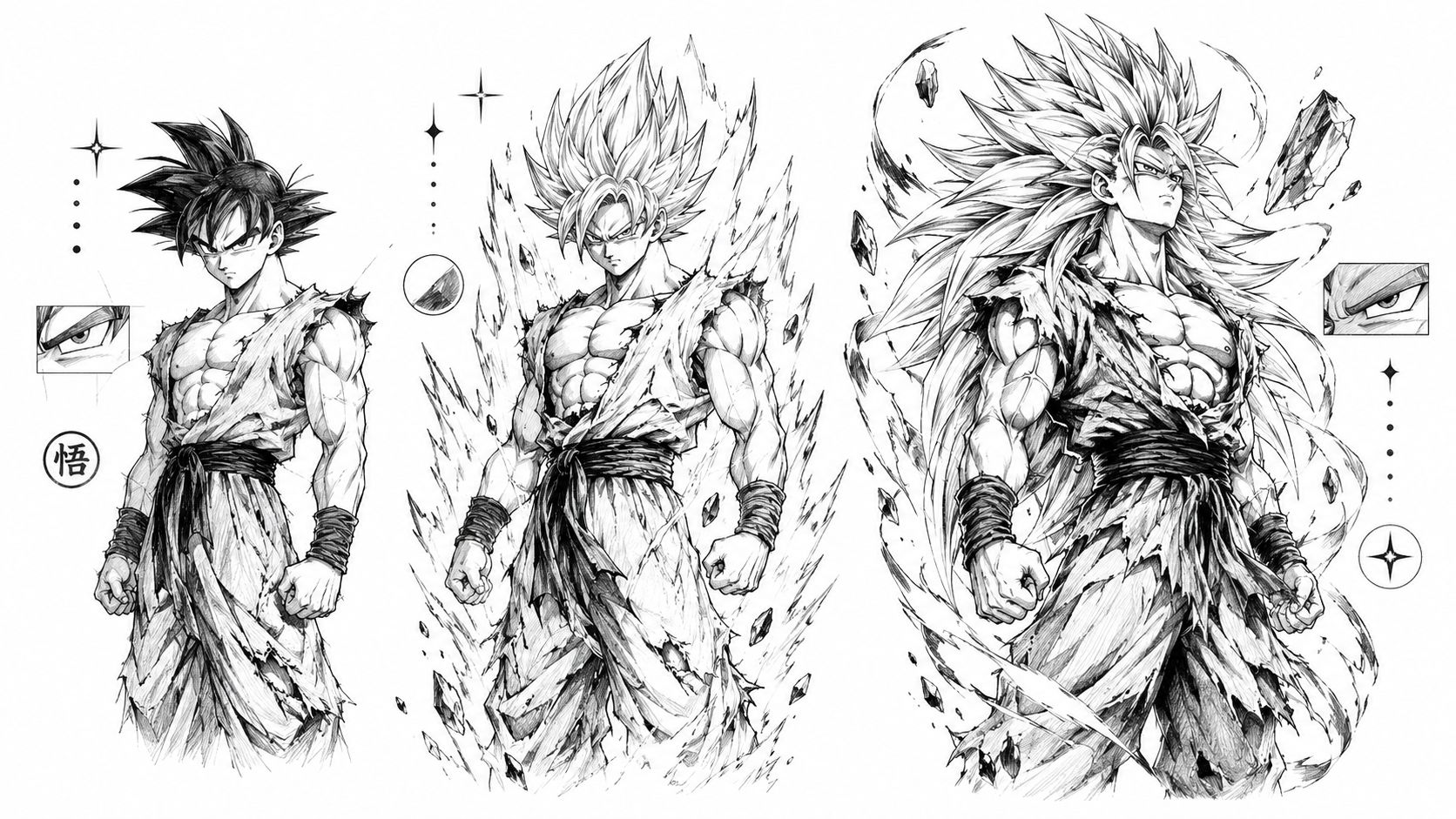
A transformation tattoo turns character development into a visual progression. Goku moving from base form through Super Saiyan to Ultra Instinct can create a vertical sequence, while Ichigo's Zanpakuto, Bankai, and Hollowfied forms can show escalating power through changing silhouettes, markings, and energy.
This concept needs structure before it needs detail. Each stage should be recognizable on its own, but the full composition should also read as one design. Repeating the same face three times may feel static. Varying posture, hair shape, expression, framing, or energy effects can show progression without filling every inch of skin.
Plan the sequence before the first appointment
Create a reference board with each transformation stage clearly labeled. Decide whether the forms should stack vertically, flow diagonally, or wrap around a limb. Think about the visual transition between them. Smoke, speed lines, sparks, clouds, or carefully placed skin breaks can connect the stages without obscuring their differences.
The plan notes recommend sessions 4 to 6 weeks apart when the project requires multiple appointments, allowing healed skin to guide the next stage. The artist may also alter later sections after seeing how the first part sits on your body. That flexibility is valuable, especially for a sleeve or large back design.
A transformation sequence is usually stronger when each form receives enough space. If you reduce all stages to tiny figures, the design may become a timeline only you can interpret. If the tattoo is intended for public visibility, discuss whether the full sequence should sit on the forearm or move to the upper arm, chest, or back for easier concealment.
10. Anime Quote and Dialogue Tattoos
Words can hold the emotional core of a series without reproducing a full character. “Plus Ultra” from My Hero Academia, “Believe It” associated with Naruto, or a translated line that shaped your view of a story can work with custom lettering, a small emblem, or an illustrative element. The best quote tattoos feel personal even when the words are recognizable to other fans.
Text has a different risk profile from imagery. A slightly imperfect face may still look expressive, but a misspelled word or inaccurate translation changes the tattoo's meaning. Confirm the original language, spelling, punctuation, and translation through multiple reliable references. Don't rely on a screenshot with no context.
Make the lettering readable
The plan guidance recommends at least 4 to 5 inches in width when the quote needs to remain clear. That doesn't mean every phrase should be that size. It means the artist needs enough room to build letterforms with appropriate spacing and line weight. Very small lettering can blur visually over time, particularly when several words are packed together.
Decide whether you want Japanese script, English lettering, or both. Japanese calligraphy can create a strong visual effect, but it should be verified by someone who understands the language and context. English custom lettering may be easier for you and others to read, while still allowing the artist to create a style connected to the anime.
Pair the quote with a restrained symbol rather than a crowded scene. A small object, character silhouette, or energy motif can establish the reference without competing with the words. Before booking, show the artist the exact text and explain why it matters. That conversation will help determine the right font, placement, scale, and visual support.
10 Anime Tattoo Styles for Men: Comparison Guide
Design Type | Implementation Complexity 🔄 | Resource Requirements ⚡ | Expected Outcomes 📊 | Ideal Use Cases 💡 | Key Advantages ⭐ |
|---|---|---|---|---|---|
Classic Manga Character Portraits | High; precise facial features and intricate shading | 2–4 hours; skilled portrait artist; 4–6 inch sizing recommended | ⭐ Highly recognizable, timeless black-and-gray portrait | Fans seeking a specific character likeness for the arm or chest | Strong identity, enduring appeal, expressive detail |
Full-Color Anime Sleeve Designs | Very high; multi-character composition and color planning | 6–12+ sessions of 4–6 hours; substantial budget; phased scheduling | 📊 Striking full-arm statement with narrative depth | Large-scale storytelling and comprehensive fandom pieces | ⭐ Maximum visual impact and creative scope |
Japanese Kanji and Anime Fusion | Moderate to high; requires lettering precision and cultural accuracy | 1–3 hours; skilled calligraphy artist; translation verification | 📊 Meaningful fusion of traditional and modern symbolism | Personal designs combining cultural motifs with anime references | 💡 Personal significance and distinctive aesthetic |
Minimalist Anime Line Tattoos | Moderate; demanding line consistency despite simple appearance | ⚡ 30 minutes–2 hours; fine-line specialist; small sizing suitable | ⭐ Clean, subtle design with relatively graceful aging | Discreet tattoos for wrists, forearms, or ankles | Fast execution, elegant appearance, lower maintenance |
Anime Combat and Action Scenes | Very high; complex movement, perspective, and effects | 1–3 sessions of 3–6 hours; large placement recommended | 📊 Dynamic scene conveying energy and narrative | Fans commemorating iconic battles or dramatic moments | ⭐ Visually energetic and story-driven |
Anime Demon and Mythical Creature Designs | High; detailed anatomy, textures, and effects | 1–3 sessions of 4–8+ hours; typically 5–8 inches or larger | 📊 Powerful, imposing design with mythological depth | Creature-focused pieces for the chest, back, or thigh | Strong presence, rich symbolism, dramatic detail |
Anime Weapon and Symbol Tattoos | Moderate; detailed engravings and emblem accuracy required | 2–4 hours; high-resolution references; moderate sizing | ⭐ Recognizable standalone design with manageable scope | Fans wanting a subtle reference to a series or faction | Efficient session length and clear fandom association |
Anime Eye and Gaze Designs | High; precise iris patterns and color gradients | 1–3 hours; specialist precision; 3–4 inch minimum recommended | ⭐ Intense visual impact in a relatively compact format | Focused tattoos featuring supernatural abilities | Highly recognizable and effective at smaller scale |
Anime Transformation and Power-Up Sequences | Very high; multiple forms, transitions, and large composition | 2–4 sessions totaling 8–16+ hours; extensive planning and budget | 📊 Dramatic visual narrative showing character evolution | Large back pieces, leg sleeves, or full-arm designs | ⭐ Conversation-starting storytelling and progression |
Anime Quote and Dialogue Tattoos | Moderate; lettering clarity, translation, and layout require care | 1.5–3 hours; experienced lettering artist; 4–5 inch width recommended | 💡 Personal, readable reminder of a chosen value or message | Motivational or philosophy-based tattoos on arms or chest | Meaningful customization and language flexibility |
Turn Your Favorite Scene Into a Tattoo Plan
Start with the part of the story you want to carry. Is it a character's expression, a transformation, a weapon, a quote, or the feeling of a particular scene? If you can explain why the image matters without relying only on “it looks cool,” you'll give the artist useful direction for building a custom design.
Then choose the visual treatment. Minimalist linework suits a compact symbol or first tattoo, but it won't preserve every detail from a manga panel. Black and gray can emphasize expression, contrast, and shading while simplifying the color problem. Full color creates immediate impact and can reproduce energy effects, clothing, and supernatural eyes more directly, but bright tones need thoughtful sun protection and aftercare. Independent guidance notes that bright colors such as yellow, pink, and light blue can fade faster than black ink, especially with sun exposure, so ask how the artist expects your chosen palette to age.
Placement should reflect more than pain tolerance. The spine, ribs, elbow, wrist, and neck are commonly described as more painful because they're bony or nerve-dense, while the upper arm, forearm, chest, and back are generally more manageable. Visibility matters just as much. A forearm sleeve is easy to show and discuss, but an upper-arm, chest, or back piece may give you more flexibility in professional settings. Tell the artist what you wear to work and whether you want the tattoo covered easily.
Prepare for a design consultation
Bring high-resolution references, not compressed social media screenshots. Include several views when the design involves a face, weapon, creature, or action pose. Note which details are essential and which can change. A good artist may adapt the composition for your anatomy, simplify crowded areas, or replace a background element with negative space so the tattoo remains readable.
Ask directly about the artist's experience with anime-inspired work, portraiture, color, Japanese-influenced composition, lettering, or large-scale projects. Discuss the estimated number of sessions, healing between appointments, clothing for the session, hydration, and aftercare. Don't arrive with a rigid expectation that the paper image will transfer unchanged. Skin curves, movement, and long-term readability should influence the final design.
Copyright-sensitive imagery is also worth discussing. Your artist can explain what adaptations may be appropriate for a custom tattoo and how to develop an original composition inspired by the subject rather than copying another tattooer's work. You can also browse this tattoo gallery to compare approaches before your consultation.
Plan the practical details
Tattoo satisfaction depends heavily on whether the finished piece matches the client's expectations. Available client data reports 75% satisfaction and another 19% somewhat satisfied, while a clinical survey found 98% of participants were willing to keep their tattoos, as summarized by AARP's tattoo coverage. Those findings support a simple principle: spend more time refining the design before making it permanent.
For Denver clients, Think Tank Tattoo offers complimentary consultations about design direction, placement, and timing. The studio's booking information states that appointments require a non-refundable $100 deposit, the shop minimum is $100, and services are available to clients 18 and older. Confirm current details directly through Think Tank Tattoo's website, since booking policies and availability can change.
Once the tattoo is finished, follow the artist's aftercare instructions rather than improvising with products or picking at peeling skin. Protect healed color from unnecessary sun exposure, keep the skin moisturized as advised, and let the artist assess the result before scheduling maintenance. A strong anime tattoo should look compelling on the appointment day and still make sense as part of your body years later.
Think Tank Tattoo offers complimentary consultations for custom anime-inspired concepts, including guidance on design direction, placement, and timing. Visit Think Tank Tattoo to discuss your character portrait, sleeve, symbol, or larger project with a Denver tattoo studio serving clients 18 and older.
Comments