
Customize Tattoo How to Design Ink You Will Love
You've saved a dozen tattoo references, opened an AI image generator, and still can't tell whether you're looking at a finished concept or just a collection of attractive pictures. You know the subject matters, but you're unsure how large it should be, where it belongs, which style will stay readable, or what your artist needs from you.
A successful custom tattoo doesn't begin with one perfect image. It begins with a conversation about intent, body placement, scale, timing, budget, and longevity. Once those constraints are clear, inspiration becomes useful instead of confusing.
Table of Contents
Why Custom Tattoos Start With Constraints Not Just Inspiration - Personalization has become the normal format - A consultation is a design partnership
How to Prepare Ideas Your Artist Can Use - Build a purposeful reference set - Turn vague preferences into usable language - Treat AI images as references, not stencils
Choosing Style Placement Scale and Color With Longevity in Mind - Compare the main decisions - Let scale protect the idea
Working Through Consultation Sketches and Refinement Like a Pro - Understand the refinement stages - Give feedback that moves the drawing forward
Booking Sessions Deposits and Aftercare That Protects Your Custom Work - Confirm the studio terms early - Prepare for the appointment and healing
Why Custom Tattoos Start With Constraints Not Just Inspiration
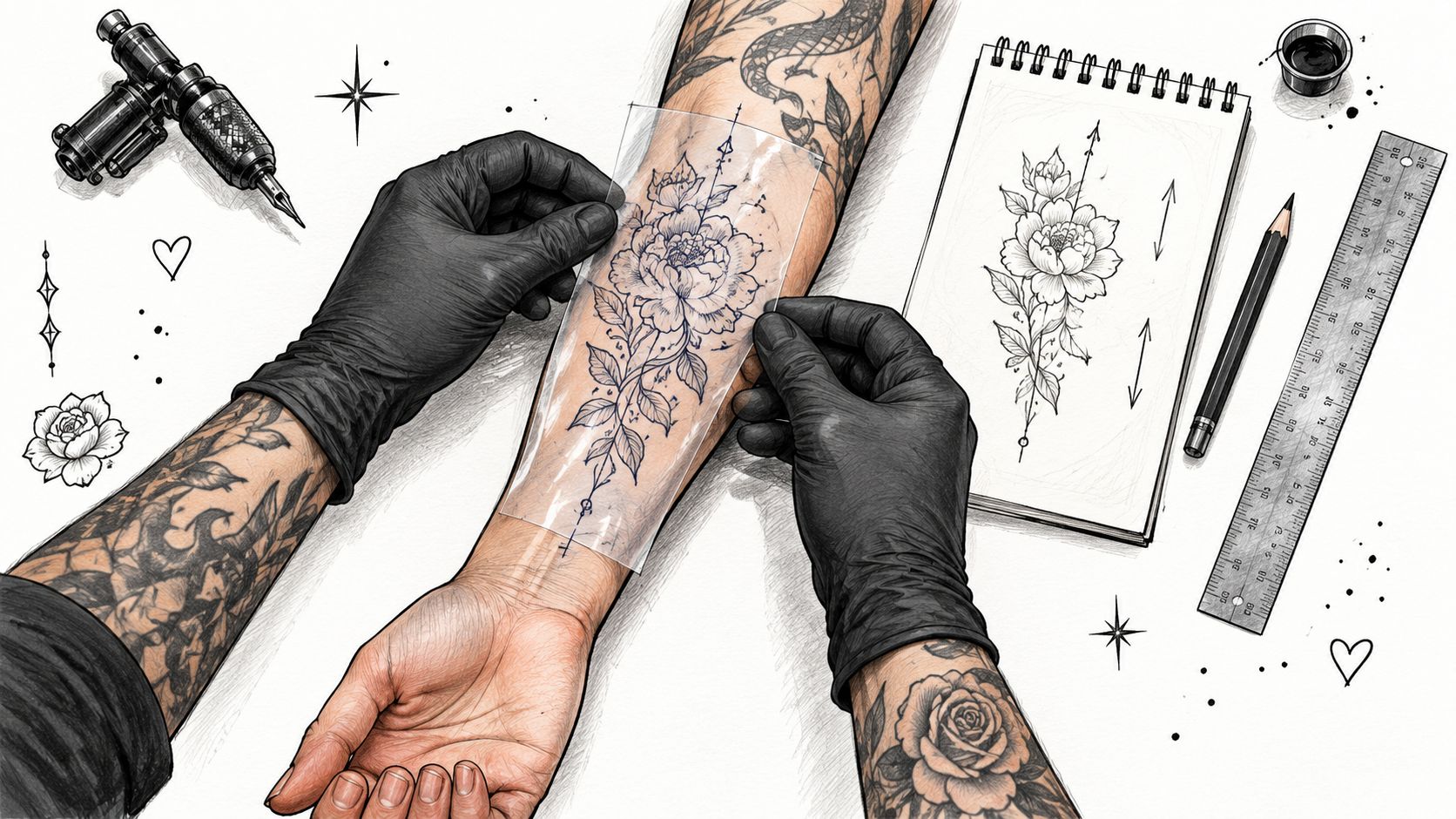
A client might arrive with a floral forearm image and ask for “something like this, but personal.” That's a starting point, not a design brief. The important questions come next. Does the flower represent a person, a place, or a specific memory? Should the piece feel botanical, ornamental, dark, delicate, or graphic? Does it need to fit beside existing work? Will the client want a sleeve later?
Those answers change the tattoo more than a reference image does. A design intended for the inner forearm needs a different flow than one built for the shoulder. A small symbol can't carry the same level of detail as a back piece. Someone with a fixed travel date may need a different session plan than a collector who's comfortable building a large composition over several appointments.
Personalization has become the normal format
Custom work now sits within a broader tattoo market that has moved well beyond a specialized subculture. One 2026 industry estimate valued the global tattoo market at USD 2.31 billion in 2025 and projected it to reach USD 9.25 billion by 2034, with a projected compound annual growth rate of 15.08%, while another estimate valued the market at USD 2.43 billion in 2025 and forecast USD 5.99 billion by 2034. The differing estimates use different methodologies, but both describe sustained demand in the category, as detailed by Custom Market Insights' tattoo market analysis and Business Research Insights' tattoo market report.
Custom design is central to that shift. One 2025 industry summary reported that around 60% of tattoo customers prefer custom designs over flash, while a fact-checked 2026 statistics page stated that 70% of tattoos are custom-designed. The sources differ, but the direction is consistent. Clients increasingly want collaborative work that reflects their body, story, and taste rather than an image selected from a standard sheet. The same statistics set reported that 25% of tattoos cost over USD 1,000, which helps explain why larger or more complex pieces often require substantial consultation and skilled, staged labor. Those figures appear in the Business Research Insights statistics summary.
Practical rule: Bring the meaning and the visual direction. Let the artist solve the translation into skin.
A consultation is a design partnership
A useful consultation locks the major decisions before anyone worries about tiny decorative details. The artist needs to understand your subject, preferred mood, placement, approximate size, color expectations, schedule, and whether the tattoo needs to connect to future work.
That process protects both sides. You avoid paying for a design that can't fit your anatomy, and the artist avoids guessing at priorities that should have been discussed early. A strong studio will also tell you when an idea needs to become larger, simpler, darker, or more carefully placed to remain legible.
The result isn't a copy of your reference. It's a composition built around your intent and the way your body moves. That's what makes customization more than choosing a subject and adding a name.
How to Prepare Ideas Your Artist Can Use
A phone full of unrelated tattoo images slows a consultation. Your artist needs a brief that separates what the tattoo must contain from what caught your eye.
Write the idea in plain language before collecting references. “A snake with flowers” leaves too many decisions open. “A coiled snake representing recovery, with native mountain flowers, a calm rather than aggressive mood, and a vertical forearm flow” gives the artist a workable starting point. Professional design vocabulary is unnecessary. Identify the emotional direction, the intended placement, and the elements you would regret losing.
Build a purposeful reference set
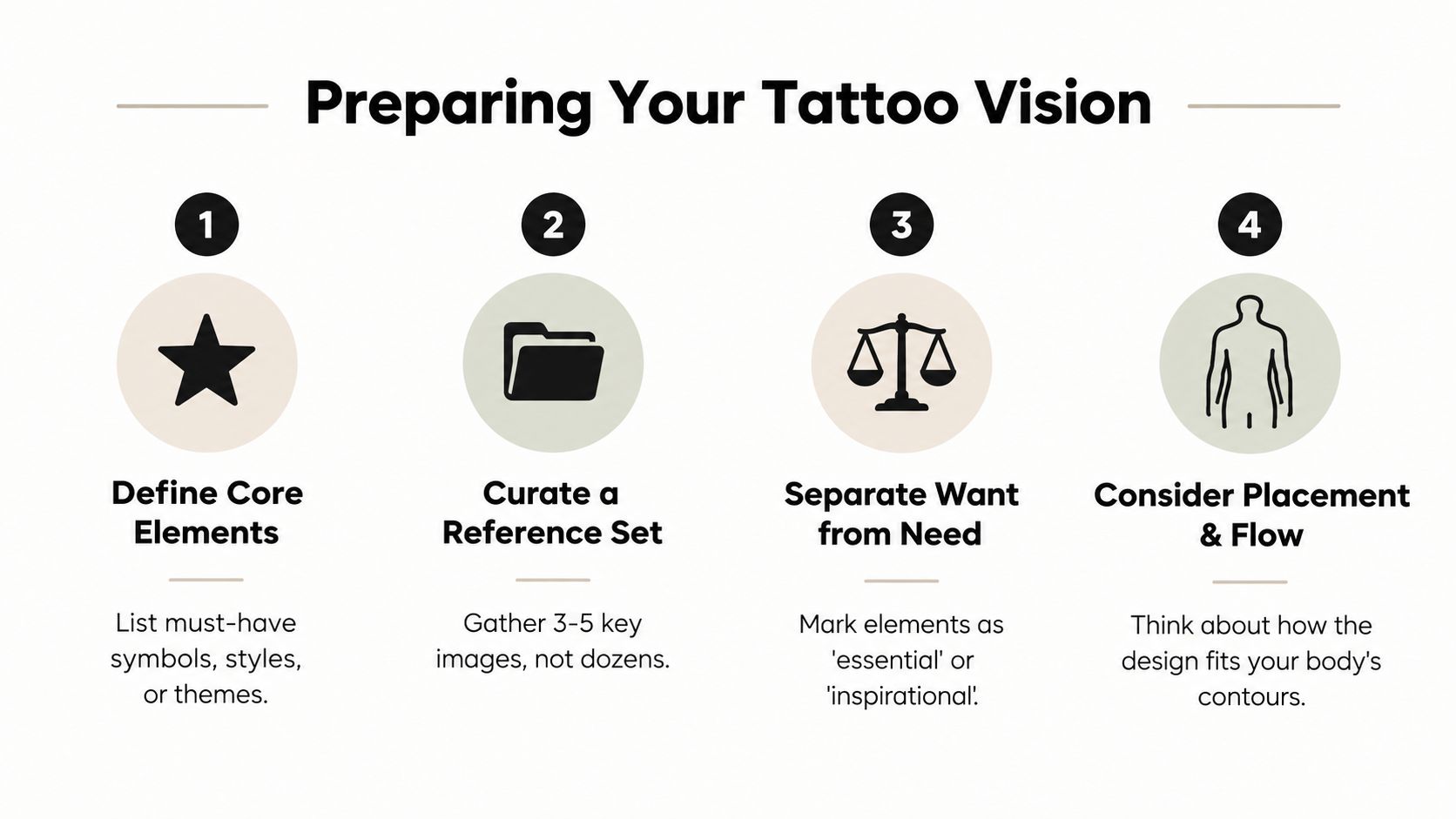
Use a small group of references, with each image answering a different question. One can show the subject, another the line quality, another the composition, and another the mood or color treatment. Before your consultation, review the studio's tattoo artist portfolio to confirm that the artist's existing work matches your direction. A portfolio check can prevent a mismatched booking before anyone begins drawing.
For most consultations, three to five key images are more useful than a crowded gallery. That range is a planning recommendation, not a universal rule. If every image points toward a different style, the artist must spend consultation time sorting out contradictions instead of developing your concept.
Organize your references into three groups:
Must-have elements: Symbols, subjects, or words that carry the meaning.
Style direction: Line weight, shading approach, realism, ornament, or graphic treatment.
Atmosphere: Calm, severe, playful, devotional, weathered, or minimal.
Mark each item as essential, preferred, or inspirational. This gives your artist room to preserve the core idea when anatomy, scale, or readability makes a literal translation impractical.
Turn vague preferences into usable language
Labels such as “fine-line” or “traditional” can mean different things to different artists. Describe what you like in the reference instead: open skin, bold outlines, soft gradients, dense black, visible texture, muted color, or a clean silhouette. Specific observations help the artist separate your visual preference from the reference image itself.
Placement deserves the same precision. Note the body area, whether the design should face you or other people, how much space it can occupy, and whether it needs to leave room for future tattoos. Include deal-breakers too. You might dislike heavy black, visible color, faces, text, or designs that wrap around the arm.
Treat AI images as references, not stencils
AI-generated images can help you explore combinations that are difficult to find through ordinary searches. They can communicate a general mood, color relationship, silhouette, or subject pairing. They often fail as tattoo blueprints because they may contain impossible anatomy, muddy small details, inconsistent line logic, and decoration that will not translate cleanly onto skin.
Recent coverage reports that over 30% of tattoo clients arrive with an AI-generated design, and describes virtual try-on as increasingly expected in the design process. Those claims, along with the limitations discussed beside them, appear in AI for Tattoo's 2026 tattoo trends coverage. The useful question is not whether your artist can copy the image. Ask what part of it communicates your idea.
Bring the original prompt or several variations if they clarify your direction, then identify which parts are essential. An ethical artist should redraw the concept for your body, make it original, and adjust details for healing and future readability. AI can open the conversation. The finished tattoo still needs human judgment about skin, movement, and time.
Choosing Style Placement Scale and Color With Longevity in Mind
A tattoo can look excellent in a freshly photographed portfolio and still be a poor match for your chosen placement. Style, scale, and anatomy work as a package. Decide them together rather than selecting a trend first and asking the skin to accommodate it later.
Fine-line and micro-realism remain highly requested, but execution varies widely. Independent trend coverage identifies both styles as prominent in 2026 and points to an execution gap in fine-line work, as discussed in this 2026 tattoo trend overview. Small details need adequate spacing and contrast. If the design is too tiny or the skin moves and stretches constantly, delicate marks may lose clarity sooner than a larger, more open composition.
Compare the main decisions
Option | Best For | Longevity and Healing Note |
|---|---|---|
Fine-line | Subtle symbols, light botanical work, restrained lettering | Requires careful execution, adequate spacing, and realistic expectations about detail retention. |
Micro-realism | Small portraits, animals, or compact scenes | Detail can become crowded if the scale is too small, so the artist may need to simplify the reference. |
Bold blackwork | Strong silhouettes, graphic subjects, high contrast | Clear shapes often remain easier to read, but dense applications can require thoughtful healing and spacing. |
Black and gray | Shading, portraits, atmospheric compositions | Gives the artist control through value and contrast without relying on color saturation. |
Color work | Botanical pieces, illustrative designs, expressive compositions | Color selection should support contrast, skin tone, and the intended visual hierarchy. |
Fingers and hands | Small marks, lettering, symbols, visible accents | High use, movement, and exposure make these placements less forgiving than more stable areas. |
Ribs and sternum | Vertical compositions, ornamental work, meaningful central pieces | Curves and movement affect stencil placement, client comfort, and how the composition reads on the body. |
Elbows and joints | Designs that intentionally use or frame movement | The artist must account for bending, texture, and changing surface shape. |
Placement affects more than pain. It determines how the design bends, how the stencil sits, how you'll protect the area during healing, and how much movement the finished piece must tolerate. Fingers, hands, elbows, sternum, ribs, and side-body areas each create different technical problems. A design that works beautifully on the outer forearm may need substantial changes before it belongs near a joint or high-movement zone.
Long-term test: If the tattoo only works when viewed in a perfectly flat photo, the composition probably needs more consideration.
Let scale protect the idea
Scale isn't a cosmetic preference. It controls whether the artist has enough room to separate lines, preserve facial features, show texture, and create a readable focal point. Shrinking a detailed reference until it fits a small space usually removes the breathing room that made the image effective in the first place.
Color decisions should follow the same logic. Black and gray can create depth through value and negative space, while color can establish mood and emphasis. Neither is automatically more durable. The artist should choose pigments, contrast, saturation, and spacing based on the design, the placement, and your skin.
A good consultation may end with a different combination than you expected. That isn't a failure of customization. It means the original intent has been protected instead of forcing a trend onto unsuitable anatomy.
Working Through Consultation Sketches and Refinement Like a Pro
A strong consultation turns a loose idea into a sequence of decisions. The artist listens for the story behind the subject, studies the intended placement, checks how the design will move with the body, and identifies conflicts before the drawing becomes too developed.
Arrive ready to discuss priorities rather than expecting a finished image immediately. Be prepared to explain orientation, possible future additions, visual weight, reference sources, and what you want the tattoo to communicate from a distance. These details help the artist protect your intent while adapting the design to skin.
Understand the refinement stages
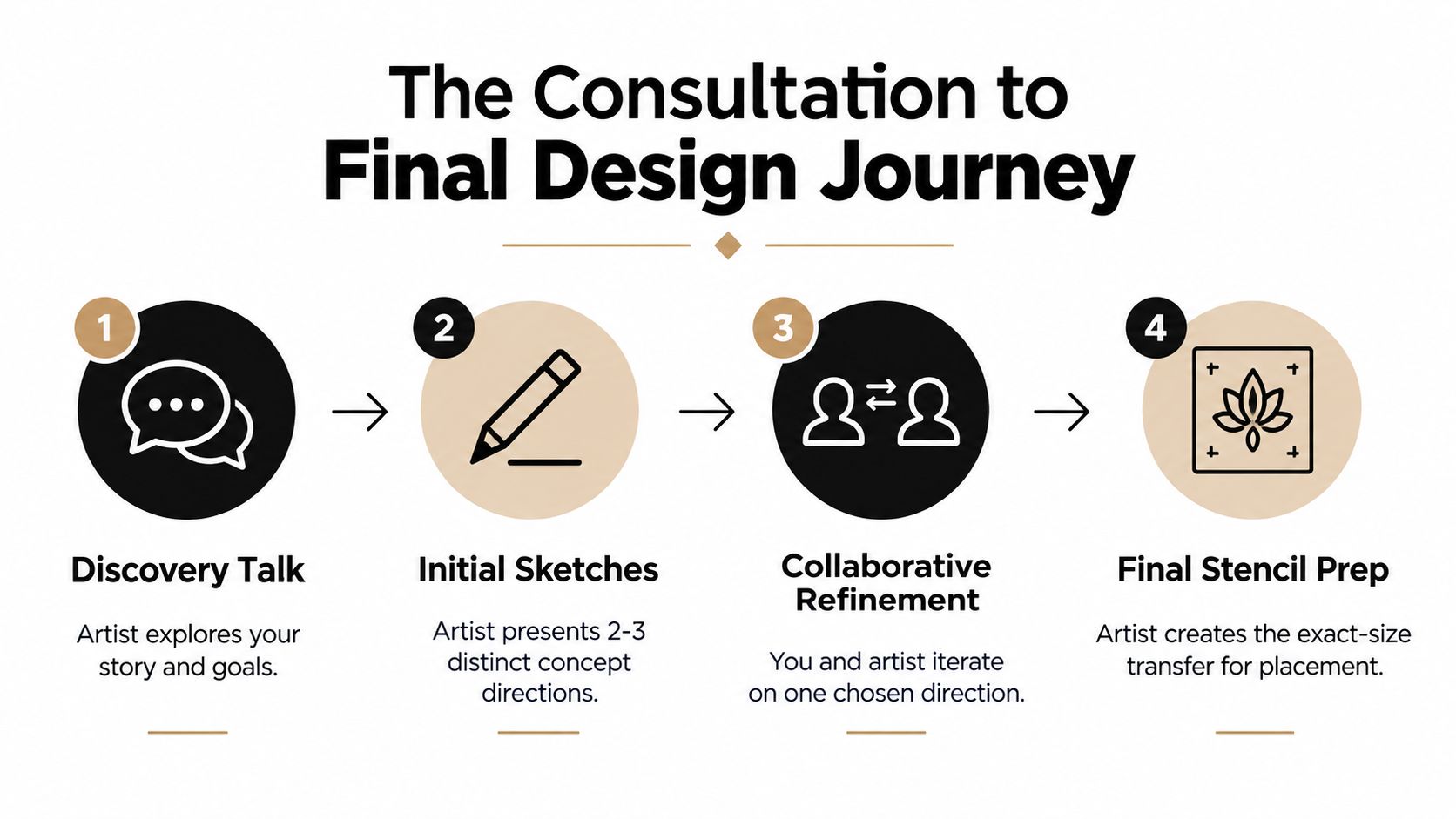
A practical custom workflow generally moves from discovery to initial concepts, one selected direction, refinement, approval, and stencil preparation. Artists organize these stages differently, but the main decisions should remain visible.
Early sketches need to answer structural questions. Is the focal point in the right place? Does the composition follow the arm, leg, chest, or back? Does the negative space feel intentional? Are the proportions believable? Tiny texture changes, minor ornament, and small color adjustments belong later.
Strong design feedback guidance from Think Tank Tattoo separates major composition choices from smaller edits. That keeps feedback useful. If the central arrangement is wrong, changing a leaf shape will not fix it.
Give feedback that moves the drawing forward
Useful feedback identifies the issue and explains its priority. “The face feels too aggressive for the memory I'm trying to honor” gives the artist a clear direction. “Can the main flower face outward, with the stem following the forearm instead of crossing it?” addresses flow and placement.
Avoid rewriting every line unless you are a trained designer collaborating on equal technical terms. The artist needs your response to the design, not a second competing drawing assembled from disconnected instructions. Share what feels right, what feels wrong, and which elements carry the most meaning.
AI-generated references can help communicate mood, subject, or broad composition, but they are not reliable tattoo-ready plans. They often contain anatomy, line, texture, or detail that will not translate cleanly to skin. Use them as conversation material, then let the artist rebuild the idea around placement, stencil clarity, and long-term readability.
For a sleeve, review transitions between major pieces and the negative space around them. For a back piece, check how the design reads as the body turns, rather than judging only a flat digital image. For a small tattoo, prioritize silhouette, spacing, and immediate readability over decorative complexity.
Useful feedback sounds like: “The composition is right, but the secondary details are competing with the focal point.”
A final stencil lets you assess exact size and placement on your actual body before the needle begins. Look at it standing, sitting, relaxed, and in motion where possible. Check whether the orientation still feels right when your arm hangs naturally or your torso turns.
The artist should lock major decisions before linework starts. Late changes create rework, which can affect design clarity and the appointment schedule.
Watch a consultation-to-stencil walkthrough in the embedded video below for a visual example:
Booking Sessions Deposits and Aftercare That Protects Your Custom Work
Good design can still be undermined by rushed scheduling, poor preparation, or careless healing. Booking is part of the tattoo process because the artist needs enough time to prepare the custom work and you need enough time to arrive rested, fed, and able to follow aftercare instructions.
Confirm the studio terms early
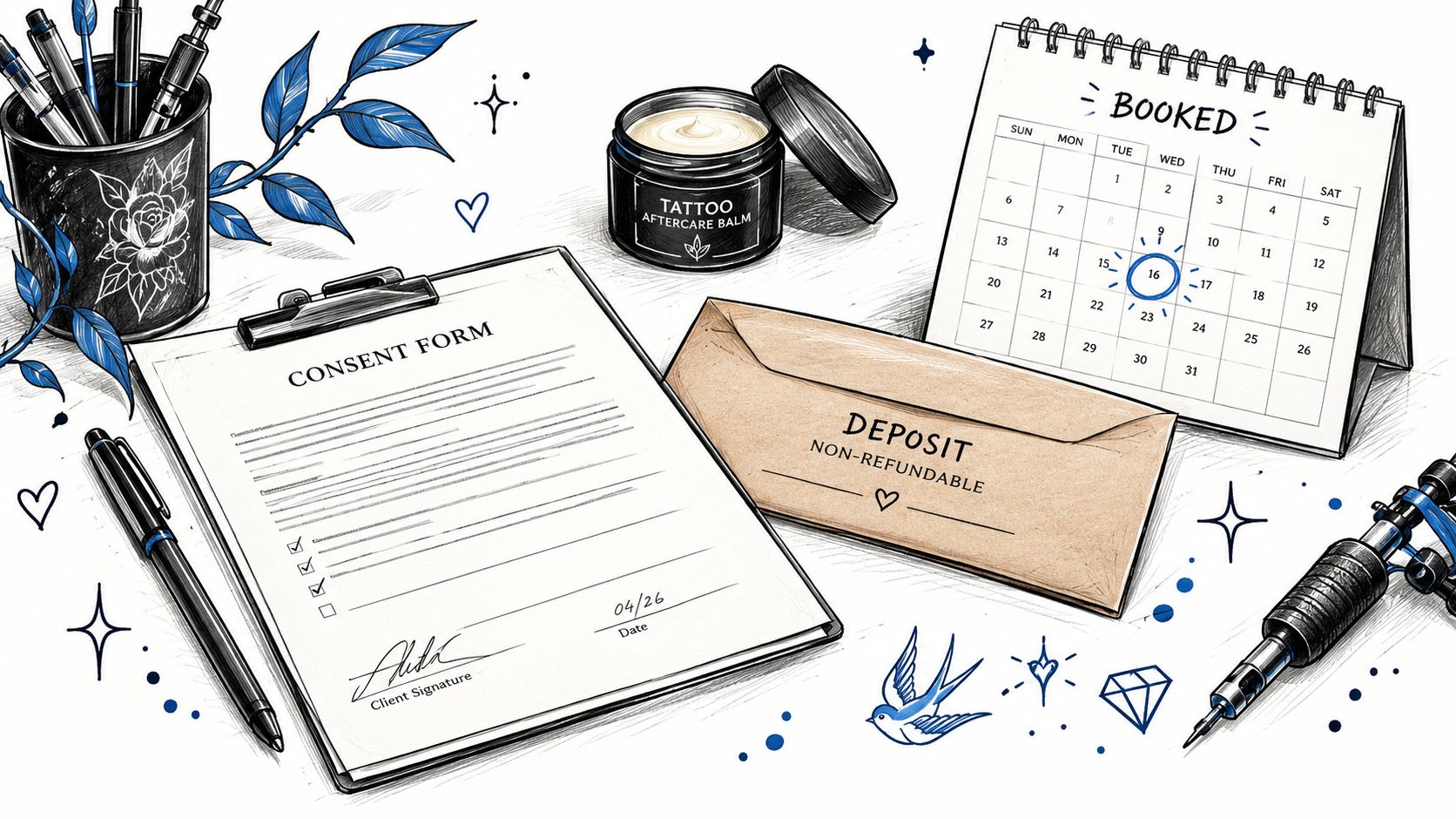
Before paying a deposit, ask what it reserves, how rescheduling works, whether it applies to the final balance, and what happens if the concept or artist changes. Think Tank Tattoo publishes its tattoo deposit policy, so clients can review the studio's expectations before booking.
At Think Tank Tattoo, clients must be 18 or older, the shop minimum is $100, and a non-refundable $100 deposit reserves an appointment, according to the studio information provided for this article. Booking is available by phone or email, and complimentary consultations cover design direction, placement, timing, and artist fit.
For a large sleeve, back piece, or other multi-session project, confirm the expected appointment structure and whether each session will focus on a particular section. Don't schedule the final session immediately before a beach trip, athletic event, or period when you won't be able to protect the healing skin.
Prepare for the appointment and healing
Eat a normal meal, hydrate, wear clothing that gives the artist access without creating friction, and bring any approved reference material. Tell the artist about relevant skin concerns, sensitivities, medications, or previous tattoo reactions. Clear communication helps the artist make safer decisions.
Aftercare instructions vary by technique, bandage, placement, and studio protocol. Follow the instructions you receive rather than combining several internet routines. Keep the area clean, avoid unnecessary friction and picking, and contact the artist if the healing process looks different from what you were told to expect.
Infectious complications reported in published surveys range from about 0.5% to 6% of tattooed people, and a systematic review identified 67 serious bacterial infection cases in medical literature from 1984 to 2015, as documented in this systematic review on tattoo-related complications. The review also discusses inconsistent aftercare guidance, including whether clients are told when to contact the tattooist or seek physician care. That makes your studio's written instructions and follow-up process important.
Seek medical advice for concerning symptoms rather than trying to diagnose a complication through social media. Your artist can explain expected healing and identify when a healthcare professional should become involved, but they aren't a substitute for medical care.
Your Custom Tattoo Ready to Book and Built to Last
A finished concept is ready for booking when it survives practical questions, not just emotional excitement. You should know what the tattoo means to you, where it belongs, how large it needs to be, which style supports the subject, and what compromises you're willing to make.
Use this final check before confirming an appointment:
Intent: Can you explain the central idea in a few clear sentences?
References: Have you separated essential elements from images that are only inspirational?
Placement: Have you considered body contours, movement, visibility, and future work?
Scale: Does the design have enough room for its important details?
Style: Does the chosen approach support clarity instead of following a trend blindly?
Color: Do the palette and contrast serve the focal point?
Timing: Can you attend the session without rushing the consultation or healing period?
Budget: Have you discussed the expected scope, deposit, and session plan?
Aftercare: Do you understand the studio's instructions and how to ask for help?
First-timers often worry that they need to arrive with a complete drawing. They don't. Collectors sometimes worry that a custom piece won't connect with existing work. That's why placement, flow, and future planning belong in the first conversation rather than after the stencil is already made.
The strongest custom tattoos come from shared responsibility. You bring the meaning, preferences, references, and honest boundaries. The artist brings drawing skill, technical judgment, body awareness, and experience with how designs behave on living skin.
If your idea is still rough, that's fine. A rough idea becomes bookable when the right artist can ask focused questions and turn your answers into a design with a clear purpose, suitable scale, and realistic longevity.
Think Tank Tattoo offers complimentary consultations for discussing concept, placement, timing, and artist fit, followed by custom design review and stencil preparation. Visit Think Tank Tattoo in Denver to bring your references, talk through the constraints, and schedule a custom tattoo built around your body and your long-term plans.
Comments