
7 Cyber Tattoo Designs: Studios Worth Booking in 2026
You've got a rough sketch in your phone. It might be a forearm circuit piece, a shoulder sigil, or a biomechanical panel with exposed machine parts. The problem isn't finding inspiration. The problem is that cyber tattoo designs split into different style families, and the studio that handles one well might not be the best fit for another.
That's the fundamental booking question. Do you want cyberpunk linework, cybersigilism, biomechanical blackwork, or tech realism? Those aren't interchangeable. They use different line weights, different placement logic, and different healing trade-offs. The lineage matters too. Cyber tattoo designs come from the cyberpunk movement, a science-fiction subgenre that emerged in the late 1970s and became established in the 1980s, with imagery shaped by circuitry, cyborg bodies, urban dystopia, and the clash between identity and machine power, as outlined in this history of cyberpunk tattoo design.
The seven studios below are ordered by how well their published materials support distinct cyber goals, from broad custom versatility to narrower style specialization. Each entry focuses on what matters when you are booking, style fit, placement, customization, aftercare expectations, and the questions worth bringing into a consultation.
Table of Contents
1. Think Tank Tattoo
A circuit forearm can go in several directions before the stencil is cut. It may need dense blackwork, biomechanical depth, or finer technical lines. Think Tank Tattoo is a strong starting point when that choice is still open. The Denver studio has operated since 2002, works from a 3,000 sq. ft. space, and publishes a broad artist roster. That range gives the consultation practical value. You can compare artists before committing to a style that may not suit the placement.
Think Tank's roster spans blackwork, biomechanical, and fine-line work. A circuit forearm may read better through solid black shapes and controlled negative space. A rib-panel machine concept may need layered shading and anatomical flow. A sleeve needs one artist, or a clearly coordinated plan, so the circuitry, seams, and open skin remain consistent across sessions.
Where Think Tank fits best
Think Tank suits clients who need translation from a loose reference board to a workable tattoo plan. Its published process emphasizes complimentary consultations, design refinement, placement discussion, and clear aftercare. Those steps matter for cyber designs because anatomy changes the result. A chest sigil must follow the pectoral curve. A forearm panel needs spacing that remains readable as the arm turns. Fine details packed too tightly can soften during healing and become harder to distinguish over time.
Studio-floor rule: Bring references for the visual language you want, then ask the artist which line weight, contrast level, and detail scale will survive on your chosen placement.
The studio also fits larger projects, including first tattoos, collectible pieces, and multi-session work. Discuss the full body flow before approving isolated elements.
A sleeve with readable structure: Plan circuit paths, mechanical seams, and negative space across the entire arm.
A shoulder-to-chest cyber panel: Set the main shapes along the body's movement instead of filling every area with small details.
A black-and-grey machine fusion piece: Check how the artist builds shading transitions and separates metal forms from surrounding skin.
What to ask before you book
Think Tank requires a non-refundable $100 deposit and has a $100 shop minimum. Booking is handled by phone or email. Public hourly pricing is not listed, so ask for the expected session length, total estimate, and whether revisions are included in the consultation.
Use these prompts:
“Which artist on your roster is the closest fit for cyberpunk linework versus biomechanical rendering?”
“Will this design still read well if we simplify the smallest details?”
“What placement gives the cleanest long-term result for this geometry?”
“Do you recommend black-only first, then color later, or a single-pass design?”
For Denver clients, Think Tank's long track record, broad style range, and consult-led customization make it a useful all-around choice. Its strongest role is helping you select the right cyber family before color, glow effects, and final line density are locked in.
2. Future Ink Tattoo & Supply

Some studios mention futuristic work in passing. Future Ink Tattoo & Supply puts cyborg, cybernetic, and cyberpunk language directly into its style presentation. That makes it one of the clearer fits for clients who already know they want a heavier, geometry-forward, less delicate version of cyber tattoo design.
The Oakland shop's published materials point toward bold structure. Think blackwork fields, Japanese geometry influence, robotic forms, and stronger contrast instead of whisper-thin line stacks. If your reference board includes hard panels, segmented armor shapes, or broad circuitry that should hold from across the room, Future Ink makes more sense than a fine-line specialist.
Best use case and trade-offs
This is the pick for clients who want cyber tattoos that feel more machined than ornamental. It's also a smart place to start if you're combining cyber motifs with blackout framing or dense geometry. The shop is open daily and offers several contact paths, which keeps the booking side simple.
A practical note on color. Cyber concepts often tempt clients toward UV and neon effects, but those choices need restraint. Before chasing a glow-heavy look, it's worth reviewing how artists discuss UV reactive tattoo ink and what clients should consider. Bright effect inks may photograph well, but the long-term conversation should still center on readability, skin response, and how the design looks in normal light.
Bigger cyber shapes usually age with more dignity than tiny decorative code fragments.
Future Ink is appointment-based unless there's availability, and the site doesn't publish pricing. It also notes payment limitations. None of that is unusual, but it means this shop is best for clients who already know the visual lane they want and are ready to inquire directly.
Bring these questions:
“Can this design be built as bold blackwork instead of fine detail?”
“Where should blackout or heavy fill stop so the cyber elements still breathe?”
“Do you have healed examples of large cyberpunk or cyborg pieces?”
3. Black Serum Tattoo
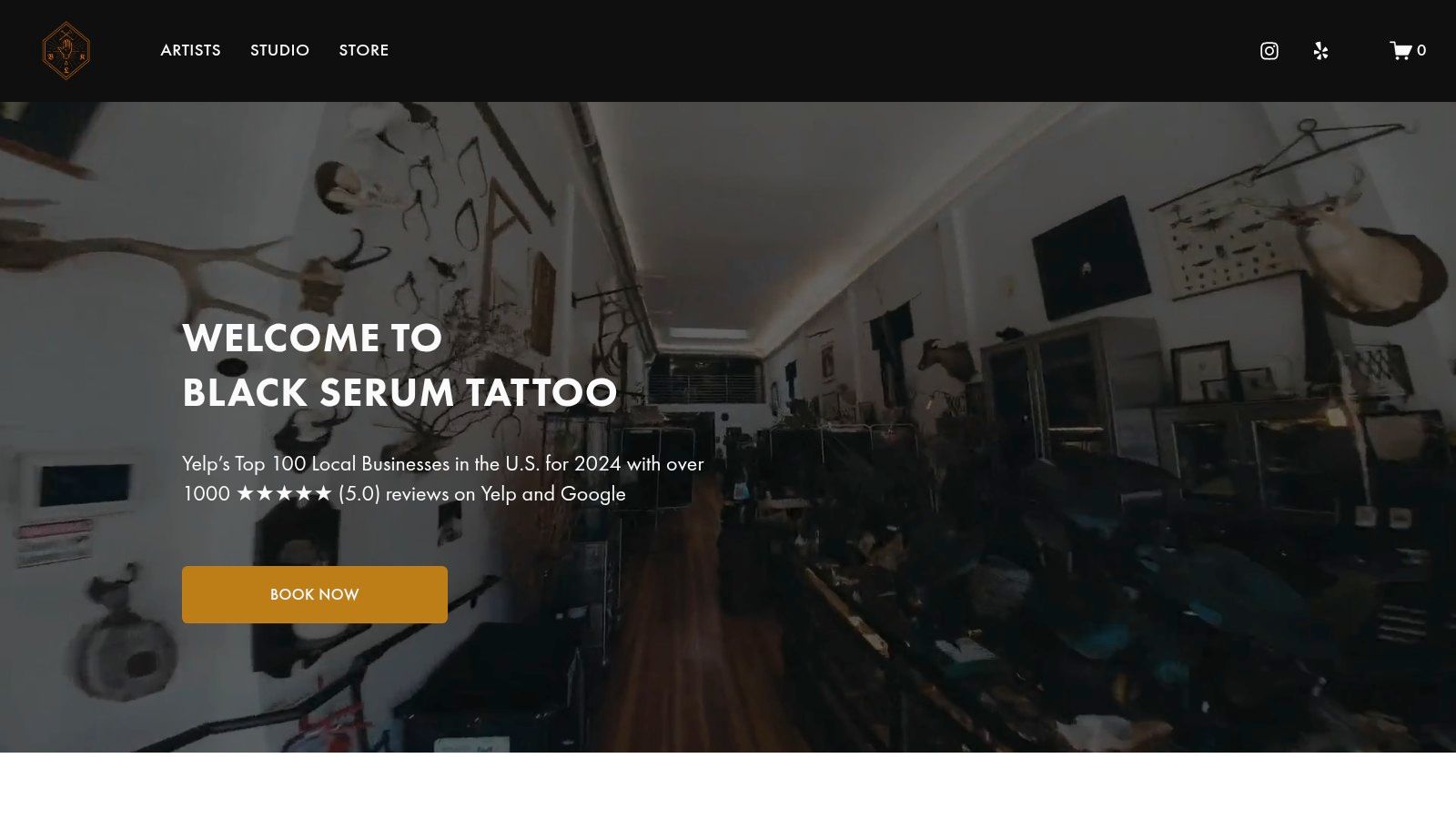
If your version of cyber means crisp, high-contrast, and controlled, Black Serum Tattoo stands out. The Mission District studio is appointment-only, gallery-like, and built around artists whose published specialties include blackwork, fine-line, etching, and in some cases cyber. That combination is good for designs that rely on precision edges instead of painterly effects.
I'd steer a client who wants a cyber piece that looks sharp from both near and far. Not soft biomech. Not color realism. More like angular pattern systems, blades of negative space, and dense black framing that gives the whole tattoo structure.
Why line quality matters more here
Recent trend coverage around cyberpunk and cybersigilism notes a move toward thinner, sharper, more body-contoured linework, but it also points out a real content gap around aging, blur, touch-ups, and later removal in these ultra-fine compositions, as discussed in this trend analysis on cyber and cybersigilism tattoo durability. That's exactly why Black Serum's style fit matters. If you're going thin, the artist's control has to be obvious in the portfolio.
A useful adjacent reference is geometric blackwork tattoo design principles. Cyber linework often succeeds for the same reason strong geometric work does. It uses spacing, contrast, and deliberate restraint. More tiny lines doesn't automatically mean a better result.
Best placements: outer forearm, upper arm, upper back, calf, and flatter chest zones where symmetry reads cleanly.
Less forgiving placements: hands, fingers, inner biceps, and any area where friction and motion can soften ultra-fine details faster.
Best client type: someone willing to simplify a cool sketch so it stays readable later.
Black Serum doesn't publish rates, and spontaneity isn't the point here. You book this shop because the portfolio proves technical control. Ask to see healed blackwork and healed fine-line pieces, not just fresh photos.
4. Baron Art Studio
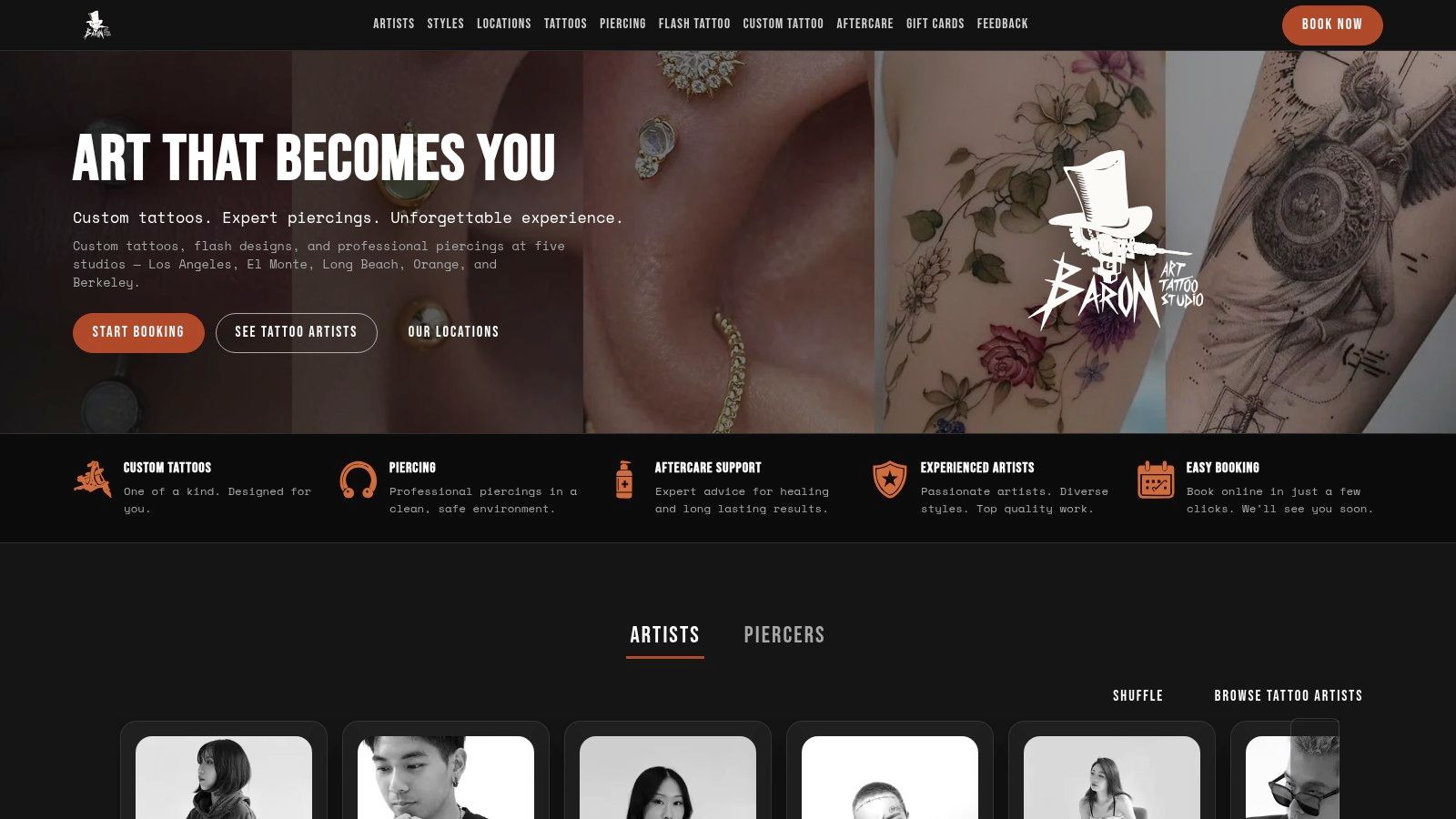
Baron Art Studio is one of the easiest picks for clients who specifically want cybersigilism, not just broad “futuristic” styling. The studio network maintains a formal cybersigilism category and backs that up with artist pages, booking paths, and placement guidance. That clarity helps because cybersigilism and cyberpunk get mixed together online, even though they don't solve the same design problem on skin.
Baron also has a practical advantage. Multiple Southern California locations, custom and flash options, and walk-in access at some shops lower the barrier for first-timers who want the look without navigating a vague intake process.
Where Baron works best
This is a strong fit if you want thin-line body-following forms, sharp symmetry, or a piece that wraps around the shoulder, spine, sternum, collarbone, or hip in a way that feels more ornamental than illustrative. The studio's setup supports that lane well. Free consultations on artist pages and clearer deposit and rescheduling policies also help if you're still dialing in scale.
Don't book cybersigilism from a moodboard alone. Book it from healed examples on actual bodies.
That matters because cyber-adjacent symbolism can tempt people into literal “tech” concepts like scannable tags, access symbols, or NFC-style marks. If you're thinking that way, keep the design symbolic unless you're working with a true wearable system. A peer-reviewed review of epidermal and wearable NFC/RFID sensors notes that high-power readers can theoretically activate NFC tags at distances up to 50 cm, and that identifier skimming can enable cloning even when data access is password-protected, according to this review of NFC and RFID wearable security constraints. For tattoo planning, that means the safe move is visual language, not embedded credentials.
Ask Baron artists:
“Is this design true cybersigilism, or am I really asking for cyberpunk ornament?”
“Where does this need open skin so the shape doesn't collapse?”
“Would flash be a strong base for customization, or should this start from scratch?”
5. Monolith Studio

A torso design can look balanced in a sketch and fail once it reaches the body. Monolith Studio focuses on solving that problem through planning. The Brooklyn studio publishes detailed material on cybersigilism, including its history, techniques, body architecture, and project scale. That makes it a strong option for work intended to follow the spine, sternum, shoulder, or torso rather than sit as a separate graphic.
Its approach suits clients who want high-concept, symbol-driven compositions with deliberate structure. The studio's “Book Experience” process also suggests a longer design consultation. Bring references, placement ideas, and a clear sense of scale. A complex cyber piece needs time for proportion, negative space, and line weight before the needle touches skin.
Built around anatomy and design control
Cyber and Y2K-era tattoo references commonly combine computer code, circuit-board pathways, robotic forms, geometric grids, neon palettes, and biomechanical structures. A published overview of cyber and Y2K-era tattoo aesthetics describes the style's balance between clean geometry and organic distortion. On a body, that contrast needs control. Fine lines can lose clarity as they curve, while dense blackwork can close up during healing if open skin is not planned carefully.
Color and glow effects need the same discipline. Neon accents may read best as small highlights against black or unpigmented space, rather than filling every circuit or symbol. Ask how the artist expects the contrast to age, especially on areas that bend, stretch, or receive regular sun exposure.
Best for: sternum maps, spine pieces, shoulder wraps, torso work, and large custom line compositions.
Less ideal for: impulse walk-ins, tiny one-off symbols, or a quick quote without design discussion.
Consult prompt: “How should this composition widen or taper to match my anatomy?”
Monolith fits projects where the body is part of the drawing, not just the surface beneath it.
6. Love Machine Tattoo
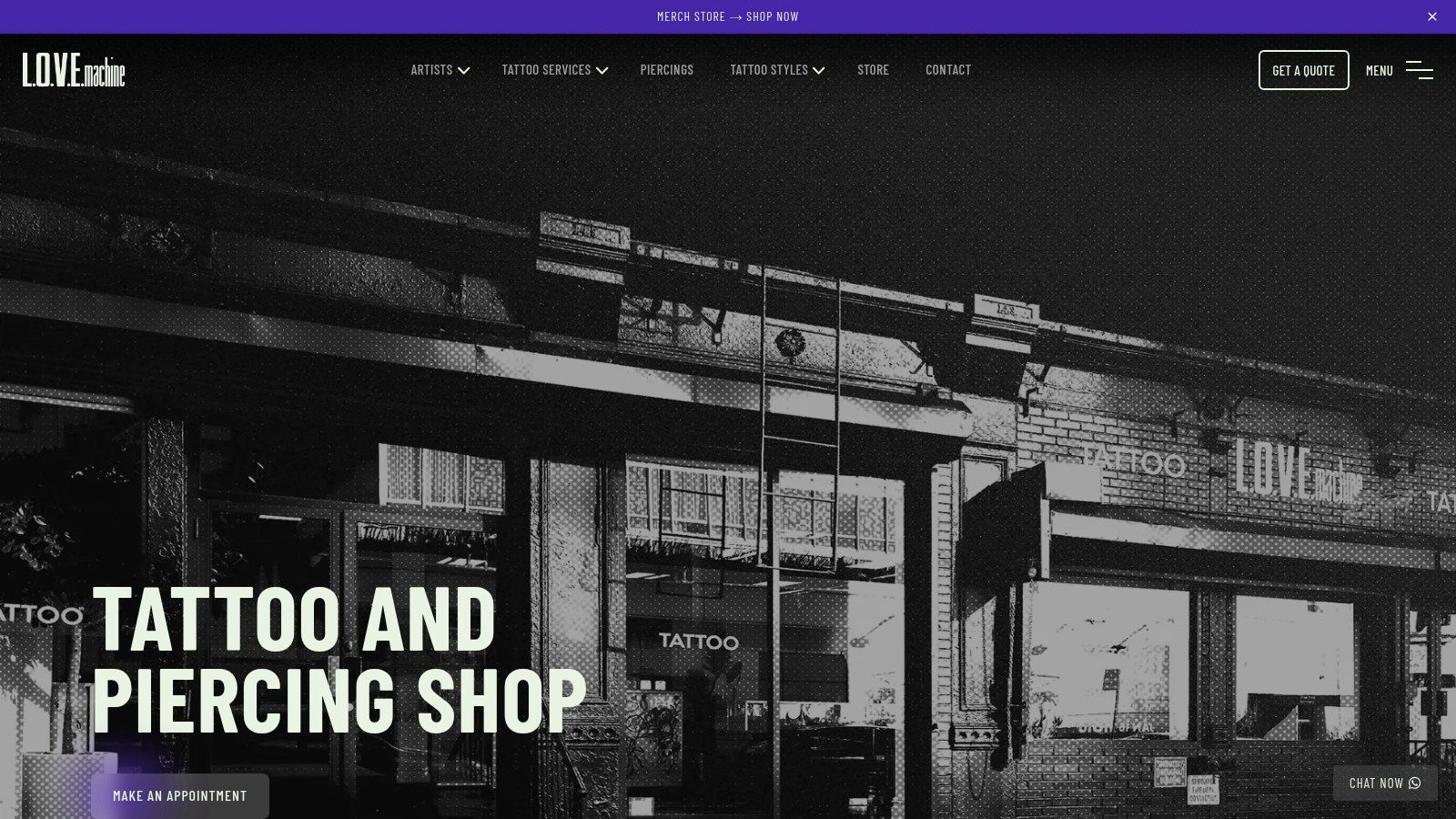
Love Machine Tattoo suits clients who want a direct route from reference board to appointment. The SoHo shop publishes a dedicated cybersigilism page, daily hours, a broad artist roster, and intake through quote forms and WhatsApp. That setup can reduce back-and-forth during the first inquiry.
Its published material supports thin-line, symmetrical, and tribal-adjacent cyber forms. These designs depend on consistent line weight, clean spacing, and careful placement. Ask whether the chosen artist has healed examples with similar density. Fine lines can soften over time, while tightly packed shapes may lose open skin if the design is reduced too far.
Love Machine also makes sense for hybrid concepts. A board may combine ornamental spikes, geometric loops, and repeating structures without fitting one fixed label. Repetition and spacing then become the main design system. The guide to fractal tattoo design ideas and repeating form logic offers a useful reference for discussing how forms can recur, expand, or change scale across the body.
Use the roster carefully. A larger team gives you more routes into blackwork, fine line, or realism, but a general style page cannot show every artist's line temperament. Match the artist to the actual reference, then discuss how much black, open skin, and color the design needs.
For the consultation, bring separate references for line style and placement. Explain whether you prefer an airy circuit pattern or a denser ornamental structure. If the design includes glow-like color, ask how small accents will sit beside blackwork and how the contrast may change during healing. Also ask about touch-ups before booking.
Love Machine is a practical option for Manhattan clients who value access, range, and a clear intake process.
7. SadBoy Studios

For a design built around mech parts, game-inspired armor, sci-fi faces, chrome surfaces, or controlled neon glow effects, SadBoy Studios offers a clear cyber-realism route. Its published work places technology into an image with depth and surface detail, rather than reducing it to abstract cybersigilism marks.
The downtown Phoenix studio also presents itself as a contemporary art space, with event and mobile tattoo activation capabilities. Those services do not determine tattoo quality, but they show a practice connected to current visual culture and image-led work. Ask which artist handles the specific reference, especially if the piece combines armor, skin, reflected light, and small mechanical details.
When realism beats linework
Cyber realism requires decisions about light, reflection, depth, and the way color interacts with skin. The consultation should cover the design's focal point, the amount of black used to hold contrast, and whether glow accents will remain readable after healing. Placement matters too. Curved areas can distort armor plates or faces, while flatter space gives reflective surfaces cleaner edges.
Ink selection also matters when the concept depends on saturated reds, blues, metallic tones, or neon-like contrast. An analytical survey of 73 commercially obtained tattoo inks found that 93% violated European labeling requirements, 50% incorrectly declared at least one pigment ingredient, and 61% contained pigments considered capable of causing sensitization or other adverse effects. The research also detected nickel and chromium in almost all samples. A separate reconstructed-human-skin study identified four of 16 inks as highly cytotoxic after 24-hour intradermal exposure, as reported in this analysis of tattoo ink composition, labeling, and biological risk.
Ask the artist which pigments will create the glow or metallic effect, whether the concept can work in black and grey, and whether healed cyber-realism examples exist on your skin tone. Discuss the expected healing changes before choosing small highlights or tightly packed color.
SadBoy fits clients who want technology rendered as a detailed image, with a consultation focused on color behavior, placement, and long-term contrast.
Top 7 Cyber Tattoo Studio Comparison
Studio | 🔄 Booking & Complexity | ⚡ Resources & Accessibility | ⭐ Expected Quality / Outcomes | 📊 Ideal Use Cases | 💡 Key Advantages / Tips |
|---|---|---|---|---|---|
Think Tank Tattoo | Appointment-based; $100 non-refundable deposit; no online rates | Large 3,000 sq. ft. studio; diverse artist roster; phone/email booking | ⭐⭐⭐⭐, seasoned, stylistically diverse artists | First-timers, collectors, large multi-session custom work | 💡 Free consultations; strong local reputation; contact shop for pricing |
Future Ink Tattoo & Supply | Multiple channels (form/phone/email); open daily; quotes after inquiry | Cyberpunk-specialist artists; Rockridge/BART access; cash/Zelle accepted | ⭐⭐⭐⭐, strong for cyber/biomech and heavy blackwork | Futuristic, tech-forward large-scale geometry and cyber pieces | 💡 Review dedicated cyberpunk portfolio; expect quote-on-request |
Black Serum Tattoo | Appointment-only; clear hours; per-artist inquiry for pricing | Gallery-like Mission studio; detailed artist portfolios; strong reviews | ⭐⭐⭐⭐, precision blackwork & fine-line excellence | Crisp, high-contrast cyber linework and etching styles | 💡 Check artist portfolios; high third-party reputation (Yelp Top 100) |
Baron Art Studio | Appointments and walk-ins; multi-location scheduling; quotes via submission | Multiple SoCal locations; custom and flash options; named artist pages | ⭐⭐⭐, quality varies by artist and location | Accessible options for both first-timers and collectors; flash work | 💡 Free consults on artist pages; clarify cybersigilism vs cyberpunk during consult |
Monolith Studio | "Book Experience" workflow for complex projects; consultation-heavy; quote per complexity | High-concept Brooklyn studio; emphasis on body architecture and planning | ⭐⭐⭐⭐⭐, very high for architectural, precise linework | Collectors seeking precise, multi-session cybersigilism/customs | 💡 Expect detailed prep, realistic time estimates, and advanced planning |
Love Machine Tattoo | Quick intake via "Get a Quote" and WhatsApp; daily hours | Large multi-style team in SoHo; easy quote triage | ⭐⭐⭐⭐, strong for thin-line and symmetrical cyber compositions | Fast quotes, thin-line geometric cybersigilism and hybrid concepts | 💡 Use WhatsApp for fast triage; review individual portfolios for exact style fit |
SadBoy Studios | Appointment-based; published non-refundable deposit; offers event/mobile bookings | Boutique downtown Phoenix studio; inclusive ownership; mobile activation capability | ⭐⭐⭐, good for cyber realism and color/neon effects | Tech realism (mech parts, neon glows), event or mobile tattoos | 💡 Confirm artist cyber portfolios before booking; clear deposit policy |
Turning Your Cyber Concept Into a Booked Session
The fastest way to waste a consultation is to show up with only a vibe. Bring a reference board that separates style, placement, and specific details. One folder should show the line temperament you like, thin, bold, mechanical, ornamental. Another should show where on the body you want the tattoo to live. A third can hold details like exposed wiring, glitch texture, biomechanical seams, or neon accents.
Say the style family out loud. Tell the studio whether you want cyberpunk linework, cybersigilism, or tech realism. That one step clears up a lot of confusion because those categories age differently, heal differently, and require different artist strengths. Fine-line body-following sigils need spacing discipline. Heavy cyber blackwork needs shape control. Realistic machine rendering needs smooth value transitions and smart color handling.
Before you book, confirm the studio's deposit policy, consultation process, and whether the artist can show portfolio examples with the exact cyber look you want. Don't settle for “they do good tattoos.” Ask for healed examples when possible. Fresh tattoos often make tiny details look cleaner than they'll read later.
Healing deserves planning too. Cyber tattoos often rely on contrast, edge clarity, and negative space. That means placement, friction, sun exposure, and aftercare matter. If the tattoo sits on an area that rubs against waistbands, backpack straps, or gym equipment, mention that before finalizing the stencil. If you're traveling, swimming, or starting a physically demanding work stretch, schedule around it.
If you're sourcing artists through social platforms, be direct and organized. A clear message, solid references, and good timing go further than a long paragraph full of vague inspiration. These local outreach and DM booking tips apply well to tattoo inquiries too. Keep it concise. Ask the right questions. Then let the artist shape the design for the body, not just the screenshot.
If you're in Denver and want a cyber piece that fits your anatomy and your long-term goals, Think Tank Tattoo gives you the right setup, complimentary consultations, an experienced multi-style roster, and clear aftercare support. Bring your references, narrow down whether you want cyberpunk linework, cybersigilism, or tech realism, and start the conversation with Think Tank Tattoo.
Comments