
First Tattoo Tips: 8 Things to Know Before You Book
You've booked the cheapest walk-in in Denver, skipped the consultation, and arrived with a design saved from your phone. Then the questions start. How much will it hurt? How long will the appointment take? What do you put on the tattoo afterward? A few hours later, the artwork may be finished, but the uncertainty has just begun.
Most first-tattoo problems come from choices made before the needle touches skin. The studio, design, placement, artist, budget, physical preparation, and aftercare plan all shape the experience. Pain matters too, but it's easier to manage when the rest of the appointment has been planned properly.
These first tattoo tips follow the path a nervous client takes, from choosing a Denver studio to watching the tattoo heal. You'll get practical questions to ask, trade-offs to consider, and specific steps you can take before booking. Preparing for a tattoo has something in common with feeling ready for therapy. You don't need to eliminate every unknown. You need enough information to make a clear decision.
Table of Contents
1. Choose a Reputable, Established Studio with Professional Credentials
2. Invest Time in Designing the Right Tattoo Through Consultation - Use the consultation to solve technical problems
3. Prepare Mentally and Understand Pain Management - Make the appointment easier to manage
4. Plan Your Placement Strategically for Visibility and Versatility - Leave room for the tattoo you might want later
6. Research and Connect With Artists Who Specialize in Your Desired Style - Match the artist to the design
7. Set a Realistic Budget and Understand Tattoo Pricing - Budget for the finished piece
8. Don't Rush Into Your First Tattoo. Take Time to Ensure You're Ready - Use the waiting period productively
1. Choose a Reputable, Established Studio with Professional Credentials
A polished reception area is useful, but it isn't proof of safe tattooing. Look for a studio that can explain its hygiene process, identify its artists, and show healed work. An established shop should be able to answer direct questions without treating them as an inconvenience.
Ask whether the studio uses single-use needles and ink caps, how reusable equipment is sterilized, and which local health requirements apply. The U.S. Food and Drug Administration explains that tattoo inks are injected into the dermal layer, creating a direct route for microorganisms, and that contamination can occur even when an artist follows hygienic procedures. The FDA's tattoo safety guidance also advises consumers to ask what products are being used and retain the brand and color information when possible.
Practical rule: A clean-looking workstation is reassuring, but it can't verify the microbiological status of a sealed pigment. Ask for process transparency.
Visit the studio before committing if you can. Notice whether the workspace is orderly, whether staff communicate clearly, and whether artists are willing to discuss your concerns. Reviews can help, but focus on comments about communication, cleanliness, healed results, and how the studio handled problems.
Think Tank Tattoo has operated in Denver since 2002 and works from an open, 3,000-square-foot studio on South Broadway. Its artists cover different styles, and the shop offers complimentary consultations. Those details don't replace your own questions, but they give a first-time client a practical starting point for evaluating a studio.
2. Invest Time in Designing the Right Tattoo Through Consultation
A reference image shows what caught your eye. It doesn't automatically show what will work on your body. Your artist needs to consider the design's scale, line weight, detail, movement, and how the skin curves around the chosen placement.
Bring a small collection of references rather than one image you expect the artist to copy. Include photographs, drawings, color ideas, and a short explanation of what you like about each example. You might like the composition from one image, the linework from another, and the restrained color palette from a third. Saying that clearly gives the artist room to build something custom.
Use the consultation to solve technical problems
Tell the artist what the tattoo means to you, but don't assume the meaning alone determines the final design. A symbol may need to be simplified to remain readable. Fine detail may need more space. A design intended for a small wrist placement may work better on the upper arm if you want the shapes to stay distinct.
Discuss these points before you approve the appointment:
Design direction: Explain the subject, mood, references, and elements you want to avoid.
Size and proportion: Ask how the design will scale to your body and whether detail will remain legible.
Placement options: Compare locations based on visibility, body contours, clothing, and future tattoos.
Session expectations: Ask about likely appointment length, breaks, pain, and aftercare.
Preview timing: Confirm when you'll see the design and how revisions are handled.
A complimentary consultation should produce more than an appointment time. You should leave with a clearer design direction, a realistic placement, and a plan for the session. To begin that conversation, use the Think Tank Tattoo contact page.
3. Prepare Mentally and Understand Pain Management
Tattoo pain isn't a fixed rating. It changes with placement, line density, shading, session length, and your own tolerance. A small tattoo on one area may feel manageable, while a larger piece over a sensitive or bony area can demand more concentration and more breaks.
Anticipatory anxiety can make the appointment feel harder before it begins. You don't need to act fearless. Tell your artist that it's your first tattoo, ask what sensations to expect, and agree on a signal for a pause. Most artists would rather work with a client who communicates than with someone who stays quiet until they're overwhelmed.
Prepare your body in ordinary ways. Sleep well, eat a substantial meal before the appointment, drink water, and bring a snack for a longer session. Avoid alcohol before tattooing. Don't stop prescribed medication or change a medical routine without speaking with your clinician, but do tell the artist about medications or health conditions that could affect bleeding or healing.
Make the appointment easier to manage
Slow breathing helps prevent you from tensing every muscle. Keep your shoulders loose and focus on a steady exhale when the needle feels intense. Wear clothing that gives the artist access to the area without forcing you to expose or rub the new tattoo afterward.
For a large design, multiple sessions can be a better choice than trying to finish everything in one exhausting appointment. The trade-off is more visits and more scheduling, but shorter sessions can make it easier to maintain focus and care for the tattoo properly.
Don't choose a placement based only on a pain chart. Choose a design and location you can live with, then ask the artist how to plan the work realistically. If you later decide the tattoo isn't right for you, effective laser tattoo removal may still involve its own discomfort and limitations, so thoughtful planning matters.
4. Plan Your Placement Strategically for Visibility and Versatility
Placement affects more than pain. It determines who sees the tattoo, how clothing touches it, how the design follows your body, and whether you have room for future work. A location that looks ideal in a reference photo may not suit your daily clothes, job requirements, or long-term collection.
Start with visibility. If you need to cover the tattoo for work, family events, or formal clothing, test that with the clothes you wear. A small wrist tattoo may sit under a watch or bracelet, while an upper-arm or thigh design usually gives you more control over when it's visible. Hands, fingers, feet, and other exposed areas can demand more maintenance and may not offer the same flexibility.
Then consider the shape of the area. A circular design may sit naturally on a shoulder, while a long botanical piece may follow the forearm or calf. Your artist can use stencils or placement mockups to show how the artwork moves when you stand, sit, bend, or relax your arm.
Leave room for the tattoo you might want later
A first tattoo doesn't have to determine your entire collection, but it shouldn't accidentally block future plans. If you think you may want a sleeve, discuss the idea before placing a standalone design in the middle of the area. If you want one small piece only, tell the artist that too.
Consider healing conditions as well. Tight clothing, repeated friction, intense sunlight, and activities involving water can complicate early care. Avoid tattooing over skin that's irritated or actively inflamed. If you have eczema, psoriasis, a history of keloid scarring, or another skin concern, ask whether a dermatologist's opinion makes sense before booking.
Placement is a design decision, not an afterthought. The best location balances visibility, body shape, lifestyle, healing, and future flexibility.
5. Follow Professional Aftercare Instructions Precisely
A fresh tattoo needs a clear care plan, not improvisation. The dressing system, washing instructions, moisturizer, and timing can vary, so follow the directions your artist gives you for that specific tattoo. Write them down or take a photo before leaving the studio.
The FDA warns that tattoo reactions can include allergic responses, infection, permanent disfigurement, and lasting discoloration. Its consumer guidance also notes that removal may be difficult or incomplete. That's why aftercare isn't just about preserving color. It's part of managing an open skin injury and recognizing when routine healing has changed into a medical concern. Read the FDA guidance on tattoo and permanent makeup safety for the broader risks.
Keep the routine simple:
Clean as directed: Use the washing method and timing recommended for your dressing.
Touch only when needed: Wash your hands before cleaning, and don't pick or scratch peeling skin.
Use suitable products: Choose the product your artist recommends, especially if your skin is sensitive.
Avoid soaking: Don't swim or immerse the tattoo until the artist or clinician confirms it has healed.
Protect the area: Keep friction, heavy sun exposure, and dirty environments away from the healing skin.
Watch the trend: Mild tenderness, localized redness, peeling, and itch should generally settle rather than intensify.
Increasing warmth, spreading redness, pus-like drainage, severe pain, fever, red streaking, persistent raised bumps, or a rash limited to one pigment color needs prompt medical attention. Don't keep adding new creams to a suspected reaction. That can irritate the skin further and make the cause harder to identify.
Think Tank Tattoo provides specific tattoo aftercare guidance so clients can review instructions after the appointment. For a broader comparison of dressing principles, see this burn wound bandage guide, but your tattoo artist's instructions for the actual dressing remain the relevant starting point.
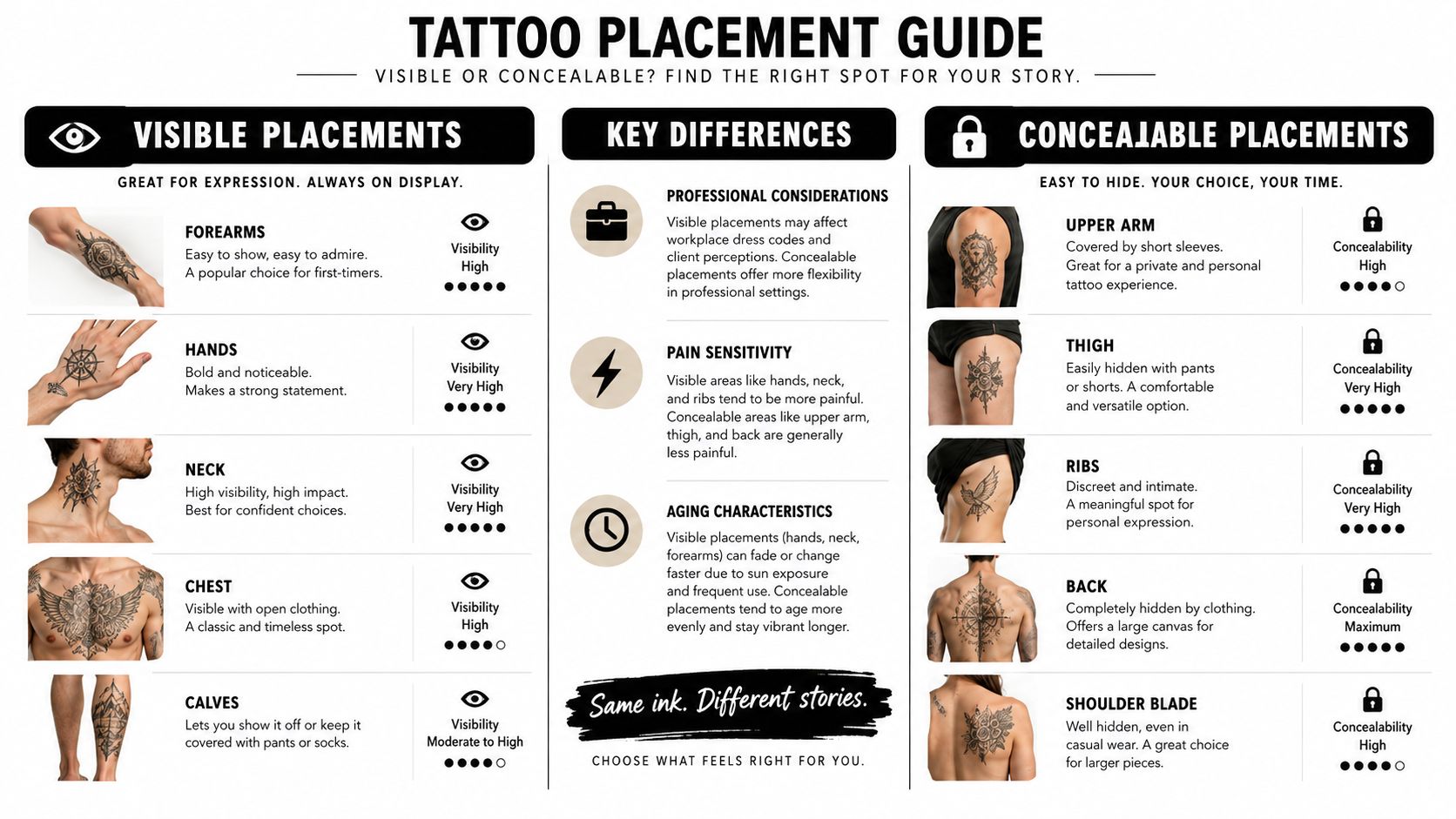
Here's a visual guide to compare placement, visibility, and aging considerations:
You can also review this appointment care video before your session:
6. Research and Connect With Artists Who Specialize in Your Desired Style
An artist can be talented and still not be the right match for your design. Style-specific experience matters. A portrait requires convincing facial structure and controlled shading. Geometric work depends on consistent lines and balance. Traditional tattoos rely on bold outlines, clear shapes, and a practiced approach to classic imagery.
Review complete portfolios, not only the most striking image on a social media page. Look for repeated quality across healed and completed work. Ask whether the examples are the artist's own tattoos and whether they have made pieces similar to your concept. An artist should be able to explain what they'd change for your skin, placement, and desired size.
“Choose the portfolio, not just the studio name.”
That doesn't mean you have to arrive with a rigid brief. A strong artist may suggest fewer details, a different orientation, or a larger scale because the original idea would lose clarity over time. The useful question is whether the recommendation serves your design or just pushes you toward work the artist prefers.
Match the artist to the design
Use the consultation to discuss technique as well as appearance. Ask how the artist approaches linework, black-and-gray shading, color packing, fine detail, realism, or illustrative forms. If the design combines styles, ask to see comparable work rather than assuming one portfolio covers every specialty.
Think Tank Tattoo maintains an artist directory where first-time clients can compare the team's different approaches. Take notes while browsing. Save the names of artists whose work consistently matches the qualities you want, then contact the studio with a focused description instead of sending the same request to everyone.
7. Set a Realistic Budget and Understand Tattoo Pricing
A tattoo quote reflects more than the time the needle is running. Artist experience, design complexity, size, color, placement, preparation, and the number of sessions can all affect the final price. Ask how the studio charges before you approve the booking, and make sure you understand what the estimate includes.
A deposit is part of the booking process, not an unexpected add-on. Think Tank Tattoo requires a non-refundable $100 deposit to reserve an appointment, and its shop minimum is $100. Those are specific studio policies, so confirm current details when you contact the shop. A deposit also means you should be ready to attend, communicate about scheduling, and understand the cancellation terms.
Budget for the finished piece
Don't save only for the first appointment. Include the full design, possible additional sessions, travel, aftercare products, and a tip if you plan to give one. If your budget only works for a smaller or simpler version, discuss that openly. A good artist can often recommend a change in scale or detail, but cutting corners on hygiene or artist fit isn't a sensible saving strategy.
Ask these questions before paying:
Pricing method: Is the work priced hourly, by piece, or through another structure?
Estimate scope: Does the quote cover the complete design or only the first session?
Deposit terms: When is the deposit due, and what happens if you need to reschedule?
Revision expectations: Are design changes handled before the appointment, and when must they be requested?
Touch-up policy: If healed work needs attention, how does the studio handle that request?
The cheapest quote may not be the lowest long-term cost if the tattoo needs major correction or removal. Compare communication, portfolio fit, safety practices, and clarity of terms alongside price.
8. Don't Rush Into Your First Tattoo. Take Time to Ensure You're Ready
A tattoo can be meaningful without being urgent. If you're unsure about the design, placement, artist, or budget, postponing the appointment is a responsible decision. A studio that handles first tattoos professionally should give you space to ask questions rather than pressure you into a same-day commitment.
Wait when the idea came from a temporary emotional situation, an argument, intoxication, or pressure from a partner or friends. Partner names, trend-driven symbols, and copied designs deserve extra scrutiny because your circumstances and preferences can change while the tattoo remains. You don't need to reject an idea just because it's popular. You do need to know whether you like the design itself or only the feeling surrounding it today.
Use the waiting period productively
Keep the reference images in one folder. Write down what you like and what you'd remove. Test the placement with clothing, consider whether the scale is large enough for the detail, and show the concept to people whose judgment you trust. Their feedback shouldn't decide for you, but it may reveal a spelling issue, cultural concern, or practical problem you missed.
You can also use the pause to screen your own readiness:
Design clarity: Can you describe the subject, style, size, and elements you don't want?
Artist confidence: Does the portfolio show the kind of work you're requesting?
Financial comfort: Can you pay the deposit and planned cost without creating stress?
Health disclosure: Are you prepared to discuss allergies, skin conditions, medications, or immune concerns?
Aftercare availability: Can you protect the tattoo while it heals?
A tattoo reaction may appear after the first few days. A recent medical review describes immediate irritation and infection, delayed hypersensitivity, and longer-term inflammatory complications, with some infections emerging weeks or months later. In a retrospective dermatology cohort discussed in that review of tattoo complications, 31% of patients developed symptoms within one month, while other cases began later, including one to three months, three to six months, and even years afterward. Persistent symptoms deserve medical evaluation rather than repeated experimentation with new aftercare products.
First Tattoo Tips: 8-Point Comparison
Item | Process / Complexity 🔄 | Resources / Speed ⚡ | Expected outcomes ⭐ | Ideal use cases 💡 | Key advantages 📊 |
|---|---|---|---|---|---|
Choose a Reputable, Established Studio with Professional Credentials | Moderate, research, visits, verification | Higher cost & time (deposits, appointments) ⚡ | High-quality work, safer environment ⭐ | First-time clients; important or permanent pieces | Reduces infection risk; professional guidance; peace of mind |
Invest Time in Designing the Right Tattoo Through Consultation | Moderate, iterative revisions and meetings 🔄 | Time for consultations, possible design fees ⚡ | Personalized, well-scaled design with less regret ⭐ | Custom work; meaningful or placement-sensitive pieces | Better fit to body; confidence in final design |
Prepare Mentally and Understand Pain Management | Low, planning and pre-appointment prep 🔄 | Low cost; time for sleep, hydration, avoidance of blood thinners ⚡ | Lower anxiety and improved pain tolerance during session ⭐ | Pain-sensitive placements; long sessions; first-timers | Improved comfort, fewer complications, better healing |
Plan Your Placement Strategically for Visibility and Versatility | Low–Moderate, consultation and placement testing 🔄 | Time for discussion; possible design adjustments ⚡ | Optimal visibility, longevity, and integration with body ⭐ | Profession-sensitive placements; future sleeve planning | Better aesthetics, concealability options, aging resilience |
Research and Connect With Artists Who Specialize in Your Desired Style | Moderate–High, portfolio review and targeted outreach 🔄 | Time, possible travel, potentially higher fees ⚡ | Style-accurate, technically sound tattoos ⭐ | Style-specific work (realism, watercolor, geometric) | Superior technique, consistency, stylistic expertise |
Set a Realistic Budget and Understand Tattoo Pricing | Low, comparison and financial planning 🔄 | Financial commitment; savings and possible payment plans ⚡ | Clear expectations; fewer surprises; access to quality artists ⭐ | Large/custom pieces; multiple-session projects | Prevents underpaying; secures professional standards |
Don't Rush Into Your First Tattoo, Take Time to Ensure You're Ready | Low, decision-making and reflection 🔄 | Time to wait and refine idea; minimal monetary cost ⚡ | Reduced regret; more meaningful choices ⭐ | First-timers; emotionally significant tattoos | Higher long-term satisfaction; thoughtful decisions |
Follow Professional Aftercare Instructions Precisely | Moderate, daily care routine for 2–4 weeks 🔄 | Aftercare products and time commitment ⚡ | Proper healing, color retention, reduced complications ⭐ | Every new tattoo during healing period | Speeds recovery, prevents infection, preserves tattoo quality |
Turn These Tips Into Your Booking Checklist
Before you book, confirm that the studio can explain its licensing or regulatory compliance, single-use supplies, reusable-equipment sterilization, and ink identification process. Ask whether the artist can record the manufacturer, color, and lot or batch information when available. The FDA notes that contaminated ink, not only unsterile equipment, can contribute to infection, so product transparency belongs in the conversation.
Book a complimentary consultation when you're ready. Bring your references, explain the meaning and style you want, and discuss size, placement, visibility, future tattoos, pain, session length, and aftercare. If you have allergies, eczema, psoriasis, keloid scarring, immune suppression, relevant medication, or a previous pigment reaction, disclose it before the appointment. The artist can help with routine planning, but a healthcare professional should assess suspected allergy or infection.
Budget for the deposit and the complete design, not only the first session. At Think Tank Tattoo, the stated policy is a non-refundable $100 deposit, with a $100 shop minimum. Confirm current pricing, scheduling, and cancellation terms directly with the studio because policies can change.
Finally, make sure your life can accommodate healing. You'll need to follow the dressing and cleaning instructions, avoid picking, protect the tattoo from friction and intense sun, and delay swimming or soaking until the skin has healed. Increasing warmth, spreading redness, drainage, fever, red streaking, severe pain, persistent raised bumps, or a confined color reaction calls for prompt medical assessment.
If the design still feels unclear, wait a few months. Use that time to refine the concept and find the right artist rather than accepting a tattoo you weren't ready to choose. If you're in Denver, call or email Think Tank Tattoo on South Broadway to schedule a consultation and bring your questions with you.
Your next step this week is simple. Save three reference images, write down your preferred placement and the questions you want answered, then contact the studio for a consultation before paying a deposit.
Think Tank Tattoo offers complimentary consultations, a collaborative design process, and artists working across diverse styles in its Denver studio. Visit Think Tank Tattoo to review the artists, prepare your questions, and request a first-tattoo consultation.
Comments