
Geometric Hand Tattoos: A Complete Guide for Denver Clients
You've saved a geometric design, compared finger symbols with back-of-hand mandalas, and found yourself drawn to the crispness of perfectly spaced lines. The fresh photograph looks compelling. The harder question is whether those lines will still read clearly after daily washing, sun exposure, flexion, and friction have had their say.
Geometric hand tattoos demand more planning than their clean appearance suggests. The hand is visible, mobile, and constantly in use. A strong result depends on choosing the right geometry for the placement, leaving enough negative space, using suitable line weight, and accepting that maintenance is part of the decision. For Denver clients, outdoor exposure, driving, work gloves, tools, and frequent handwashing all deserve a place in the consultation.
Table of Contents
The Timeless Allure of Geometric Hand Tattoos - Why the hand changes the meaning
Understanding Key Substyles and Design Elements - Linework - Dotwork - Mandala - Sacred geometry
Placement Strategies for Hands and Fingers - Back of the hand - Fingers and knuckles - Palm placement
The Healing Process and Initial Care Phases - The early phase - Tissue formation and settling
Long-Term Maintenance and Longevity Tips - Build maintenance into ordinary routines
The Timeless Allure of Geometric Hand Tattoos
A small black triangle on the back of the hand can look modern, architectural, and almost weightless in the studio. The same design must later withstand gripping, washing, sunlight, friction, and constant movement. Geometric tattooing has older roots than contemporary fine-line work, while hand placement turns a private symbol into something visible during a handshake, over coffee, or while reaching for a phone.
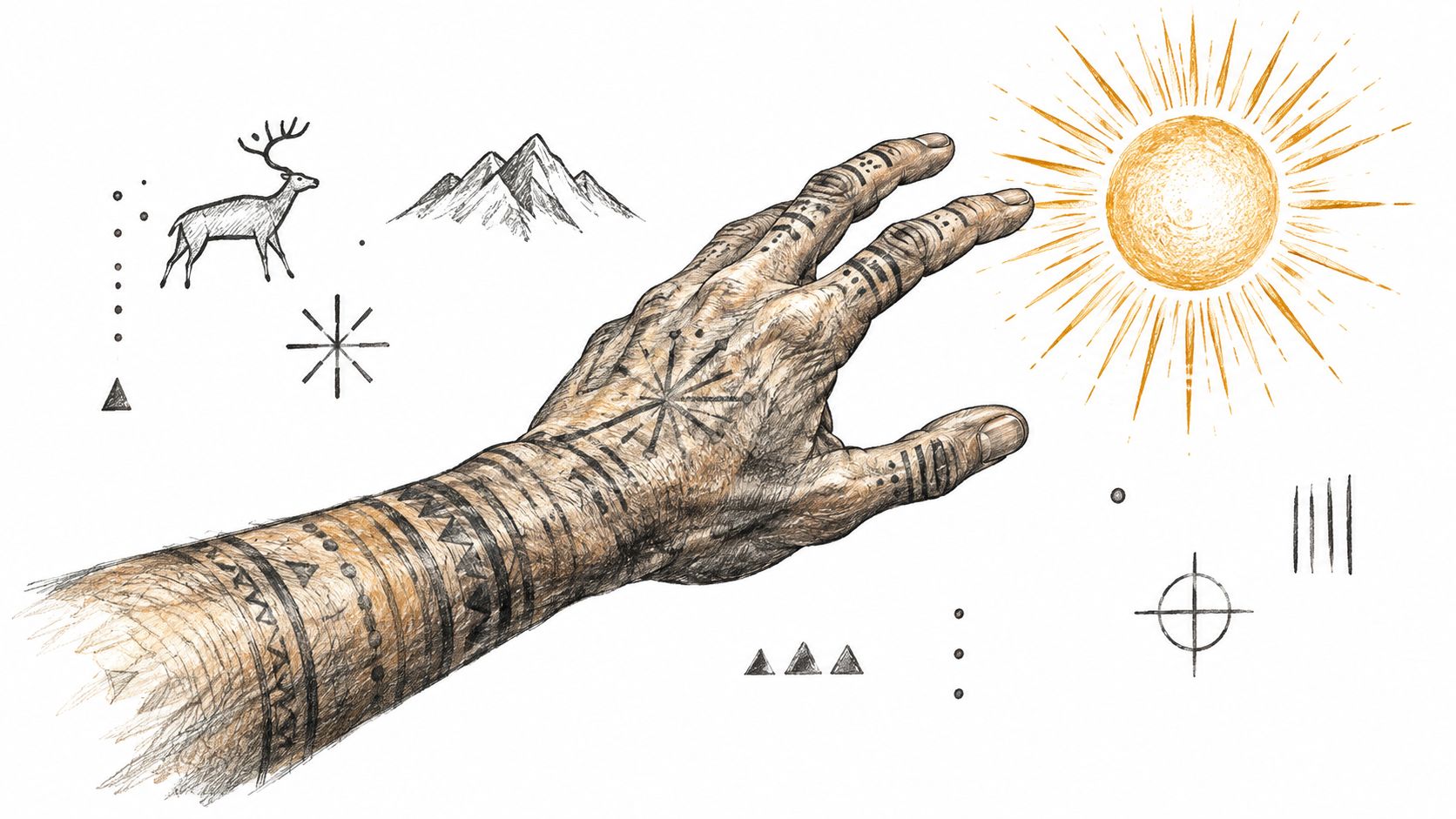
Ötzi the Iceman, a naturally preserved Copper Age mummy found in the Alps, provides the best-known early evidence. Ötzi had 61 tattoos, including simple lines and cross-like marks. Researchers have suggested that some may have served a therapeutic purpose because they appeared near areas showing physical strain or degenerative disease, as described in this historical overview of geometric tattooing. Ancient Egyptian, Polynesian, and pre-Columbian Mesoamerican traditions also used patterned body marking to communicate identity, status, spirituality, or group membership.
Why the hand changes the meaning
Modern geometric work brings that history together with precise linework, dotwork, symmetry, mandala structures, and mathematical forms. Circles, triangles, spirals, hexagons, and Platonic solids can hold personal meaning without depicting a literal object. Their ordered structure also gives the artist a framework for fitting a design across uneven surfaces.
The hand makes the decision more visible and technically demanding. Skin over the knuckles and joints folds, stretches, and experiences repeated friction, so narrow gaps can close visually and softened edges stand out. A design that looks perfectly balanced when fresh may need wider spacing, simpler geometry, or stronger lines to remain legible as the hand ages.
A back-of-hand tattoo is difficult to overlook. It becomes part of your public identity, not an occasional private detail. That visibility may suit you, but it requires accepting that changes in line sharpness and spacing will remain easy to see.
Practical rule: Choose a geometric hand tattoo for its structure and its long-term relationship with your hand, not only for the crispness of a fresh studio photograph.
The style became especially prominent in the 2010s, alongside the growth of fine-line, blackwork, and dotwork aesthetics, according to this summary of contemporary tattoo trends and placements. Its popularity does not make the work disposable. It does mean you should distinguish a lasting attraction to geometric form from a temporary preference for a social-media layout.
Understanding Key Substyles and Design Elements
“Geometric” describes a design language, not one single technique. The best choice depends on how much detail the placement can support, how boldly you want the tattoo to read, and how much visual change you'll accept as the skin ages.
Linework
Linework uses clean continuous strokes to define structure. It suits small triangles, angular symbols, grids, bands, and single-line compositions. On fingers and near joints, ultra-fine parallel lines can lose separation as the skin moves and experiences friction. A skilled artist may simplify the pattern, open the spacing, or increase the line weight so the design remains readable rather than preserving every detail from a reference image.
Dotwork
Dotwork creates shading and gradients from individual dots. It can soften the severity of solid black geometry and gives mandalas or sacred-geometry patterns a measured tonal range. The technique still requires restraint. A dense field of dots placed too close together can visually merge as the tattoo settles, particularly in a compact area.
Mandala
Mandalas radiate from a central point, so symmetry is the main technical challenge. On the back of the hand, the artist must adapt the circle to the hand's contours and account for the relationship between the knuckles, thumb, and wrist. A mandala that looks symmetrical on paper may need controlled distortion in the stencil to appear balanced on a three-dimensional hand.
Sacred geometry
Sacred geometry uses symbolic forms such as interlocking circles, the Flower of Life, triangles, hexagons, and other mathematical structures. These designs can scale well, but scaling isn't the same as merely shrinking the artwork. Small fingers may support a simplified segment or isolated symbol, while a full pattern needs the broader surface of the back of the hand.
Use specific design language during your consultation. Instead of saying “something geometric,” explain whether you want continuous linework, stippled shading, radial symmetry, or an interlocking pattern. You can also browse Think Tank Tattoo's tattoo blog to clarify the visual vocabulary you want to discuss.
Placement Strategies for Hands and Fingers
A geometric tattoo can look precise in a still stencil and shift visually as the hand opens, closes, grips, and rotates. Placement controls the available surface, daily friction, visibility, and how much detail the skin can realistically retain.
Placement | What works well | Main trade-off |
|---|---|---|
Back of the hand | Mandalas, larger symbols, structured compositions | Highly visible and exposed to sun and movement |
Fingers | Bands, isolated symbols, compact geometry | Limited space and substantial friction |
Knuckles | Bold marks, small repeated forms | Joints move constantly and spacing is unforgiving |
Palm | Strong, simple symbols for experienced clients | High mechanical stress and difficult ink retention |
Back of the hand
The back of the hand offers the broadest continuous surface, making it suitable for a centered mandala, angular composition, or pattern that extends toward the wrist. The stencil should be checked with the hand open, closed, and rotated. Lines that appear evenly spaced in one position can compress or drift when the skin folds.
Visibility brings practical responsibility. Client-facing work, healthcare, construction, hospitality, and outdoor jobs can expose the tattoo to handling, sunlight, and repeated contact. A delicate design may need stronger lines and more open spacing to remain legible through that routine. Fine geometry has less room for error here because every asymmetry is easy to see.
Fingers and knuckles
Fingers suit compact geometry and isolated symbols. Crowded detail is harder to preserve because bending, washing, gripping, and contact with objects repeatedly stress the skin. Narrow bands and tiny intervals can soften or break up, so simplify the pattern before reducing its size.
Knuckles create a strong repeated rhythm, but each joint interrupts the surface. The stencil must follow those folds and account for movement rather than treating the hand as a flat diagram. A design that crosses several knuckles may need deliberate spacing or bold, separated elements to keep the pattern readable.
Hand tattoos are a popular placement, but popularity does not predict retention or appearance. The hand's exposure and constant use make geometric precision more dependent on design scale, line weight, and the client's daily routine.
Palm placement
Palm tattoos require realistic expectations. This skin flexes repeatedly and receives heavy abrasion, so intricate geometry is a poor starting point for many clients. Ask whether the concept still works as a bold, simplified mark, and accept that some palm designs may require future assessment or touch-up.
The best placement is the one that matches the design's complexity to the hand's mechanical demands. A small symbol may outperform a miniature mandala because its structure has enough space to remain clear.
The Healing Process and Initial Care Phases
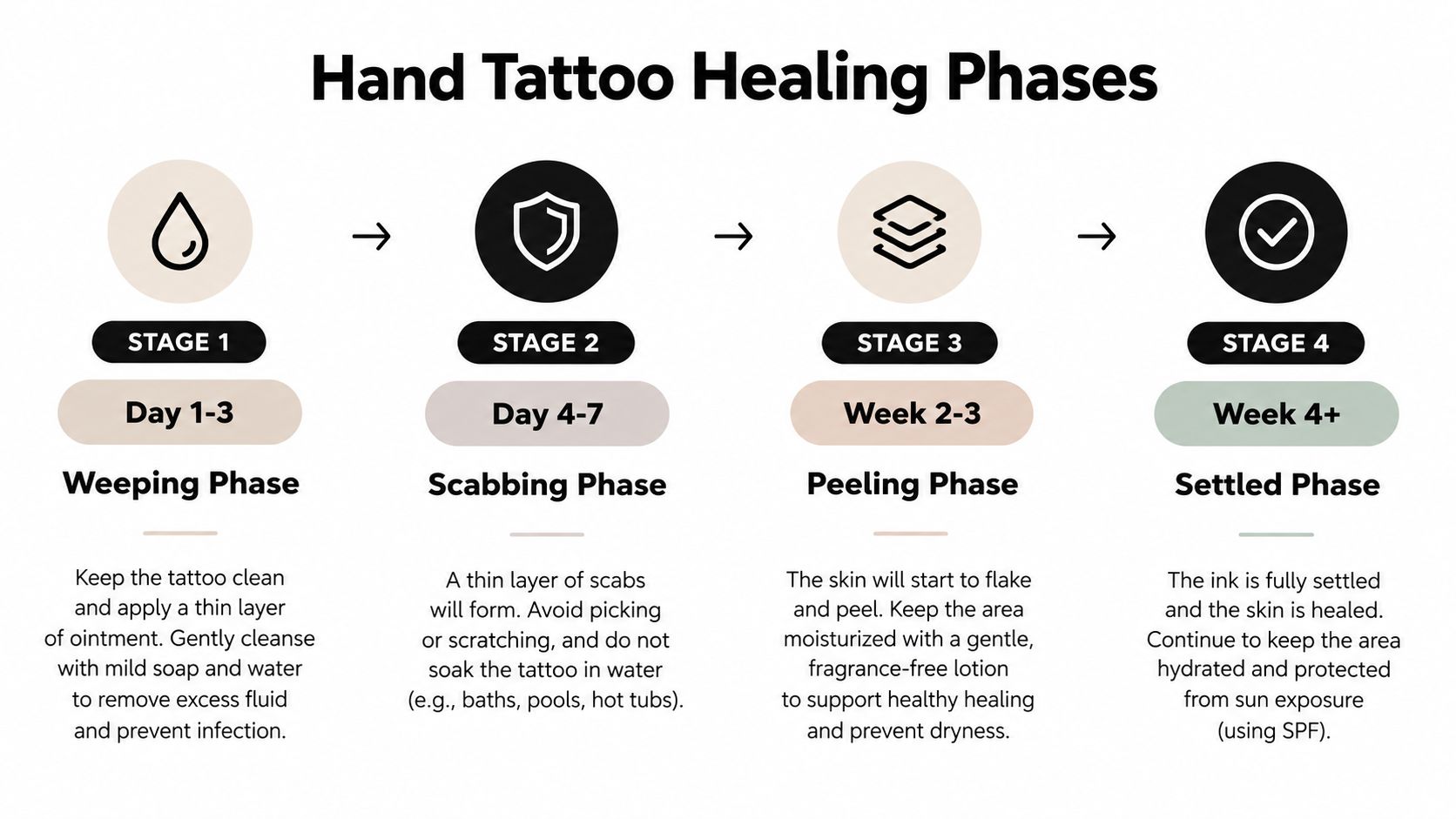
A geometric hand tattoo can look asymmetrical before the skin has settled. Swelling, redness, moisture, peeling, and temporary surface distortion can shift how lines and negative space appear. Judge the design too early, and you may mistake normal healing for a placement or stencil problem.
The early phase
Inflammation can last up to approximately 10 days. In a controlled human-skin model, inflammatory signaling began to decline measurably after roughly 4–7 days, according to this clinical study of tattoo healing. During this stage, wash the tattoo gently as directed by your artist, pat it dry, and apply only a thin layer of the recommended aftercare product.
Hands are difficult to protect because they are always working. Keep contact deliberate, avoid rubbing and soaking, and do not pick flakes or scabs. Scrubbing to make geometric lines appear sharper can disturb the healing surface and affect how evenly the pigment settles.
Tissue formation and settling
Tissue formation can continue for as long as 3 months, while deeper remodeling may continue for up to 1 year, as documented in the same clinical study. Peeling marks the visible part of healing, not the end of biological change. Fine lines may soften slightly, and contrast can shift after the skin looks closed.
Follow your studio's written instructions and consult the Think Tank Tattoo aftercare guidance for practical reference. Keep the area clean, avoid prolonged soaking during healing, and wait until peeling, redness, and surface irregularity have resolved before requesting corrective detail.
Do not assess final symmetry during the first week. Let the skin settle before deciding whether a geometric line needs attention.
Long-Term Maintenance and Longevity Tips
The main enemies of a geometric hand tattoo are not mysterious. Ultraviolet exposure and physical abrasion repeatedly challenge the pigment and the skin that holds it. Because geometric designs depend on consistent line weight, crisp angles, and clean negative space, small changes can become visually obvious.
Tattoo pigments are retained inside cells in both the epidermis and dermis, but photodegradation can break pigment molecules down over time, as described in this review of tattoo pigment behavior and injury. Sunlight doesn't need to erase a tattoo for it to affect the design. A slight reduction in black density can make adjacent lines feel less balanced, while softened edges can close a narrow gap.
Build maintenance into ordinary routines
Once the tattoo is fully healed, use broad-spectrum sun protection on exposed skin and reapply during prolonged outdoor activity. In Denver, consider the situations that place your hands directly in the sun, including driving, hiking, cycling, patio work, and outdoor jobs. During healing, follow medical guidance to keep new tattoos out of direct sun until the skin has closed.
Friction deserves equal attention. Gloves, tools, sports equipment, repeated chemical washing, and abrasive work surfaces can all affect a hand tattoo's appearance. You can't eliminate every source of wear, but you can plan around it.
Frequent washing: Use gentle products where possible and pat rather than aggressively rub the tattooed area.
Manual work: Tell the artist what equipment and gloves you use so the design can be simplified or strengthened appropriately.
Outdoor exposure: Protect fully healed skin with sunscreen and cover the area when practical.
Fine detail: Accept that a smaller, bolder composition may age more clearly than a dense miniature pattern.
The minimalist option isn't automatically the low-maintenance option. If its visual identity depends on tiny gaps and hairline strokes, every lost detail matters more.
Choosing the Right Artist and Studio
Geometric tattooing exposes inconsistency. A slightly uneven curve, changing line weight, or poorly adapted stencil can stand out more than it would in an organic illustrative design. Choose an artist by reviewing healed work when available, not only freshly completed photographs.

Look for repeated evidence of control:
Line consistency: Strokes should maintain intentional weight rather than becoming irregular without a design reason.
Symmetry: Radial and mirrored patterns should remain balanced across the actual body surface.
Placement adaptation: The stencil should account for joints, tendons, knuckles, and how the hand closes.
Design restraint: The artist should be willing to remove detail when the placement can't support it.
Studio standards: Ask about sterile equipment, single-use supplies, surface cleaning, and written aftercare.
A consultation should include more than selecting a reference image. Discuss the hand you use most, your occupation, exposure to sun and water, whether you wear gloves, and how visible the tattoo needs to be. An artist who asks those questions can recommend a design that fits your life rather than copying a pattern onto a difficult surface.
Think Tank Tattoo offers complimentary consultations for design direction, placement, and timing, and its artist roster includes artists with different areas of specialization. The studio's collaborative process can be useful when you need to refine a geometric concept before stencil preparation.
The booking conversation should also cover deposits, minimums, age requirements, touch-up expectations, and aftercare products. Treat hygiene and communication as part of technical quality. A beautiful stencil isn't enough if the appointment process leaves important health or maintenance questions unanswered.
Here's a closer look at the kind of studio environment and process clients should evaluate:
Preparing for Your Consultation
Bring a small set of references, but don't arrive with the expectation that every detail must survive unchanged. Show the artist what you like about each image, such as open spacing, radial symmetry, heavy outlines, or stippled shading. Explain where you want the tattoo and how you use your hands every day.
Ask direct questions:
How will this design change when my hand is open, closed, and relaxed?
Which lines need to be heavier or farther apart for this placement?
Should the pattern stop before a joint or flow across it?
What level of fading and touch-up should I realistically expect?
Which aftercare products fit my work and washing routine?
What pigment options are appropriate for my medical history and preferences?
Black ink isn't automatically identical across brands or formulations, and no patch test can guarantee that a reaction won't occur. Reviews describe tattoo reactions as immediate or delayed, including allergic, inflammatory, and granulomatous responses, with hypersensitivity reported most often involving red, black, and green pigments or combinations, according to this dermatology review of tattoo reactions and ink safety. Tell your artist about previous reactions and seek medical advice when your history raises concern.
Ask what symptoms require clinical evaluation, especially if a reaction appears long after the tattoo has healed. Good planning protects both the appearance of the geometry and your health.
Think Tank Tattoo offers complimentary consultations, custom design development, stencil preparation, and artist guidance for placement-specific work in Denver. Visit Think Tank Tattoo to discuss a geometric hand tattoo designed around your anatomy, occupation, and long-term maintenance needs.
Comments