
How to Cover Hand Tattoos: Temporary and Permanent Fixes
You've got an interview tomorrow, a formal event this weekend, or a workplace policy that suddenly makes the ink on your hands feel impossible to ignore. You can cover a tattoo on your upper arm with a sleeve and forget about it. Hands are different. Every handshake, coffee cup, keyboard, door handle, and hand wash tests the disguise.
The most reliable approach depends on how long you need coverage, how much movement your hands will handle, and whether the tattoo is fully healed. Makeup can work for a short, carefully tested window. Clothing creates a stronger physical barrier. Cover-ups and laser treatment address the tattoo itself, but they require planning and realistic expectations.
Table of Contents
Why Hand Tattoos Require Specialized Concealment - Why ordinary concealer breaks down
Layering Makeup for High-Friction Skin - Prepare the surface - Neutralize the ink - Build coverage in controlled passes - Set every layer
Strategic Clothing and Accessory Barriers - Compare the practical options
Navigating Fresh Ink and Healing Timelines - What to do when work can't wait
Permanent Transformations Through Cover-Ups and Laser - What an artist evaluates
Choosing the Right Concealment Strategy - Use a real-world durability test
Why Hand Tattoos Require Specialized Concealment
You have an interview tomorrow, a formal event this weekend, or a workplace policy that makes your hand tattoo a concern. A jacket can cover an arm, and a collar can hide a neck tattoo. Your hands stay visible during a greeting, phone call, signature, meal, or routine hand wash, so coverage must withstand movement and contact rather than look convincing only at rest.
Employer attitudes can also affect the decision to conceal visible ink. In a 2018 YouGov survey about tattoos and hiring, 60% of employers said a candidate with hand tattoos would be less likely to be hired. The figure was higher for neck tattoos, while forearm tattoos drew less concern. The same survey found that 53% said forearm tattoos wouldn't matter in hiring, placing hand tattoos among the more closely scrutinized placements.
That pressure does not make your tattoo a mistake. It reflects workplace expectations in customer-facing roles, healthcare, food service, retail, and child-focused work. The same YouGov survey also indicated that many tattooed adults did not usually have visible tattoos, which helps explain why temporary concealment remains useful for interviews and formal occasions.
Why ordinary concealer breaks down
Hands bend, stretch, sweat, wash, and rub against other surfaces throughout the day. Knuckles and finger joints change shape constantly, so a thick layer that looks smooth on a relaxed hand can crack when you close your fist. Soap and water wear down the edges, while sleeves, paperwork, keyboards, and door handles add friction. A cosmetic fix may last through a short meeting and fail during a full shift.
Test skin tolerance before testing coverage. The Thermo Recovery Wear sensitive skin guide offers practical guidance on irritation triggers, fabric contact, and preparation for reactive skin. Redness or stinging can make coverage more noticeable and may indicate that the product or removal process is unsuitable.
Future placement choices deserve the same practical assessment. These tattoo placement ideas can help compare visibility, clothing coverage, and the way a design fits daily hand use before committing to new work.
Studio perspective: A hand tattoo is difficult to hide because the skin is always moving and rarely protected. Temporary makeup solves a deadline. A cover-up or laser treatment addresses the tattoo itself, but both require consultation, healing time, and realistic expectations.
Choose layered cosmetics when you need short-term coverage and can carry a touch-up kit. Choose cuffs, sleeves, or gloves when the setting allows a physical barrier. If concealment has become a repeated burden, consult an experienced tattoo artist about a cover-up or a qualified removal provider about laser treatment.
Layering Makeup for High-Friction Skin
A single coat of skin-tone concealer usually fails on a hand. It may mute the tattoo briefly, but blue-black ink often remains visible beneath it, and the product can gather at creases or transfer onto clothing. Durable coverage comes from thin layers with different jobs, not from applying one heavy mask.
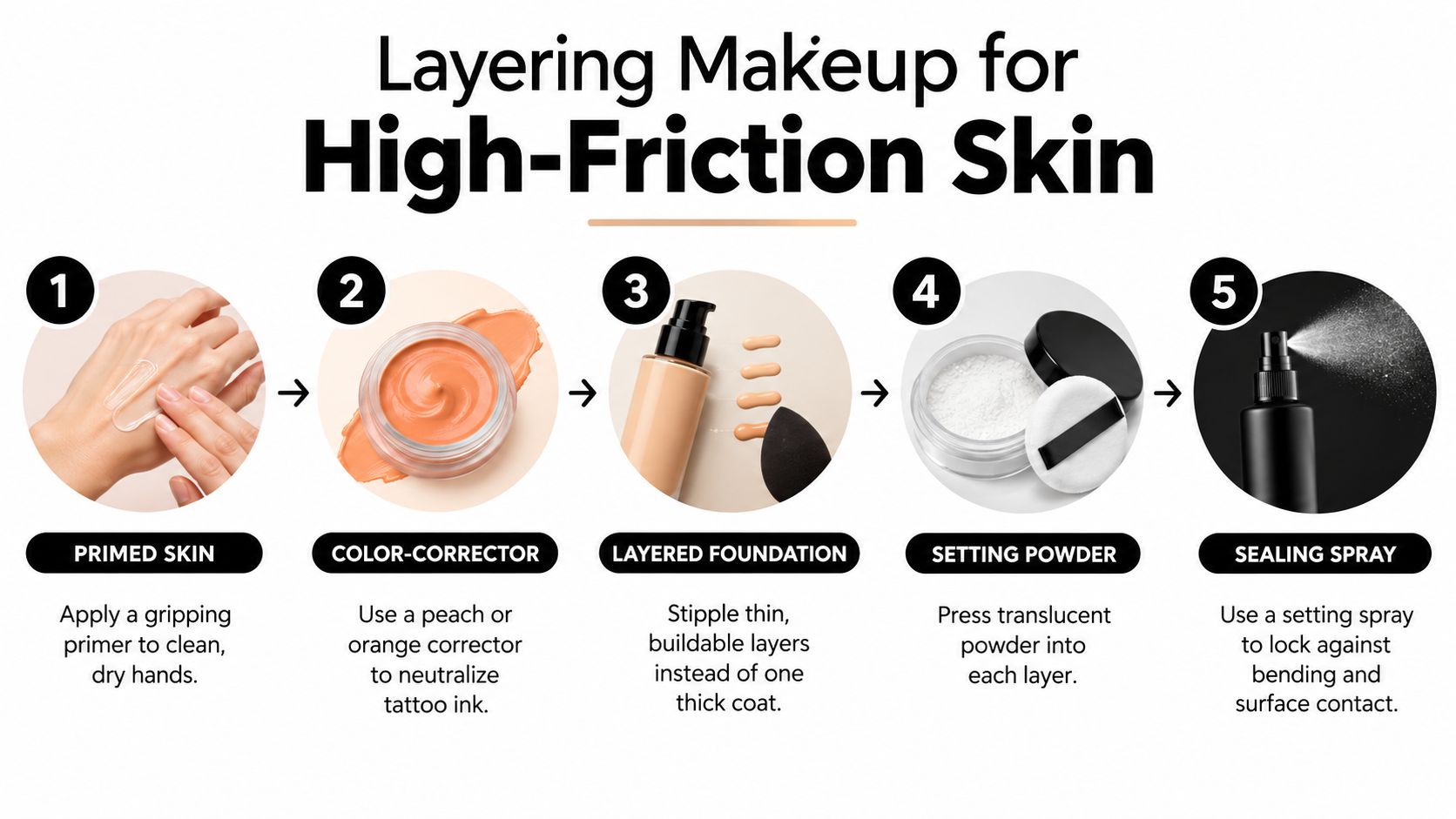
Prepare the surface
Start with clean, dry skin. Wash away oil, hand cream, and residue, then pat the area dry. Apply a light moisturizer only if the skin feels tight, and give it time to settle. A greasy surface makes makeup slide, while completely dry, flaky skin causes patchiness.
Press on a gripping primer rather than rubbing it around. Keep the layer thin, especially over knuckles and finger joints. Primer gives the corrective products something to hold onto, but it can't compensate for damp skin or excess skincare underneath.
Neutralize the ink
Look at the tattoo in natural light and identify its dominant tone. Dark blue or blue-black ink often needs an orange or red-orange corrector before a skin-colored product goes on top. A peach corrector may be enough for softer or lighter shadows, while deeper ink generally needs a stronger warm countertone.
Use a small synthetic brush or damp makeup sponge and tap the corrector over the tattoo. Don't rub. Rubbing moves pigment around the surface and can disturb the primer, leaving the edges darker than the center. Your aim is to soften the ink's color, not to create a finished skin tone at this stage.
Build coverage in controlled passes
Apply a full-coverage concealer in a thin layer, using a stippling motion. Let it dry before adding more. Follow with a skin-matched foundation, again tapping rather than dragging. Spray foundation can help create a lighter finish, and product guidance commonly recommends holding the spray about 6 to 8 inches away and using short spurts, as described in L'Oréal Paris' tattoo cover-up makeup guidance.
The important trade-off is opacity versus flexibility. One thick coat may hide more immediately, but it's more likely to crack when your hand bends. Several thin passes take longer and may require patience between layers, yet they move more naturally with the skin.
For fingers: Work around each side separately and keep the joints from becoming overloaded with product.
For the back of the hand: Use a broader damp sponge to soften the transition into your natural skin.
For dark outlines: Correct the darkest sections first instead of applying excessive foundation everywhere.
For knuckles: Bend and relax the hand while checking the finish, then remove excess product from the creases.
Set every layer
Press translucent powder into the makeup with a puff or small sponge. Brushing aggressively can lift the correction underneath. Powder matters because it reduces surface movement and helps prevent transfer when the hand touches fabric, paper, or furniture.
Finish with a fixing spray, using a light, even application. Let the surface dry completely before putting on a jacket, gloves, or jewelry. Carry a compact powder, small sponge, and the foundation or concealer used for the final layer. Touch-ups should be pressed on, not wiped across the tattoo.
Practical rule: Test the finished hand by typing, washing it carefully, opening a door, shaking hands, and bending your fingers before trusting it at an interview.
Makeup has a practical ceiling. Frequent washing, friction, sunlight, and natural skin turnover shorten wear time on the hands. If the coverage looks good only while your hand is still, it isn't ready for a full day.
Strategic Clothing and Accessory Barriers
Physical barriers often outperform makeup when the setting allows them. They don't depend on pigment staying attached to the skin, so they're less vulnerable to rubbing and hand washing. The challenge is social: a glove or unusual sleeve can attract more attention than a discreet tattoo if it looks out of place.
A dress shirt with a longer French cuff can cover part of the back of the hand while still looking deliberate. A blazer with sleeves that reach the wrist creates another layer, though it won't hide finger tattoos when your hands are active. Choose fabrics that stay in place instead of loose cuffs that slide back every time you move.
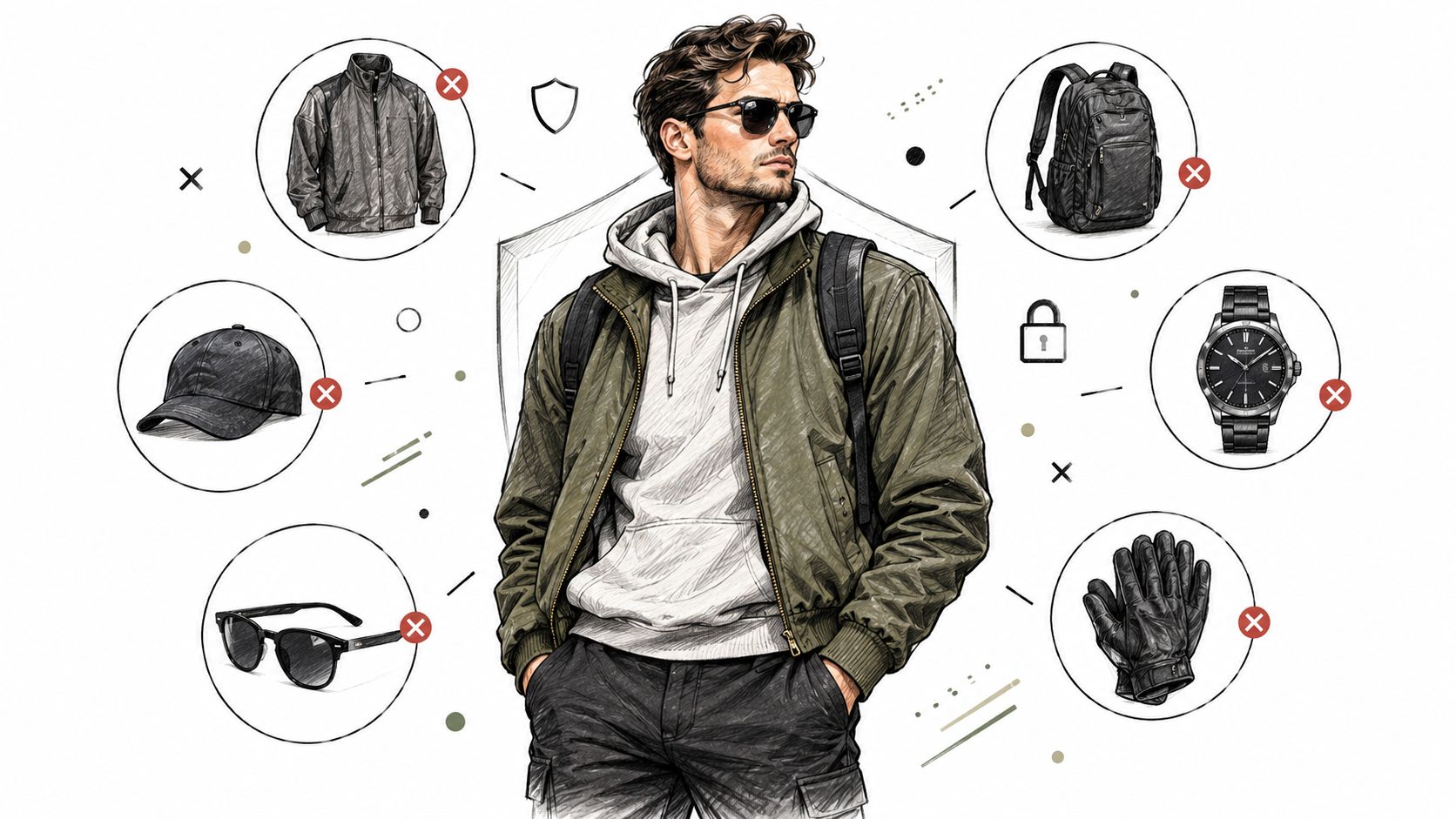
Compare the practical options
Option | Coverage | Main advantage | Main limitation |
|---|---|---|---|
Long cuffs | Partial to moderate | Looks natural in formal clothing | Exposes the hand during movement |
Tailored jacket sleeves | Partial | Polished and easy to integrate | Can't reliably hide fingers |
Lightweight gloves | High | Creates a consistent physical barrier | May look unusual indoors |
Opaque formal gloves | High | Suitable for some ceremonies and events | Less acceptable in many interviews |
Makeup under clothing | Adjustable | Covers exposed areas precisely | Can transfer and needs testing |
Gloves work best when the environment already makes them plausible. Formal evening wear, outdoor winter events, hospitality work, laboratory tasks, and certain performance settings may accommodate them. Thin, close-fitting gloves are less distracting than bulky athletic gloves, but they can still look conspicuous during a corporate interview.
Fingerless gloves rarely solve the problem. They may hide the back of the hand while leaving the tattooed fingers exposed, and the edge can draw attention directly to the area you're trying to minimize. Decorative rings and bracelets also have limited value. They can break up visual focus, but they won't conceal a tattoo reliably and may conflict with workplace expectations.
For an interview, clothing should look like normal professional clothing first. If you need to explain a glove, sleeve, or wrap before the meeting even begins, it may create more questions than it answers. A tested makeup layer under a conventional cuff can be the quieter choice, with clothing acting as backup rather than the only defense.
Navigating Fresh Ink and Healing Timelines
Fresh tattooed skin isn't a blank surface waiting for makeup. It's healing tissue that needs protection, and covering it with cosmetics or adhesive products too early can interfere with that process. A new hand tattoo is especially vulnerable because the area experiences repeated washing, stretching, friction, and contact throughout the day.
Don't use foundation, concealer, setting spray, or ordinary adhesive tape over a fresh tattoo unless your tattoo professional has specifically approved the product and timing. The safer priority is the aftercare routine provided by your artist. Keep the area clean according to those instructions, avoid unnecessary rubbing, and don't create a sealed, sweaty environment with improvised coverings.
What to do when work can't wait
If you've just had the tattoo done and an important event is approaching, contact the studio rather than improvising. Your artist can explain whether the existing protective dressing should remain in place, how to manage clothing contact, and which activities could compromise healing. For additional guidance on caring for colored work, use these color tattoo care instructions, while treating your own artist's directions as the primary reference for your specific tattoo.
The verified guidance on temporary concealment is clear about the boundary: fresh tattoos shouldn't be covered with makeup or adhesive products, and hand tattoos may need protective barriers during the first 1 to 2 weeks because the area is difficult to keep undisturbed. That doesn't mean every tattoo is ready for cosmetics at the same point. Healing varies with the tattoo's size, saturation, placement, skin response, and aftercare.
Do not conceal active healing. If the skin is still weeping, scabbing, peeling, tender, or unusually warm, treat it as healing skin rather than a cosmetic surface.
Wait until the tattoo is fully healed before testing corrective makeup. If you see persistent redness, spreading warmth, worsening pain, unusual discharge, or another concerning change, ask a healthcare professional for advice. Makeup can hide visual changes that should remain easy to monitor.
A formal event is temporary. Damaging a healing tattoo, irritating the skin, or delaying recovery creates a much longer problem. If the timing is impossible, wearing a clean, breathable barrier approved by your artist or explaining the situation is safer than forcing cosmetic coverage onto an unfinished healing process.
Permanent Transformations Through Cover-Ups and Laser
Temporary coverage makes sense when the need is occasional. If you're applying camouflage every week, changing your wardrobe around the tattoo, or worrying about transfer during every handshake, the recurring effort becomes part of the tattoo's real cost. At that point, the choice isn't just makeup versus removal. It's whether you want to manage visibility or change the underlying work.
A cover-up keeps you tattooed but replaces the existing visual problem with a new design. Hand cover-ups require careful planning because there's limited space, the skin moves constantly, and the original tattoo may remain visible through light colors or delicate linework. An artist may need a stronger silhouette, denser shading, darker values, or a design that uses the existing lines as part of the composition.
What an artist evaluates
Bring clear photographs and, ideally, show the tattoo in person. The artist needs to assess ink density, age, saturation, skin texture, finger placement, and how the design changes when the hand opens and closes. A floral arrangement, ornamental pattern, animal, or bold geometric composition may work in one case and fail in another.
A cover-up isn't a magic eraser. The new tattoo usually needs enough visual weight to compete with the old one, and that can limit style, color, and scale. Review guidance on covering black tattoos before a consultation so you understand why a light, fine-line concept may need modification.
For broader context, people also explore incision cover up tattoo options, where design decisions similarly depend on the underlying mark, skin condition, and the amount of visual coverage required. The anatomy differs, but the planning principle is the same: the artist designs around what already exists rather than pretending the original surface is empty.
Laser treatment takes a different route by lightening or removing pigment so the hand can remain uninked or accept a more flexible future design. It may involve multiple appointments, and hands and fingers require conservative assessment because pigment response, skin tone, sun exposure, and ink density affect the process. Pigment changes, incomplete clearing, and the need for later tattoo work are all topics to discuss with a qualified removal provider.
A studio consultation can compare both paths. The right question isn't “Can this disappear?” It's “Which result gives me the most workable appearance, timeline, and long-term flexibility?”
Choosing the Right Concealment Strategy
Start with the deadline, the setting, and the amount of hand contact involved. Makeup can suit a short interview or formal event if it has been tested under pressure. Frequent washing, gripping, and contact with equipment favor gloves, cuffs, or a workplace-policy discussion. A lasting change deserves an in-person consultation, not a rushed decision based on an online photograph.
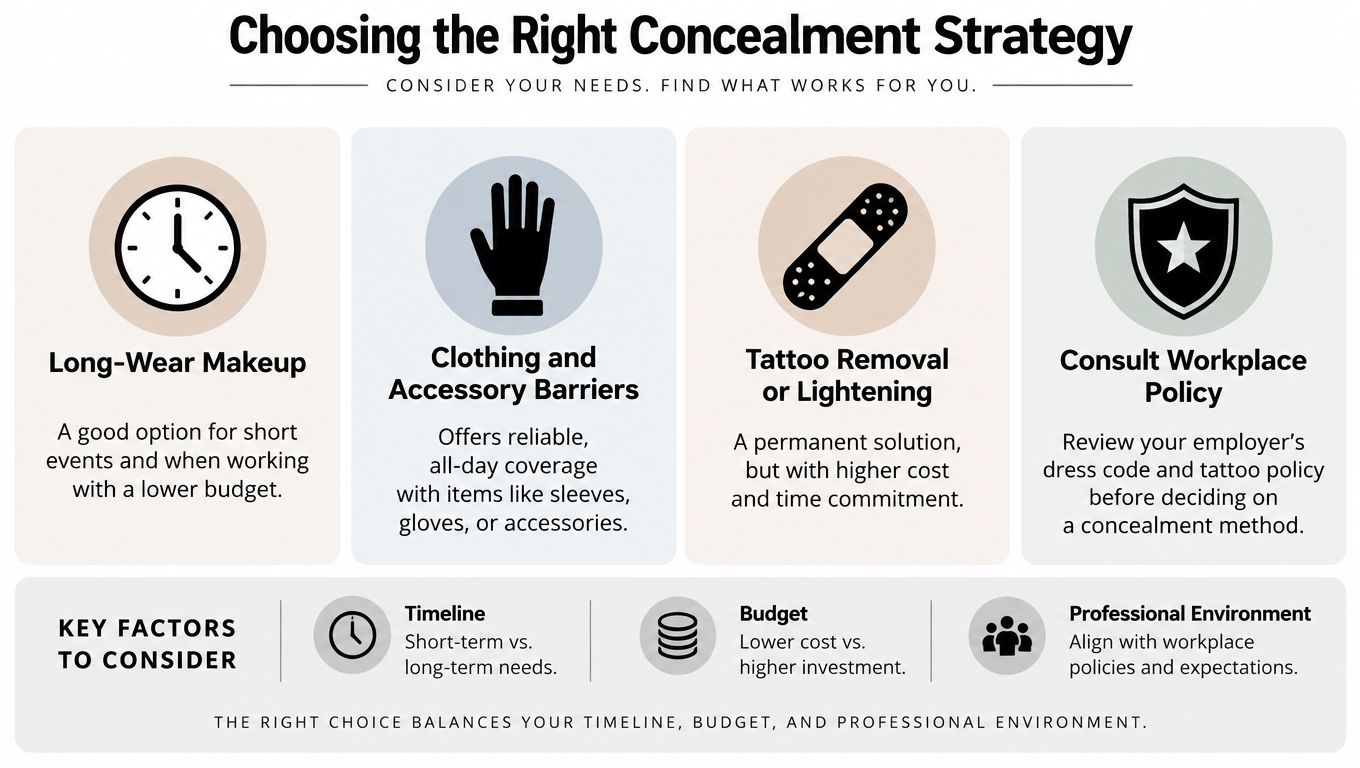
Use a real-world durability test
Apply the complete makeup system early enough to remove it without rushing. Measure how it handles the friction your day will create:
Track transfer: Wear the planned sleeves, cuffs, or gloves and check your phone, paperwork, and fabric after several hours.
Measure wash resistance: After three careful hand washes, record whether pigment transfers, edges separate, or the tattoo becomes visible.
Check workday wear: Compare French cuffs and gloves during an eight-hour schedule, including repeated gripping and hand contact.
Inspect high-friction areas: Examine knuckles, finger joints, and creases with your hand open and closed.
Pack a repair kit: Carry the same powder, sponge, and finishing product used during testing.
Choose clothing when makeup cracks, transfers, or requires repeated attention. Choose a permanent consultation when concealment has become a recurring obligation. For cover-up planning in Denver, Think Tank Tattoo offers consultations to assess existing pigment, design direction, placement, and timing.
Keep cosmetics away from fresh ink. Discuss skin condition and existing pigment before booking laser or a cover-up. Match the method to the pressure involved, whether that means one meeting, a full workday, or a long-term change in how your hands look.
Think Tank Tattoo provides cover-up consultations, design planning, and varied tattoo styles in a Denver studio. Visit Think Tank Tattoo to discuss a cover-up, a new design direction, or a referral for lightening.
Comments