
Custom Polynesian Tattoo Design: A Respectful Guide
A first-time client often arrives with a folder full of screenshots and a simple request: “I want a Polynesian sleeve, but I'm not sure what the symbols mean.” The reference images may look compatible on a phone screen while coming from different cultural traditions, regions, and systems of meaning. That uncertainty isn't a problem. It's the reason a thoughtful consultation starts with questions before it starts with lines.
A meaningful custom Polynesian tattoo design asks you to make three decisions. First, which cultural tradition are you referencing? Second, what should the piece communicate, and which visual language can express that story responsibly? Third, how will the design follow the body and remain readable as the skin heals and ages? A strong artist won't treat the consultation as a sizing appointment. They'll treat it as a conversation about culture, narrative, anatomy, and long-term care.
Table of Contents
What Custom Polynesian Tattoo Design Actually Means - Custom means translation, not resizing
Why Polynesian Is Not One Style - Choose the anchor before the imagery
Designing With Cultural Literacy First - Build the brief in seven conversations
Reading the Body Before Drawing the Line - Let anatomy direct the structure - Preserve negative space
What a Real Consultation Should Cover - Questions worth asking in the room
Respect Means Knowing the Limits of Custom - Narrowing the brief can improve the tattoo
Walking Into the Studio With a Polynesian Idea
Alex steps into a Denver studio carrying a Pinterest board labeled “Polynesian sleeve.” The first image shows a bold Marquesan back piece. The second is a detail associated with Māori facial tattooing. The third features a Tahitian sea-creature motif. Alex likes the contrast of black geometry and open skin, but hasn't considered whether those references belong together.
The artist doesn't begin by asking how large the sleeve should be. They ask what family lineage Alex has, what personal story the tattoo should carry, and where Alex expects it to sit on the body. Alex has answers about appearance, but not yet about cultural reference, personal meaning, or placement.
That gap is common, and it changes the nature of the project. “Polynesian” names a broad cultural region, not one interchangeable pattern library. A design that draws from Samoan tatau shouldn't automatically borrow a motif from another island tradition just because the shapes look compatible. Traditional Polynesian tattooing developed through structured cultural systems that could communicate identity, social position, lineage, achievement, and obligations to family or community. The University of Utah's overview of tatau describes Samoan tattooing as an Indigenous art form with a continuous history extending back roughly 2,000 years.
The first design decision isn't the motif. It's the cultural language in which the motif will speak.
A responsible consultation therefore moves in sequence. You learn the historical foundation, identify the regional tradition, build a brief around your actual story, map the design across your anatomy, and plan the sessions and healing requirements. By the time the artist draws, you should understand not only what the tattoo may look like, but why its structure belongs on your body.
What Custom Polynesian Tattoo Design Actually Means
Polynesian tattooing is best understood as a cultural communication system, not a catalog of attractive black shapes. Samoan tatau offers a clear example. Its continuous history reaches back roughly 2,000 years, and scholarship reviewed by Pacific Affairs on Samoan tattoo history examines a tradition extending across approximately 3,000 years of cultural development.
Traditional tattoos could carry information about identity, lineage, status, achievements, family relationships, and obligations. The Pitt Rivers Museum describes tattoos as treasured family and cultural inheritances, applied ceremonially by revered master artists and associated with mana, or life force. The museum's account of Polynesian tattooing tools and traditions also places these practices within a wider history of cultural continuity, suppression, and revival.
Custom means translation, not resizing
A client brings the story. The artist helps identify a culturally appropriate visual vocabulary, then builds a composition that fits the body. That process is closer to translation than to copying. The design has to preserve the relationship between its parts, rather than treating each recognizable mark as an independent icon with a universal definition.
You may have seen terms for figures, teeth, waves, animals, or directional forms in online guides. Those labels can be useful starting points, but they don't create a fixed meaning that applies everywhere. A symbol's significance can change according to regional tradition, placement, relationship, ceremony, and the person who carries it.
A Pinterest image can show you a visual quality, such as dense geometry or strong negative space. It can't provide the cultural authority or personal context needed to turn that image into your tattoo. Asking an artist to enlarge or reproduce it may produce a polished result, but the finished piece can still lack a defensible reason for its structure.
For a meaningful project, prepare a narrative before choosing icons. Describe the people, responsibilities, places, transitions, or values you want the tattoo to acknowledge. Let the artist explain which elements can be adapted and which references require more care.
Why Polynesian Is Not One Style
A client enters the studio with a screenshot labelled “Polynesian.” Before discussing motifs, the artist needs to ask a more precise question: which Polynesian tradition should guide the work? The broad label identifies a region, much as “European art” identifies a continent, but it does not specify the history, visual grammar, or cultural protocol behind a design.
Samoan tatau, Māori tā moko, Marquesan tattooing, and Tahitian tattooing share a wider Polynesian history, yet they are not interchangeable. Their structures, settings, and relationships to identity differ. The academic discussion of tattooing as a system of identity, sacredness, hierarchy, and belonging reinforces a practical point for clients: visual resemblance does not erase cultural specificity.
Tradition | Line and shape style | Typical placement | Cultural focus |
|---|---|---|---|
Samoan | Repeated zones, bands, and geometric arrangements | Large connected areas of the body | Identity, family, social obligations, ceremony, and inherited cultural practice |
Māori | A distinct visual language shaped by personal and cultural context | Placement-specific work, including facial and body areas | Genealogy, identity, relationships, and social belonging |
Marquesan | Bold geometric organization and carefully separated zones | Large body compositions and connected areas | Social identity, relationships, ritual context, and regional heritage |
Tahitian | Structured patterning with Pacific imagery and regional variation | Body areas organized as a larger composition | Identity, community, place, and historical island traditions |
Use this table as a starting map, not a symbolism dictionary. A Samoan design does not always have the same density, and a Māori piece does not follow one universal formula. The table helps establish the regional question before an artist chooses motifs, spacing, or repeated geometry.
Choose the anchor before the imagery
Name the regional anchor first. You might tell an artist, “I'm researching Samoan tatau,” or, “I'm interested in a Māori-inspired approach, but I don't have Māori ancestry.” That information gives the consultation an ethical and creative starting point.
Historical contact also shaped how Polynesian tattooing became known outside the Pacific. European observers encountered Tahitian tattooing during late eighteenth-century Pacific voyages, and the Pitt Rivers Museum identifies Captain Cook's reports from Tahiti as a major transmission point to Europe. By the 1830s, the museum reports that most British ports had at least one professional tattoo artist. Global visibility made these visual forms more familiar, not generic or ownerless.
A regional anchor also affects technical planning. Bands, negative space, repeated zones, and directional lines must suit the body area, its movement, and the way healed skin will hold contrast. The same pattern can read clearly on a broad connected surface and become crowded when compressed around a joint.
Specificity gives the project a responsible foundation. If you cannot name the tradition, pause before collecting more screenshots. Research its history, ask the artist what can be adapted, and describe the final brief as culturally specific or Polynesian-inspired.
Designing With Cultural Literacy First
A respectful design brief should be complete before line work begins. It needs to tell the artist what tradition you're referencing, what the tattoo should communicate, and where the composition will live. It should also make room for limits, uncertainty, and advice that may change your original idea.
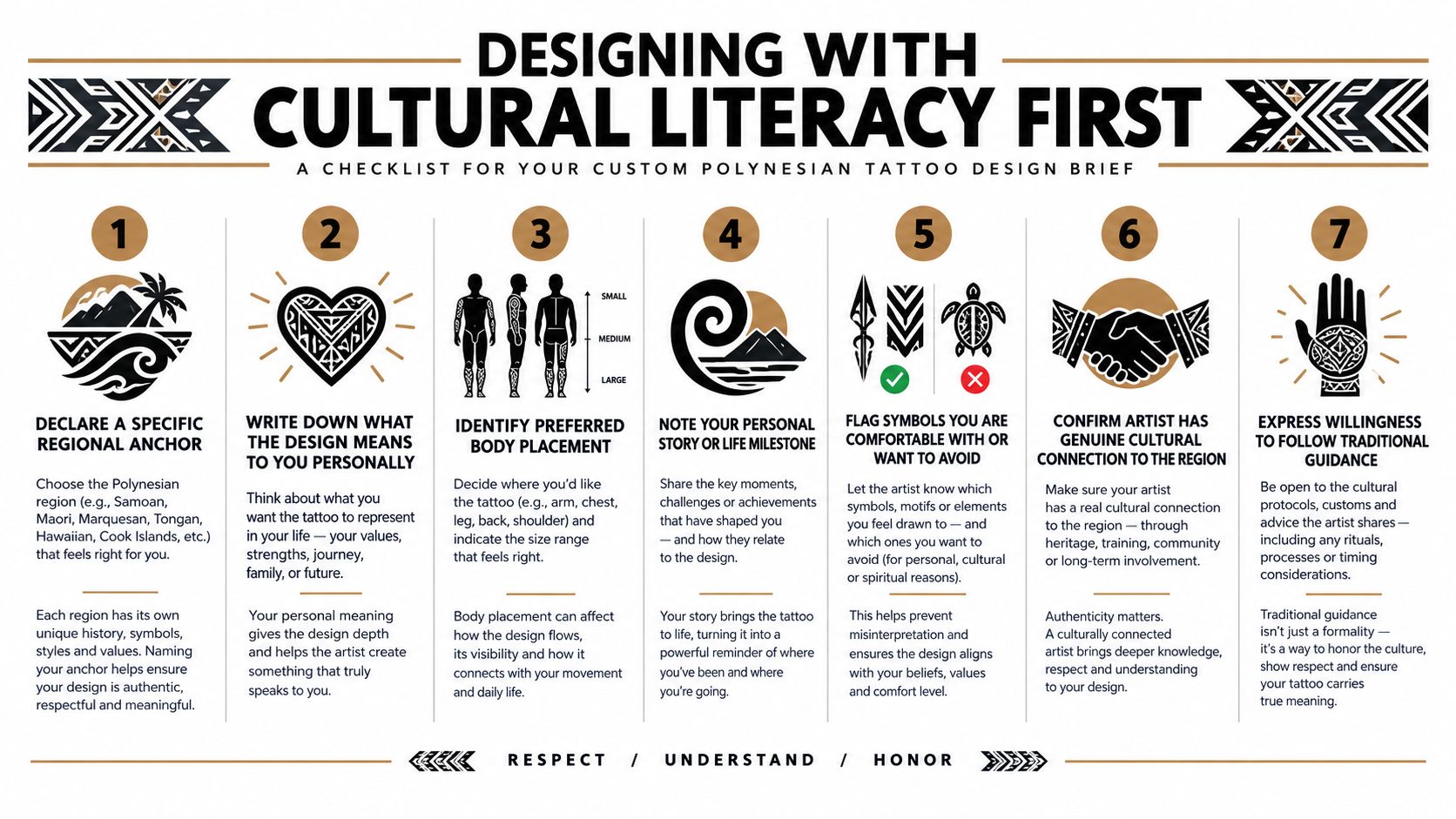
Build the brief in seven conversations
Declare a regional anchor. Identify whether your reference is Samoan, Māori, Marquesan, Tahitian, or another tradition. Don't leave the artist to combine several regions by default.
Write the personal meaning plainly. Explain the people, place, responsibility, transition, or value behind the tattoo. “I like shark teeth” isn't the same as a story the artist can responsibly translate.
Name the body placement. A shoulder, chest, back, upper arm, thigh, and calf offer different surfaces and movement patterns. Placement is part of the design language, not an empty frame.
Describe the life context. Include the milestone or relationship that prompted the tattoo, without forcing it into a symbol before the artist understands it.
List elements you welcome or want to avoid. This can include animals, figures, dense black fields, or motifs whose cultural status you haven't confirmed.
Ask about the artist's relationship to the tradition. A portfolio should show more than generic tribal geometry. Ask how the artist researches regional references and when they seek cultural guidance.
Accept correction as part of consent. A knowledgeable artist may recommend removing a motif, changing a placement, or describing the finished piece as inspired rather than traditional.
You can also review broader Pacific references through this guide to tattoos from Hawaii, while remembering that Hawaiian, Samoan, Māori, Marquesan, Tahitian, and other traditions shouldn't be collapsed into one vocabulary.
The brief protects both sides. It prevents the artist from inventing a symbolic story after the drawing is finished, and it gives you a clear basis for approving or rejecting a design. If the artist can't explain why a major element belongs in the composition, the element may be decorative filler rather than meaningful translation.
Reading the Body Before Drawing the Line
A Polynesian composition has to work in motion. The shoulder rotates, the chest expands, the abdomen changes shape, and the calf narrows toward the ankle. An artist who treats the body as a flat canvas may produce clean artwork that loses its rhythm when you stand, walk, or bend.
Let anatomy direct the structure
A shoulder cap can support a strong directional form that follows the deltoid rather than cutting across it. A chest or stomach design needs enough flexibility to remain coherent as the body expands and contracts. Long, relatively uninterrupted planes such as the thigh or calf can support flowing bands, repeated geometric units, or directional movement, provided the pattern follows the leg instead of wrapping without a plan.
A back piece offers a broad field for a connected composition. A sleeve demands more sequencing because the artist must preserve continuity around the arm while leaving usable transitions at the elbow, wrist, and underarm. The discussion of large-scale tattoo healing and pigment retention explains why dense work requires attention to inflammation, healing, and the long-term separation of black areas.
Placement | Motif fit | Healing and design risk |
|---|---|---|
Shoulder | Bold directional shapes that follow the cap | Curvature can compress horizontal bands |
Chest | Connected forms with room for expansion | Breathing and movement can distort rigid lines |
Back | Broad, layered composition with clear transitions | Large surface area may require careful session planning |
Thigh | Long flows, bands, and repeated units | Friction and clothing can complicate healing |
Calf | Vertical movement and tapered geometry | The narrowing surface can crowd dense details |
Sleeve | Linked zones that respect joints | Poor sequencing can interrupt the visual rhythm |
Preserve negative space
Bold black geometry needs breathing room. Narrow gaps can close visually as swelling resolves, pigment settles, or adjacent fields soften. Strategically sized channels of untouched skin help separate motifs and keep the composition legible after the fresh contrast fades.
The artist should map repeated elements on a body diagram and decide where transitions occur before the first session. Large projects may need multiple sittings, especially when surface area or saturation makes prolonged trauma impractical. The skin that heals is the skin your design must serve, not the temporarily swollen surface seen on appointment day.
For more ideas about how a large composition can use the back, review Polynesian back piece tattoo designs, then ask the artist to adapt the principles to your anatomy rather than copying an example.
What a Real Consultation Should Cover
A serious consultation covers more than an image folder and a price. You should leave with a clearer cultural brief, a realistic placement plan, an understanding of the artist's process, and enough aftercare information to decide whether the project fits your schedule.
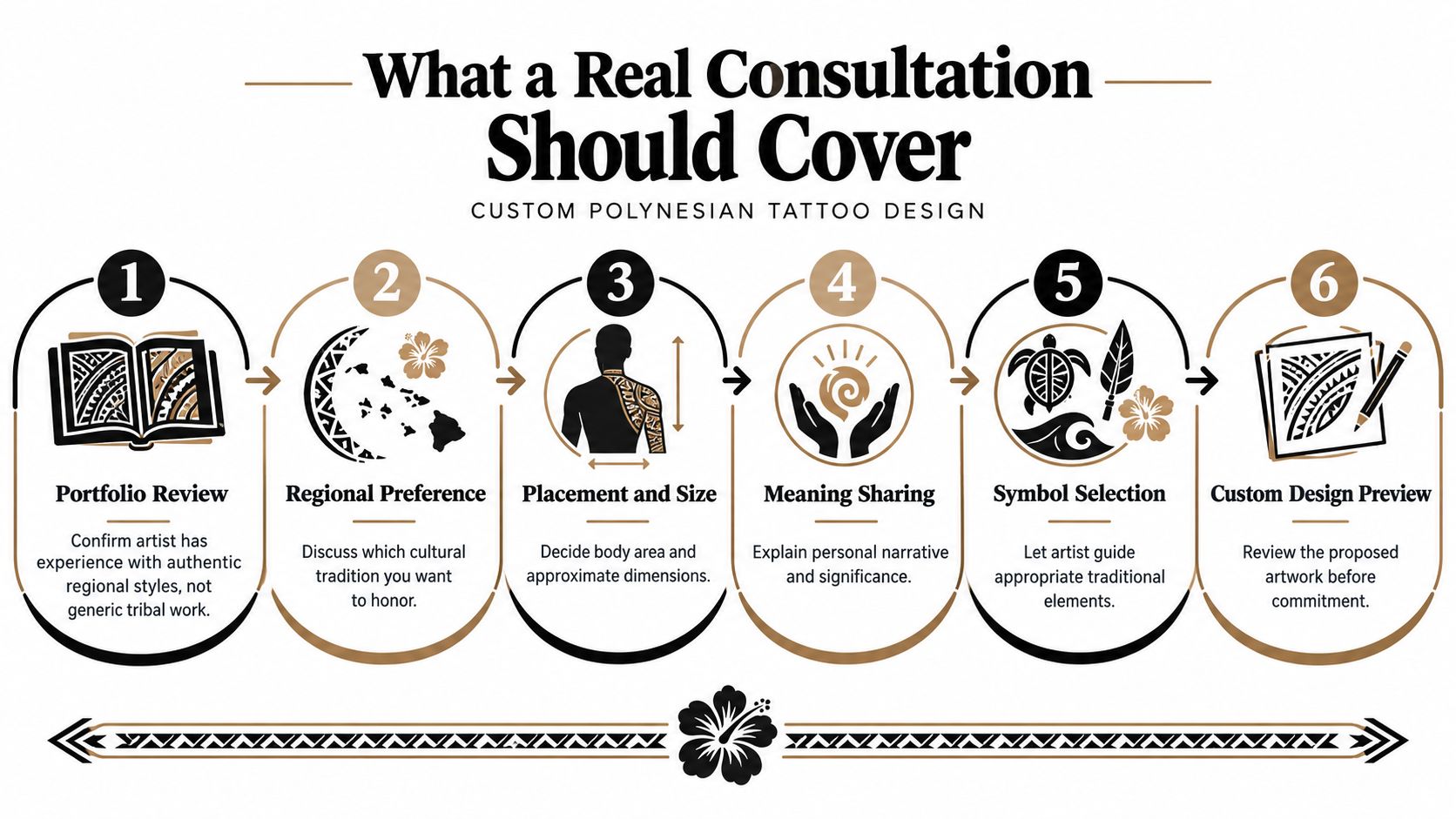
Questions worth asking in the room
Portfolio review comes first. Look for large compositions, controlled line weight, intentional negative space, and designs that wrap naturally around bodies. Ask whether the artist has experience with the specific regional tradition you named, rather than accepting a portfolio made entirely of generalized black geometry.
Then discuss the story without leading with a motif list. Explain what you want the tattoo to acknowledge, where it will sit, how visible it should be, and whether you have a direct cultural connection, family connection, informed allyship, or just an appreciation for the aesthetic.
A useful consultation also covers:
Design development: Ask how the artist moves from your narrative to a regional brief, sketch, and body-specific composition.
Scheduling: Confirm how many sessions may be appropriate, how much time should separate them, and what happens if healing takes longer than expected.
Deposits and shop policies: Request the studio's current deposit, minimum, cancellation, and rescheduling terms in writing. Policies vary, so don't rely on assumptions.
Aftercare: Ask for washing, moisturizing, clothing, exercise, sun, and water guidance that fits a large, densely packed piece.
Revisions and touch-ups: Clarify when changes can be made, how healed work is assessed, and whether touch-ups have separate conditions.
Cultural verification: Ask what the artist will do if a motif or placement needs review by a knowledgeable cultural practitioner or researcher.
The Mayo Clinic guidance on tattoo safety and aftercare recommends gentle washing and moisturizing, avoiding direct sun, and avoiding pools, hot tubs, lakes, rivers, and other soaking while a tattoo heals. It also identifies worsening redness, swelling, tenderness, pain, or discharge as reasons to seek medical advice.
Think Tank Tattoo offers complimentary consultations for discussing custom concepts, placement, timing, and artist fit, with custom design review and stencil preparation included in its process. Treat that kind of meeting as a two-way evaluation. You're assessing the studio's communication and cultural care just as the artist is assessing whether the project can be designed responsibly.
Respect Means Knowing the Limits of Custom
“Custom” doesn't mean every recognizable motif is available for unrestricted remixing. It means the artist develops a piece for a particular person, body, and story within an agreed visual and cultural framework.
A client may want to combine waves, spearheads, animal forms, human figures, and dense geometric fields because each looks appealing in isolation. The combination can still create a false impression if the elements come from different traditions or if their original contexts relate to status, lineage, ceremony, or restricted identity. Research on Pacific iconography notes that moving designs outside Pacific communities can change how those designs are received and how they mediate social relationships. The research on Pacific tattoo symbolism and cultural transfer supports a more careful approach than a universal list of meanings.
Narrowing the brief can improve the tattoo
A responsible artist might recommend fewer symbols, a different placement, or a more original pattern language. They may also tell you that the finished work should be described as Polynesian-inspired, not as a traditional tatau. That isn't a failure of customization. It's an honest description of what the design is and what it isn't.
Consult a knowledgeable cultural practitioner or researcher when:
The reference is lineage-specific. You want a design associated with family, community, rank, initiation, or ancestry that you don't personally hold.
The artist can't verify a motif. A confident explanation isn't a substitute for cultural knowledge.
Several traditions are being mixed. Ask whether the combination is meaningful or merely visually convenient.
The placement carries context. Don't assume that moving a motif to another body area preserves its original significance.
Your story is mostly aesthetic. You may be better served by an original geometric design informed by broad Pacific visual qualities than by borrowing ceremonial iconography.
You can explore floral references in this discussion of Polynesian flower tattoos, but treat any motif article as a prompt for questions, not permission to assign a universal meaning.
The most respectful custom work may be smaller, narrower, and more thoroughly researched than your first idea. Discipline gives the final design credibility.
A Practical Plan Before You Sit Down
Bring a short written plan to the consultation. Start with regional research, then define your personal narrative before opening Pinterest again. Save reference images for line quality, density, scale, and composition, not as templates to reproduce.
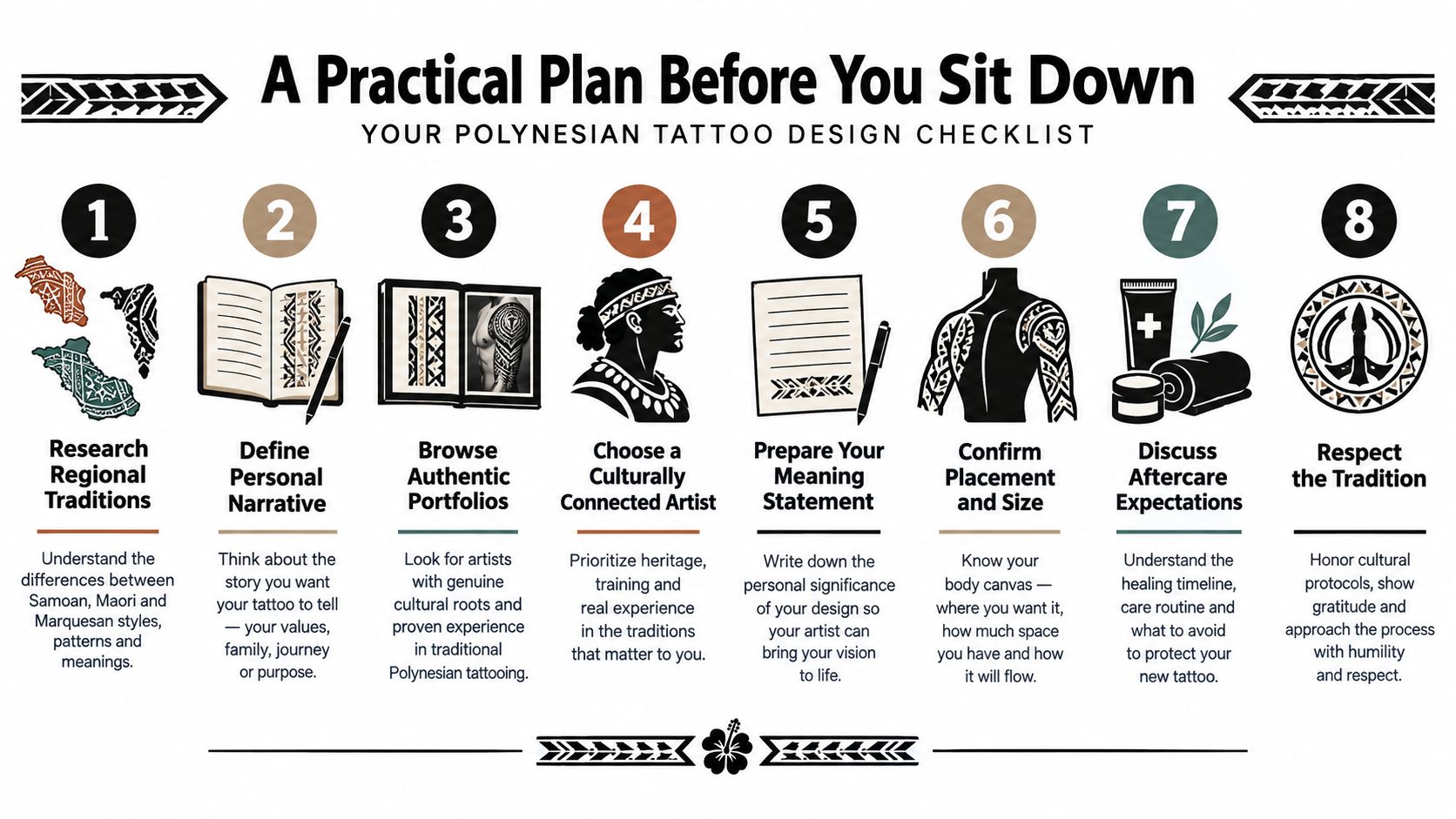
Use this sequence:
Research the regional tradition. Compare Samoan, Māori, Marquesan, Tahitian, and other references without assuming they share one symbolism system.
Write a meaning statement. Describe the people, values, place, or life passage the tattoo should carry.
Choose three to five essential visual ideas. Keep them broad until the artist confirms that they fit the chosen tradition.
List exclusions. Flag motifs, placements, or status-related references you don't want to borrow without guidance.
Check the artist's portfolio. Look for the specific regional language, body flow, line control, and healed-work evidence relevant to your project.
Photograph the placement in motion. Take reference photos while standing, sitting, bending, and rotating so the artist can anticipate distortion.
Plan the healing logistics. Ask about session spacing, work friction, exercise, travel, swimming, sun exposure, and the products the studio recommends.
Agree on the language of the finished piece. Decide whether the project will be presented as culturally specific, adapted, or Polynesian-inspired.
A custom design should also account for skin health. Tell the artist about keloids, hypertrophic scarring, unusual wound healing, allergies, immune problems, or any current skin damage before booking. If the skin is irritated or infected, postpone the session and seek medical guidance when needed.
For a visual reminder of the planning sequence, use this checklist before your consultation:
You can also watch this practical overview before meeting an artist:
The strongest custom Polynesian pieces feel inevitable because every decision supports the next one. The regional reference informs the motifs, the story informs the composition, the anatomy informs the geometry, and the healing plan protects the result.
If you're planning a custom Polynesian tattoo in Denver, Think Tank Tattoo offers complimentary consultations to discuss your regional direction, story, placement, timing, and artist fit. Bring your questions and reference images to Think Tank Tattoo, and start with a conversation that gives cultural respect and long-term wearability equal weight.
Comments