
7 Polynesian Back Piece Tattoo Designs
What makes a Polynesian back piece meaningful, a striking collection of familiar symbols, or a connected story designed for one specific body? The difference is planning. Polynesian back piece tattoo designs work best when the focal point, spine, shoulders, negative space, motif rhythm, and personal narrative are resolved together rather than assembled from a generic gallery.
The seven concepts below treat each back piece as a full composition. You'll see how a central tiki, ocean movement, geometric pattern, floral structure, or ancestral cross changes the way an artist plans the entire back. You'll also find practical guidance on session pacing, healing, readability, and artist selection. Polynesian tattooing isn't one uniform style, so Samoan, Māori, Hawaiian, Tahitian, Tongan, and Marquesan traditions shouldn't be mixed casually. Meanings and appropriate adaptations vary, and culturally knowledgeable practitioners should help verify whether a symbol fits your story. If you're considering a custom design in Hawaii, review the consultation approach described when you book Aloha Tattoo Waikiki.
Table of Contents
1. Full-Spine Tiki Face and Genealogy Design - Build the story before the pattern
2. Tribal Wave and Ocean Motif Back Piece - Control movement with negative space
3. Pe'a and Traditional Samoan Geometric Back Piece - Plan solid fill around the body
4. Māori Moko Full-Back Pattern Design - Use consultation to test interpretation
5. Hawaiian Turtle and Island Landscape Back Piece - Let the landscape support the honu
6. Tongan Kakala and Fafine Female Traditional Back Piece - Keep delicacy structurally sound
7. Marquesian Cross and Ancestral Symbols Full Back Piece - Treat enata as narrative elements
1. Full-Spine Tiki Face and Genealogy Design
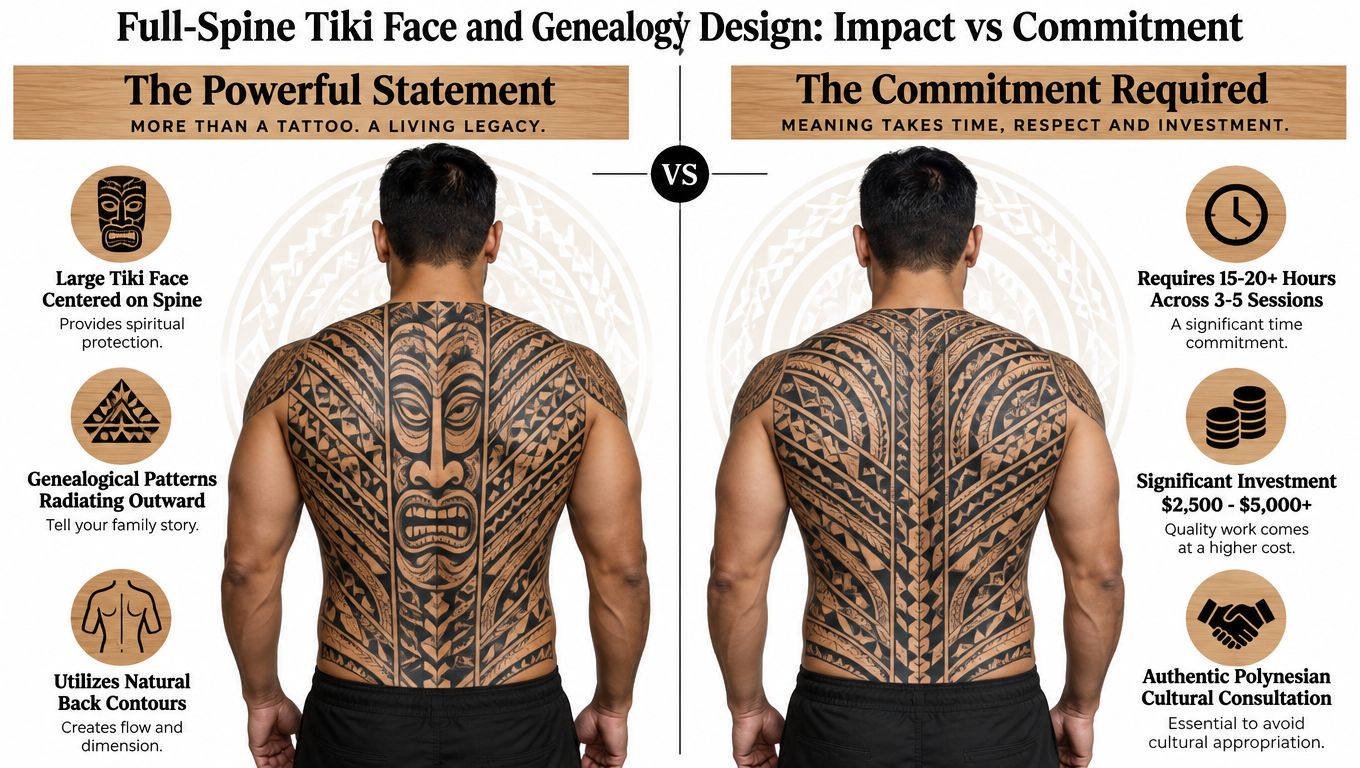
A full-spine tiki design gives the back an unmistakable visual anchor. Place the face along the vertebral line, then let family references, repeated geometric bands, and protective elements expand toward the shoulder blades and lower back. The result can feel monumental without becoming a crowded symbol catalogue, provided each section supports the central narrative.
Traditional Polynesian tattooing functioned as more than decoration. In oral cultures without writing, tattoos encoded identity, genealogy, social rank, sexual maturity, and major life milestones, according to this documented history of Polynesian tattoo meanings and traditional designs. That makes genealogy-led planning especially important. A family story should shape the composition, not appear as an afterthought beside a tiki face.
Build the story before the pattern
Bring family symbols, photographs, ancestry notes, and stories about guardianship, migration, achievement, or important transitions to the consultation. A detailed consultation at Think Tank Tattoo can help translate those references into a design that follows the natural width of the back without forcing every idea into the same visual weight.
A Samoan-inspired piece might use pe'a-influenced bands, while a Hawaiian narrative could draw from family connections to an ‘aumākua. Māori moko patterns belong to a different cultural framework and shouldn't be treated as interchangeable decoration. The artist needs to know which tradition informs the design before drawing begins.
Practical rule: The spine is an axis, not a storage line. Every motif beside it should help the eye travel through the story.
Plan the design on-body in multiple postures. Symmetry can strengthen a protective, formal composition, but perfect mirroring may make the back feel rigid. Leave controlled negative space around the tiki, across the shoulder blades, and between major bands so the focal face remains readable as the tattoo ages. Large Polynesian back compositions commonly require about 6 to 10 sessions and roughly 30 to 60 total tattooing hours, based on full-back placement guidance. Allow the project to develop gradually rather than rushing dense blackwork into one appointment.
2. Tribal Wave and Ocean Motif Back Piece
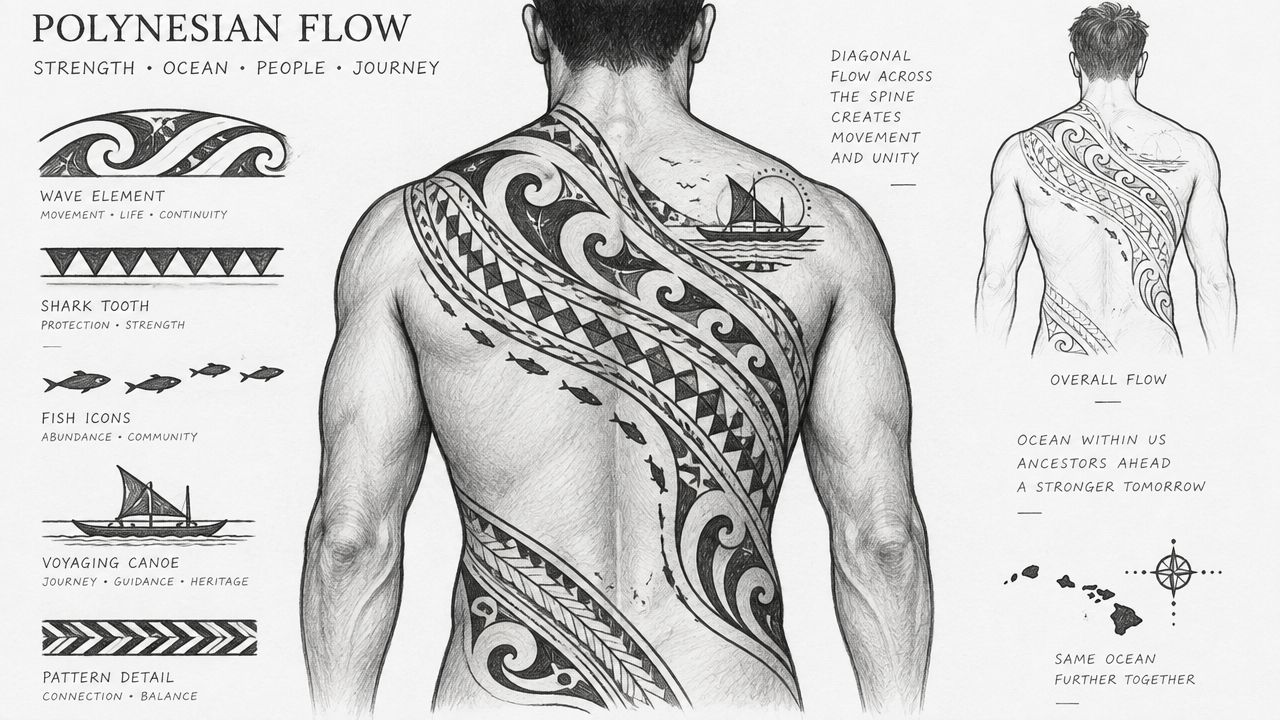
Ocean movement can give a full back piece more energy than a static central emblem. Instead of placing isolated waves, design diagonal currents that begin near one shoulder, cross the back with deliberate changes in density, and return toward the opposite hip or lower back. Fish, shark teeth, turtles, canoe references, or navigation elements should reinforce the direction of travel.
This concept works particularly well for someone whose relationship with the ocean is specific. A surfer, diver, sailor, or person raised around voyaging traditions may have a stronger foundation for the design than someone choosing wave patterns only because they look dynamic. The artist can then decide whether the ocean reads as a broad background field, a border system, or the main narrative structure.
Control movement with negative space
Wave motifs can easily become visually noisy. Ask the artist to show how open skin will separate the larger currents from smaller fills, especially around the spine and shoulder blades. A dense pattern may look powerful in a flat reference image but lose its rhythm when the shoulders rotate and the skin stretches.
Choose the main direction: Decide whether the flow should feel ascending, descending, circular, or balanced across the spine.
Set the density early: Compare a high-contrast version with a more open layout before committing to extensive fill.
Tie symbols to experience: Use canoe, fish, turtle, or shark elements only when their presence supports the personal story and chosen cultural tradition.
Test the body flow: Review the stencil standing, seated, and with the arms raised.
The historical connection between tattoo and voyaging is worth discussing with an experienced practitioner. Polynesian tattooing used handmade tools including bone, turtleshell, seashell, shark teeth, and wooden mallets, and the process held ceremonial and social importance, as described in this background on Polynesian tattooing. Contemporary work uses modern equipment, but the cultural context still matters.
A flow-based artist should refine line placement before filling secondary motifs. Full-back work is often spaced four to six weeks or longer between sessions, while surface healing commonly takes two to four weeks, according to back-piece placement and healing guidance. Wear loose, breathable clothing during recovery, keep fabric from sticking to the tattoo, and follow the artist's aftercare instructions rather than improvising.
The video below can help you compare how oceanic shapes and repeated bands create movement before your consultation.
3. Pe'a and Traditional Samoan Geometric Back Piece
A Samoan geometric back piece depends on discipline. Bold bands, repeated shapes, and carefully managed black fields can create a strong architectural structure, but the design loses credibility when an artist treats pe'a-inspired patterning as generic tribal filler. The first question isn't which pattern looks impressive. It's whether the chosen visual language belongs to a tradition you can discuss responsibly.
For someone with Samoan heritage, family history should guide the consultation. Research your family's tattooing background, speak with relatives, and bring stories rather than relying only on online flash. A contemporary Samoan-American design may incorporate personal references, but adaptation should preserve the logic and dignity of the source tradition.
Plan solid fill around the body
Large black areas behave differently from open linework. They can intensify sensation, make healing more demanding, and dominate the back if negative space isn't planned carefully. The artist should map how bands pass over the spine, wrap around the shoulder blades, and stop or continue toward future sleeves.
A traditional Samoan practitioner or an artist with demonstrated experience in Samoan pattern systems is the right starting point. A general tribal portfolio isn't enough. Look for consistent spacing, clean transitions, and examples photographed on moving bodies, not only flat digital sketches.
A strong geometric composition leaves the eye somewhere to rest. More black doesn't automatically create more impact.
The number of sessions depends on coverage, skin response, and the artist's process. Don't accept an aggressive schedule because you want the project finished quickly. The guidance on Polynesian tattoo placement and recovery explains why broad work needs careful pacing, with deeper tissue recovery continuing after the surface appears healed.
Discuss personal meaning, pattern boundaries, aftercare, and future additions during the consultation. Think Tank Tattoo's guide to Polynesian tattoo designs for women also reinforces the importance of treating the back as a placement with its own flow and proportion, rather than enlarging a small design without revision.
4. Māori Moko Full-Back Pattern Design
A Māori-inspired full-back pattern should never be reduced to a collection of attractive koru spirals. Tā moko carries connections to identity, ancestry, rank, and lineage, and the meaning of facial moko cannot be transferred to another body area as though the placement has no cultural consequence. If Māori ancestry isn't part of your story, ask the artist what respectful adaptation means before requesting a moko-derived composition.
The back can support a large, highly structured narrative, with spirals, curved lines, and genealogy-informed pathways moving from the upper back toward the pelvis. It needs more than fine detail. The artist must design a hierarchy so the major channels remain visible from a distance while smaller marks reward closer viewing.
Use consultation to test interpretation
Bring evidence that you've researched the cultural framework, not just saved reference images. Discuss family connections, the parts of the story you want represented, and whether a Māori artist or culturally connected practitioner should guide the work. An artist who knows detailed Māori-inspired design should be able to explain how the composition will differ from a generic Polynesian pattern.
The central trade-off is between intricate detail and long-term readability. Fine lines and closely packed channels may look intricate in the first months, yet they need enough breathing room to remain distinct as the tattoo settles. Plan the spine, shoulder blades, and lower back as separate zones that still connect into one visual system.
You can also review Think Tank Tattoo's perspective on geometric back tattoos when comparing structured layouts, but the cultural interpretation must come from the appropriate practitioner, not from geometry alone.
Consultation question: Which elements are genuinely personal, which belong to a specific Māori tradition, and which should be left out?
A full-back composition can become a long project. Discuss the order of work, healing intervals, line-weight choices, and how the design will connect to future shoulder or sleeve pieces. Don't approve the stencil until the artist has shown how the pattern looks while you stand naturally, move your arms, and sit.
5. Hawaiian Turtle and Island Landscape Back Piece
A Hawaiian honu design gives you a clear focal point, but the surroundings around it determines whether the piece feels coherent or overloaded. A turtle can sit between the shoulder blades, occupy the lower back, or travel diagonally through an ocean scene. Each option changes how the mountains, palms, volcanic terrain, and geometric borders frame the body.
Realism and traditional blackwork create very different commitments. A realistic honu with water, light, and island scenery needs careful value control, while a traditional approach relies more heavily on shape, repetition, and negative space. A hybrid can work, but the artist must decide which language leads. Mixing a highly realistic turtle with unrelated dense tribal panels often produces a visual conflict rather than a deliberate contrast.
Let the landscape support the honu
Ask the artist to prepare a back map showing the turtle's silhouette, the horizon or mountain line, and the areas that will remain open. The shoulder blades can create useful movement, while the spine can divide the composition or serve as the route through which secondary motifs connect. Avoid filling every open patch with small symbols. Restraint gives the central animal room to read.
A personal connection to Hawaii should inform the imagery. Share the island, family, place, or memory behind the design, and discuss whether a realistic depiction is appropriate for the cultural references you're using. Think Tank Tattoo's Denver guide to Hawaiian tattoo art discusses mapping motion across the back and adding motifs with restraint.
Choose the visual language: Decide between realism, traditional patterning, or a clearly managed hybrid.
Protect the focal point: Keep secondary symbols from competing with the honu's head, shell, or movement.
Plan future work: Leave intentional exit points if sleeves, chest panels, or a lower-back extension may follow.
Match the story to the symbols: Don't add island imagery to make the composition feel more tropical.
If your ocean connection includes a planned visit, the Turtle Bay snorkeling trip guide can help you think about the places and experiences that might inform a more personal brief. Discuss black-and-gray versus color, because color changes the artist's approach to contrast, healing, and future maintenance. Detailed realistic elements may need later refreshing as they soften over time, so ask how the artist handles that possibility before booking.
6. Tongan Kakala and Fafine Female Traditional Back Piece
A Tongan-inspired kakala and fafine design can create an elegant full-back composition through curved lines, floral references, and tapa cloth-inspired geometry. Its strength comes from controlled delicacy, not from making every area equally ornamental. The design should move with the shoulder blades and waist while keeping enough open skin to preserve the linework's clarity.
Begin with cultural and family context. Tongan patterns shouldn't be treated as interchangeable with Samoan or Hawaiian motifs, and floral elements need a reason to be present beyond their decorative appeal. A family flower, a meaningful island reference, or a story about female strength can give the artist a useful foundation for adaptation.
Keep delicacy structurally sound
Fine curves need careful spacing, especially across areas that move and compress. Ask to see how the design changes when your arms are lifted and when your back relaxes. A pattern that looks graceful in a flat drawing may become cramped around the shoulder blades if the artist doesn't test the flow on the body.
Bring tapa references, family images, and examples of florals you connect with. The artist should separate the primary structure from the accents so the back doesn't become a patchwork of small ideas.
Design decision: Let the geometry carry the composition, then use flowers as meaningful accents rather than as filler.
Plan the sessions around linework, refinement, and healing. Large back projects require patience, and surface healing doesn't mean the deeper tissue has fully recovered. Wear loose clothing, avoid friction, and protect delicate lines by following the studio's written aftercare guidance.
A useful consultation should cover the cultural source, the role of each flower, the amount of negative space, and possible connections to the ribs, hips, or future shoulder work. If the design is intended to express femininity, it doesn't need to rely on excessive ornament. Grace can come from proportion, rhythm, and the way the pattern follows the body.
7. Marquesian Cross and Ancestral Symbols Full Back Piece
The Marquesian cross is a strong central device, but it needs a complete composition around it. Place it on or near the spine, then build outward with enata, ancestral references, geometric bands, and protective forms that create a clear hierarchy. The cross should guide the eye through the back rather than sit like a logo on top of unrelated patterning.
Marquesan tattooing has its own visual identity, so an artist who labels a generic blackwork design “Polynesian” isn't demonstrating enough expertise. If Marquesian heritage is part of your family history, bring genealogy, stories of ancestors, and any knowledge of warrior or community traditions. Those details can influence whether the design expands symmetrically, moves in opposing directions, or uses one side more heavily than the other.
Treat enata as narrative elements
Human figures can carry significant meaning within a composition. Don't choose an enata shape because it fills an awkward gap. Ask what the figures represent, how many are appropriate, and whether their orientation changes the story. A culturally experienced artist should be willing to remove a symbol that doesn't belong rather than force it into the layout.
Define the central role: Decide whether the cross represents ancestry, protection, balance, or another personal idea.
Map the body first: Check how the cross and surrounding panels sit across the spine and shoulder blades.
Control blackwork: Reserve open skin around important figures and transitions.
Discuss extensions: Plan how the upper edge could connect to chest or shoulder work without cutting through the focal structure.
Large-scale tattooing may require six to ten sessions and approximately 30 to 60 hours overall, as outlined in full-back tattoo placement guidance. Don't use that range as a promise. Coverage, detail, skin response, and the artist's method all affect the schedule. Allow at least four to six weeks between sessions when the work and healing require it, following the artist's assessment rather than a rigid calendar.
The best Marquesian concept feels intentional from across a room and remains detailed at close range. That balance comes from fewer, better-resolved symbols and a practitioner who understands the tradition behind them.
7-Point Comparison: Polynesian Back Piece Tattoo Designs
Design | 🔄 Complexity | ⚡ Resources & Time | ⭐ Expected outcomes | 📊 Ideal use cases | 💡 Key advantages / Tips |
|---|---|---|---|---|---|
Full-Spine Tiki Face and Genealogy Design | 🔄 Very high, custom genealogical layout and cultural research required | ⚡ 15–20+ hrs; $2.5k–$5k+; 3–5 sessions; expert artist & cultural consultation | ⭐ Powerful visual impact; deep personalization and ancestral symbolism | Heritage expression, ceremonial/full-back centerpiece | 💡 Long consultation (2–3 hrs); bring family references; plan 6–8 week session spacing |
Tribal Wave and Ocean Motif Back Piece | 🔄 Medium, flowing composition requires linework skill | ⚡ 8–20+ hrs (scalable); 2–3 sessions typical; moderate cost | ⭐ Dynamic movement; adaptable and expandable design | Ocean-connected clients (surfers, sailors); flexible starter pieces | 💡 Start small to expand later; set density/negative-space expectations with artist |
Pe'a and Traditional Samoan Geometric Back Piece | 🔄 High, strict geometric planning and cultural authenticity needed | ⚡ 15+ hrs; 4–6 intensive sessions; solid black fills; moderate–high cost | ⭐ Bold high-contrast identity that photographs well and ages well | Samoan heritage representation; cultural / status tattoos | 💡 Work with Samoan advisors; expect strong sensation during fills; prioritize authenticity |
Maori Moko Full-Back Pattern Design | 🔄 Very high, intricate koru & genealogical narratives demand expert skill | ⚡ 15–25+ hrs; $3k–$6k+; 4–6+ sessions; cultural consultation required | ⭐ Exceptional detail and storytelling; highly sophisticated visual presence | Maori descent or deep cultural engagement; narrative-driven pieces | 💡 Hire culturally competent artist; bring genealogy research; space sessions 8–12 weeks |
Hawaiian Turtle (Honu) and Island Landscape Back Piece | 🔄 Medium, balance realism and traditional motifs | ⚡ 3–5 sessions; variable hrs; color increases time/cost; moderate resources | ⭐ Visually accessible, scenic depth; broad public appeal | Clients wanting island/animal symbolism or hybrid realism | 💡 Choose realism vs traditional early; provide personal island/family references |
Tongan Kakala and Fafine (Female) Traditional Back Piece | 🔄 Medium–High, delicate linework and cultural nuance required | ⚡ 2–4 sessions; moderate hrs; artist experienced in Tongan patterns preferred | ⭐ Graceful, feminine, culturally meaningful result | Female clients celebrating Tongan identity, motherhood, or strength | 💡 Bring tapa/flower references; emphasize healing care for fine lines |
Marquesian Cross and Ancestral Symbols Full Back Piece | 🔄 High, specialized Marquesian geometry and ancestral motifs | ⚡ 3–5 sessions; solid fills; moderate–high hrs; specialist artist recommended | ⭐ Distinctive, warrior-like presence with lasting contrast | Marquesian heritage displays; bold warrior aesthetics | 💡 Research enata meanings; require cultural consultation; prepare for intense fills |
Turn Inspiration Into a Respectful Back-Piece Plan
The strongest Polynesian back piece isn't necessarily the darkest, largest, or most detailed option. It's the design that gives every major area of the body a job, from the spine and shoulder blades to the lower back and future connection points. Before choosing a concept, identify the cultural tradition you're drawing from and explain your personal connection. If you don't have ancestry connected to the tradition, ask about respectful adaptation instead of presenting borrowed symbols as personal heritage.
Next, choose the focal point. A tiki face, honu, cross, wave system, or geometric axis can anchor the composition, but the focal element should be selected for narrative relevance as well as visual impact. Ask the artist to map the design across the spine and shoulders, test it in several postures, and show where negative space will protect readability.
Session planning should happen before the deposit. Large Polynesian back pieces are usually multi-session projects, and expert placement guidance describes the back as the largest single tattoo canvas, with symmetry, central axes, and on-body testing playing important roles in the final composition. Discuss the order of work, expected healing intervals, clothing during recovery, line weight, solid-fill areas, and how the tattoo may connect to sleeves or chest work later.
Review the artist's relevant portfolio carefully. Look for full-back projects, not just isolated motifs. Pay attention to how the artist manages transitions, open skin, anatomy, and consistency across a large surface. A polished small symbol doesn't prove that someone can engineer a readable back narrative.
Think Tank Tattoo offers complimentary consultations where you can discuss direction, placement, and timing with the team. Confirm current booking details on the studio's website, and bring your references, family stories, cultural questions, and a realistic idea of how much time you can commit. The studio's collaborative approach can be useful when you're deciding between a traditional pattern system, an illustrative design, or a custom hybrid.
A meaningful Polynesian-style back piece depends on informed collaboration, readable full-back composition, and respect for the living cultures behind the motifs. Choose the story first, then let the pattern serve it.
Think Tank Tattoo offers complimentary consultations for custom tattoos, including large-scale back pieces, so you can discuss design direction, placement, timing, and aftercare before committing. Visit Think Tank Tattoo with your references and cultural questions to begin a considered plan with a Denver tattoo team.
Comments