
8 Symmetrical Tattoo Designs to Inspire Your Next Piece
What if the best symmetrical tattoo designs aren't the ones that look perfectly mirrored on paper, but the ones that stay balanced on a moving, naturally uneven body? Symmetry can be radial, like a mandala expanding from a center point, or bilateral, like wings reflected across the sternum. It can also be geometric, organic, culturally rooted, or deliberately imperfect.
The ideas below treat symmetry as a planning strategy, not just a visual trend. For every concept, consider the motif, axis, placement, scale, line or shading technique, customization, and long-term readability. A design that works beautifully on a flat back may need a different structure on ribs, shoulders, knees, or arms, where breathing, flexion, and natural differences between the left and right sides can affect alignment.
Tattooing has become a substantial form of body art across major markets. Pew Research reported in 2023 that 32% of U.S. adults have at least one tattoo and 22% have more than one, so there's no shortage of styles to study. A complimentary consultation at Think Tank Tattoo can help you refine your direction, placement, and timing before you commit.
Table of Contents
1. Mandala Symmetrical Tattoos - Choose the structure before the details
2. Bilateral Mirror-Image Symmetrical Tattoos - Make the mirror fit the person
3. Geometric Mandala and Dot-Work Symmetrical Tattoos - Protect the smallest details
4. Symmetrical Animal Face and Wildlife Tattoos - Choose a placement that supports eye contact
5. Symmetrical Floral and Botanical Tattoos - Build balance around the body's shape
6. Symmetrical Sacred Geometry and Mathematical Patterns - Treat measurements as part of the artwork
8. Symmetrical Portrait and Symmetrical Face Tattoos - Build the composition around the face
Turn a Balanced Idea Into a Personal Design - Use a practical consultation checklist
1. Mandala Symmetrical Tattoos
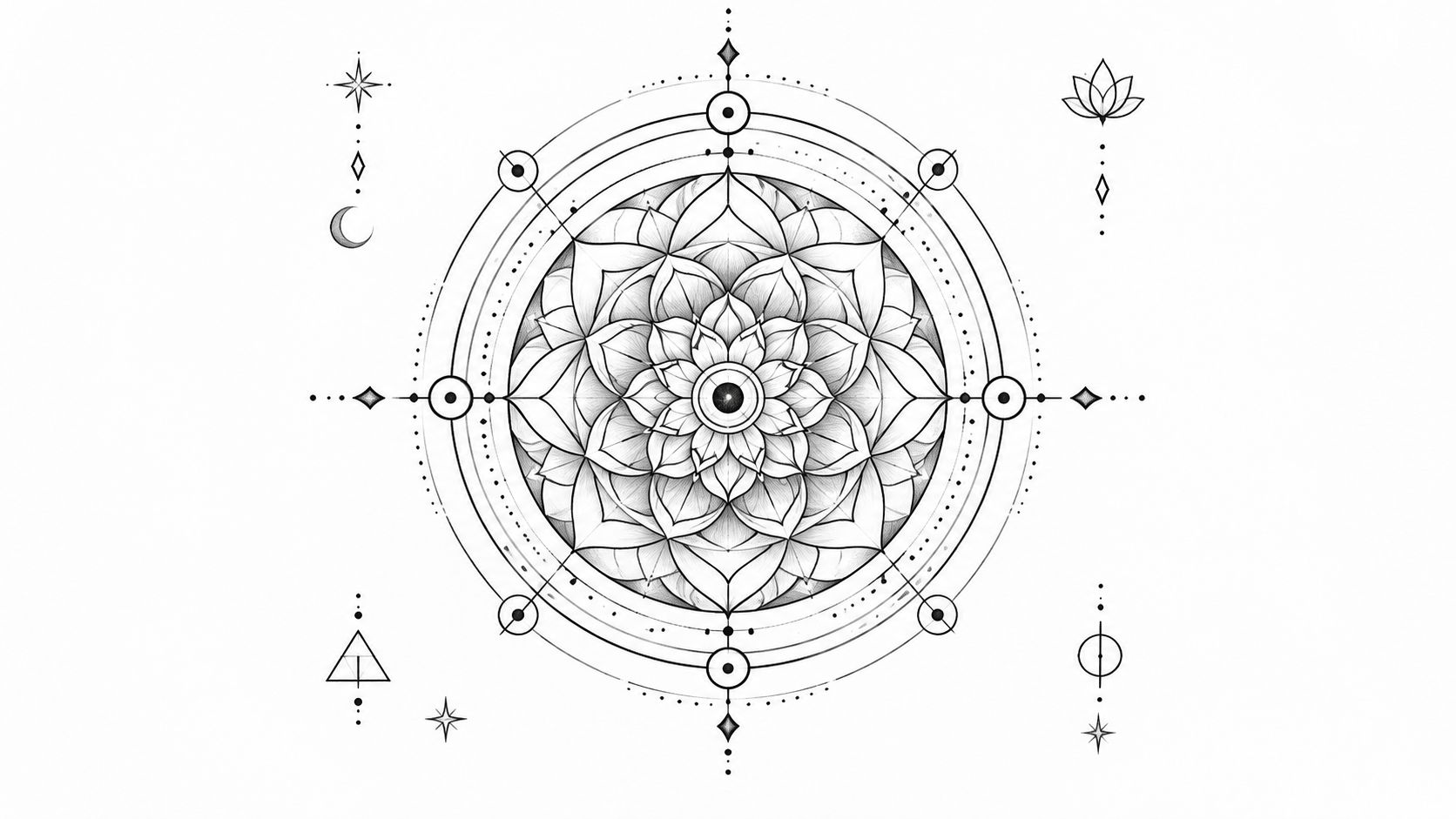
Mandalas are built around a central point, with shapes, petals, rings, and ornamental details radiating outward. That makes them a natural fit for radial symmetry, where the design remains organized around a center rather than mirrored across a left and right side.
A mandala can feel spiritual, architectural, floral, or entirely abstract. Its visual language is associated with ideas of wholeness, unity, and balance in Sanskrit and Buddhist traditions, but your tattoo doesn't have to reproduce a traditional symbol. You might combine a lotus center with fine geometric rings, use a color-filled arrangement on the chest, or build a black-and-gray focal point into a larger back piece.
Placement matters because the center must remain readable. The upper back, chest, shoulder, and upper arm can provide useful surfaces, but the artist should account for curves, muscle movement, and how the tattoo will appear when your posture changes.
Choose the structure before the details
A detailed mandala can use crisp line work, dot-work, solid black sections, soft gray shading, or a combination. Fine lines create an airy result, while heavier outlines and packed shading give the piece more visual weight. Ask how each approach will affect the design's readability after the tattoo settles and ages.
Planning rule: Bring reference images, but use them to communicate rhythm, density, and mood. Your artist should redraw the mandala for your anatomy rather than copy a flat image onto curved skin.
A complimentary Think Tank Tattoo consultation gives you space to compare line-work and dot-work approaches, discuss scale, and decide whether the mandala should stand alone or become the center of a sleeve or back composition. Detailed designs also deserve careful planning before the stencil is applied, and you should ask about aftercare and possible future touch-ups.
2. Bilateral Mirror-Image Symmetrical Tattoos
Bilateral symmetry divides a composition along a central axis and reflects the main elements from one side to the other. Think of wings across the chest, two birds facing outward on the upper back, or mirrored botanical forms extending down opposing arms.
This format creates an immediate sense of order, but the body isn't a perfectly symmetrical mannequin. One shoulder may sit higher, one pectoral may have a different contour, and the spine may not appear identical from every angle. A strong artist designs for visual balance, not mechanical duplication alone.
The most dependable registration points are stable anatomical landmarks. Guidance on geometric tattoo planning recommends using the spine, jugular notch, or navel as central references for layouts on the spine, sternum, and throat. This placement guidance explains how those landmarks support bilateral alignment.
Make the mirror fit the person
A winged chest piece can look dramatic when both sides are visible from the front, while a back design may need to be checked in motion so the wings don't appear to shift when you bend or rotate. Digital mockups and photographs can reveal problems that aren't obvious while you're standing still in front of a mirror.
Slight variation can also make an organic subject feel more believable. Two wolves can share the same overall scale and gaze direction while carrying small differences in fur, leaves, or shadow. Strict mirroring suits geometric work, but controlled irregularity can prevent flowers, animals, and faces from looking mechanical.
Before the stencil: Ask to see the layout from the front, side, and a natural seated position. A design that looks centered only when you stand rigidly may need adjustment.
Reserve enough usable space for both halves to breathe. Crowding one side, wrapping one half farther around the body, or placing the axis too close to a curve can weaken the intended balance.
3. Geometric Mandala and Dot-Work Symmetrical Tattoos
Dot-work changes the character of symmetry. Instead of relying only on continuous outlines, the artist builds gradients, texture, and depth from carefully placed dots. A geometric mandala can therefore look precise without becoming visually heavy.
The technique works especially well for shoulder pieces, upper-back compositions, arm designs, and focal elements inside a larger geometric tattoo. Dense dots can create a dark center that fades into open negative space, while repeated points can define triangles, arcs, petals, and nested shapes.
You'll want to decide whether the piece should feel delicate and architectural or dense and dimensional. A fine-line framework with stippled shading may preserve more skin breaks, while a darker design can produce stronger contrast at a distance. The choice should match both your preferred style and the amount of detail your chosen placement can support.
Protect the smallest details
Dot-work requires patience during both design and healing. Ask the artist to show comparable healed work, not only fresh photographs, and discuss how the density of dots will be scaled for your skin and the tattoo's final size.
Review the portfolio: Look specifically for healed geometric and stippled pieces, not just finished drawings.
Clarify the process: Larger or more intricate designs may require multiple appointments, so discuss scheduling before you approve the layout.
Plan aftercare carefully: Healing affects how cleanly small dot details settle, and following the studio's instructions helps protect the intended texture.
For a closer look at the technique, explore Think Tank Tattoo's guide to dot-work tattoo style.
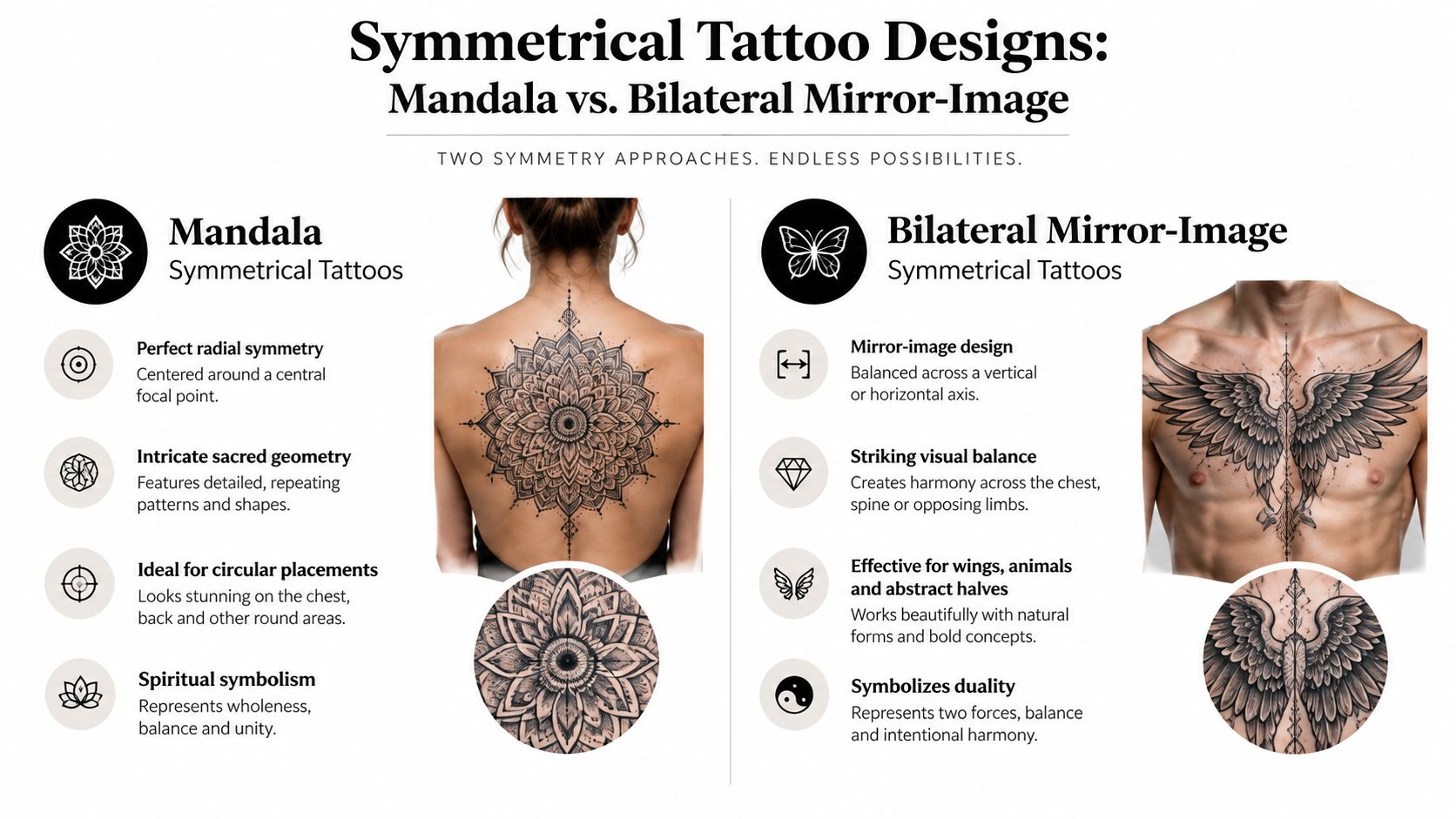
A short visual reference can help you compare radial structure with mirrored layouts before a consultation.
4. Symmetrical Animal Face and Wildlife Tattoos
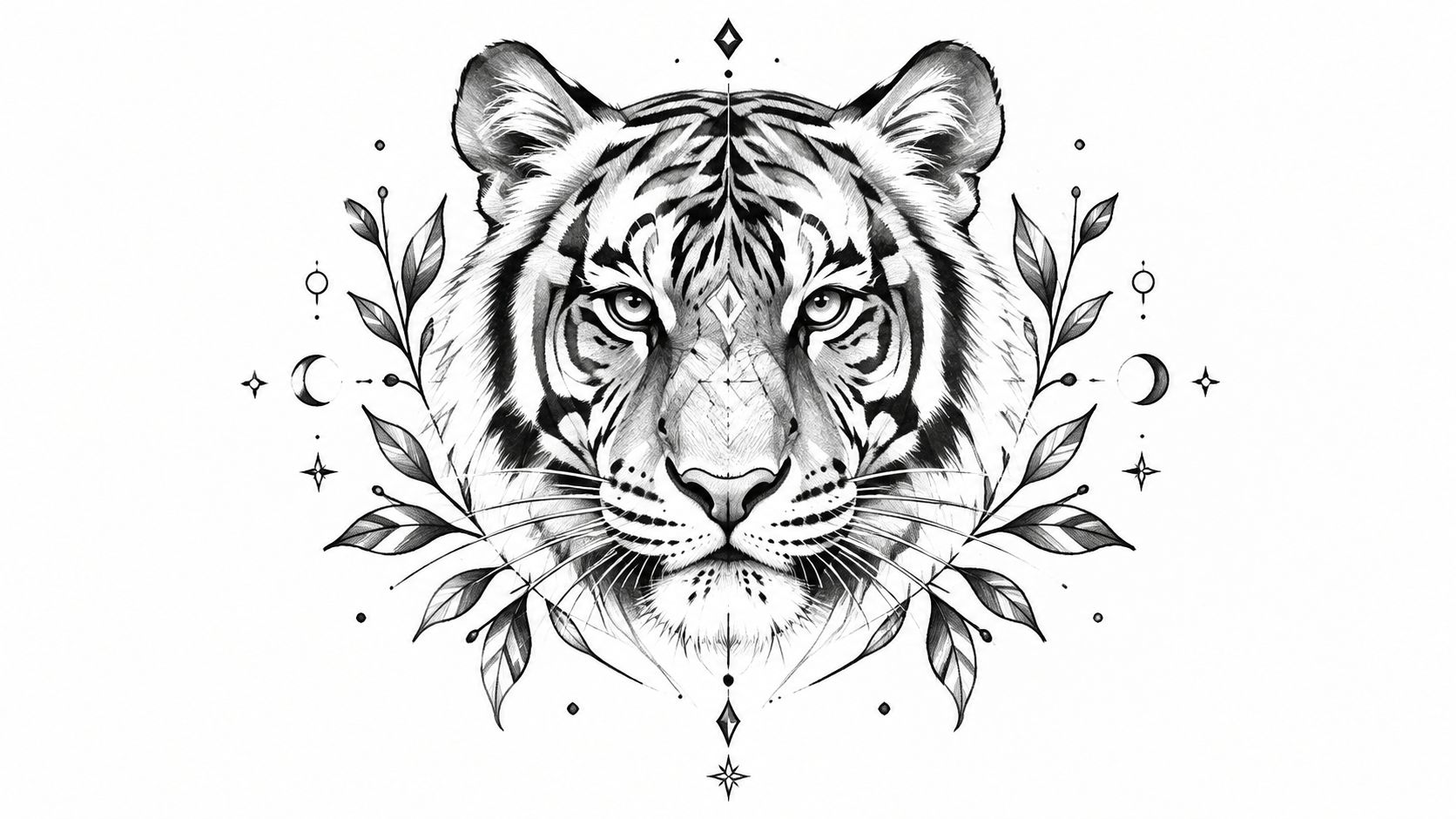
A frontal animal face depends on balance immediately. The eyes, nose, muzzle, ears, and surrounding markings all need to feel connected across the centerline, even when the design uses realism rather than obvious geometry.
Tigers, owls, bears, wolves, and big cats each create a different emotional effect. A tiger can look direct and commanding, an owl can feel watchful and ceremonial, and a bear can anchor a broader wilderness composition. You can also soften a powerful face with leaves, stars, ornamental framing, or negative space.
The reference image makes a major difference. A side-profile photograph won't help an artist build a convincingly frontal composition, so collect several straight-on images showing the animal's eyes and facial structure clearly. Think Tank Tattoo's animal tattoo design guidance can also help you compare approaches before choosing a subject.
Choose a placement that supports eye contact
The chest, upper back, and broad shoulder area can give a frontal animal enough room for its features to remain legible. A highly detailed face may lose clarity if compressed onto a narrow or sharply curved area. The artist may need to enlarge the eyes, simplify fur, or reduce surrounding ornaments to preserve the expression.
A digital mockup is useful here because a tiny shift in the eyes can change the animal's entire mood. Ask how the design will sit when your arms are relaxed, raised, or moved forward.
Direct gaze creates impact, but it also exposes alignment. Confirm the centerline and eye placement before the stencil is transferred.
A symmetrical animal tattoo doesn't have to be perfectly identical on both sides. Fur patterns, foliage, and shadow can vary subtly while the eyes, nose, and overall silhouette maintain the visual structure.
5. Symmetrical Floral and Botanical Tattoos
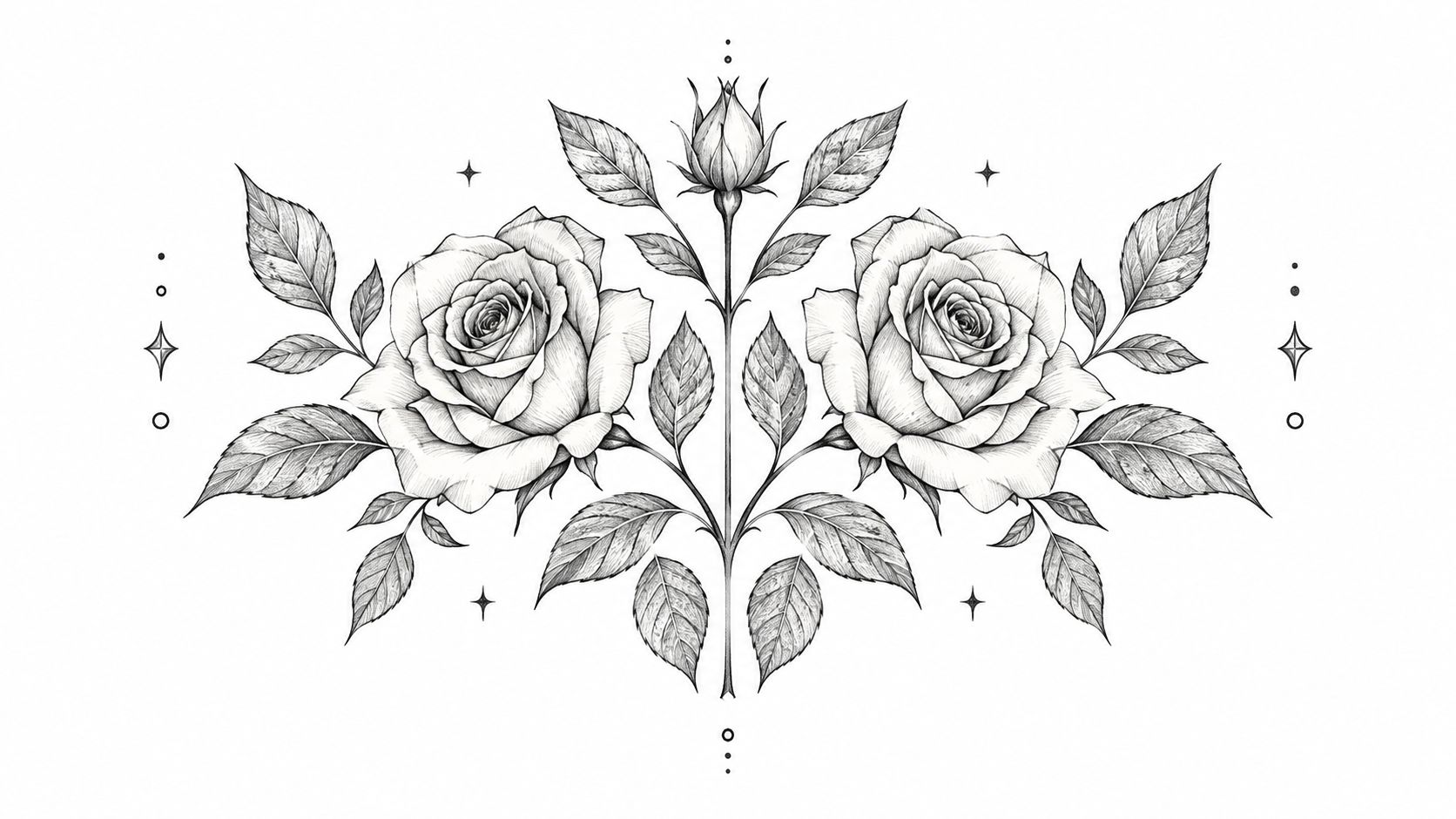
How can a floral tattoo look balanced without forcing nature into identical halves? Start by choosing the plant's role in the composition. Two roses around a central bud create bilateral balance, while a lotus with repeated petals builds a radial center. Leaves can widen the design and soften its edges, so the result follows the body instead of looking stamped onto it.
A small line-art bloom can fit the shoulder or upper arm. A fuller arrangement can grow into a chest piece, back composition, or sleeve foundation. Black and gray keeps the structure restrained. Color separates petals, leaves, and focal elements more clearly, but it also adds another choice for your artist to coordinate with line weight and placement.
Build balance around the body's shape
Use the centerline as a guide, not a command. On a chest or upper back, mirrored flowers may hold their proportions well. Around a shoulder, thigh, or arm, the design can keep its central relationship while allowing leaves and stems to curve differently on each side. That small adaptation helps the tattoo move naturally when the skin bends.
Negative space separates petals and keeps the main silhouette readable as the tattoo settles. It also prevents a wraparound design from becoming a dense band of detail.
Ask your artist to show the design at its intended size and on a body mockup. A shape that looks balanced on paper may need wider leaves, fewer details, or a shifted centerline on curved skin.
Check three decisions before finalizing the stencil:
Visual weight: Dark leaves can balance pale flowers, while open line work creates a lighter finish.
Silhouette: The floral form should read from a distance, not only through tiny details.
Future additions: Leave clear paths for connecting foliage if the piece may expand into a sleeve or larger back composition.
Discuss color with maintenance and aftercare, so the palette supports the design rather than functioning as a last-minute decoration.
6. Symmetrical Sacred Geometry and Mathematical Patterns
Sacred geometry designs combine repeated forms with symbolic meaning. The Flower of Life, Metatron's Cube, platonic solids, and geometric spirals can create compositions that feel both intellectual and spiritual, especially when the artist preserves exact spacing and proportion.
The first decision isn't the pattern. It's the meaning you attach to it. Research the symbol's history and decide whether you connect with its cultural or spiritual associations, or whether you're choosing it primarily for its structure. That distinction helps your artist develop a design that feels personal instead of decorative.
Think Tank Tattoo's sacred geometry tattoo designs can provide a useful starting point for discussing pattern families, line weight, and placement.
Treat measurements as part of the artwork
A small error in a repeated geometric pattern can become more obvious as the eye moves across the composition. Use a digital mockup to review the intended scale, center point, and spacing before the stencil is placed. Flat or relatively stable areas such as the chest, upper back, shoulder, and outer arm may display these relationships more clearly than highly flexing joints.
You can also soften mathematical strictness with contrast. Pair a precise central pattern with open skin, soft shading, or an organic frame. This creates a contemporary result without losing the structure that attracted you to sacred geometry in the first place.
Meaning before measurement: Know why the symbol matters to you, then let the artist adapt its proportions to your body.
A good custom version may not preserve every line from a reference diagram. Simplifying a dense section can improve legibility, reduce crowding, and keep the central form intact when the tattoo follows a curve.
7. Symmetrical Tribal and Cultural Pattern Tattoos
How can a tattoo use symmetry without flattening the tradition behind its pattern?
Tribal and cultural designs may rely on bilateral balance, repeated bands, radial forms, or geometric sections that flow around the body. Their strength often comes from rhythm and contrast. Placement matters as much as the motif. A pattern that wraps a shoulder or follows an arm can feel integrated, while the same pattern placed as a flat image may lose its intended movement.
Use the body as part of the layout. A Polynesian-inspired composition might follow the shoulder's curve, while Celtic knot work could form a centered radial element on the chest or back. Scale the pattern according to the available surface, then adjust spacing and line weight for areas that bend, stretch, or taper. The design should respect both the cultural reference and the body's natural asymmetries.
Placement changes meaning: Confirm whether moving, wrapping, or resizing a motif affects its cultural role before approving the stencil.
Research should come before motif selection. Within its original context, a pattern may relate to ancestry, rank, identity, achievement, spirituality, or community membership. Treating it as a set of attractive shapes can remove those meanings.
Bring references that show the design in its traditional setting, not only cropped tattoo photographs. Ask the artist about experience with the relevant tradition. If the design connects to a living culture, knowledgeable cultural practitioners or community members can help clarify appropriate use.
Verify the origin: Identify the people, region, and tradition associated with the motif.
Separate inspiration from identity: State whether you are honoring personal heritage or drawing from an aesthetic you admire.
Check body associations: Some forms belong on particular areas, so relocating a pattern may change its significance.
Perfect mirroring is not a requirement for every traditional tattoo. Research on Māori tā moko describes facial designs as expressions of lineage and ancestry, with symmetry not necessarily serving as the defining principle. A responsible design can create visual balance while preserving asymmetry that belongs to the tradition.
8. Symmetrical Portrait and Symmetrical Face Tattoos
What makes a symmetrical face tattoo look like the intended person rather than a generic face? The answer is controlled proportion. Viewers notice small shifts in the eyes, nose, mouth, expression, and tonal transitions, so portrait symmetry demands more than copying a centered outline.
Begin with a strong reference photograph. A clear frontal image suits a centered design, while several high-quality views from different angles reveal distinctive features. The artist should also consider the body's natural asymmetry. A stencil may look perfectly balanced on a screen but need slight adjustment around the chest, upper back, or shoulder.
Likeness comes before decoration: Treat the face as the anchor. Surrounding symmetry should support it.
Build the composition around the face
A portrait can stand alone on the chest or upper back, or serve as the focal point of a sleeve or larger back piece. Wings, halos, flowers, rays, and ornamental shapes can create a visual frame. Their scale must remain secondary, because heavy detail near the eyes or mouth can weaken recognition.
A digital mockup lets you compare size and placement before the appointment. Check the design while standing naturally and with the posture you expect the tattoo to follow. Curved or moving areas may require a less rigid mirror image so the portrait remains balanced as the body shifts.
Use this planning check:
Mark defining features: Tell the artist which details make the subject recognizable to you.
Check facial structure: Review the eye line, nose center, mouth width, and negative space around the face.
Match style to purpose: A simplified illustrative face and a realistic likeness require different levels of detail.
Confirm the process: Ask about preparation, session planning, and possible touch-ups before booking.
Choose an artist with portrait work that matches your goal. Review a broad portfolio, including healed examples, consistent facial structure, and expressions similar to the one you want. A fresh photograph can show line quality, but healed work better indicates how the design holds its proportions over time.
8-Point Comparison of Symmetrical Tattoo Designs
Design | Complexity 🔄 | Resources & Time ⚡ | Expected Outcomes ⭐ / Impact 📊 | Ideal Use Cases 💡 |
|---|---|---|---|---|
Mandala Symmetrical Tattoos | High 🔄🔄, precise radial geometry | Moderate‑High ⚡⚡, longer sessions for detail | Clean, highly detailed, spiritual aesthetic ⭐⭐📊 | Circular focal pieces (chest, back, shoulders); technical showcase |
Bilateral Mirror-Image Symmetrical Tattoos | High 🔄🔄, exact mirroring across axis | Moderate ⚡⚡, careful placement and mockups | Dramatic balanced composition; strong visual symmetry ⭐⭐📊 | Large chest/spine/sleeve work; wings, paired limbs |
Geometric Mandala & Dot-Work Symmetrical Tattoos | Very High 🔄🔄🔄, meticulous stippling + geometry | Very High ⚡⚡⚡, multiple lengthy sessions | Textured, gallery-quality pieces that age well ⭐⭐⭐📊 | Collectors; fine‑art, high‑detail back/shoulder pieces |
Symmetrical Animal Face & Wildlife Tattoos | Very High 🔄🔄🔄, anatomical portraiture + symmetry | High ⚡⚡⚡, detailed reference and touch-ups | Powerful, emotive realism; strong focal impact ⭐⭐📊 | Frontal chest/back portraits; wildlife-themed centerpieces |
Symmetrical Floral & Botanical Tattoos | Moderate 🔄🔄, organic symmetry with flow | Moderate ⚡⚡, color choices affect sessions | Elegant, versatile, timeless aesthetic ⭐⭐📊 | Versatile placements (arms, legs, chest); approachable for first-timers |
Symmetrical Sacred Geometry & Mathematical Patterns | Very High 🔄🔄🔄, requires exact ratios and math | High ⚡⚡⚡, detailed digital planning needed | Intellectually meaningful, precise, timeless ⭐⭐⭐📊 | Large statement pieces for spiritually/intellectually minded clients |
Symmetrical Tribal & Cultural Pattern Tattoos | High 🔄🔄, cultural motifs + balanced design | Moderate‑High ⚡⚡, consultation for authenticity | Bold, high‑impact, culturally significant results ⭐⭐📊 | Heritage representation, sleeves, back/chest pieces (with cultural consultation) |
Symmetrical Portrait & Face Tattoos | Extreme 🔄🔄🔄, elite portrait skill required | Very High ⚡⚡⚡, multiple sessions; high cost | Pinnacle of technical mastery; strong emotional value ⭐⭐⭐📊 | Commemorative or museum‑quality commissions; collectors |
Turn a Balanced Idea Into a Personal Design
Symmetry gives you a clear starting point, but it shouldn't dictate every decision. Begin by choosing the symmetry type that suits the motif and body area. A mandala or Flower of Life may need a radial center, while wings, paired animals, and split botanical forms usually depend on a bilateral axis. A knee or elbow often benefits from a centered radial arrangement because the design can distribute movement around the joint, while a sternum, throat, or spine offers a more obvious centerline for mirrored work. Technical guidance on symmetry and body placement explains how layout types respond differently to joints and central landmarks.
Next, define the motif and its meaning. Decide whether you're drawn to a tiger's direct gaze, a lotus's visual calm, a cultural pattern's heritage, or the clean logic of geometric repetition. Bring references that show the mood, density, line quality, and shading you prefer, but leave room for the artist to redraw the concept around your anatomy.
Placement should come before final scale. Identify how much usable surface the body area provides, how visible you want the work to be, and whether your existing or planned tattoos affect the composition. Arms, shoulders, chest, back, and forearms can all support symmetrical tattoo designs, but each area changes the way the axis, negative space, and silhouette behave.
Use a practical consultation checklist
Select the axis: Decide whether the design needs a central line, a central point, or a flowing path around a joint.
Choose the technique: Compare fine line, bold line work, dot-work, black and gray, color, and negative-space treatments.
Test movement: Review the stencil or mockup while standing naturally, sitting, twisting, breathing, or raising your arms.
Confirm the scale: Make sure the smallest details have enough room to remain readable after healing.
Plan the timeline: Larger and more detailed concepts may need additional design work and sessions.
Discuss aftercare: Ask how healing, sun exposure, and future maintenance may affect the finished appearance.
Natural asymmetry isn't a flaw to hide. It's a design condition to solve. Recent tattoo guidance recommends checking symmetry during breathing, twisting, and arm movement, especially on areas such as the ribs and hips. If the central axis drifts more than 3 mm during normal client motion, the placement should be reconsidered before tattooing, according to technical symmetry guidance for tattoo layouts. Your artist can anchor the design to bone landmarks, adjust the stencil, or use rotational symmetry when left and right body mass differs.
Symmetrical tattoos can still look current without becoming rigid. Trend coverage for 2026 points toward fine-line minimalism, patchwork, abstract and digital aesthetics, while also identifying geometric tattoos, layered patterns, line work, three-dimensional effects, and optical illusions as active directions. That 2026 trend guide supports a useful middle ground: use partial symmetry, controlled negative space, mixed line weights, or an organic frame around a precise center.
Think Tank Tattoo offers complimentary consultations for discussing design direction, placement, and timing. The studio's collaborative process can help you decide whether your concept needs exact mirroring, a softer organic balance, or a radial structure adapted to movement. Bring your references, identify the body area you're considering, and ask how the design will remain readable over time before you reserve the appointment.
Visit Think Tank Tattoo to arrange a complimentary consultation about your symmetrical tattoo designs, including motif, placement, scale, and customization. Their Denver team can help you turn a balanced concept into a body-aware design and explain the booking and aftercare process before you commit.
Comments