
Tattoos on Abs: A Practical Guide Before You Book
You've saved the reference images, found the right motif, and can already see it across your stomach. Then you look again at the model in the photo, notice the perfectly flat canvas, and wonder whether the same design will work on your body. That hesitation is useful. It means you're thinking beyond the appointment photo.
Tattoos on abs can look powerful, intimate, and completely custom. They can also be among the most demanding tattoos to plan because the abdomen moves, folds, stretches, compresses, and changes shape. The right question isn't only whether you can tolerate the needle. It's whether the design, placement, and healing plan make sense for the body you'll have years from now.
Table of Contents
Why Abdominal Tattoos Deserve a Different Conversation - The decisions that matter before booking
How the Abdomen Compares to Other Placements - Why time can matter more than the address
Design Choices That Actually Work on Abs - Build around the body, not over it - Scale beats fragile detail
Pain, Sessions, and Staging Large Pieces - When to split the work
Healing and Aftercare Specific to the Abdomen - A practical healing schedule
What Happens When Your Body Changes Shape - Design for change before it happens - Think in decades, not photographs
Booking Your Tattoo With Think Tank Tattoo - Questions worth asking
Why Abdominal Tattoos Deserve a Different Conversation
An abdominal tattoo isn't a larger version of a forearm tattoo. Your stomach changes with posture, breathing, meals, muscle tension, weight fluctuation, and everyday movement. The skin also encounters constant contact from clothing, seatbelts, furniture, and the position you sleep in.
That doesn't make the abdomen a bad canvas. It makes it an active canvas. A skilled artist has to design around movement rather than pretending the skin will stay stretched and flat like it appears in a reference photograph.
Abdominal tattooing also has a long history. The Pitt Rivers Museum's record of tattooing notes that mummified Nuba women dating to about 4200 B.C. show tattoos on the abdomen. In modern clinical datasets, abdomen and chest placements remain a substantial part of tattoo location choices. One dermatology study recorded 112 female tattoos, or 14.9% of women's tattoos, on the abdomen and chest, compared with 8 male tattoos, or 5.8%, while another study recorded 158 tattoos, or 15.6% of its sample, in those areas. Those figures describe specific study samples, not every tattooed population, but they confirm that torso tattooing isn't a niche idea.
The decisions that matter before booking
Before you send a deposit, make four decisions with your artist:
Design behavior: Will the image still read if the stomach expands, contracts, or creases while you sit?
Placement behavior: Does the design follow the navel, hip bones, ribs, and natural abdominal contours?
Session behavior: Is the piece small enough to complete comfortably, or will prolonged work compromise the skin and your concentration?
Lifestyle behavior: Can you protect the area from rubbing waistbands, sweating, and repeated stretching during healing?
The abdomen is especially vulnerable to visible distortion after significant weight change, pregnancy, or major muscle development. Guidance on tattoo placement and changing skin supports a practical design rule: avoid rigid geometric linework and exact symmetry across the midline when future skin tension changes are likely.
Artist's rule: Don't design the tattoo for the flat, freshly stenciled stomach on appointment day. Design it for the body in motion.
A good abdominal piece doesn't require a gym-ready body. It requires an honest consultation, a design with enough structural strength, and an artist who understands how the torso behaves.
How the Abdomen Compares to Other Placements
Pain comparisons become misleading when they treat the body as a map with fixed ratings. A tattoo on the abdomen can feel manageable in one zone and sharp in another, even during the same appointment. The upper abdomen near the sternum, lower ribs, and navel usually demands more concentration than the fleshier central belly.
The strongest available large-sample evidence also argues against treating location as the only predictor. A 2020 Polish study of 1,092 tattooed adults found that body area wasn't a statistically significant predictor of tattoo pain. Participants reported average pain of 4.35 out of 10 during the session and 2.07 out of 10 immediately afterward, while session time, bleeding, and stress showed stronger relationships with higher pain. The study included 863 women and 229 men. See the tattoo pain survey summary and placement discussion for the reported findings.
That matters because clients often ask whether “the abs” hurt as though the entire stomach has one sensation. It doesn't. Ribs and sternum tend to feel sharper because the artist works closer to bone and areas with less cushioning. The inner bicep can feel sensitive but usually has fewer daily compression problems. The spine combines a bony surface with a narrow working area. The abdomen offers more flesh in the middle, but it moves constantly under the needle.
Placement | Typical Pain | Healing Friction | Shape-Change Risk |
|---|---|---|---|
Abdomen | Moderate, with sharper zones near the sternum, ribs, and navel | High, because waistbands, belts, seatbelts, and sitting compress the area | High |
Ribs | Often sharp and demanding near bone | Moderate, with friction from clothing and sleeping positions | Moderate |
Sternum | Sharp and sensitive over the central bone | Moderate, especially from clothing and chest movement | Lower than the abdomen |
Inner bicep | Sensitive but often easier to position and relax | Low to moderate | Moderate |
Spine | Sharp over bony sections, variable elsewhere | Moderate, especially when lying down | Lower than the abdomen |
Why time can matter more than the address
A large, dense piece can hurt more because the skin receives prolonged needle exposure, not just because it sits on the stomach. Longer work also raises the chance that you'll tense your core, shift position, or lose patience. Those reactions make it harder for the artist to keep lines clean and spacing consistent.
Healing friction is the abdomen's less glamorous disadvantage. Arms and legs usually have more airflow and fewer daily pressure points. Stomachs get folded while sitting, pressed by jeans, and moved every time you laugh, cough, reach, or stand.
So don't choose a placement based on a pain chart alone. Ask the artist to map the actual zones, explain where the design will cross sensitive anatomy, and account for the pressure your clothing puts on the area.
Design Choices That Actually Work on Abs
The abdomen rewards designs with visual structure. Bold outlines, solid fills, deliberate shading, and medium-to-large shapes usually hold their identity better than fragile detail spread across moving skin. The goal isn't to make every abdominal tattoo heavy. The goal is to give the design enough visual authority that small changes in skin tension don't destroy its readability.
Traditional, neo-traditional, blackwork, and carefully planned geometric work can all suit the torso. Photorealistic micro-detail and minimalist single-line designs demand more caution because their effect depends on precise spacing and delicate marks. That doesn't make them impossible. It means the artist needs to scale them generously and place them where movement won't constantly interrupt the image.
Build around the body, not over it
Start with the anatomy:
Use the navel as an anchor. A centered composition can run from the sternum toward the navel, frame the navel, or radiate outward from it. The navel gives the artist a stable reference point when the torso changes position.
Choose symmetry consciously. A symmetrical design looks formal and intentional, but it exposes every shift across the midline. An asymmetrical piece can feel more natural and gives the artist more freedom to follow the ribs, waist, or hip.
Leave breathing room. Don't force the design into the narrow spaces around the navel or hip bones. Negative space helps the image remain legible when you bend or sit.
Follow the abdominal contours. A motif that curves with the torso usually looks more integrated than one built from rigid horizontal or vertical lines.
A sternum-to-navel piece creates a strong central statement. It also makes the navel and midline part of the composition, so even minor asymmetry becomes visible. A design anchored to one side can be easier to adapt around body changes, scars, stretch marks, or an uneven natural contour.
Scale beats fragile detail
Ask to see the design as a stencil on your actual body, not only as a digital drawing. Stand, sit, bend, and relax your stomach while looking at it. A motif that looks balanced while standing may compress awkwardly across the navel when seated.
Avoid placing the lowest part of the design where a waistband will constantly rub it. Leave enough clearance around areas that crease naturally. If you're considering a full stomach composition, let the artist create a hierarchy, with the strongest shape carrying the main message and smaller details supporting it.
Practical rule: If the tattoo only looks right when your stomach is stretched flat, the design isn't finished.
The most common mistake is designing for an imagined set of perfectly symmetrical abs. The second is treating the abdomen like a blank rectangle. It isn't. It's a curved, breathing surface with a center point, soft transitions, and edges that disappear into the ribs, hips, and sides.
Pain, Sessions, and Staging Large Pieces
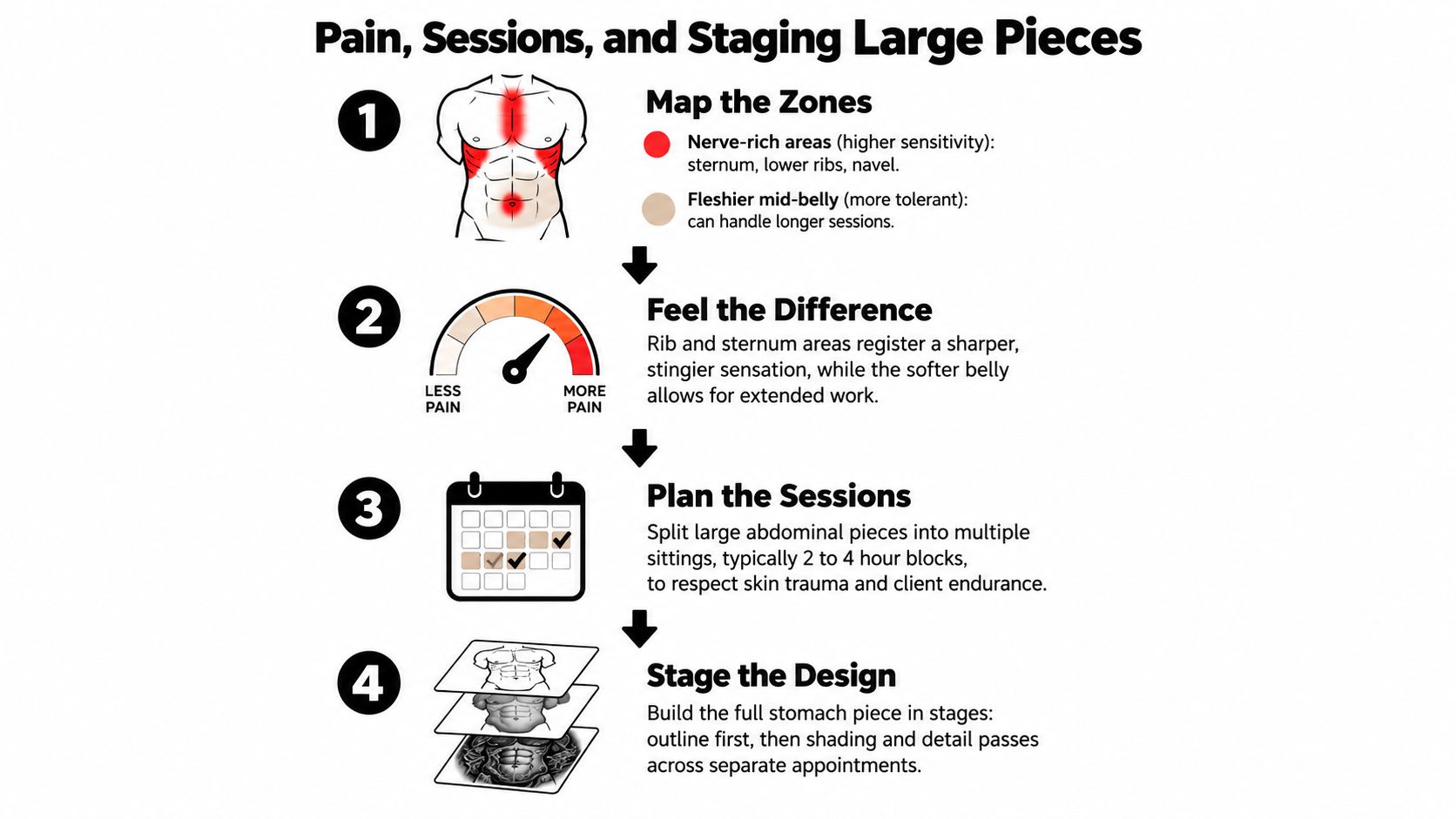
The abdomen doesn't produce one uniform sensation. Around the sternum, lower ribs, and navel, clients often describe the needle as sharper and stingier. The fleshier middle of the stomach tends to be easier to tolerate for sustained work, although stress, bleeding, session length, and individual sensitivity still matter more than a simple body-part label.
Breathing helps. So does relaxing the abdominal wall instead of bracing it against the machine. Core engagement makes the artist work against a moving, tense surface, and it usually makes the experience harder for you. Eat beforehand, arrive hydrated, and agree on breaks before the machine starts.
When to split the work
A large abdominal piece should usually be staged when the design combines broad solid areas, dense black-and-grey shading, and detail that crosses several moving zones. Splitting the work gives the skin time to settle and lets the artist assess how the first pass has healed before forcing every element into one sitting.
Use three questions:
How much skin will receive repeated passes? Dense saturation across the stomach creates more trauma than a light outline.
How much concentration does the design require? Fine intersections, mirrored elements, and complex transitions suffer when either person is exhausted.
How do you handle discomfort? If you know your tolerance drops sharply after sustained work, staging is the responsible choice.
There's a trade-off. Multiple appointments require more scheduling and more shop time, but they can protect line quality, color saturation, and design accuracy. A client who wants a large torso piece should read how to prepare for a long tattoo session before deciding whether one sitting is realistic.
Don't treat finishing in one appointment as a badge of toughness. The cleanest result usually comes from stopping before the skin and the client become unreliable working surfaces.
Healing and Aftercare Specific to the Abdomen
A fresh abdominal tattoo has to recover while your torso bends, twists, sweats, and presses against clothing. Follow your artist's bandage instructions first, because wrap type, wear time, and adhesive differ. During the early healing period, protect the piece from unnecessary stretching, rubbing, contamination, and repeated creasing.
The first 1 to 4 days usually bring the most inflammation, including redness, warmth, and plasma weeping. Peeling and itching commonly follow during the next 3 to 7 days. The deeper skin continues remodeling for roughly 4 to 8 weeks, according to this abdominal tattoo healing guidance. Treat the tattoo as healing tissue throughout that period, even if the surface starts looking calm.
A practical healing schedule
First 48 hours: Keep the initial dressing in place for the time your artist specifies. Wear clean, loose clothing, and avoid anything that traps sweat against the tattoo.
Days 3 through 7: Remove the wrap only when your artist instructs you to do so. Wash gently with mild, fragrance-free soap and lukewarm water. Pat the area dry, then apply a thin layer of suitable fragrance-free moisturizer.
Week 2: Flaking and itching are expected. Do not scratch, peel, or scrub the skin. Choose soft clothing with a waistband that sits away from the tattoo.
Weeks 3 and 4: The surface may appear settled while deeper layers continue repairing. Keep direct sun off the area, and do not treat the tattoo as fully healed just because it no longer looks raw.
After the first month: Have the artist assess the healed work before scheduling a touch-up. Surface appearance does not always show whether the dermis has finished remodeling.
Sleep on your back if that prevents the tattoo from creasing against the sheets. If that position is uncomfortable, wear clean, loose sleepwear and avoid pressing the fresh work into a tight fold. Delay swimming, hot tubs, and other soaking until the tattoo has healed and your artist approves. Light activity may be manageable once the surface has closed, but heavy sweating, friction, and gym equipment pressing against the abdomen create avoidable irritation.
Seatbelts, compression shirts, tight jeans, and elastic waistbands all deserve attention. Adjust them away from the tattoo when possible instead of allowing repeated pressure across the skin. If you are considering laser hair removal near the piece, read these safe protocols for tattooed skin before booking a session.
Mild redness, warmth, weeping, peeling, itching, and soreness can occur during normal healing. Contact your studio if the bandage fails, the tattoo encounters avoidable contamination, or you are unsure about an aftercare product. Seek medical advice for worsening pain, spreading redness, significant swelling, persistent discharge, or symptoms that fall outside the expected pattern. Persistent abdominal pain needs medical attention rather than automatic dismissal as ordinary tattoo soreness.
Keep the aftercare simple and consistent. The Tattoo Aftercare 101 guide can help you prepare before the appointment and follow a sensible routine afterward. Your artist's instructions take priority because they reflect the dressing and products used on your specific tattoo.
What Happens When Your Body Changes Shape
The long-term risk with an abdominal tattoo isn't usually the discomfort on appointment day. It's designing a piece that depends on the stomach never changing.
Weight gain, weight loss, pregnancy, abdominal surgery, and significant muscle change can alter the amount, direction, and tension of skin across the torso. The effect varies by person and by design, but the principle is simple. A tattoo follows the skin. When the skin shifts, the tattoo shifts with it.
Medical literature on abdominal body-contouring procedures shows that skin can measurably tighten after tissue changes. One cohort reported average surface-area contraction of 7.6% at six months, while another reported 13% to 16% contraction in tattooed abdominal sites. These findings come from surgical contexts, so they don't predict exactly what will happen to every tattoo after ordinary weight change or pregnancy. They do demonstrate that abdominal skin is capable of substantial structural change. The clinical discussion of abdominal skin contraction helps explain why long-term distortion deserves more attention than it gets.
Design for change before it happens
Fine lines, tightly packed detail, rigid grids, and perfectly mirrored geometry have less room for movement. Bold shapes, strong outlines, intentional negative space, and compositions with flexible spacing tend to remain easier to read when the abdomen changes.
If pregnancy is part of your future plans, say so during the consultation. Don't let embarrassment make the decision for you. A design placed across skin likely to experience major expansion may change more visibly than one positioned higher on the torso or away from areas of greatest tension. No artist can promise that a tattoo will return to its original appearance after a major body change.
The same applies after weight loss or abdominal surgery. Wait until your body and any scars have stabilized before asking an artist to work over or near the area. If loose skin is part of your concern, research non-surgical skin tightening options separately from tattoo planning. A cosmetic procedure may change the surface, but it won't remove the need for an artist to evaluate the skin in person.
Think in decades, not photographs
Ask yourself whether the design still works if the center shifts slightly, a curve softens, or one side changes more than the other. If the answer is no, revise the concept before the stencil goes on.
A strong abdominal tattoo doesn't fight the body's future. It leaves the design enough flexibility to age with it.
Stretch marks also deserve an honest conversation. They can affect line placement, ink saturation, and the visual rhythm of a composition. Read about tattoos on stomach stretch marks before assuming every area of skin will take ink in the same way.
Booking Your Tattoo With Think Tank Tattoo
Treat the first consultation as a design meeting, not a checkout step. Bring reference images that show the subject, composition, and style you like. Also bring examples of what you don't want. That saves time and gives the artist a clearer picture than one polished image from social media.
Measure your expectations against your torso, not against someone else's photograph. A design that fills another person's stomach may need more width, height, or breathing room on you. Be ready to explain whether you want the piece centered, navel-anchored, asymmetrical, or connected to future work on the ribs, chest, or hips.
Questions worth asking
Abdominal portfolio: Can the artist show healed torso work, not only fresh photographs?
Design behavior: How will the stencil account for the navel, sitting position, hip bones, scars, or stretch marks?
Session plan: Will the artist stage the outline, shading, and detail, or attempt the whole piece at once?
Future changes: How might weight fluctuation, pregnancy, surgery, or muscle development affect the proposed placement?
Touch-ups: What does the studio's touch-up policy cover, and when will the healed tattoo be evaluated?
Estimate: Is the quote flat-rate or hourly, and how do design revisions affect appointment time?
Deposit: What deposit is required, and what happens if you need to reschedule?
Think Tank Tattoo is a Denver studio established in 2002 with artists working across varied styles. The studio offers complimentary consultations, accepts clients 18 and older, requires a non-refundable $100 deposit, and lists a $100 shop minimum. Confirm current availability, policies, and estimate details directly with the studio because scheduling and business terms can change.
Wear clothing that gives the artist clear access without forcing you to expose more of your body than necessary. A loose, adjustable top and relaxed bottoms are usually more practical than restrictive clothing. Ask about parking, appointment timing, and rescheduling before you commit, especially if you're traveling to the South Broadway location.
Book the consultation only when you're prepared to discuss the tattoo as a long-term piece. The right artist won't just place the design where it looks best for five minutes. They'll test the stencil against your anatomy, explain the trade-offs, and tell you when the concept needs to change.
Think Tank Tattoo offers complimentary consultations for custom work, including placement and timing discussions that matter for tattoos on abs. Visit Think Tank Tattoo to start the conversation, bring your references, and plan a piece built for your body now and through the changes ahead.
Comments