
Tattoo Under Fingernail What It Is Pain and Safety
You're probably here because you saw a photo or short video of a tattoo under fingernail and had the same reaction a lot of clients do. Is that real. Does the ink go under the nail. And if it does, is it a cool niche idea or a bad bet for your hand?
That confusion makes sense. Under-nail work sits in a strange corner between tattooing, nail anatomy, and medical caution. It looks tiny, but it isn't simple. The nail unit behaves nothing like the forearm, calf, or even a standard finger tattoo.
I've had plenty of Denver clients ask about unusual placements after scrolling hand tattoo inspiration, including ideas that sit close to the cuticle, sidewall, or nail edge. A lot of those conversations start in the same place as broader finger tattoo ideas. Then the question gets more specific. What if the design goes under the nail itself?
The honest answer is that people often use the same phrase for very different things. Sometimes they mean a tiny design near the nail fold. Sometimes they mean pigment in the skin under the nail plate. Sometimes they're really talking about medical tattooing used after nail surgery, not decorative body art at all. That mix-up is where most bad expectations begin.
Table of Contents
Introduction to Tattoo Under Fingernail Ideas - Why this idea gets misunderstood - What matters before you even ask about booking
What a Subungual Tattoo Really Means - Think of the nail unit like a fitted glove with a hard cover - Cosmetic novelty and medical use are not the same thing - Why artist experience matters more here
How Under Fingernail Tattooing Is Performed - What the professional discussion should cover - Why the technique is so constrained - What clients should expect to hear - Questions worth asking in consultation
Pain Healing and How Long It Lasts - What pain usually feels like - Healing doesn't act like a flat-skin tattoo - What “lasting” really means here - Smarter healing expectations
Safety Risks and Common Misconceptions - Pigment under the nail can complicate medical judgment - Infection and chronic reactions aren't theoretical - Three misconceptions that cause bad decisions
Removal Options and Smarter Alternatives - Why correction is tough - Choosing a look with less downside - When to walk away from the idea
Booking Your Consultation at Think Tank Tattoo - What to bring to the consultation - Good questions for this specific appointment
Introduction to Tattoo Under Fingernail Ideas
A client once described it to me like this: “I want something hidden, sharp-looking, and weird in a good way. Not a regular finger tattoo. Something under the nail.” That wording tells you a lot. People usually aren't looking for a traditional placement. They're chasing the surprise factor.
The catch is that the nail unit is an anatomical structure, not just an empty pocket waiting for ink. If you think of normal tattooing as working on a leather surface with some give, under-nail placement is more like working in a tight envelope with a hard shield on top and delicate tissue underneath. There's less room for error, less room for swelling, and fewer good options if the result heals badly.
Why this idea gets misunderstood
Three things tend to get lumped together:
Nail art done on top of the nail plate
Nail-adjacent tattooing around the cuticle or side of the finger
True under-nail pigment placement involving the tissue beneath or around the nail structure
Those are not the same job.
Practical rule: If the design idea depends on the phrase “the nail will hide it,” you need a much more careful consultation than you would for a standard hand tattoo.
People also assume tiny means easy. In tattooing, tiny sometimes means harder. The smaller the work area, the more exact the depth, angle, and healing conditions have to be. Add a fingernail on top, and the conversation changes fast.
What matters before you even ask about booking
If you're considering a tattoo under fingernail, focus on four things first:
Placement reality. Ask whether your idea is under the nail, next to it, or only visible as the nail grows.
Pain expectations. This isn't the same sensation as a finger side tattoo.
Longevity. Pigment behavior around the nail is less predictable than expected.
Safety. Under-nail pigmentation can raise medical questions that ordinary tattoo placements usually don't.
That's the part I'd rather explain clearly than oversell.
What a Subungual Tattoo Really Means
When people say tattoo under fingernail, the most precise word they're usually reaching for is subungual. That means under the nail. Another useful term is periungual, which means around the nail. Then there's nail bed, which is the tissue under the nail plate that supports nail growth.
Those words matter because each area behaves differently.
Think of the nail unit like a fitted glove with a hard cover
The nail plate is the hard visible nail. Under it sits the nail bed. At the base is the matrix, which helps generate the nail. Around the sides are tight folds of skin that don't leave much spare space.
A normal tattoo needle works in skin that has some flexibility and cushion. The nail unit doesn't give you much of either. That's why under-nail ideas aren't just “small finger tattoos with a different angle.” They're a different problem altogether.
Here's the simplest breakdown:
On the nail plate means decorative nail work, not a lasting skin tattoo
At the cuticle or sidewall means tattooing nearby skin
Under the nail plate means interacting with a medically sensitive structure
Cosmetic novelty and medical use are not the same thing
Most online content blurs the line.
A cosmetic novelty tattoo aims for an unusual look. A medical nailbed tattoo can serve a reconstructive purpose after surgical nail removal. A PubMed-indexed chapter describes nailbed tattooing as a reconstructive technique, and later research described tattooing as a way to create controlled-depth microconduits for drug delivery through the nail without penetrating the nail bed in a projected 2026 study, which points to functional nail procedures rather than simple novelty use in this PubMed record.
That doesn't mean your design idea belongs in a medical setting. It means the term covers more than one world.
The first smart question isn't “Can this be tattooed?” It's “Which nail structure are we even talking about?”
Why artist experience matters more here
With regular body placements, an artist can often adjust size, depth, and design to suit the skin. Under the nail, there's much less room to improvise. If the placement concept depends on lifting, bypassing, or working around nail structures, you're no longer in standard tattoo territory.
That's why a serious consultation should feel a little boring. Clear anatomy. Clear limits. Clear reasons an artist might decline the idea.
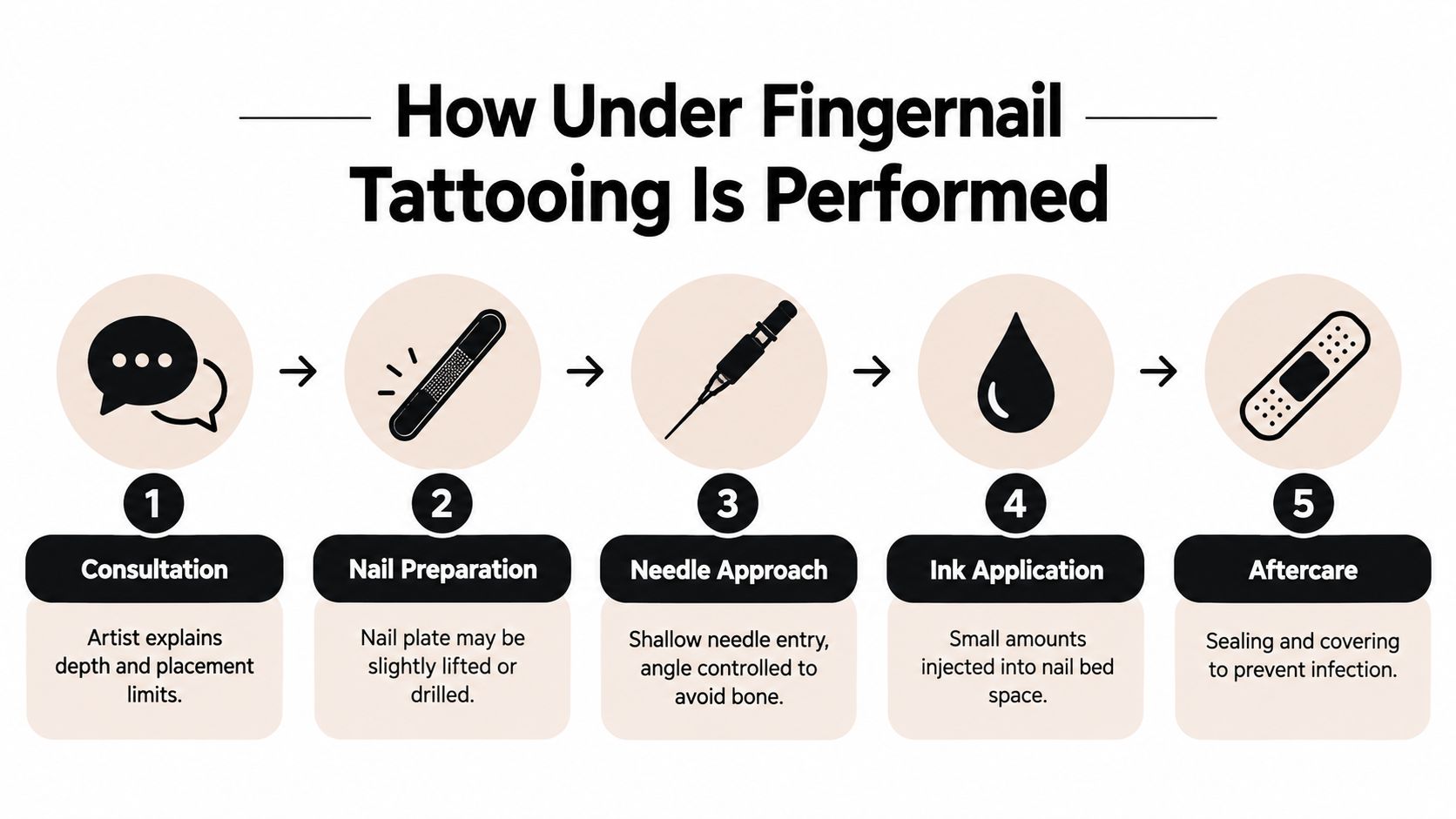
How Under Fingernail Tattooing Is Performed
A client will sometimes point at a photo and say, “I want the ink under the nail.” That single phrase can describe three very different procedures. One involves tattooing nearby skin. One involves working at the free edge where the nail ends. One would mean reaching tissue protected by the nail plate itself.
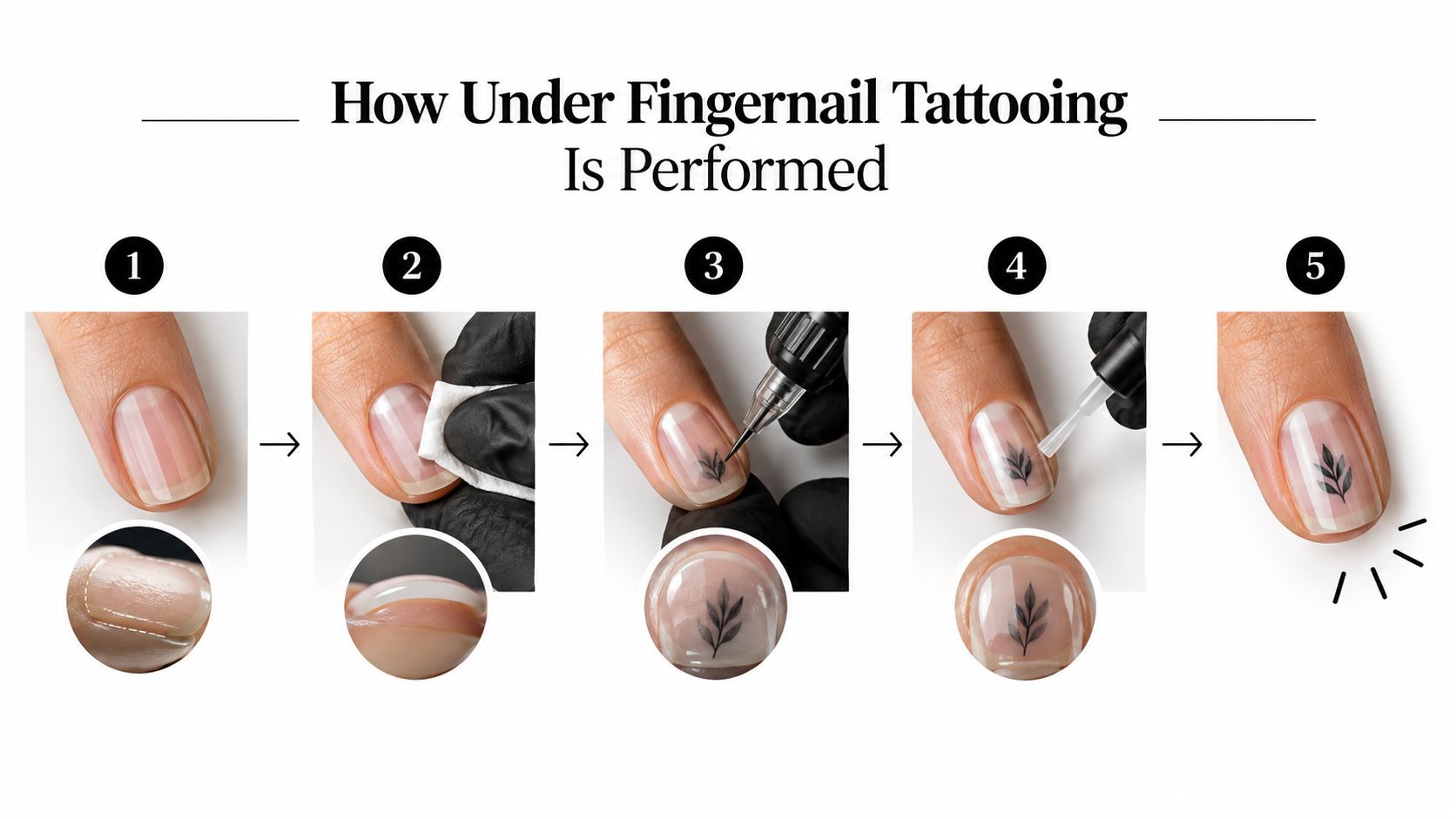
That distinction shapes the whole procedure.
The nail unit works a bit like a hard window over a very sensitive workbench. The visible nail plate is the window. Under it sit the nail bed and matrix, which help support the nail and produce new growth. If a design idea depends on getting pigment beneath that window, access becomes the first problem, not the last.
What the professional discussion should cover
A careful artist starts by locating the target tissue in plain language. Are you asking for pigment in the skin around the nail fold, in the hyponychium under the free edge, or in tissue covered by the nail plate? Those are not interchangeable spots, and they do not carry the same limits.
Health history matters more here than with many standard placements. Prior trauma, nail lifting, recurring fungal or bacterial issues, and unexplained dark streaks can all change whether the idea is appropriate to attempt. Persistent pigment changes in a nail are also something a client should not brush off as “just cosmetic.”
Why the technique is so constrained
On flat skin, an artist can stretch the area, see the entry angle clearly, and place pigment in tissue that is built to move a little. The nail unit offers much less room for that kind of control. The space is tighter, visibility is worse, and the tissue reacts in a more confined way.
Clinical reviews of tattoo complications describe tattooing as an acute aseptic inflammatory injury, with common short-term reactions such as redness, swelling, pain, and bleeding, plus possible delayed allergic or granulomatous responses in this review of tattoo complications. Around the nail, even a small amount of swelling can feel magnified because the area is boxed in by hard structures.
For that reason, true subungual access is not standard tattoo procedure. Cosmetic novelty discussion and medical nail procedures also need to stay separate. A reconstructive or research setting may use tools, goals, and safety standards that do not translate to a decorative studio service.
What clients should expect to hear
A solid consultation sounds specific. You should hear exactly where the pigment would sit, what blocks access, and what outcome is realistic.
An honest explanation often includes points like these:
Access limits: the nail plate may physically prevent a standard tattoo approach to the intended tissue
Depth control: a tiny error matters more because the target area is small and sensitive
Design limits: tiny enclosed anatomy does not hold intricate detail well
Outcome uncertainty: nail growth, pressure, and local trauma can change how the result looks over time
One blunt question helps a lot. Ask what exact part of the nail unit would hold the pigment. If the answer stays vague, the plan is vague too.
Questions worth asking in consultation
You do not need a step by step DIY lesson. You do need enough clarity to tell whether the artist understands nail anatomy and knows when to decline.
Ask questions such as:
Have you tattooed the skin around the nail, the tissue under the free edge, or anything involving the nail unit itself?
What structure would contain the pigment in my case?
What signs would make this a bad candidate before we start?
If nail changes or unusual swelling showed up later, what follow-up would you advise?
Good under-nail conversations usually sound less exciting than social media clips. That is a good sign. In this area, clear limits are part of good technique.
Pain Healing and How Long It Lasts
This is the part people usually underestimate.
The under-nail area tends to feel intense because the tissue is tight, sensitive, and boxed in. On a normal tattoo, irritation can spread into surrounding skin and calm down as the body settles. Around the nail unit, even mild swelling can feel amplified because there isn't much soft tissue reserve.

What pain usually feels like
Clients often expect “small tattoo, small pain.” Under-nail work doesn't follow that rule well. The sensation is often described more like pressure, burning, or a sharp trapped feeling than a simple scratch.
That matters after the appointment too. Everyday tasks become the test:
Typing: repeated fingertip contact can irritate the area
Opening cans or jars: pressure loads the nail edge
Gym grips or tool handles: friction can aggravate swelling
Accidental bumps: those hurt more than people expect
If your fingers are already sore from overuse, it can help to understand basic finger joint pain relief strategies before adding fresh irritation to the area.
Healing doesn't act like a flat-skin tattoo
A forearm tattoo heals on skin surface and deeper tissue. A nail-area tattoo may also be affected by nail growth, nail adherence, and repeated hand use. That means the visual result can shift as the nail changes.
Reviews also note that tattoo complications can appear years later and may include allergic reactions, chronic inflammatory reactions, infections, lichenoid or granulomatous responses, and papulo-nodular fibrosis in this overview of tattoo pigment reactions. In the nail unit, a persistent reaction can interfere with how the nail sits or grows.
What “lasting” really means here
People hear “tattoo” and think fixed placement, stable visibility, long-term consistency. With under-nail ideas, all three assumptions get shaky.
Longevity depends on where the pigment sits:
If it's in skin beside the nail, it may behave more like a difficult hand tattoo
If it's tied to tissue influenced by nail growth, visibility may change over time
If the area scars or inflames, the result can distort rather than fade
A tattoo can last and still stop looking the way you wanted. Those are two different questions.
Smarter healing expectations
The most useful mindset is to think in phases, not in one finish line. Early soreness is one thing. Nail changes are another. Delayed irritation is its own issue.
If you want a general framework for normal tattoo recovery versus warning signs, this guide to tattoo healing stages and what's normal is a good baseline. Just remember that nail-area work deserves more caution than a standard healed-skin checklist.
Safety Risks and Common Misconceptions
The biggest myth about a tattoo under fingernail is that it's low stakes because it's small and hidden. In reality, the under-nail region can trigger more serious questions than a larger tattoo on ordinary skin.

Pigment under the nail can complicate medical judgment
One reason dermatologists pay attention to under-nail pigment is that serious conditions can appear there. Subungual melanoma is rare but documented worldwide. It represents about 0.7% to 3.5% of all melanomas worldwide, and the great toe and thumb account for 75% to 90% of cases according to this dermatopathology review.
That doesn't mean a decorative pigment mark is melanoma. It does mean this part of the body is not treated casually in medicine.
There's also a history of foreign material under or near the nail mimicking disease. One report described a 77-year-old woman whose pigmentation came from a pencil injury 70 years earlier, later identified as a graphite tattoo on histopathology. That long persistence is one reason clinicians take nail pigmentation seriously in this nail-unit reference.
Infection and chronic reactions aren't theoretical
General tattoo risk data isn't perfectly suited to the nail unit, but it still matters. A 2024 review of 308 tattoo-related complications found that 91.9% were chronic, and a separate review estimated bacterial infectious complications affect 1% to 5% of tattooed individuals overall, with Staphylococcus aureus and Streptococcus pyogenes among the main causes in this complication review.
The nail-specific concern is simple. If an enclosed, delicate structure gets infected, inflamed, or scarred, the aftermath isn't just redness. It can alter how the nail attaches or grows.
Three misconceptions that cause bad decisions
“It's hidden, so it's safer.” Hidden doesn't mean protected. It can mean harder to monitor.
“It's tiny, so removal will be easy.” Small placement does not equal easy correction.
“If it changes later, I'll just touch it up.” Nail-area changes can involve anatomy, not only fading.
If a pigment mark under or around a nail changes in shape, color, size, or tenderness, that calls for medical evaluation, not tattoo troubleshooting.
That's not alarmism. It's the right category of caution.
Removal Options and Smarter Alternatives
Removal is where a lot of edgy concepts stop sounding fun. A tattoo under fingernail is hard to revise because the problem isn't only the ink. It's the location.
If a result heals poorly, looks uneven, or starts interfering with the nail, you're not dealing with a broad piece of skin that can be reworked easily. You're dealing with a small anatomical structure that doesn't love being bothered twice.
Why correction is tough
Laser removal discussions online usually focus on accessible skin surfaces. The nail unit complicates that. The anatomy is enclosed, the target area is tiny, and any treatment plan has to respect the nail itself.
If you're trying to understand the general mechanics of laser removal before talking to a specialist, this picosecond laser tattoo removal guide is useful background reading. Just don't assume nail-area pigment follows the same straightforward path as a shoulder or forearm tattoo.
Choosing a look with less downside
Here's the cleaner way to compare your options.
Option | Pain and Healing | Longevity and Removal |
|---|---|---|
Under-nail placement | Often high discomfort for such a small area. Healing can be awkward because the finger is always in use. | Unpredictable appearance over time. Correction is difficult. |
Nail-adjacent skin tattoo | Still spicy, but more familiar tattoo territory than true subungual work. | Better chance of stable healing than under-nail concepts. Removal is still tricky on hands, but more feasible. |
Fingertip or side-of-finger tattoo | Friction-heavy and prone to wear. Often needs realistic expectations. | Visibility is strong. Aging can be uneven, but revision is usually more workable. |
Nail plate art | Non-permanent and low commitment. | Easiest to change. Not a true tattoo. |
Temporary design or press-on concept | Minimal risk to anatomy. | Short-term only, but highly reversible. |
When to walk away from the idea
Skip the under-nail concept if your main goal is any of the following:
Easy reversibility
Fine detail
Predictable healing
Low-maintenance aftercare
If what you really want is a hidden, unconventional hand detail, a nail-adjacent placement usually gets you closer to the vibe without forcing the anatomy into a bad deal.
Booking Your Consultation at Think Tank Tattoo
You walk in with a tiny reference photo and say, “I want it under the nail.” A good consultation slows that sentence down. In the nail unit, “under the nail” can mean the free edge, the sidewall, the skin beside the plate, or the tissue beneath the nail plate itself. Those are not small wording differences. They change the answer.
At Think Tank Tattoo, the useful version of this appointment is specific and anatomy-first. The goal is to sort cosmetic novelty ideas from placements that drift into medical territory, such as damaged nailbed reconstruction, and from research concepts like microconduits for drug delivery. A tattoo studio handles the first category. The other two belong in very different settings.
The shop offers complimentary consultations for clients 18 and older. Appointments require a non-refundable deposit, and the studio has a shop minimum. Think Tank Tattoo is on South Broadway in Denver, with enough room for artists to compare placement options and talk through whether your idea belongs near the nail, on the finger, or nowhere on that hand at all.
What to bring to the consultation
Bring material that helps your artist map the exact part of the nail unit you mean.
Clear reference images: Show the visual effect you like, but also mark the exact location.
A plain description: Say whether you mean under the free edge, beside the nail, in the proximal fold area, or beneath the nail plate.
Your hand-use reality: Tell the artist if your hands deal with typing, tools, climbing, kitchen work, weight training, or constant washing.
Relevant nail history: Mention prior trauma, chronic nail irritation, lifting, infections, or any existing pigment change.
That last point matters. The nail unit is small, but it has several structures stacked close together, like thin layers in a tight pocket. If the location is vague, the advice will be vague too.
Good questions for this specific appointment
Skip broad questions and ask for a direct read on the placement.
Which part of the nail unit do you think I am pointing to?
Would you tattoo that area, or would you decline it because of anatomy and healing limits?
Is there a nearby placement that gives the same hidden-detail effect with a more predictable result?
What should I expect if the design shifts, fades unevenly, or becomes hard to assess during healing?
If you want to contact the shop before coming in, this guide on how to write a tattoo consultation email helps you send clear photos and describe the placement accurately.
Sometimes the best consultation outcome is not approval. It is a better translation of the idea. A small sidewall tattoo, fingertip placement, or nail-adjacent design often gives the same offbeat feel without asking the nail apparatus to do something it handles poorly.
If you want a clear adult conversation about whether your concept is cosmetic, unrealistic, or better moved to a neighboring spot, visit Think Tank Tattoo to set up a consultation.
Comments